
Coca-Cola(KO)

Search documents
可口可乐公布二季报:中国市场旗舰品牌销量强劲
Xin Hua Cai Jing· 2025-07-23 12:32
Group 1 - The core viewpoint of the article highlights Coca-Cola's resilient growth as demonstrated in its Q2 2025 financial report, with revenue of $12.535 billion, a 1% increase, and net profit of $3.803 billion, a 58% increase [2] - Coca-Cola updated its full-year 2025 performance guidance, expecting comparable currency-neutral earnings per share to grow by approximately 8% and earnings per share to grow by about 3%, both exceeding previous estimates [2] - The CEO emphasized strong performance in the Chinese market, noting that flagship brands and the food service channel drove overall sales growth despite a cautious consumer environment [2] Group 2 - Coca-Cola is increasing investments in China to optimize production capacity and meet the rapidly growing consumer demand, with several key projects making progress [3] - A new production base in Hainan is set to start construction by the end of the year, aimed at enhancing production efficiency and creating a more automated and intelligent green factory [3] - A new can production line at COFCO Coca-Cola in Guizhou has commenced operations, expected to add approximately 50,000 tons of annual capacity, utilizing advanced automation technology to significantly improve production efficiency [3]


可口可乐二季度净利增长58%,计划秋季在美推蔗糖版可乐
YOUNG财经 漾财经· 2025-07-23 12:28
资料图。本文来源:澎湃新闻 记者 吴雨欣 可口可乐二季度净利增长58%,计划秋季在美推蔗 糖版可乐 可口可乐将在美国推出新款蔗糖版可乐。 7月22日美股盘前,可口可乐公司发布了2025年二季度财报,财报显示,公司二季度营收125.35亿 美元,同比增长1%,有机营收(非公认会计准则)同比增长5%;净利润为38.1亿美元,同比增长 58%;营业利润增长了63%,营业利润率从上年同期的21.3%提升至34.1%;每股收益(非公认会 计准则)为0.87美元,同比增长4%,预估0.83美元。 在财报中,可口可乐公司表示,该公司计划于今年秋季在美国推出一款采用美国蔗糖制成的产品, 以扩大其可口可乐商标产品系列。此次推出的产品旨在补充公司核心产品组合,为不同场合和偏好 的消费者提供更多选择。 在当日的财报会上,可口可乐的高管重申了这一计划,"正如你们上周可能看到的,我们感谢总统 对我们可口可乐品牌的热情,"可口可乐公司董事会主席兼首席执行官詹鲲杰(James Quincey) 说。 詹鲲杰指出,该公司已经在多款饮料中使用了这种甜味剂,"实际上,我们在美国产品组合中的许 多其他品牌都使用蔗糖,从柠檬水到茶,再到一些咖啡产品 ...
Coca-Cola to Sell Cane Sugar Soda in US After Trump’s Urging
Bloomberg Television· 2025-07-23 12:14
Market Strategy & Consumer Preference - Coca-Cola is aligning with consumer preferences for sugar-based sodas as opposed to high fructose corn syrup options [1][2] - The company aims to capitalize on the preference for cane sugar Coke, potentially inspired by experiences in markets like Mexico [5] - Coca-Cola plans to introduce brand extensions with cane sugar, likely at a premium price in select markets to create exclusivity [3] Ingredient & Supply Chain Economics - The choice of ingredient depends on the ability to capture a premium price that offsets the higher cost of cane sugar compared to heavily subsidized high fructose corn syrup (HFCS) [4] - Coca-Cola's supply chain was built around HFCS due to corn subsidies in the US [4] Innovation & Product Portfolio - The introduction of cane sugar Coke is part of Coca-Cola's broader innovation efforts [3]
蔗糖可乐救不了肥胖的美国人
虎嗅APP· 2025-07-23 10:25
Core Viewpoint - The article discusses the political and economic implications of Trump's proposal to replace high fructose corn syrup (HFCS) with cane sugar in Coca-Cola, highlighting the complex interplay between health concerns, agricultural subsidies, and political interests in the U.S. beverage industry [1][4][8]. Group 1: Political and Economic Context - Trump's announcement to negotiate with Coca-Cola regarding the sugar content in its products is seen as a politically motivated move rather than a personal preference [1]. - The widespread use of HFCS in the U.S. is largely due to its cost-effectiveness, influenced by protective tariffs on imported sugars and agricultural subsidies that favor corn production [2][3]. - The political connections between sugar industry stakeholders and the Republican Party suggest that Trump's actions may be aimed at benefiting specific interest groups, such as sugar barons in Florida [2][3]. Group 2: Health Implications - The article raises questions about the health impacts of HFCS compared to cane sugar, noting that while some studies link fructose to metabolic issues, the evidence is not definitive [5][6]. - Public perception of HFCS as unhealthy has been fueled by rising obesity rates in the U.S., leading to calls for healthier alternatives [4][5]. - The debate over sugar types reflects broader societal issues regarding diet and health, with the article suggesting that simply switching sugars will not resolve the underlying health crisis in America [7][9]. Group 3: Industry Dynamics - Coca-Cola's choice to use HFCS is primarily driven by cost considerations, complicating any potential compliance with Trump's proposal [4][8]. - The competition between traditional sugar producers and HFCS manufacturers has led to a public relations battle, contributing to a general distrust in food safety among consumers [6][7]. - The article emphasizes that the real issue is not the type of sugar consumed but the overall high sugar intake in the American diet, which is linked to various health problems [7][9].
可口可乐2025Q2净利润增长58%,中国市场销量增长加快冰柜投放
Jin Rong Jie· 2025-07-23 10:04
Core Insights - Coca-Cola reported Q2 2025 revenue of $12.535 billion, a 1% increase, with organic revenue growth of 5% and net profit of $3.803 billion, up 58% [1] - CEO James Quincey emphasized the company's focus and adaptability in a changing environment, expressing confidence in achieving updated 2025 performance guidance and long-term goals [1] - Coca-Cola retained the top position in the food and beverage category in the 2025 Kantar BrandZ Most Valuable Global Brands list, ranking 14th overall, up one position from the previous year [1] Revenue and Sales Performance - The company's overall case volume sales declined by 1%, with carbonated soft drinks down 1% and juice, value-added dairy, and plant-based beverages down 4% [1] - The no-sugar Coca-Cola saw a 14% increase in sales, driven by growth across all geographic operating segments [1] - Coffee products experienced a 1% growth, primarily due to performance in the Asia-Pacific region, while tea products remained flat [1] Pricing and Profitability - Coca-Cola's pricing and product mix increased by 6%, aided by market pricing initiatives and a favorable product portfolio [2] - Operating profit rose by 63%, attributed to organic revenue growth across all geographic regions, timely marketing investments, and effective cost management [2] Market Strategy and Expansion - In China, Coca-Cola reported strong brand performance and growth in the foodservice channel, focusing on refined channel strategies and targeted promotional activities [2] - New production capacity was added with the launch of a new can production line in Guizhou, expected to add approximately 50,000 tons annually, and a new production base in Haikou is set to begin construction [2] Future Outlook - The company anticipates organic revenue growth of 5% to 6% for the full year 2025 [3]
Wall Street calls this Buffett big money maker a ‘Strong Buy'; Time to pounce?
Finbold· 2025-07-23 09:17
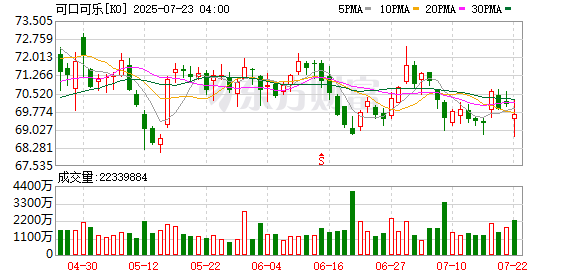
Core Viewpoint - Coca-Cola is experiencing bullish sentiment from analysts, with strong buy ratings and a positive outlook for future performance [1][2]. Analyst Ratings - 18 analysts rated Coca-Cola stock as a 'Strong Buy,' 17 as 'Buy,' and only 1 as 'Hold,' with no 'Sell' ratings [1]. - The average 12-month price target is set at $79.50, indicating a potential upside of 14.13% from the current price of $69.66 [2]. Financial Performance - In Q2 2025, Coca-Cola reported an EPS of $0.87, exceeding expectations of $0.83, driven by gross margins rising to 62.4% [6]. - Revenue for Q2 was $12.5 billion, slightly below the expected $12.55 billion, but organic revenue grew by 5%, offsetting a 1% decline in unit case volume [6]. Dividend and Investor Confidence - Coca-Cola has a 64-year history of dividend increases, with the next dividend of $0.51 per share expected to yield $204 million for Berkshire Hathaway [4]. - The company's strong brand loyalty and outsourced production model contribute to its operational stability and attractiveness as an investment [5]. Price Target Adjustments - Following strong Q2 results, Deutsche Bank raised its price target for Coca-Cola to $81 from $80 while maintaining a 'Buy' rating, citing expected growth in unit case sales and productivity gains [7].
可口可乐2025第二季度财报:营销创新与中国市场韧性支撑持续增长
Jing Ji Guan Cha Bao· 2025-07-23 08:03
Core Insights - Coca-Cola demonstrated strong profitability and brand resilience in Q2 2025, achieving a 1% revenue growth and an impressive 58% net profit growth despite external uncertainties [1] - The company updated its full-year 2025 guidance, projecting a comparable currency-neutral EPS growth of approximately 8%, organic revenue growth of 5%-6%, and a non-GAAP EPS growth of about 3% [1] Group 1: Marketing Innovation - Coca-Cola's focus on brand innovation has led to a 14% increase in sales of Coca-Cola Zero Sugar, reflecting the company's successful differentiation strategy targeting health-conscious consumers [2] - The "Share a Coke" campaign returned, emphasizing personalization and social interaction, effectively resonating with Gen Z consumers [2] Group 2: Market Expansion Strategies - The company is leveraging cross-industry collaborations, such as the partnership between Fanta and the popular game "Honkai: Star Rail," to engage younger consumers and expand its target audience [3] - Coca-Cola's strategic focus on the Chinese market has resulted in strong performance, particularly in the foodservice channel, supported by refined channel strategies and increased market activities [3] - Localized investments, including the establishment of production facilities in Hainan and a new canning line in Guizhou, are enhancing production efficiency and capacity to meet rising consumer demand in China [3][4]
可口可乐公司第二季度营收125.35亿美元
Bei Ke Cai Jing· 2025-07-23 07:47
Group 1 - The core viewpoint of the articles highlights Coca-Cola's financial performance in Q2 2025, with revenue of $12.535 billion, a 1% increase, and a net profit of $3.803 billion, reflecting a 58% growth despite a 1% decline in global case volume [1] - The organic revenue growth for Coca-Cola in the same quarter was reported at 5%, driven by strong performance in markets such as Central Asia, Argentina, and China, which offset declines in Mexico, India, and Thailand [1] - Coca-Cola's flagship brand showed resilience, with the no-sugar variant achieving a 14% growth in Q2 [1] Group 2 - The company announced plans to launch a cane sugar version of its product in the U.S., reverting to its original sweetener after previously switching to corn syrup due to cost increases [2] - Coca-Cola's CEO, James Quincey, indicated that the company will utilize a variety of sweetening options across its brands to cater to consumer preferences [2] - Quincey emphasized the company's focus and adaptability in response to changing external conditions, expressing confidence in achieving the updated performance guidance for 2025 [3]
可口可乐Q2净利暴增58%至38亿美元,零度可乐增长14%超预期!
Jin Rong Jie· 2025-07-23 06:12
Core Insights - Coca-Cola reported a net profit of $3.803 billion for Q2, a significant increase of 58% year-over-year [1] - The company's revenue reached $12.535 billion, reflecting a 1% year-over-year growth, with organic revenue growth of 5% [1] - Operating profit margin improved from 21.3% in the previous year to 34.1%, with earnings per share of $0.87, surpassing market expectations of $0.83 [1] Financial Performance and Business Development - Overall shipment volume decreased by 1%, influenced by varying market performances across regions [3] - Growth in Central Asia, Argentina, and China was offset by declines in Mexico, India, and Thailand [3] - Sales of carbonated soft drinks fell by 1%, with Coca-Cola brand sales also down by 1% [3] - Growth in Europe, the Middle East, and Africa could not fully compensate for declines in Latin America [3] - Zero Sugar Coca-Cola showed strong performance with a 14% increase, contributing from all operational regions [3] - Sales of carbonated flavored beverages decreased by 2%, while juice, value-added dairy, and plant-based beverage sales fell by 4% [3] - Water, sports drinks, coffee, and tea sales remained stable, with coffee sales up by 1% due to strong performance in the Asia-Pacific region [3] - Price/product mix increased by 6%, driven by market pricing strategies and favorable product mix [3] Sugar-Based Products and Coffee Business Expansion - Coca-Cola plans to launch a product made with American sugar this fall in the U.S. to complement its core product lineup [4] - The new product aims to provide more options for consumers with different preferences [4] - The company has utilized sugar sweeteners in various beverages, including lemonade, tea, coffee products, and vitamin water [4] - Typically, Coca-Cola sold in the U.S. uses high fructose corn syrup, while countries like Mexico, the UK, and Australia often use sugar [4] - Food scientists note that high fructose corn syrup enhances fruit and spice flavors, while sugar provides a broader and longer-lasting sweetness [4] - The coffee business performed well in the Asia-Pacific region with a 1% sales increase, while tea business remained stable [4] - Growth in Europe, the Middle East, and Africa was offset by declines in North America [4]

可口可乐公司披露第二季度财报:净利润同比增长58% CEO这样回应美国蔗糖版产品和咖啡业务
Mei Ri Jing Ji Xin Wen· 2025-07-23 04:13
Core Insights - Coca-Cola reported Q2 2025 revenue of $12.535 billion, a 1% year-over-year increase, and a net profit of $3.803 billion, reflecting a 58% year-over-year growth [1] - The significant increase in net profit is attributed to price increases and adjustments in the product mix, despite a 1% decline in global sales [1] - The Chinese market showed growth in sales, driven by strong performance from the flagship Coca-Cola brand and the foodservice channel [1] Revenue and Profit Performance - Revenue for Q2 2025 was $12.535 billion, up 1% from the previous year [1] - Net profit reached $3.803 billion, marking a substantial 58% increase year-over-year [1] - Global sales volume decreased by 1%, but pricing and product mix improved by 6% [1] Market and Product Strategy - Coca-Cola plans to launch a new product made with American cane sugar in the U.S. market this fall to cater to consumer demand for differentiated flavors [1] - The company is exploring various sweetener options across its product lines, including lemonade, tea, coffee, and vitamin water [1] - Coffee is identified as a large, fragmented, and growing category within the beverage industry, although the investment in Costa has not met expectations [1] Costa Coffee Insights - Costa Coffee, a subsidiary of Coca-Cola, has 355 stores in China as of July 23, primarily concentrated in Jiangsu and Shanghai, with over 50% located in first-tier cities [1] - The performance of Costa in key growth areas such as ready-to-drink coffee and home brewing products has been underwhelming, leading the company to reflect on its strategy [1]