
LENOVO GROUP(LNVGY)

Search documents
联想集团(00992):发挥供应链优势应对存储周期影响
HTSC· 2025-11-21 02:11
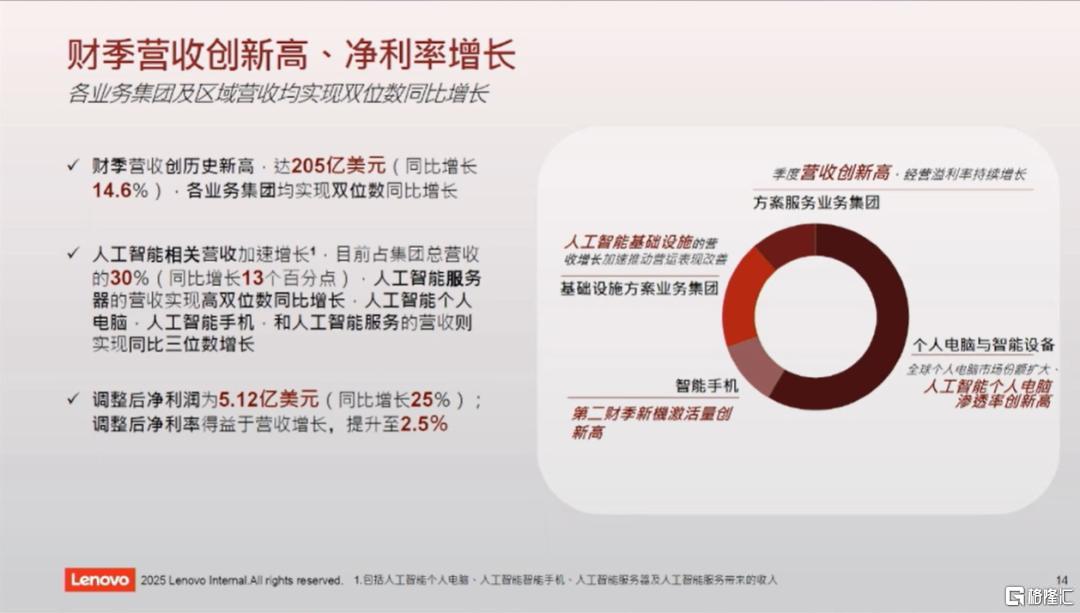
Investment Rating - The report maintains a "Buy" rating for the company, Lenovo, with a target price adjusted to HKD 14.00 from the previous HKD 16.00, reflecting a 12.5% decrease [5][7]. Core Insights - Lenovo reported a revenue of USD 20.45 billion for 2QFY26, representing a year-over-year increase of 14.6%, surpassing Bloomberg's consensus estimate by 1.7%. The Non-HKFRS net profit attributable to shareholders was USD 512 million, up 25.2% year-over-year, exceeding the company's prior guidance by approximately 19% [1][5]. - The company benefits from a strong position in the global PC market, holding the largest market share and demonstrating robust supply chain management capabilities, which enhances its resilience against industry cycles [1][2]. - The AI-related business has become a core growth driver, with its revenue contribution reaching 30% and a year-over-year increase of 13 percentage points [1][5]. Summary by Sections IDG (Intelligent Devices Group) - IDG's revenue increased by 11.8% year-over-year, with an operating profit margin of 60%. The global PC market share rose by 1.8 percentage points to 25.6%, marking a record high [2]. - Driven by mixed AI demand, PC revenue grew by 17% year-over-year, with AI PC penetration increasing by 16 percentage points to 33% of total shipments [2]. ISG (Infrastructure Solutions Group) - ISG's revenue grew by 23.7% year-over-year, primarily due to strong demand for cloud infrastructure and enterprise solutions. The AI server business recorded high double-digit revenue growth [3]. - The Neptune liquid cooling technology saw a revenue increase of 154% year-over-year, reinforcing the company's leadership in energy-efficient AI infrastructure [3]. SSG (Solutions and Services Group) - SSG achieved an 18.3% year-over-year revenue growth, maintaining double-digit growth for 18 consecutive quarters, with an operating profit margin exceeding 22% [4]. - The project and solution services, along with operational services, accounted for 60% of SSG's total revenue, indicating a stable growth trajectory [4]. Financial Projections - The report projects a slight decrease in Non-HKFRS net profit estimates for FY26, FY27, and FY28 by 1.8%, 1.7%, and 1.7% respectively, with expected profits of USD 1.66 billion, USD 1.85 billion, and USD 2.08 billion [5][10]. - The expected Non-HKFRS EPS for FY26, FY27, and FY28 is projected to be USD 0.12, USD 0.14, and USD 0.15 respectively, reflecting growth rates of 15.5%, 11.4%, and 12.4% [5][10].

High-Performance Supercomputer Launched to Advance AI Innovation and Scientific Discovery
Prnewswire· 2025-11-20 12:42
Core Insights - Equinix and Lenovo have partnered to provide a high-performance computing (HPC) solution for Merck KGaA, aimed at enhancing drug discovery, materials innovation for semiconductors, and overall scientific research capabilities [1][2][4] Company Developments - Merck KGaA has launched a state-of-the-art HPC built on Lenovo ThinkSystem servers, utilizing advanced liquid cooling technology, hosted in an Equinix AI-ready data center in Germany [1][2] - The HPC platform combines private and public cloud infrastructure, allowing for flexible scaling to meet varying computational demands [2][3] Technological Advancements - The partnership emphasizes the importance of data and technology in scientific progress, with the HPC enhancing computational capabilities and enabling more effective use of AI and advanced analytics [2][3] - Equinix's infrastructure supports high-performance workloads while reducing energy consumption, aligning with Merck's environmental, social, and governance (ESG) targets [3][4] Market Position - Lenovo is recognized as a global technology powerhouse with a revenue of US$69 billion, focusing on AI-enabled devices and infrastructure [5] - Merck KGaA operates across life science, healthcare, and electronics, generating sales of €21.2 billion in 2024, with over 62,000 employees dedicated to scientific advancements [6][7]



从PC公司到AI公司,联想集团正改变基本盘
Ge Long Hui· 2025-11-20 09:29
Core Insights - Lenovo Group is transitioning from being perceived solely as the world's largest PC manufacturer to a significant player in the AI sector, with its AI business now accounting for 30% of total revenue [2][27] - The company aims to reshape investor perceptions by highlighting its non-PC business growth, which has contributed to substantial revenue and profit increases, including a net profit growth rate exceeding 100% in some quarters [1][27] - Lenovo's hybrid AI strategy positions it as a leading provider of edge AI solutions, integrating AI capabilities across consumer and enterprise segments [4][12] Group 1: Business Transformation - Lenovo is fundamentally transforming from a PC-centric company to an AI-focused enterprise, with AI-related services becoming a major revenue driver [21][27] - The company’s revenue sources are shifting from hardware sales to AI infrastructure and service solutions, indicating a move towards a recurring revenue model [21][27] - The three main business segments—Intelligent Devices Group (IDG), Infrastructure Solutions Group (ISG), and Solutions and Services Group (SSG)—are evolving in their roles, with SSG becoming a key driver of high-margin growth [21][22] Group 2: Financial Performance - Non-PC business revenue has steadily increased, reaching nearly 47% of total revenue, reflecting a clear shift towards AI-related infrastructure and services [22][23] - The ISG and SSG segments are experiencing significant growth, with ISG revenue increasing by 24% and SSG achieving a profit margin of over 22% [23][24] - AI-driven revenue growth is evident, with AI PC sales increasing by 197% and AI server revenue more than doubling, showcasing strong demand for AI capabilities [24][25][26] Group 3: Strategic Positioning - Lenovo's hybrid AI strategy allows it to serve as a critical integrator in the AI value chain, bridging the gap between hardware and AI services [7][19] - The company is positioned to control the "terminal entry" in the AI ecosystem, which is crucial for user interaction and data flow [18][19] - By embedding AI capabilities into its devices, Lenovo aims to create a personalized AI experience for users, enhancing its competitive edge in the market [11][12]
应对存储价格上涨 联想集团宣布已签署长期零部件供应协议
Zheng Quan Shi Bao Wang· 2025-11-20 09:11
Core Viewpoint - Lenovo Group has signed a long-term supply agreement with key component suppliers to address the rising storage chip prices driven by the surge in artificial intelligence (AI) demand [1][2]. Group 1: Supply Chain Strategy - The long-term contract aims to ensure sufficient supply for the upcoming year, reflecting Lenovo's emphasis on stability and sustainability during its AI transformation [1][2]. - By locking in key component supplies, Lenovo can better control cost fluctuations and gain strategic advantages in a competitive market [2][3]. - Lenovo's significant purchasing power allows it to negotiate favorable terms in the supply chain, creating a competitive edge that smaller players cannot match [3]. Group 2: Market Context and Performance - The global storage chip prices are increasing due to heightened demand from data center operators for AI server construction, leading to a tightening supply of traditional storage chips used in smartphones, computers, and gaming devices [1]. - Lenovo's Intelligent Devices Group (IDG) reported a revenue of 108.1 billion RMB in the second quarter of the 2025/26 fiscal year, marking a 12% year-on-year increase, with AI terminal devices contributing significantly to this growth [3]. - The CEO of Lenovo believes that the market will not experience a bubble, but rather a phase of AI technology becoming more widespread and accessible [3].
联想集团杨元庆:明年1月将在全球范围内推出个人超级智能体
Zheng Quan Shi Bao Wang· 2025-11-20 08:02
Core Viewpoint - Lenovo Group is set to launch a personal super intelligent agent globally on January 6 at the Lenovo Innovation Technology Conference, which will integrate various wearable and environmental sensing devices, as well as portable devices and personal trusted computing hubs, aiming to create a personalized experience that learns individual habits and predicts intentions [1] Group 1 - The personal super intelligent agent will utilize personalized algorithms and models to continuously learn and adapt to user preferences [1] - The technology aims to achieve a level of interaction described as "thinking what you think, acting as you wish" [1] - The initiative reflects Lenovo's commitment to advancing personal computing and smart technology integration [1]
联想集团财报解读:现金流强劲 研发投入成持续增长源泉
Ge Long Hui· 2025-11-20 07:10
Core Insights - Lenovo Group reported a record high revenue of 146.4 billion RMB for the second quarter of the fiscal year 2025/26, representing a 15% year-on-year growth [1] - Adjusted net profit increased by 25% year-on-year, reaching 3.66 billion RMB [1] Financial Performance - Revenue for the quarter grew by 15% to 146.4 billion RMB, marking a historical high for the fiscal quarter [1] - Adjusted net profit rose by 25% to 3.66 billion RMB [1] - Operating cash flow reached 2.8 billion USD, supported by revenue growth and improved inventory management [1] - Free cash flow increased to 1.9 billion USD, providing strong support for growth across all business groups [1] - Adjusted net financial costs decreased by 27% year-on-year after excluding nominal interest on convertible bonds, indicating effective cost-saving measures [1] Strategic Initiatives - Research and development expenditure grew by 8% year-on-year, driving the development of a hybrid artificial intelligence strategy [1] - Lenovo launched a comprehensive range of AI-driven devices and experiences during the "Lenovo Innovation World 2025" event, covering consumer, commercial, and mobile device sectors [1] - The new product lineup includes high-performance personal computers, smart tablets, immersive gaming devices, and Motorola smartphones, reflecting the company's vision of "AI for All" [1]
联想集团Q2业绩:现金流造血能力强劲 财务健康边际牢固
智通财经网· 2025-11-20 07:05
Core Viewpoint - Lenovo Group reported a record high revenue of 146.4 billion RMB for the second fiscal quarter of 2025/26, marking a 15% year-on-year increase, with adjusted net profit rising by 25% to 3.66 billion RMB [1] Financial Performance - Revenue for the second fiscal quarter reached 146.4 billion RMB, a 15% increase compared to the previous year [1] - Adjusted net profit grew by 25% to 3.66 billion RMB [1] - Operating cash flow reached 2.8 billion USD, supported by revenue growth and improved inventory management [1] - Free cash flow increased to 1.9 billion USD, providing strong support for growth across all business groups [1] - Adjusted net financial costs decreased by 27% after excluding nominal interest on convertible bonds, indicating effective cost-saving measures [1] Research and Development - R&D expenditure increased by 8% year-on-year, driving the development of a hybrid artificial intelligence strategy [1] - Lenovo continues to invest in its artificial intelligence development blueprint, capitalizing on opportunities presented by hybrid AI [1] Product Launches - At the "Lenovo Innovation World 2025" event, the company launched a full suite of AI-driven devices and related experiences across consumer, commercial, and mobile sectors [1] - The new product lineup includes high-performance personal computers, smart tablets, immersive gaming devices, and Motorola smartphones, reflecting the company's vision of "AI for All" [1]
联想集团杨元庆:已与关键零部件供应商签署长期供货合同
Zheng Quan Shi Bao Wang· 2025-11-20 06:55
Core Insights - Lenovo Group's Chairman and CEO Yang Yuanqing announced the signing of long-term supply contracts with key component suppliers to address the rising prices of storage chips driven by surging demand for artificial intelligence (AI) [1] - Yang expects that the shortage and price increases of storage components will not be a short-term issue and may persist throughout the next year [1] - The company aims to ensure sufficient supply and competitive costs through these long-term contracts, allowing it to maintain its gross and net profits while remaining competitive in the market [1]
联想集团董事长杨元庆:整个明年联想都有足够的存储供应
Xin Lang Cai Jing· 2025-11-20 06:38
Core Viewpoint - Lenovo Group reported a record high revenue of 146.4 billion RMB for the second quarter of the fiscal year 2025/26, reflecting a year-on-year growth of 15% and an adjusted net profit increase of 25% to 3.66 billion RMB [1] Financial Performance - Revenue for the second quarter reached 146.4 billion RMB, marking a 15% increase year-on-year [1] - Adjusted net profit rose by 25% to 3.66 billion RMB [1] Supply Chain Management - Lenovo's Chairman and CEO, Yang Yuanqing, stated that the company has the capability to manage supply shortages and price increases better than competitors [1] - The company has long-term contracts with key suppliers, ensuring sufficient storage supply for the entire next year [1] Business Confidence - Yang expressed strong confidence in the infrastructure business, including servers, asserting that rising component prices will not impact gross or net profit [1] - The company remains optimistic about maintaining market competitiveness while preserving gross and net profit in the long term [1]
联想集团董事长杨元庆:明年1月6日将推出个人超级智能体
Xin Lang Cai Jing· 2025-11-20 06:38
Core Viewpoint - Lenovo Group's Chairman and CEO Yang Yuanqing announced the launch of a personal super intelligent agent at the Lenovo Innovation Technology Conference on January 6, which will integrate various wearable and environmental sensing devices to create a personalized user experience [1] Group 1 - The personal super intelligent agent will be capable of coordinating with various portable devices and will continuously learn user habits and predict intentions through personalized algorithms and models [1] - The intelligent agent aims to become a user's personal digital twin by listening, seeing, and remembering what the user does [1]