Meta Platforms(META)

Search documents
速递|2025,AI九巨头“合纵连横”之年:从拼模型到拼生态,谁的“朋友圈”更牢固?
Z Potentials· 2025-12-29 04:53
Core Insights - The year 2025 is anticipated to be a pivotal year for robotics, particularly for leading AI companies as they enhance their AI hardware and software product matrices, with nearly all enterprises investing in humanoid robot technology development [1] Group 1: AI Company Developments - Major tech companies are developing comprehensive AI hardware and software ecosystems, indicating a shift towards robotics and AI integration in both industrial and domestic settings [3] - Companies like Google, Microsoft, Amazon, and OpenAI are making significant strides in AI technology stacks, aiming to increase revenue and reduce costs through better control over AI training servers [3][4] - Meta has expanded its lead in AI devices but lags in AI model development, while xAI has made progress in LLM quality and consumer AI applications [6][12] Group 2: Competitive Landscape - The competition among major AI companies is intensifying, with a complex network of alliances forming as companies seek to reduce dependency on key suppliers like Nvidia and Microsoft [4][19] - Google remains a dominant player, significantly enhancing its capabilities in AI server chips, evidenced by a $20 billion deal with Anthropic for tensor processing units [10] - OpenAI is expanding its cloud partnerships beyond Microsoft, with Amazon signing a $38 billion server deal and plans for collaboration on e-commerce projects [21] Group 3: Emerging Technologies - Companies are focusing on humanoid robots and wearable AI devices, with Amazon making substantial investments in augmented reality glasses [7][14] - Tesla is leading in humanoid robotics with its Optimus robot, despite facing challenges with its functionality [15] - The development of AI applications and devices is expected to continue evolving, with OpenAI planning to launch various wearable AI products by 2026 [14]





Meta大逃杀,小扎「地狱模式」曝光,不拼命搞AI就滚蛋
3 6 Ke· 2025-12-29 03:17
Core Insights - Meta is entering a "high-intensity year" in 2025, with significant investments in AI and a shift in focus from the metaverse to personal superintelligence [1][5][22] - The company is undergoing a major restructuring, including layoffs and a tightening of performance evaluations, which has created internal friction and employee turnover [20][24][26] - Meta's AI strategy is under scrutiny as competitors like Google and OpenAI advance, raising questions about the effectiveness and sustainability of Meta's investments [38][40] Group 1: Strategic Shifts - Meta is investing hundreds of billions in AI, establishing the Meta Superintelligence Labs (MSL) to focus on personal superintelligence [1][6] - The company has reduced its metaverse budget by up to 30%, reflecting a strategic pivot away from previous investments in that area [22] - CEO Mark Zuckerberg has emphasized a "war-time mode," indicating a shift in company culture and management style towards higher performance expectations [5][23] Group 2: Internal Dynamics - The restructuring of the AI department has led to confusion and dissatisfaction among employees, with reports of unclear project ownership and frequent team reassignments [10][16][20] - A significant number of employees have left Meta, citing a mismatch between the company's evolving culture and their personal values [24][25][26] - The new performance evaluation system has created a high-pressure environment, with 15-20% of employees expected to be rated as "underperforming," leading to increased competition and stress [23][20] Group 3: Market Position and Competition - Meta's AI investments are projected to reach $60-72 billion by 2025, but the company has yet to produce market-impacting products [36][38] - Competitors like Google and OpenAI are rapidly advancing their AI capabilities, putting pressure on Meta to clarify and strengthen its AI strategy [39][40] - The effectiveness of Meta's AI strategy and its ability to attract and retain talent remain uncertain, as the company navigates a challenging competitive landscape [40][41]

华人一作,Meta等复刻AlphaZero神话,AI甩开人类自修成神
3 6 Ke· 2025-12-29 02:44
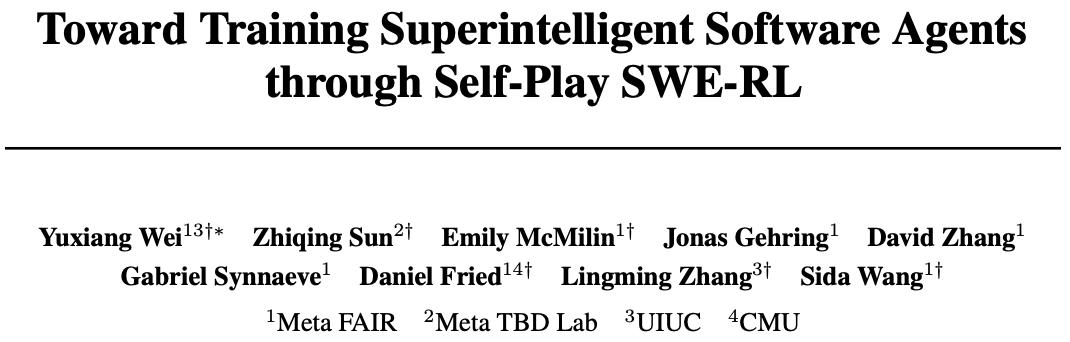
当模型学会「左右互搏」的那一刻,平庸的模仿时代结束了,真正的硅基编程奇迹刚刚开始。 编程界的AlphaZero时刻,终于来了? 当年,AlphaZero抛弃人类棋谱,仅凭「左右互搏」便参透了超越千年的棋道。 而今天,AI程序员的致命伤,恰恰就在于它们太像「人」了—— 靠学习人类代码长大的AI,注定无法突破人类的平庸。 就在最近,来自Meta、UIUC和CMU的研究团队,凭借最新成果Self-play SWE-RL(SSR),正在试图复刻AlphaZero的神话—— 抛弃人类教师,拒绝模仿。 论文地址:https://arxiv.org/pdf/2512.18552 只要给AI一个代码库,让它分饰「破坏者」与「修复者」进行死斗。 在这场无需人类插手的自我博弈中,一种真正的、超越人类经验的编程奇迹,正在诞生。 被「喂养」的AI与人类数据的天花板 从Devin到OpenDevin,再到各大厂内部的代码助手,它们确实能帮程序员干不少脏活累活。 但这里有一个隐形的瓶颈。 目前主流的训练方法,无论是SWE-RL还是DeepSWE,本质上都是在教AI「模仿」。 这种依赖人类知识的模式有三个致命伤: 数据不够用:高质量的、带 ...
碾压小扎,22岁成亿万富翁,2025年AI造富速度刷新人类认知
3 6 Ke· 2025-12-29 02:03
2025 年,AI 不仅占据话题 C 位,更成为超级造富机,将 50 多位创始人送入亿万富翁俱乐部。本文将盘点这场史无前例的 AI 财富狂欢与背后 的顶级赢家。 2025 年,AI 无疑是绝对的话题中心。 空谈误国,实干兴邦,而 AI 公司的估值更是真金白银。 这一年,AI 成为了超级财富制造机,从大模型构建、基础设施铺设到应用层落地,它正以惊人的速度渗透进日常生活,也顺手将 50 多位创始人送进了亿 万富翁俱乐部。 开年即决战。 1 月,中国的 DeepSeek 发布开源模型,仅用美国巨头零头的算力就训练出了性能惊人的模型,不仅让金融市场为之震颤,也将其创始人梁文锋的身家推 高至约 115 亿美元,一举跨入超级富豪行列。 大洋彼岸的 Anthropic 也不甘示弱。 作为 Claude 的开发者,这家公司在年初以 615 亿美元的估值完成了 35 亿美元融资,其七位联合创始人全员晋升亿万富翁。 到了 9 月,随着新一轮总计 130 亿美元资金的注入,其估值已飙升至 1830 亿美元。 这种巨额融资并非个例。 根据 Crunchbase 的数据,今年全球投资者向 AI 领域狂砸了超 2000 亿美元,这一数字 ...

Meta 大逃杀!扎克伯格「地狱模式」曝光,不拼命搞 AI 就滚蛋
Xin Lang Cai Jing· 2025-12-29 01:48
这是一场被 AI 逼出来的「极限压力测试」。对于 Meta 来说,这是一场「输不起」的战斗。假如 OpenAI、Google 能够率先打造出 10 亿用户级别的个人 智能体,将牢牢占据 AI 时代的超级入口。 Meta 过去多年苦心经营的平台优势、网络效应所形成的护城河,将可能面临彻底瓦解的风险。留给 Meta 抢夺「个人超级智能」平台级入口的窗口期可能 只有这一两年。 Meta CEO 扎克伯格 这也是为什么小扎会在全员会议上说:「这是马拉松,但对我来说,今年更像短跑。」 在「高强度之年」的号召之下,Meta 在过去一年进入了全面冲刺状态。小扎不仅在 AI 上投入数百亿美金,成立 MSL(超级智能实验室,Meta Superintelligence Labs),还收缩了对元宇宙的投入,全力以赴其「个人超级智能」愿景。甚至连小扎的领导语气也发生了明显变化,开始公开推崇他所 说的「更偏阳刚的能量」。 自上而下的「高强度」转变,也带来了 Meta 内部管理风格的变化 —— 公司的 DEI(多元、公平与包容)文化开始回撤;绩效考核拉满,数千名被标记为 低绩效的员工遭到裁员,员工压力激增…… 过去一年,小扎用「战时模 ...

超越苹果(AAPL.US)、微软(MSFT.US)!白银暴涨185%跻身全球资产市值前三
智通财经网· 2025-12-28 23:48
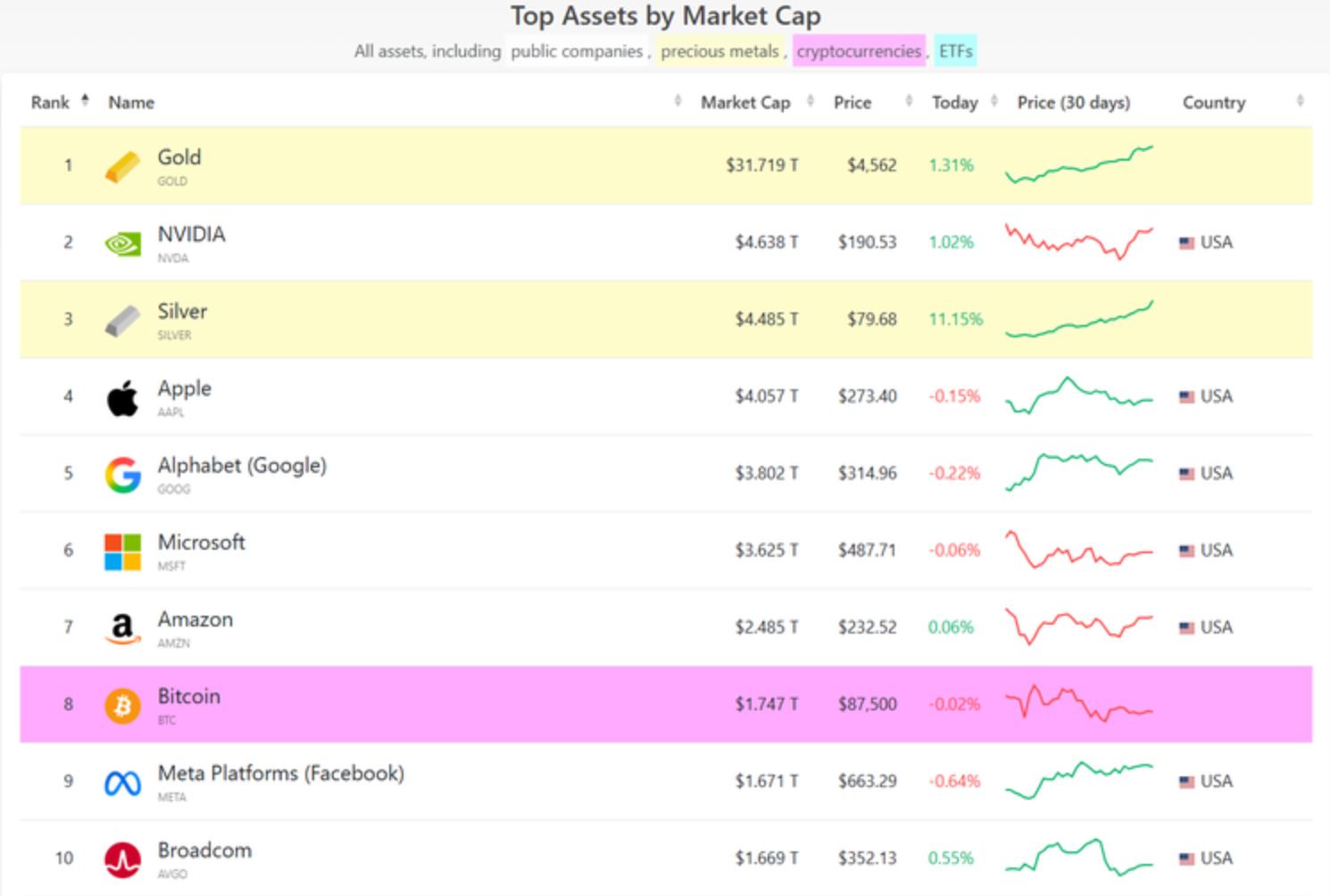
Group 1 - The core point of the article highlights that spot silver has surged over 185% this year, becoming the third most valuable asset globally, following gold and NVIDIA, surpassing major tech companies like Apple, Google, and Microsoft [1] - According to CompaniesMarketCap data, the market capitalization of silver is $4.485 trillion, while gold leads with $31.719 trillion, and NVIDIA follows closely with $4.638 trillion [1] - The historical high for spot silver was reached at $79.29 per ounce, closing at $79.11, and it has since broken the $80 per ounce mark, driven by supply constraints, designation as a critical mineral by the U.S., steady industrial demand, and market expectations of Federal Reserve interest rate cuts [1] Group 2 - Several exchange-traded funds (ETFs) focused on silver and silver mining include iShares Silver ETF (SLV.US), Abrdn Silver ETF Trust (SIVR.US), ProShares 2x Long Silver ETF (AGQ.US), ProShares 2x Short Silver ETF (ZSL.US), Sprott Physical Silver Trust (PSLV.US), Global X Silver Miners ETF (SIL.US), PureFunds ISE Junior Silver Miners ETF (SILJ.US), and Invesco MSCI Global Silver Miners ETF (SLVP.US) [2]

有色板块再创高点
Yang Zi Wan Bao Wang· 2025-12-28 23:21
Group 1 - Victory Energy (001331) has achieved an 11-day continuous rise, indicating strong market interest and potential volatility in its stock price [1] - Jia Mei Packaging (002969) has also seen significant price movement with 9 out of 11 days of gains, suggesting a similar trend of investor speculation [1] - The overall market showed a slight increase with the Shanghai Composite Index rising 0.1% and recording an 8-day upward trend, while trading volume increased to 2.16 trillion yuan, up 235.7 billion yuan from the previous trading day [1] Group 2 - The copper and aluminum sectors are performing strongly, with Jiangxi Copper (600362) hitting a new high since January 2008, and other companies like Zijin Mining (601899) and Luoyang Molybdenum (603993) also reaching historical peaks [1] - The market is experiencing rapid rotation of hotspots, with over 3,400 stocks declining, indicating a challenging environment for many investors [1] - The global metal futures market has resumed a "surge" mode, with COMEX gold, silver, and copper futures all reaching historical highs, reflecting strong demand and market dynamics [1] Group 3 - Fenglong Co. (002931) announced that after a change in control, the company will continue to focus on its original business, with no immediate plans for major changes or asset restructuring [2] - Victory Energy (001331) indicated that if its stock price continues to rise, it may apply for a trading suspension for verification, highlighting potential risks for investors [3] - Jia Mei Packaging (002969) also warned that if its stock price experiences further abnormal increases, it may seek a trading suspension, emphasizing the disconnect between stock price and fundamental performance [4] Group 4 - The U.S. stock market saw slight declines across major indices, with the Nasdaq down 0.09% and Tesla falling over 2%, indicating mixed performance among large tech stocks [5] - Despite the declines, the weekly performance showed positive trends for major indices, with the Nasdaq gaining 1.22% and the S&P 500 up 1.4%, suggesting resilience in the broader market [5]


盘前必读丨官方明确明年继续“国补”;央行发布重磅报告
Di Yi Cai Jing· 2025-12-28 23:18
Market Overview - The market structure characteristics are expected to continue in the short term, with trading volume being a key signal for market trends [1][9] - Major U.S. stock indices hovered near historical highs, with the Dow Jones down 0.04%, Nasdaq down 0.09%, and S&P 500 down 0.03% at the close [3] - The Nasdaq China Golden Dragon Index rose by 0.72%, with notable gains from Alibaba (1.5%), Pinduoduo (1.4%), and Baidu (1.2%) [3] Commodity Markets - Gold futures for December delivery increased by 1.08% to $4,529.10 per ounce, while silver futures surged by 7.68% to $76.48 per ounce, with post-market gains pushing silver above $78 per ounce [4] - International oil prices declined, with WTI crude down 2.76% to $56.74 per barrel and Brent crude down 2.57% to $60.64 per barrel [3] Financial Policies and Regulations - The People's Bank of China and the State Administration of Foreign Exchange announced the promotion of integrated currency pools for multinational companies, aiming to streamline cross-border fund management [6] - The National Bureau of Statistics released implementation opinions to strengthen data technology innovation, targeting the establishment of leading data technology innovation platforms by 2027 [6] Market Sentiment and Investment Trends - Institutional investors are increasingly adding to A500 ETF and other broad-based products, contributing to stable incremental capital in the market [9] - The market is currently characterized by a "buy on dips, structural switching" approach rather than aggressive trend-based accumulation at high levels, indicating a potential for gradual upward movement in the market [9] Company-Specific Developments - Xiaomi Group's co-founder plans to sell up to $2 billion of Class B common stock [10] - ST Houlv's chairman is under investigation for information disclosure violations by the China Securities Regulatory Commission [10] - Chipmaker AI orders from Chip Original Co. exceeded 24.94 billion yuan, with over 84% of fourth-quarter orders related to AI computing power [10]



全球大公司要闻 | 宁德时代:2026年钠电池将开启全领域大规模应用
Wind万得· 2025-12-28 22:31
Core Viewpoint - The article highlights significant developments in various companies and industries, focusing on advancements in battery technology, production plans, and strategic business decisions that may impact market dynamics and investment opportunities. Group 1: Battery Technology and Automotive Industry - CATL announced that sodium-ion batteries will be widely applied in battery swapping, passenger cars, and commercial vehicles next year, marking the commercialization of sodium-ion battery technology and potentially reducing the industry's reliance on lithium resources [2] - LG Energy Solution terminated a battery supply contract with Ford worth approximately 9.6 trillion KRW and another with FBPS valued at about 3.9 trillion KRW, which together account for over half of the company's projected sales in 2024, indicating a strategic shift to optimize customer structure and mitigate operational risks [2] - Toyota plans to set its global production target for 2026 at over 10 million vehicles to meet the strong demand for hybrid vehicles, with an expected production of around 10 million vehicles in 2025, while also recalling certain models due to safety concerns [3] Group 2: Chinese Companies Developments - Geely Auto officially sued Xinwanda over a contract dispute, seeking compensation of up to 2.3 billion CNY, which involves issues related to the performance of battery supply agreements, with potential implications for the electric vehicle supply chain [5] - Xiaomi's co-founder plans to sell up to 2 billion USD of B-class common stock starting December 2026, with proceeds aimed at establishing an investment fund, while expressing confidence in the group's business outlook [5] - XPeng Motors and others have introduced tax rebate or equivalent subsidy schemes to counteract the impact of declining new energy vehicle purchase tax policies, aiming to stabilize end-user prices and support sales in the year-end market [5] Group 3: Other Notable Developments - Wangfujing successfully won a 113 million CNY duty-free project at the capital airport, which will enhance its revenue share from the duty-free business and accelerate project implementation to capitalize on consumer recovery opportunities [6] - Aerospace Development reported that its low-orbit satellite business accounted for less than 1% of total revenue in the first three quarters, emphasizing that this segment is still in the cultivation phase with plans for future investment based on development conditions [6] - Kweichow Moutai's chairman emphasized the need for market stability and reasonable pricing strategies at the 2026 distributor conference, aiming to prevent price speculation and ensure a balanced product supply based on market demand [6]






The Next Stock-Split Stock That Could Make You Rich
The Motley Fool· 2025-12-28 18:51
Core Viewpoint - Meta Platforms has seen a significant increase in share price, rising 443% over the past three years, closing at $661.50, positioning it similarly to companies like Apple, Nvidia, and Tesla regarding potential stock splits [1][3]. Group 1: Stock Split Potential - Meta has never executed a forward stock split since its IPO, but the rising share price and earnings power have increased the likelihood of a split in 2026 [3]. - Stock splits do not alter the fundamental value of holdings but can enhance liquidity and broaden the investor base, potentially leading to higher trading activity and market valuation over time [4][6]. - Historical data indicates that companies that split their stock experience an average total return of 25.4% in the 12 months following the announcement, significantly outperforming the S&P 500's average return of 11.9% during the same period [6]. Group 2: Business Fundamentals - Meta reaches nearly 3.5 billion users daily across its family of apps, providing it with unmatched global scale and pricing power in digital advertising [7]. - The company has projected fiscal 2025 capital expenditures between $66 billion and $72 billion, primarily aimed at expanding its artificial intelligence infrastructure [7]. - Investments in AI-driven ad tools are enhancing ad targeting efficiency and improving returns on ad spend for advertisers, while also expanding the addressable market through new ad surfaces like WhatsApp, Reels, and Threads [8]. Group 3: Long-term Investment Outlook - For long-term investors, a potential stock split could act as an additional catalyst on top of Meta's strong fundamentals, potentially driving share prices higher in the coming months [9].