
Morgan Stanley(MS)

Search documents
Bank of America makes bold call on bank stocks
Yahoo Finance· 2026-01-11 19:47
Group 1: Market Outlook - Credit quality is expected to remain stable, with no significant credit cycle anticipated without a recession, although specialized exposures may pose risks [1] - Rate stability is deemed more important than rate cuts, with a positively sloped yield curve and lower rate volatility expected to enhance net interest margins [2] - The banking sector is predicted to experience strong mergers and acquisitions and initial public offerings due to strategic investor interest and a smooth approval process [2] Group 2: Bank of America’s Position - Bank of America (BofA) is optimistic about bank stocks, citing multiple fundamental drivers that create a supportive environment for the sector [4] - The focus is on Global Systemically Important Banks (GSIBs) and select regional banks that demonstrate growth potential [5] - BofA's "Year Ahead 2026" report indicates that current conditions resemble those of the late 1990s and early 2000s, rather than the post-global financial crisis period [5] Group 3: Stock Recommendations - Citigroup is highlighted as having the best risk/reward profile among large-cap banks, with a price target raised to $140, implying a 14.3% upside [7] - Wells Fargo is viewed positively due to the removal of the asset cap, which is expected to enhance growth and productivity [14] - Morgan Stanley is considered a strong buy due to its unique business setup and potential for synergies within its integrated franchise [20][21] Group 4: Earnings Projections - BofA forecasts Citigroup's earnings per share (EPS) to grow by about 25% annually from 2026 to 2027, with a projected EPS of $10.57 for 2026 [7][9] - Morgan Stanley's EPS is expected to reach $7.07 in 2026, with an average annual growth of about 15% [18] - Goldman Sachs is projected to have an EPS of $10.95 in 2026, with an implied upside of 12.6% [24] Group 5: Sector Dynamics - The removal of regulatory constraints is expected to allow banks like Wells Fargo to pursue better growth opportunities [14] - BofA believes that the GSIBs will lead the sector as capital markets activity increases, with a multi-year re-rating cycle anticipated [29][31] - The classic drivers of returns in 2026 are expected to remain focused on revenues, costs, capital, and credit, rather than AI, which is not yet a significant profit driver [31]


Earnings Kickoff, CPI and Other Can't Miss Items this Week
Yahoo Finance· 2026-01-11 18:00
Financial Sector Insights - Major banks including JPMorgan, Bank of America, and Goldman Sachs are reporting earnings this week, providing insights into consumer spending, business loan demand, and credit quality trends [1][2] - Key metrics such as net interest margins, loan loss provisions, and deposit dynamics will be critical for assessing bank conditions [1] - Investment banking revenues will shed light on M&A activity and capital markets health, while wealth management results will reflect retail investor sentiment [1] Economic Data Releases - The December CPI report is anticipated to be a significant economic release, indicating inflation trends as 2025 concludes [3] - Both headline and core CPI readings will be closely monitored for signs of inflation reacceleration, which could impact Federal Reserve policy [3] - Retail sales data will provide context on consumer demand strength, influencing pricing power and market sentiment [3] Semiconductor Sector Update - Taiwan Semiconductor's earnings will be crucial for understanding global semiconductor demand, particularly in AI and other end markets [4] - Insights on advanced node utilization and capital expenditure plans will be vital for assessing the sustainability of AI-driven chip demand [4] - TSM's commentary on competition from Samsung and Intel will provide context on industry dynamics and future investment expectations [4] Retail Sector Analysis - The NRF 2026 and ICR conferences will offer significant retailer preannouncements and guidance updates, impacting consumer discretionary sector sentiment [6] - November retail sales data will provide hard evidence of holiday shopping performance, with comparisons to conference commentary being critical for assessing retailer optimism [6] - Existing home sales data will further contextualize consumer behavior in the residential real estate market [6] Healthcare Sector Developments - The JPMorgan Healthcare Conference will gather key players in the pharmaceutical and biotech industries, generating significant news flow [7] - Updates on pipeline developments and regulatory approvals from major drugmakers could substantially influence stock movements [7] - The conference will highlight critical themes such as drug pricing pressures and innovations in oncology and gene therapy [7]


1 Stock to Buy, 1 Stock to Sell This Week: Morgan Stanley, Capital One Financial
Investing· 2026-01-11 13:54
Group 1 - The article provides a market analysis focusing on Morgan Stanley and Capital One Financial Corporation, highlighting their recent performance and market trends [1] Group 2 - Morgan Stanley's investment strategies and market positioning are discussed, emphasizing its role in the financial services sector [1] - Capital One Financial Corporation's financial results and growth metrics are analyzed, showcasing its competitive standing in the banking industry [1]



摩根士丹利邢自强:美元贬值,战略资产升值
Sou Hu Cai Jing· 2026-01-11 11:26
Core Viewpoint - The traditional fiat currency system, represented by the US dollar, is experiencing credit erosion, leading to a depreciation trend of assets outside of fiat currencies, with strategic assets like energy and precious metals gaining market favor [1] Group 1 - Morgan Stanley's Chief Economist for China, Xing Ziqiang, highlighted the increasing market preference for strategic assets and certain non-traditional fiat currency assets [1] - The attractiveness of RMB assets is noted, as they can be viewed as an asset outside the traditional fiat currency system led by the US, depending on their yield to attract long-term investment [1]
What to Expect in Markets This Week: Big Bank Earnings, December Inflation Data, Retail Sales, TSMC Earnings
Investopedia· 2026-01-11 10:55
Group 1: Earnings Reports - Major financial institutions including JPMorgan, Wells Fargo, Morgan Stanley, and Goldman Sachs are set to report earnings, marking the start of the earnings season for Q4 2025 [1][3] - JPMorgan Chase, the largest U.S. bank, will kick off the earnings season with its year-end report, having recently announced it will become the next issuer of the Apple Card [3] - Wells Fargo anticipates slower growth in net interest income for the year, while BNY Mellon and Goldman Sachs are also scheduled to report [4] Group 2: Economic Indicators - December's Consumer Price Index is expected to show inflation pressures slowing to 2.7%, with additional reports on wholesale inflation from October and November to provide further insights [6] - Retail sales data for November will offer insights into consumer activity during the holiday shopping season, which is crucial for the U.S. economy [8] - Reports on new and existing home sales are anticipated, as home sales have stalled due to ongoing affordability challenges [8] Group 3: Sector-Specific Insights - Taiwan Semiconductor's earnings will be closely watched to assess the chipmakers' ability to sustain revenue growth amid rising demand for AI chips [5] - Delta Air Lines' earnings will provide insights into the travel sector's recovery following disruptions caused by last year's government shutdown [5]

Wall Street's Crypto Debate Is Over As Banks Go All-In On BTC, Stablecoins, Tokenized Cash
ZeroHedge· 2026-01-10 23:40
Core Insights - Major banks are transitioning from viewing cryptocurrency as a risk to actively integrating it into their operations, focusing on regulated investment products and blockchain-based payment systems [3][4][5] Group 1: JPMorgan's Initiatives - JPMorgan is extending its US dollar deposit token, JPM Coin, onto the Canton Network, indicating progress towards production-ready blockchain infrastructure [4][6] - JPM Coin is designed as a digital claim on JPMorgan's dollar deposits, facilitating faster and more secure transactions on public blockchains [7] Group 2: Morgan Stanley's ETF Offerings - Morgan Stanley is entering the cryptocurrency ETF market with proposed products that provide exposure to Bitcoin and Solana, potentially reaching over 19 million clients [8][9] - The launch of spot Bitcoin ETFs has been highly successful, attracting significant inflows and demonstrating strong investor demand [10][12] Group 3: Barclays and Stablecoin Investments - Barclays has made its first investment in stablecoin infrastructure by backing Ubyx, a stablecoin clearing platform, reflecting traditional finance's growing interest in digital dollar systems [12][13] - This investment aligns with Barclays' strategy to explore opportunities in new forms of digital money, such as stablecoins [13] Group 4: Bank of America's ETF Recommendations - Bank of America has approved its wealth advisers to recommend Bitcoin ETFs, indicating Bitcoin's increasing integration into traditional finance [15][16] - The bank's chief investment office has suggested that clients allocate 1% to 4% of their portfolios to digital assets, highlighting a shift in investment strategy [16]



Morgan Stanley's Mike Wilson Sees 'Crystal Clear' Earnings Growth, Says 'Big Beautiful Bill' Will Fuel Consumer Stocks Rally
Yahoo Finance· 2026-01-10 18:31
Core Viewpoint - Morgan Stanley's Chief Investment Officer Mike Wilson presents a bullish outlook for the U.S. equity market, predicting high teens earnings growth and focusing on the consumer goods sector as a key investment area [1][5]. Group 1: Economic Drivers - Wilson describes the market's path as "crystal clear," driven by a stabilizing Federal Reserve and legislative support that will rejuvenate the consumer sector [2]. - He emphasizes a combination of falling interest rates and fiscal stimulus as factors that will unlock pent-up demand in the consumer goods sector [2][3]. Group 2: Consumer Goods Sector Performance - Wilson identifies consumer goods as his top conviction pick for the year, suggesting that the sector is poised for a rebound after experiencing a "rolling recession" [2]. - The Dow Jones U.S. Consumer Goods Index has shown a performance of 9.62% over the last six months, while year-to-date performance is -1.40% and one-year performance is 6.42% [4]. Group 3: Earnings Outlook - Contrary to concerns about a slowdown, Wilson asserts that the earnings outlook is strengthening, forecasting earnings growth in the "high teens" as the market rally expands beyond the technology sector [5]. - A significant factor in this optimism is the Federal Reserve's renewed asset purchasing to stabilize funding markets, which Wilson views as a positive development for investors [6].
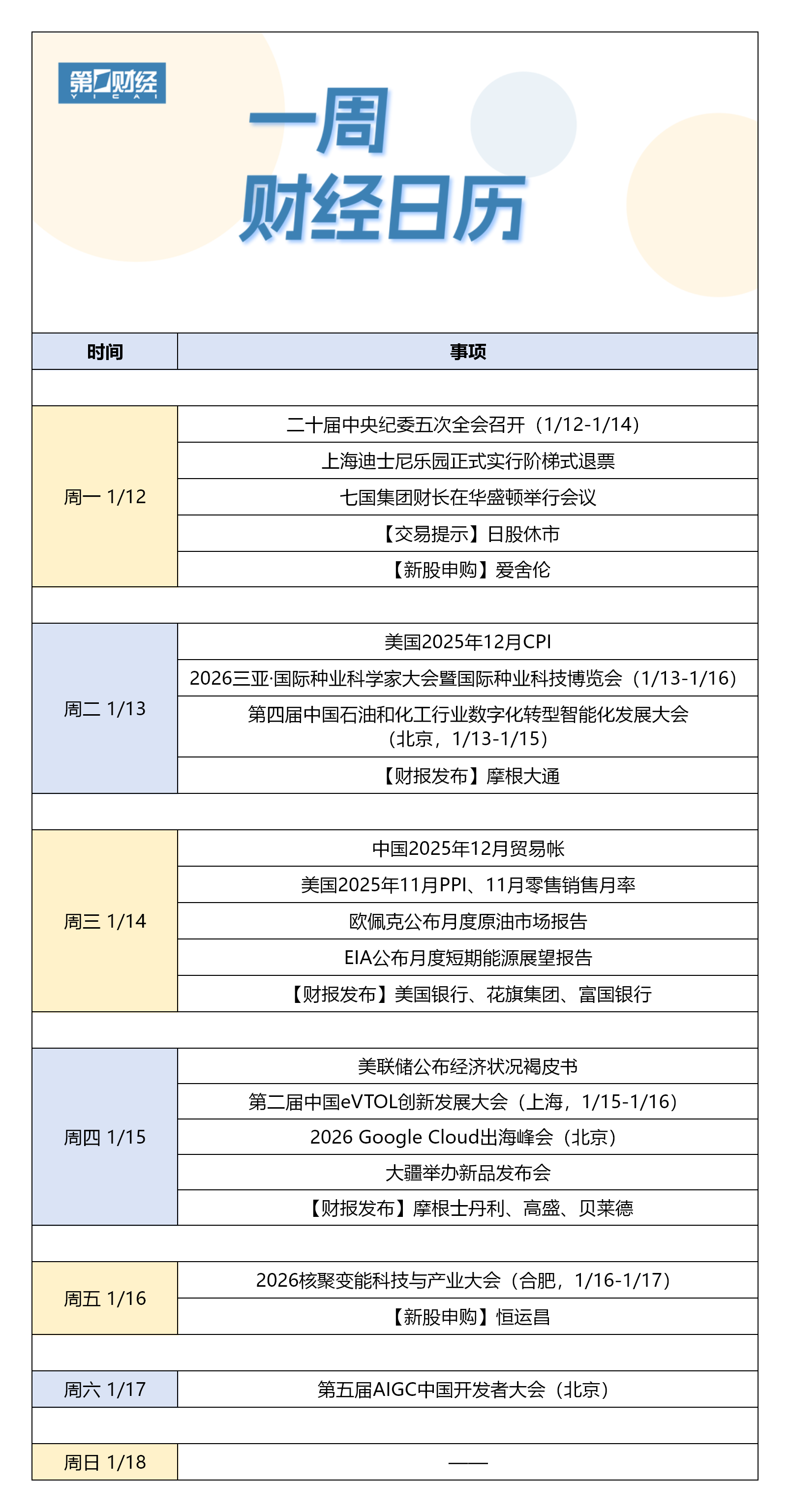
下周财经日历(1月12日-1月18日)
Di Yi Cai Jing· 2026-01-10 12:39
Group 1 - Morgan Stanley and Citigroup are set to release their financial reports on January 15, 2026 [2] - The second China eVTOL Innovation Development Conference is scheduled for January 15, 2026 [2] - The fifth AIGC China Developer Conference will take place on January 18, 2026 [2] Group 2 - The U.S. Federal Reserve will publish its Beige Book on January 14, 2026, providing insights into economic conditions [2] - The OPEC monthly oil market report is expected to be released on January 14, 2026 [2] - The EIA will publish its monthly short-term energy outlook on January 14, 2026 [2]

全球官方黄金储备首超美债,摩根士丹利预测金价将达4800美元
Sou Hu Cai Jing· 2026-01-10 07:13
Group 1 - The core viewpoint of the articles is that gold has surpassed U.S. Treasury bonds to become the largest reserve asset globally, driven by significant price increases and central bank purchases [1][2] - According to the World Gold Council, as of November 30, the total official gold reserves held by the U.S. overseas amount to over 900 million troy ounces, valued at approximately $3.82 trillion [1] - In comparison, the value of long-term and short-term U.S. Treasury bonds held by governments outside the U.S. is nearly $3.88 trillion as of October [1] Group 2 - If the central bank's gold reserves remain unchanged by year-end, the value of U.S. overseas gold reserves could reach $3.93 trillion, surpassing the value of foreign-held U.S. Treasury bonds [2] - The last time foreign institutions held more gold than U.S. Treasury bonds was in 1996 [2] - Morgan Stanley predicts that gold prices will rise to $4,800 per ounce by the fourth quarter of 2026, driven by declining interest rates, changes in Federal Reserve leadership, and continued purchases by central banks and funds [2]

跨资产-2026 年我们关注的跨资产主题-Cross-Asset Dispatches-Cross-Asset Themes We're Watching in 2026
2026-01-10 06:38
Summary of Key Points from the Conference Call Industry Overview - The focus is on the global equities market and cross-asset themes for 2026, with a particular emphasis on the performance of US equities compared to other regions [2][10][54]. Core Insights and Arguments 1. **Market Performance Expectations**: 2026 is expected to show more differentiated performance, with equities leading over fixed income. The previous year, 2025, was characterized as an 'everything rally' with global equities, represented by MSCI ACWI, increasing by 23% [10][13]. 2. **Valuation Concerns**: Current equity multiples are near the 90th percentile, with the S&P 500's cyclically adjusted P/E (CAPE) at 39x, close to the peak in 2022. This raises concerns about the sustainability of current valuations [16][18]. 3. **US Exceptionalism Narrative**: The narrative around the end of US exceptionalism is resurfacing, as US equities have seen increased allocations from global equity funds, maintaining the US as the top allocation for the last 15 years [27][28][34]. 4. **Cross-Asset Correlations**: There is a debate on the normalization of cross-asset correlations, with a suggestion that government bonds should not be abandoned as diversifiers despite current correlation trends [35][36]. 5. **Economic Growth and Inflation**: The forecast for global real growth is resilient at 3.2% for 2026, with US CPI expected to decline to 2.6% by year-end, allowing for potential Fed rate cuts [22][23]. Important but Overlooked Content 1. **Asset Allocation Recommendations**: The current asset allocation recommendation includes an overweight (OW) in equities, equal weight (EW) in core fixed income, and underweight (UW) in commodities and cash [11][54]. 2. **Sector-Specific Insights**: The report highlights that AI-related capital expenditures are expected to act as a tailwind for risk assets, suggesting a shift in focus from macro to micro risks [14]. 3. **Investor Sentiment**: The sentiment around US assets is changing, with correlations between US stocks and the USD indicating a perception of the dollar as a safe haven, despite previous concerns [48]. 4. **Future Risks**: The potential for a shift in the macro environment is noted, where good growth, disinflation, and low rates could be disrupted, impacting earnings and valuations [23][24]. Conclusion - The outlook for 2026 suggests a complex environment for investors, with high valuations, shifting correlations, and renewed debates around US exceptionalism. The recommendation is to maintain a focus on equities while being cautious about fixed income and commodities [54].