
Morgan Stanley(MS)

Search documents
跨资产-美联储重启资产购买决定的影响是什么-Cross-Asset Brief-What's the Impact of the Fed's Decision to Restart Asset Purchases
2026-01-06 02:23
Summary of Key Points from the Conference Call Industry and Company Overview - The conference call primarily discusses the impact of macroeconomic factors on various asset classes, particularly focusing on the Federal Reserve's monetary policy, U.S. economic growth, and commodity markets, including metals and currencies. Core Insights and Arguments Federal Reserve's Asset Purchases - The Fed's decision to restart asset purchases at a rate of $40 billion per month aims to enhance control over short-term interest rates during periods of market stress, which is expected to support front-end liquidity and sensitive risk assets [9][2][8] U.S. Economic Growth Outlook - The U.S. GDP growth in Q3 2025 surprised to the upside at 4.3% quarter-over-quarter, compared to a consensus of 3.3%. This growth is attributed to strong consumption and exports, with firms passing through tariff costs by raising prices, which is expected to lower downside risks to the labor market and support a growth rebound in 2026 [14][3][16] Metals Market Sustainability - The recent rally in metals is deemed sustainable, driven by demand from AI-related power consumption. Data centers are projected to consume 500,000 tons of copper in 2025, increasing to approximately 740,000 tons in 2026, contributing significantly to copper demand growth [19][20] Japanese Yen and Interest Rates - A weaker Japanese Yen could lead to a deeper sell-off in long-end Japanese government bonds (JGBs). The Bank of Japan's lack of urgency regarding rate hikes may create perceptions of being behind the curve on inflation, potentially exacerbating the depreciation of the Yen [22][24] UK Inflation and Bank of England - UK inflation fell to 3.2% year-over-year in November, leading to expectations of a rate cut by the Bank of England in Q1 2026. The inflation drop is attributed to seasonal effects and a rapid decline in food prices [26][27] Other Important Insights - The Fed's asset purchases are not classified as quantitative easing but are intended to improve liquidity conditions in the money market [9] - The potential for further price increases by U.S. corporates is anticipated through Q1 2026, with core CPI inflation expected to rise to 3.0% early next year [14] - The discussion highlights the sensitivity of risk assets to liquidity conditions, as evidenced by the widening of 2-year UST SOFR swap spreads following the Fed's announcement [10][12] This summary encapsulates the key points discussed in the conference call, providing insights into the macroeconomic environment and its implications for various asset classes.

跨资产聚焦-年末保持韧性-Cross-Asset Spotlight-Resilient into Year-End
2026-01-06 02:23
Summary of Key Points from the Conference Call Industry Overview - The report discusses the performance of various global asset classes, including equities, commodities, and currencies, with a focus on market sentiment and positioning as of early January 2026. Core Insights and Arguments - **S&P 500 and FTSE 100 Performance**: The S&P 500 slightly retreated from December highs, while the FTSE 100 reached all-time highs, indicating a divergence in market performance [7][8] - **Gold Performance**: Gold closed the year with its strongest annual gain in four decades, with a revised forecast of US$4,800/oz by Q4 2026. However, the pace of price increases may slow due to demand destruction risks as prices rise [7][12] - **Currency Movements**: The USDCNY dipped to its lowest level in two years, reflecting changes in currency dynamics [10][11] - **Market Volatility**: The MOVE Index reached lows not seen since 2021, indicating reduced market volatility [14][18] Important but Potentially Overlooked Content - **Forecasts for Global Indices**: Morgan Stanley provided forecasts for various indices, including a projected S&P 500 return of 6,858 in a bull case and a bear case of 5,600, indicating a potential volatility of -17.2% [3] - **ETF Flows**: The report tracks daily fund flows across approximately 5,000 ETFs globally, covering around US$7 trillion in assets, which provides insights into cross-asset sentiment and positioning [21] - **Market Sentiment Indicator (MSI)**: The MSI aggregates survey positioning, volatility, and momentum data to quantify market stress and sentiment, with current readings indicating a mix of negative and positive sentiment [59][60] Additional Data Points - **Commodities Performance**: Commodities overall saw a total return of 2.5% over the past week, with energy leading gains in global equity sectors [70] - **Bond Market Dynamics**: US high yield and emerging market sovereign bonds tightened by 3 basis points and 4 basis points, respectively, indicating a slight improvement in credit conditions [70] This summary encapsulates the key insights and data points from the conference call, providing a comprehensive overview of the current market landscape and expectations for various asset classes.
2025年度港股承销排行榜
Wind万得· 2026-01-05 22:35
Market Overview - In 2025, the Hong Kong stock market experienced a strong recovery, with the Hang Seng Composite Index rising by 30.98% [2] - The market exhibited a "dual-driven" characteristic, with the Hang Seng Financial Index leading with a 39.26% increase, while the Hang Seng Technology Index and Sustainable Development Enterprises Index rose by 23.45% and 31.36% respectively [2] - The performance of the Hang Seng Hong Kong Stock Connect Small and Medium-sized Enterprises Index (+30.93%) activated financing channels for small and medium-sized enterprises, indicating a significant structural development in the market [2] Equity Financing Trends - The total amount of equity financing in the Hong Kong stock market reached HKD 612.2 billion in 2025, a 250.91% increase from HKD 174.5 billion in the previous year [5][8] - Initial Public Offerings (IPOs) raised HKD 285.8 billion, up 224.24% from HKD 88.1 billion the previous year [22] - Placement financing saw a remarkable increase, raising HKD 289.6 billion, a 438.66% rise compared to the previous year [5] - The amount raised through rights issues decreased to HKD 7.6 billion, down 43.33% from the previous year [5] Financing Method Distribution - In 2025, the distribution of financing methods showed that IPOs accounted for 46.69% of total fundraising, while placements made up 47.31% [12] - Other methods included consideration issuance at 4.40%, rights issues at 1.23%, and public offerings at 0.37% [12] Industry Distribution of Financing - The top three industries for fundraising were Automotive and Parts (HKD 95 billion), Hardware Equipment (HKD 80.9 billion), and Pharmaceuticals and Biotechnology (HKD 80.8 billion) [13] - In terms of the number of financing events, the Pharmaceuticals and Biotechnology sector led with 68 events, followed by Software Services with 66, and Non-bank Financials with 56 [15] IPO Market Insights - A total of 117 companies went public in 2025, a 67.14% increase from 70 in the previous year [18] - The highest fundraising industry for IPOs was Electrical Equipment, raising HKD 44.6 billion, followed by Non-ferrous Metals at HKD 42.8 billion [28] - The top three IPOs by fundraising amount were CATL (HKD 41.006 billion), Zijin Mining International (HKD 28.732 billion), and SANY Heavy Industry (HKD 15.349 billion) [35] Refinancing Market Insights - The total amount raised through refinancing in 2025 was HKD 326.4 billion, a 278.15% increase from HKD 86.3 billion the previous year [40] - The Automotive and Parts sector led refinancing with HKD 66.2 billion, primarily from BYD's placement of HKD 43.5 billion [44] - The number of refinancing projects increased to 574, up 43.50% from 400 the previous year [40] Underwriting and Advisory Rankings - CICC topped the IPO underwriting scale with HKD 51.652 billion, followed by CITIC Securities (HK) at HKD 46.029 billion [54] - Goldman Sachs led the refinancing underwriting scale with HKD 32.244 billion, followed by CICC at HKD 24.967 billion [70]






6 Positive Catalysts for Stocks That Investors Are Underestimating: MS
Business Insider· 2026-01-05 19:14
Worried that stocks are due for a rough patch after three consecutive years of strong returns? Don't be, says Morgan Stanley."We think consensus is still underestimating the collective impact of a series of bullish catalysts," said Mike Wilson, the bank's chief US equity strategist, said in a note on Monday. He continued: "While these variables have received attention individually, we believe their collective impact remains underappreciated in terms of fueling the rolling recovery."Here are six big cataly ...

美股异动 | 道指首次突破49000点 大型银行股走高 高盛(GS.US)涨近5%
智通财经网· 2026-01-05 16:02
Group 1 - The Dow Jones Industrial Average (DJIA) has surpassed 49,000 points for the first time, currently up by 1.3% [1] - Major U.S. bank stocks have risen, with Goldman Sachs (GS.US) increasing nearly 5%, JPMorgan Chase (JPM.US), Morgan Stanley (MS.US), and Bank of New York Mellon (BK.US) rising over 3%, and Wells Fargo (WFC.US) and Bank of America (BAC.US) up over 2% [1] - The Institute for Supply Management (ISM) reported that the U.S. Manufacturing Purchasing Managers' Index (PMI) fell to 47.9 in December 2025, down from 48.2 in November, marking the lowest level since October 2024 and significantly below the economists' expectation of 48.4 [1] Group 2 - Despite the ongoing contraction in manufacturing, ISM noted that the PMI remains above 42.3, which is consistent with overall economic expansion in the long term [1] - The U.S. economy grew at an annualized rate of 4.3% in the third quarter, exceeding trend growth levels [1] - Although a record-length government shutdown is expected to negatively impact economic activity in the fourth quarter, most economists anticipate that the U.S. economy could accelerate again by 2026 due to the effects of tax cuts and ongoing investments in artificial intelligence [1]


摩根士丹利股价创历史新高,现涨3%
Mei Ri Jing Ji Xin Wen· 2026-01-05 15:17
(文章来源:每日经济新闻) 每经AI快讯,1月5日,摩根士丹利股价创历史新高,现涨3%。 ...
每日机构分析:1月5日
Xin Hua Cai Jing· 2026-01-05 11:59
马来银行:新加坡2026年经济增速或从高位温和回落 德意志银行:2030年全球AI数据中心支出或达4万亿美元,成本压力加剧 【机构分析】 摩根士丹利:韩元持续升值或需结构性改革落地 ·摩根士丹利利率策略师预计,2026年欧元区11个最大国家的政府债券总发行量将增加约7%,达到1.472 万亿欧元。1月份可能延续往年趋势,成为发行最活跃的月份。策略师指出,尽管年初集中发行模式在 各国间存在差异,但今年情况预计大致相似,仅通过拍卖发行的债券规模就可能达到约950亿至1050亿 欧元。 ·Exness分析师指出,市场在美联储关键政策周前保持观望,即将公布的经济数据将主导美元与利率前 景。投资者对委内瑞拉局势反应平淡,焦点转向本周美联储官员讲话,有关通胀与就业的信号或引发汇 市与债市波动。 ·丹斯克银行策略师指出,15-20年期国债正取代30年期成为欧元区长端债券新热点,受荷兰养老金改革 推动,欧债发行结构正向该期限区间倾斜。 ·摩根士丹利策略师指出,AI数据中心大规模投资正推高芯片与电力成本,预计美国通胀在2027年底前 将持续高于美联储2%目标。 ·英杰华投资集团警示,AI热潮叠加欧美日财政刺激将加剧通胀压力,各 ...
欧股2026年展望:机构高喊还有上涨空间 看好银行、可再生能源与德国刺激受益股
智通财经网· 2026-01-05 09:09
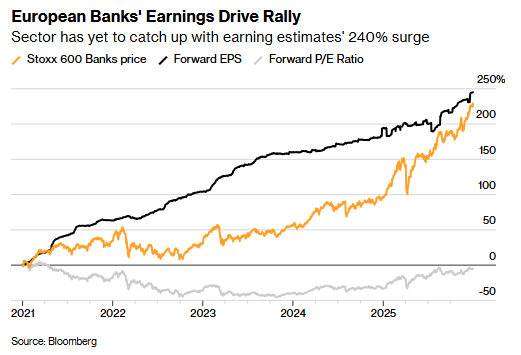
智通财经APP获悉,经历了自2021年以来表现最佳的一年之后,分析师和策略师们预测,欧洲股市在 2026年仍有进一步上涨空间。 具体来看,去年表现出色的板块普遍被认为将继续走强。作为2025年迄今为止表现最佳的板块,银行业 被看好将再度交出亮眼成绩单,摩根士丹利和巴克莱银行均将其列入首选推荐。围绕国防开支增加、可 再生能源及电气化的看涨主题预计也将延续。 众多券商在新年选股策略中还特别指出,受益于德国经济刺激政策的企业将是另一大投资亮点,而具备 清晰自我改善策略的公司同样备受关注。 以下为分析师们在新一年度力荐的欧洲热门标的精选: 摩根士丹利 由Marina Zavolock领导的策略师认为,2026年欧洲股市有望借力"美国经济复苏范围扩大"的东风持续走 高。美国市场贡献了欧洲企业约23%的加权营收,随着美国企业盈利增长超市场预期,叠加利好的税收 与监管政策,欧洲企业将从中显著受益。 摩根士丹利2025年最看好的欧洲板块中,银行业位居榜首,烟草与国防板块紧随其后。个股层面的核心 推荐标的包括桑坦德银行、劳埃德、西门子能源、森特理克集团、费森尤斯集团、荷兰国际集团、 Prosus NV、莱茵金属、ENGIE S ...

华尔街大行财报季即将来袭 花旗警告摩根士丹利(MS.US)回调将至:拥挤多头迎来高门槛预期
智通财经网· 2026-01-05 08:51
Core Viewpoint - Citigroup's recent report indicates that Morgan Stanley (MS.US) is increasingly positioned as a "high-end/premium" bank and investment banking financial complex, but the current valuation reflects the market's consensus on optimal investment returns, leading Citigroup to maintain a "neutral" rating with a target price of $170, suggesting a significant price correction in the short to medium term [1] Group 1: Valuation and Market Expectations - The market has priced in "best-in-class returns," resulting in a significant premium on Morgan Stanley's stock price under the "implied cost of equity capital" framework, making the risk/reward ratio less favorable compared to other investment opportunities in the financial sector [2] - Citigroup believes that Morgan Stanley's profit elasticity is primarily driven by cost discipline rather than aggressive market-driven assumptions, with an expected 2% upward revision in overall earnings for 2026 due to slower expense growth and better cost management [2][5] Group 2: Earnings Projections - Earnings per share (EPS) projections for Morgan Stanley are as follows: 2024A at $7.95, 2025E at $9.90, and 2026E at $11.00, with a slight upward revision for 2026 compared to previous estimates [3] - The report highlights that Morgan Stanley remains one of the most crowded consensus longs within Citigroup's coverage, indicating high sensitivity of the stock price to "slightly below stringent expectations" in the short to medium term [3] Group 3: Business Model and Risk Factors - Citigroup's assessment of Morgan Stanley's current stock price and valuation can be summarized as "high-quality company + fundamentally sound business model, but valuation and positioning significantly lower investment success rates" [4] - The implied cost of equity capital is estimated at approximately 8.7%, indicating that the current price reflects a fully priced return, while the target price model uses a 9.3% cost of equity capital, suggesting that the current valuation is not cheap [5] - Citigroup emphasizes that Morgan Stanley's cyclical exposure remains significant, particularly in investment banking and capital markets, with core risks including a downturn in capital market activities and valuations, which could severely impact profitability if economic growth and volatility fall below expectations [5]

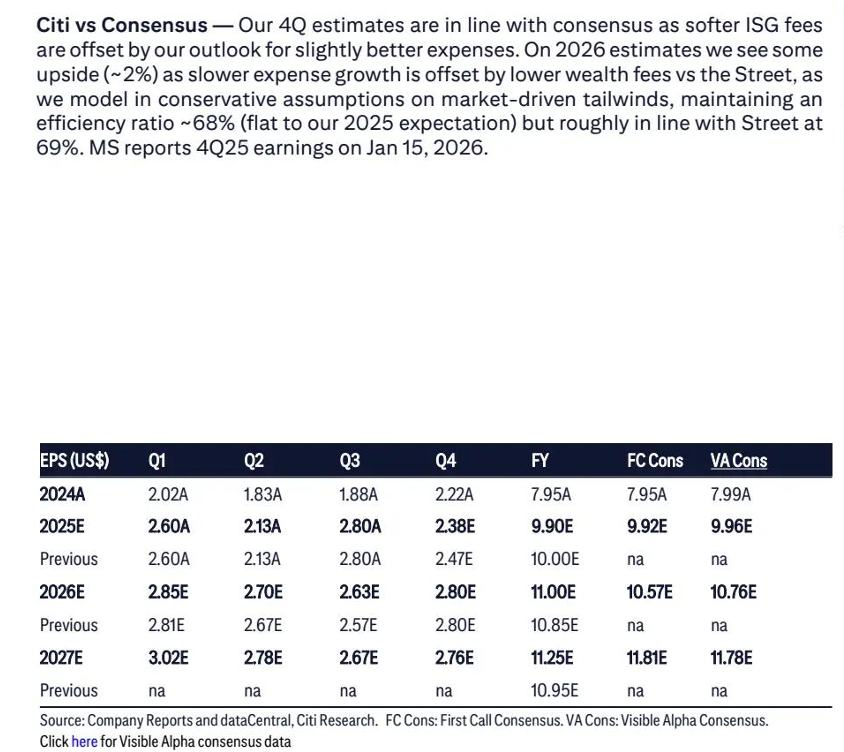
华尔街看好2026美股,标普500有望冲击8000点
Jin Rong Jie· 2026-01-05 08:47
本文源自:市场资讯 尽管如此,多家华尔街主流投行仍预测牛市将在2026年延续。美国银行预计,年末标普500指数将触及 7100点。摩根大通与高盛则给出了更为乐观的目标,分别预测该指数将升至7500点和7600点。摩根士丹 利在《2026年投资展望》报告中预计,标普500指数将在未来12个月内升至7800点。部分观点认为,若 美联储放松政策超出预期,标普500指数甚至有望超过8000点。 作者:观察君 若标普500指数在2026年实现上涨,将创下自2007年以来的最长连涨纪录。据道琼斯市场数据统计,该 指数历史上仅出现过五次连续四年及以上上涨的走势。 在经历了连续三年的强劲上涨后,华尔街主要机构对2026年美国股市前景普遍持乐观态度,认为当前的 高估值水平尚不足以阻止市场延续升势。不过,市场共识的形成也引发部分策略师的谨慎情绪。 声明:市场有风险,投资需谨慎。本文为AI基于第三方数据生成,仅供参考,不构成个人投资建议。 自2023年至2025年,标普500指数及其他主要美国股指已连续三年实现两位数涨幅。步入本轮上涨的第 四年,市场环境更为复杂,众多大型股估值已处高位,经济前景亦显模糊。 ...