
Microsoft(MSFT)

Search documents
A股收评 | 白酒突然暴涨!茅台冲击涨停 市场迎三大变局信号
智通财经网· 2026-01-29 07:17
Market Overview - The market showed significant divergence today, with traditional blue-chip sectors like liquor and real estate surging, leading to a substantial rise in the Shanghai Stock Exchange 50 Index, while technology sectors such as semiconductors and chips weakened, resulting in notable declines in the STAR Market and ChiNext Index [1] - The total market turnover reached 3.2 trillion yuan, an increase of over 200 billion yuan compared to the previous trading day, with more than 3,500 stocks declining [1] Key Signals - Three major changes in the market were noted: 1. The simultaneous rise of real estate and liquor stocks indicates potential structural volatility as the market rotates towards these rebound assets [1] 2. The recent surge in commodities, including gold, reflects liquidity trends, while cryptocurrencies have remained relatively subdued, suggesting inflation expectations may significantly impact AI and computing power [1] 3. The unexpected performance of government bonds, particularly the strong showing of 30-year treasury futures, indicates a complex narrative in the market, suggesting that the rotation is not strictly binary [1] Sector Performance - Consumer stocks, particularly liquor and retail, saw a significant afternoon rally, with Kweichow Moutai rising by 8% and several stocks hitting the daily limit [1] - Precious metals and oil and gas stocks experienced volatility but ultimately rallied, with China Gold achieving five consecutive limit-ups and Hunan Gold four consecutive limit-ups [1] - AI application concepts surged, with multiple stocks like Sai Group and Tiandi Online hitting the daily limit [1] - The banking sector also saw gains, with Qingdao Bank hitting the daily limit, while semiconductor, military, and automotive sectors faced the largest declines [1] Fund Flow - Major funds focused on sectors such as advertising, software development, and liquor, with significant net inflows into stocks like BlueFocus, Kweichow Moutai, and iFlytek [3] Future Outlook - Short-term market trends indicate a continued oscillation, with the Shanghai Composite Index expected to maintain an upward trajectory, although space for growth before the Spring Festival appears limited [2][8] - The market sentiment is supported by a weakening US dollar and ongoing monetary easing, which may provide a conducive environment for further capital inflow [7] - The upcoming earnings reports from A-share companies and North American tech giants are anticipated to have a more pronounced impact on market structure [6]






Microsoft shares fall 6% in Frankfurt after results
Reuters· 2026-01-29 07:16
Core Insights - Microsoft shares experienced a decline of 6.2% in Frankfurt following the announcement of record spending on artificial intelligence in the last quarter and slower growth in cloud computing, raising concerns among investors [1] Company Summary - Microsoft reported a record expenditure on artificial intelligence in the last quarter, indicating a significant investment in this area [1] - The company also noted a slowdown in cloud-computing growth, which has contributed to investor worries [1]


Tesla, Apple And 3 Stocks To Watch Heading Into Thursday - Tesla (NASDAQ:TSLA)
Benzinga· 2026-01-29 07:10
Core Viewpoint - U.S. stock futures are trading higher, with Microsoft and Apple expected to attract investor attention due to their recent financial performances [1] Group 1: Microsoft Corp. (NASDAQ:MSFT) - Microsoft reported second-quarter revenue of $81.3 billion, representing a 21% year-over-year increase, surpassing the Street consensus estimate of $80.25 billion [1] - The company achieved non-GAAP earnings per share of $4.14, exceeding the Street consensus estimate of $3.86 [1] - Despite the strong financial results, Microsoft shares fell 6.1% to $452.04 in after-hours trading [1] Group 2: Apple Inc. (NASDAQ:AAPL) - Analysts anticipate Apple to report quarterly earnings of $2.67 per share on revenue of $138.42 billion [1] - Apple shares experienced a slight increase of 0.1%, reaching $256.79 in after-hours trading [1]



Bristol Myers Squibb (BMY), Microsoft (MSFT) Partner to Enhance Early Lung Cancer Detection Through AI
Yahoo Finance· 2026-01-29 07:07
Bristol-Myers Squibb Company (NYSE:BMY) is one of the best inexpensive stocks to buy now. On January 20, Bristol Myers Squibb announced a partnership with Microsoft (NASDAQ:MSFT) to enhance the early detection of lung cancer. The collaboration centers on integrating Bristol Myers’ oncology expertise with Microsoft’s advanced AI-enabled radiology platform. By using these digital tools, the companies aim to streamline the identification of non-small cell lung cancer, ensuring patients are guided toward optim ...

微软2025财年Q4财报:总营收增17%,云业务成核心增长引擎
Huan Qiu Wang Zi Xun· 2026-01-29 07:02
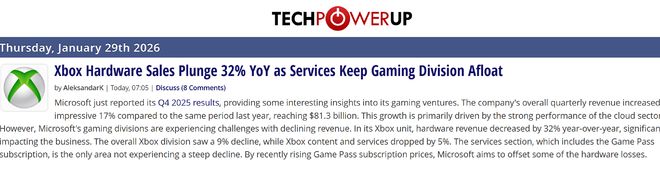
Core Insights - Microsoft reported a strong overall performance for Q4 of fiscal year 2025, with total revenue increasing by 17% year-over-year to $81.3 billion, driven primarily by robust growth in cloud computing and other high-margin businesses [1][3] Group 1: Business Segment Performance - The "Productivity and Business Processes" segment, which includes products like Word, Excel, and PowerPoint, generated $34.1 billion in revenue, reflecting a 16% year-over-year increase, continuing to provide stable income for the company [3] - The "Intelligent Cloud" segment, powered by Azure services, showed significant growth with revenue reaching $32.9 billion, marking a 29% year-over-year increase, highlighting the effectiveness of Microsoft's strategic shift towards cloud computing [3] - In contrast, the gaming segment faced challenges, with Xbox hardware revenue declining by 32% year-over-year, leading to an overall revenue drop of 9% for the Xbox division, although subscription services like Game Pass remained a stable growth point [3] Group 2: Strategic Focus - With the continuous decline in Xbox business performance, its priority within Microsoft's overall strategy is decreasing, as the company shifts its focus towards high-value areas such as Azure cloud services and Microsoft 365 commercial subscriptions [4]
微软因向未成年人设备植入追踪Cookie,遭奥地利监管机构裁定违法
Huan Qiu Wang Zi Xun· 2026-01-29 07:02
Core Viewpoint - The Austrian data protection authority (DSB) ruled that Microsoft illegally implanted tracking cookies on devices used by underage students without consent, constituting a violation of data protection laws [1][2] Group 1: Legal Findings - The DSB has ordered Microsoft to cease tracking activities on the affected students within four weeks [1] - The ruling stems from a complaint filed by the digital privacy organization "noyb," which highlighted that Microsoft shifted data protection responsibilities to schools and failed to ensure students' rights to access their data [1] - This is not the first time Microsoft has lost a case regarding student tracking; a previous ruling in October 2022 also found Microsoft guilty of illegal tracking through its education platform [2] Group 2: Microsoft’s Response - A Microsoft spokesperson stated that Microsoft 365 Education complies with all necessary data protection standards and that educational institutions can continue to use it in accordance with GDPR [2] - Microsoft is currently reviewing the latest ruling and will decide on subsequent actions in due course [2] Group 3: Privacy Concerns - Felix Mikolasch, a lawyer from noyb, emphasized that tracking minors clearly violates privacy protection principles, suggesting that Microsoft does not genuinely prioritize privacy protection [2]

Fed Steady, Earnings Mixed, and Oil Takes Center Stage
Investing· 2026-01-29 06:53
Market Analysis by covering: S&P 500, Microsoft Corporation, Crude Oil WTI Futures, Tesla Inc. Read 's Market Analysis on Investing.com ...

Microsoft’s AI Spending Test Overshadows Strong Earnings Beat
Investing· 2026-01-29 06:50
Market Analysis by covering: Microsoft Corporation. Read 's Market Analysis on Investing.com ...
AI办公竞争白热化,厂商争夺上海硬科技企业
Xin Lang Cai Jing· 2026-01-29 05:58
Core Insights - The AI office sector has been rapidly growing over the past year, with major players like Microsoft, Google, and Kingsoft competing for market share in the AI To B (business) market by launching AI collaborative office products by 2025 [1][2] - Kingsoft Office has made significant strides in the enterprise market, particularly among private and local state-owned enterprises, with a notable increase in revenue and the acquisition of key clients [2][3] Group 1: Market Dynamics - The collaborative office market is characterized as a "game among giants," with various platforms vying for dominance in the AI office space [1] - Shanghai is emerging as a critical battleground for AI office orders, with Kingsoft Office's WPS 365 "Enterprise Brain" already deployed among major clients in the region [1][2] - Kingsoft Office has reformed its channel system to better compete against Microsoft's stronghold, signing "Changhong Jiahua" as its national distributor to reach a broader market [1][2] Group 2: Competitive Strategies - A key strategy for Kingsoft Office is to replace Microsoft in the enterprise market, particularly targeting private and local state-owned enterprises [2] - Kingsoft Office has reported significant growth in the private enterprise sector, with a revenue increase and the acquisition of industry-leading clients such as Beike and Starbucks [2] - The company aims to replicate its success across various industries by leveraging its experience with top clients [2] Group 3: Financial Performance - Kingsoft Office's personal business accounts for 59% of total revenue, but growth has slowed to 11%, while the WPS 365 enterprise collaboration business has seen revenue growth exceeding 70% [2][3] - Microsoft reported a quarterly revenue of $34.12 billion in its productivity and business processes segment, reflecting a year-on-year growth of approximately 16% [3] Group 4: Challenges and Opportunities - Kingsoft Office faces challenges in overcoming traditional brand perceptions among younger, tech-savvy enterprises and must enhance its product capabilities to meet the needs of small and medium-sized businesses [5] - The AI office market in China is still in the "co-creation stage," with significant potential but requiring the emergence of a killer application for natural growth [5] - The exploration of new AI product forms and interaction modes is ongoing, indicating that the market is still evolving [5]


大行评级|花旗:微软上季收入与盈利表现稳健但展望喜忧参半,评级“买入”
Ge Long Hui· 2026-01-29 05:52
花旗发表报告指,微软上季收入与盈利表现稳健,Azure云业务按年增长38%,仍略低于市场预期的 39%至40%增长。此表现源于强劲的商业订单增长(按年增长228%),主要受先前宣布的OpenAI合作、新 签订的Anthropic合约,以及强劲资本支出(375亿美元,对比市场预期340亿美元)驱动。 报告指,微软季度业绩展望喜忧参半:存储器及供应链问题导致更多个人运算(MPC)部门走弱,拖累每 股盈利;但Azure展望显示增速预期较上财季略有提升,且略高于市场预期。该行目前予微软"买入"评 级及660美元目标价。 ...