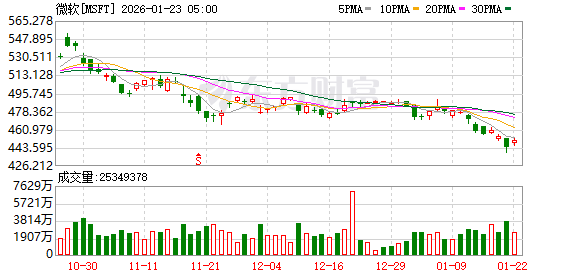
Microsoft(MSFT)

Search documents
明星科技股多数走强





Ge Long Hui A P P· 2026-01-23 15:19
Group 1 - AMD shares increased by nearly 4% [1] - TSMC, Micron Technology, and Microsoft shares rose over 2% [1] - Nvidia, Meta, and Amazon shares gained over 1% [1]
Ahead of Microsoft (MSFT) Q2 Earnings: Get Ready With Wall Street Estimates for Key Metrics
ZACKS· 2026-01-23 15:15
Core Viewpoint - Analysts expect Microsoft to report quarterly earnings of $3.88 per share, reflecting a year-over-year increase of 20.1%, with revenues projected at $80.23 billion, up 15.2% from the previous year [1] Revenue Estimates - Revenue from 'Productivity and Business Processes' is estimated at $33.49 billion, indicating a year-over-year change of +13.8% [4] - 'Intelligent Cloud' revenue is projected to reach $32.41 billion, showing a significant increase of +26.9% from the prior-year quarter [4] - 'More Personal Computing' revenue is expected to be $14.27 billion, reflecting a decrease of -2.6% compared to the previous year [5] - 'LinkedIn Revenue' is anticipated to be $5.05 billion, indicating a year-over-year increase of +10.1% [5] - Revenue from 'Dynamics products and cloud services' is expected to be $2.23 billion, with a year-over-year change of +16.8% [6] - 'Product Revenue' is projected at $17.80 billion, reflecting a +9.7% change from the prior-year quarter [6] - 'Service and other' revenue is estimated to reach $62.70 billion, indicating a +17.4% change from the previous year [6] Percentage Change in Revenue - The estimated percentage change in revenue for 'Productivity and Business Processes' is 13.8%, compared to 14.0% reported in the same quarter last year [7] - 'Intelligent Cloud' is expected to see a percentage change of 26.9%, up from 19.0% in the previous year [7] - Overall, the forecasted percentage change in revenue is 15.1%, compared to 12.0% from the previous year [8] Unearned Revenue Estimates - Long-term unearned revenue is projected to reach $3.43 billion, up from $2.54 billion reported in the same quarter last year [8] - Short-term unearned revenue is expected to be $51.39 billion, compared to $45.51 billion reported in the same quarter last year [9] Stock Performance - Over the past month, Microsoft shares have decreased by -7.6%, while the Zacks S&P 500 composite has increased by +0.6% [9] - Microsoft holds a Zacks Rank 2 (Buy), indicating a potential to outperform the overall market in the upcoming period [9]


U.S. Stock Market Navigates Mixed Open Amid Tech Weakness and Geopolitical Calm
Stock Market News· 2026-01-23 15:07
Market Overview - The U.S. stock market opened with mixed sentiment as investors reacted to corporate earnings and easing geopolitical tensions [1] - Major indices showed modest movements, with a notable rotation from mega-cap technology stocks towards small-cap companies [1] Major Market Indexes - The S&P 500 rose 0.05% to 6916 points, recovering from earlier losses, but is down 0.4% for the week [2] - The Dow Jones Industrial Average (DJIA) closed at 49,384.01 after a 0.6% increase, nearing the psychological 50,000 mark [3] - The Nasdaq Composite, after a 0.9% gain to close at 23,436.02, experienced a subdued open, indicating a shift in investor focus [4] Small-Cap Performance - Small-cap ETFs have led the market rally with year-to-date gains exceeding 7%, contrasting with the flat performance of mega-cap tech ETFs [4] - The Invesco S&P 500 Equal Weight ETF (RSP) climbed 3.3%, attracting significant fresh capital, signaling broader market recovery interest [4] Upcoming Earnings - The fourth-quarter 2025 earnings season is underway, with S&P 500 companies expected to report an earnings growth of 8.8% year-over-year, potentially reaching around 12% [6] - Key companies reporting today include Schlumberger Limited, Ericsson, and Capital One Financial, among others [6][7] Economic Indicators - Today's focus includes preliminary PMI data and final January Consumer Sentiment figures, with further insights expected next week [8] - The Personal Consumption Expenditures (PCE) index is projected to show a 0.2% month-over-month increase, with year-over-year readings at 2.8% [9] Corporate Developments - Intel shares fell 13% in premarket trading after a weaker-than-expected first-quarter outlook, despite surpassing fourth-quarter earnings estimates [14] - TikTok finalized a deal to avert a U.S. ban, involving a joint venture with Oracle and retaining a 19.9% stake for ByteDance [14] - Capital One Financial's shares declined after announcing the acquisition of fintech startup Brex for $5.15 billion while missing fourth-quarter earnings estimates [14] - Amazon is reportedly planning layoffs across various divisions, although its shares remained relatively unchanged [14] - Microsoft is noted for its sluggish performance, contributing to the drag on traditional market-cap-weighted indices, while Nvidia remains a focus for investors [14]






Microsoft Stock Hands Over $350 Billion To Shareholders
Forbes· 2026-01-23 14:51
Core Insights - Microsoft has returned $368 billion to shareholders over the past decade through dividends and share buybacks, making it the second-largest capital return in corporate history after Apple [2] - The company's strong cash flows from its transition to cloud computing and SaaS models have enabled it to reward investors while investing in Artificial Intelligence [3] Financial Performance - Microsoft has achieved a revenue growth rate of 15.6% over the last twelve months and a 13.2% average growth rate over the last three years [8] - The company has a free cash flow margin of nearly 26.6% and an operating margin of 46.3% for the last twelve months [8] - The minimum annual revenue growth for Microsoft in the last three years was 7.5% [8] Capital Return Strategy - The combination of consistent dividend increases and strategic stock repurchases has enhanced Microsoft's earnings per share and maintained high investor confidence [3] - Dividends and share repurchases are seen as direct returns of capital to shareholders, reflecting management's confidence in the company's financial stability [4] Market Position - Microsoft, along with companies like Meta, is growing at a faster and more predictable rate compared to others, yet has returned a smaller proportion of its market cap to investors [5] - The total capital returned to shareholders as a percentage of current market cap appears inversely related to growth potential for reinvestments [5]
Microsoft Slumps Heading Into Earnings—Here’s What Matters Most
Investing· 2026-01-23 13:29
Market Analysis by covering: . Read 's Market Analysis on Investing.com ...

微软发布首个机器人 VLA+ 模型,触觉进入核心架构
Sou Hu Cai Jing· 2026-01-23 13:08
Core Insights - Microsoft has officially launched Rho-alpha, its first VLA+ model specifically designed for robotics, which aims to convert natural language commands into precise robot control signals [2] - Rho-alpha integrates visual, language, and tactile perception, enhancing the capabilities of traditional VLA models and allowing robots to perform complex physical tasks in dynamic environments [2][4] Technology and Innovation - The core innovation of Rho-alpha lies in its multi-modal perception and real-time action generation capabilities, emphasizing tactile input alongside visual and language data [4][5] - Rho-alpha can adjust robot actions based on feedback from tactile sensors, improving reliability when handling fragile or flexible objects, a limitation of conventional VLA models [6][7] - The model translates natural language prompts directly into low-level control actions, enabling more natural and flexible task execution compared to traditional planning methods [8] Learning and Adaptation - Microsoft is researching mechanisms for continuous learning, allowing robots to adapt to different user habits and enhance user trust over time [9] - Rho-alpha combines real machine data, simulation, and large-scale visual question-answering data for training, addressing data scarcity issues in the robotics industry [11][12] Industry Context - The release of Rho-alpha signifies Microsoft's extension of its AI expertise into complex robotic systems, aligning with the broader trend of physical AI as a core direction for future artificial intelligence [10][11] - The entry of major tech companies into the robotics field is expected to accelerate the development of autonomous capabilities in robots, marking Microsoft's involvement as a potential starting point for industry advancements [14]


通信行业2026年度投资策略:聚焦AI:算力降本向光而行,应用落地网络先行
Guolian Minsheng Securities· 2026-01-23 12:20
Group 1 - The core viewpoint of the report emphasizes that the demand for AI computing power will continue to grow and diversify in 2026, extending from data centers to network edges and even internal terminals [8][13][27] - The report highlights the significant capital expenditure (Capex) growth driven by business revenue, with major cloud service providers like Google, Microsoft, and Amazon showing consistent revenue growth exceeding 20% year-on-year [27][31][35] - The report identifies the increasing importance of silicon photonics technology, particularly the 1.6T optical module, which is expected to maintain accelerated growth and enhance the global market share of domestic optical chips and devices [7][54][70] Group 2 - The report discusses the emergence of new technologies such as Scale-UP supernodes and their impact on optical link demand, indicating that these technologies will drive additional link requirements in 2026 [7][9][66] - It notes that the AI infrastructure is experiencing a high level of prosperity, with significant investments in data centers and AI capabilities expected to continue, particularly in the U.S. [47][49][53] - The report anticipates that the integration of silicon photonics will significantly increase its market penetration, projecting that by 2026, over half of optical module sales will come from silicon photonics solutions [70][75]


Top 5 Defense & Aerospace Stocks After Microsoft's $170M Air Force Win
247Wallst· 2026-01-23 11:54
Core Insights - Microsoft has secured a $170 million cloud contract with the Air Force, indicating a significant shift in defense modernization and technology procurement by the Pentagon [1] Group 1: Company Impact - The contract highlights Microsoft's growing influence in the defense sector, showcasing its capabilities in cloud technology [1] - This deal is part of a broader trend of increased spending on technology by defense agencies, reflecting a modernization wave [1] Group 2: Industry Trends - The defense industry is undergoing a transformation, with a focus on advanced technology solutions to enhance operational efficiency [1] - The Pentagon's technology buying patterns are evolving, emphasizing the need for cloud services and digital infrastructure [1]
微软回应多项服务突然中断:采取恢复措施保障产品使用
Zhong Guo Xin Wen Wang· 2026-01-23 11:03
(文章来源:中国新闻网) 图片来源:微软社交媒体截图 北京时间23日上午,微软(MSFT)再次发文称:由于我们采取了负载均衡措施,服务可用性和功能正在 持续改善。我们正在积极监控性能并进行有针对性的调整,以进一步提高稳定性和可用性,同时继续采 取恢复措施,确保提供可靠的服务体验。 中新网1月23日电据媒体报道,近日,微软(MSFT)多项服务突然中断,导致用户无法使用Office、 Outlook、Teams等服务。多位用户报告Microsoft Outlook出现问题。此后,微软(MSFT)在社交媒体上发 文称,其支持团队正在调查此次服务中断事件。 ...