P&G(PG)

Search documents
X @Bloomberg
Bloomberg· 2025-10-02 07:48
Procter & Gamble says it will discontinue its business in Pakistan, months after the company announced a global restructuring program https://t.co/gQ84qka3P0 ...

Procter & Gamble (PG) To Announce FQ1 2026 Results on October 24
Yahoo Finance· 2025-10-02 06:55
Core Insights - The Procter & Gamble Company (NYSE:PG) is highlighted as a top blue-chip stock to consider at its 52-week lows, with upcoming fiscal first-quarter results set to be released on October 24, 2023 [1] Financial Performance - In the fiscal fourth quarter of 2024, the company reported a revenue of $20.89 billion, reflecting a year-over-year growth of 1.74% and exceeding consensus estimates by $46.86 million. The earnings per share (EPS) was $1.48, surpassing estimates by $0.06. Management anticipates full-year revenue growth for 2026 to be between 1% to 5% [2] Analyst Ratings - Wall Street analysts are optimistic about The Procter & Gamble Company, with Filippo Falorni from Citi reiterating a Buy rating and a price target of $181 on September 16. Christopher Carey from Wells Fargo also maintained a Buy rating but adjusted the price target from $173 to $170 on September 25 [3] Company Overview - The Procter & Gamble Company is engaged in the production and sale of branded consumer packaged goods on a global scale, with product categories including Beauty, Grooming, Health Care, Fabric & Home Care, and Baby & Family Care [4]
Procter & Gamble (PG): A Dividend King with Over Six Decades of Increases
Yahoo Finance· 2025-10-01 17:55
Core Insights - The Procter & Gamble Company (NYSE:PG) is recognized as one of the 12 Best Dividend Aristocrat Stocks to invest in currently [1] - The company has a diverse portfolio across Beauty, Grooming, Health Care, and Home Care segments, operating in nearly 180 markets with a strong distribution network [2] - Procter & Gamble has maintained a stable dividend growth for 69 years, currently offering a quarterly dividend of $1.0568 per share, resulting in a dividend yield of 2.78% as of September 26 [4] Company Strategy - The company's recent strategy emphasizes product leadership and enhanced brand messaging, supported by established retailer relationships and innovation driven by research [3] - Continuous innovation and maintaining brand relevance are crucial for Procter & Gamble to meet diverse consumer demands [2] Financial Performance - The long and stable dividend track record has attracted investor interest, highlighting the company's financial stability and commitment to returning value to shareholders [4]
Wells Fargo Drops its Price Target on The Procter & Gamble Company (PG) from $173 to $170
Yahoo Finance· 2025-09-30 19:11
Group 1 - The Procter & Gamble Company (NYSE:PG) is recognized as one of the 11 Most Profitable Blue Chip Stocks to consider for investment [1] - Wells Fargo has revised its price target for Procter & Gamble from $173 to $170, reflecting a 1.73% decrease, while maintaining an Overweight rating [2] - Analysts show consistent confidence in Procter & Gamble's long-term growth, with BNP Paribas reiterating an Outperform rating at $177 and UBS lowering its target to $180 [2] Group 2 - Procter & Gamble has a diverse portfolio across various categories, generating approximately $85 billion in annual sales, with over 20 brands each exceeding $1 billion in international sales [3] - The company's stock stability is attributed to a balanced mix of high-growth and mature product areas, alongside ongoing global demand for consumer necessities [3][4] - Procter & Gamble offers branded consumer packaged goods in sectors such as Beauty, Grooming, Health Care, Fabric & Home Care, and Baby, Feminine & Family Care [4]
Why Procter & Gamble (PG) is a Cornerstone of Recession-Proof Dividend Portfolios
Yahoo Finance· 2025-09-29 17:35
Core Insights - Procter & Gamble (PG) is recognized as one of the top recession-proof dividend stocks, highlighting its resilience during economic downturns [1][2]. Company Overview - Founded in 1837, Procter & Gamble has established itself as a leading producer of household and personal care products, including a wide range of items such as detergents, diapers, and cleaning supplies [2]. - The company boasts over 20 brands that each generate more than $1 billion in annual sales, with many brands being market leaders in their respective categories [3]. Brand Strength and Market Position - Procter & Gamble's strong brand recognition provides leverage with retailers, enabling the company to implement price increases even during inflationary periods [4]. - The company maintains a relatively low debt level, which helps shield its earnings from the adverse effects of rising interest rates [4]. Dividend Performance - Procter & Gamble is classified as a Dividend King, having increased its dividend payouts for 69 consecutive years [5]. - The current quarterly dividend is $1.0568 per share, resulting in a dividend yield of 2.77% as of September 26 [5].
Why These 2 Recession-Proof Dividend Kings Are a Steal Right Now
The Motley Fool· 2025-09-29 08:15
Core Viewpoint - Investors seeking attractive yields and recession-resilient businesses should consider Coca-Cola and Procter & Gamble as strong options due to their historical performance and current valuations [1][2]. Group 1: Dividend Yields and Comparisons - The average dividend yield for S&P 500 stocks is 1.2%, while consumer staples companies average 2.5%. Coca-Cola offers a yield of over 3%, and Procter & Gamble's yield is approximately 2.8% [2][8]. - Both companies are classified as Dividend Kings, having consistently increased their dividends for over 50 years, even during recessions [7]. Group 2: Business Resilience - The consumer staples sector is considered recession-resistant as it includes businesses selling essential items, which consumers continue to purchase regardless of economic conditions [3][5]. - Coca-Cola and Procter & Gamble are among the largest publicly traded consumer staples companies, ranking No. 3 and No. 4 globally [5]. Group 3: Investment Valuation - Coca-Cola and Procter & Gamble are currently trading at attractive valuations, with price-to-sales, price-to-earnings, and price-to-book ratios below their five-year averages [9]. - Although neither stock is extremely cheap, their reasonable pricing is considered a good opportunity for investors, as these companies rarely go on sale [9]. Group 4: Long-term Investment Strategy - Warren Buffett's investment philosophy emphasizes buying good businesses at reasonable prices and holding them for long-term growth, which applies to both Coca-Cola and Procter & Gamble [10][11]. - Adopting a long-term investment approach with these companies may yield favorable outcomes, as current valuations could be seen as bargains in hindsight [11].

All It Takes Is $15,000 Invested in Each of These 3 Dow Jones Dividend Stocks to Help Generate Over $1,000 in Passive Income Per Year
The Motley Fool· 2025-09-28 23:59
Core Viewpoint - The article highlights three established companies—Coca-Cola, Procter & Gamble, and Sherwin-Williams—as reliable dividend stocks that can enhance passive income for investors, especially in the current market environment [2][20]. Coca-Cola - Coca-Cola has a strong history of dividend payments, having raised its dividend for 63 consecutive years, earning it the title of Dividend King [8]. - The company is currently experiencing solid organic growth and is diversifying its product lineup towards healthier options, such as Coca-Cola Zero Sugar and Diet Coke [7]. - Coca-Cola's stock is trading at a price-to-earnings (P/E) ratio of 23.6, below its 10-year median P/E of 27.7, and offers a dividend yield of 3.1% [8]. Procter & Gamble - Procter & Gamble is facing challenges due to inflation and cost-of-living pressures affecting consumers, which has led to its stock hovering around a 52-week low [9][10]. - The company has announced a restructuring plan that includes cutting 7,000 jobs and exiting certain brands and markets [10]. - P&G has a P/E ratio of 23.4 and a forward P/E of 21.8, with a dividend yield of 2.8%, making it appealing for risk-averse investors [14]. Sherwin-Williams - Sherwin-Williams has underperformed major indexes this year due to high interest rates impacting its end markets, but it has a strong history of dividend increases, with 46 consecutive years of raises [15][17]. - The company has a solid business model, selling products through various channels, and has seen its stock price increase by 352% over the last decade [17][18]. - Sherwin-Williams is considered a good buy for long-term investors, despite its current dividend yield of only 0.9% [17][18]. Investment Appeal - All three companies are characterized by their ability to pay growing and reliable dividends, making them suitable for investors looking for non-tech-focused investment opportunities [20]. - Coca-Cola and Procter & Gamble are currently trading at discounted valuations compared to their historical averages, while Sherwin-Williams is in line with its 10-year median valuation [20].



The Procter & Gamble Company (PG) to Cut 7,000 Jobs, Streamline Portfolio for Growth
Yahoo Finance· 2025-09-28 22:43
Core Viewpoint - The Procter & Gamble Company is undergoing a significant restructuring and portfolio simplification to enhance growth amidst economic challenges and slowing sales [2][4]. Group 1: Restructuring and Job Cuts - The company plans to cut 7,000 jobs, approximately 6.4% of its global workforce, by mid-2027, focusing on non-manufacturing roles to improve productivity and resource allocation [2][4]. - This restructuring is in response to demands from activist investors for cost efficiency and a focus on core brands [2]. Group 2: Portfolio Streamlining - Procter & Gamble is streamlining its product lines, particularly in international markets, by reducing variety in certain categories and divesting slower-growing brands [3]. - The company is concentrating on core markets such as the U.S., China, Japan, Canada, and Western Europe, which show modest organic sales growth, while addressing underperforming "enterprise markets" [3]. Group 3: Financial Outlook - Analysts view Procter & Gamble as undervalued, with a 12-month price target of approximately $176, indicating a potential upside of 16% from current levels [4]. - Earnings per share (EPS) for fiscal 2026 is projected at $6.99, with stable revenue expected [4]. - The company's reputation for steady dividends and defensive characteristics makes it appealing in uncertain market conditions [4].
P&G to Webcast Discussion of First Quarter 25/26 Earnings Results on October 24
Businesswire· 2025-09-26 16:00
Core Points - Procter & Gamble Company will webcast a discussion of its first quarter earnings results on October 24, 2025, starting at 8:30 a.m. ET [1] - Media and investors can access the live audio webcast at www.pginvestor.com, and it will also be available for replay [1] - Procter & Gamble serves consumers globally with a strong portfolio of trusted, quality brands, including Always®, Ambi Pur®, and Ariel® [1]
用大模型帮助投资!研究机构:到2029年AI投顾规模将增长600%
Hua Er Jie Jian Wen· 2025-09-26 03:04
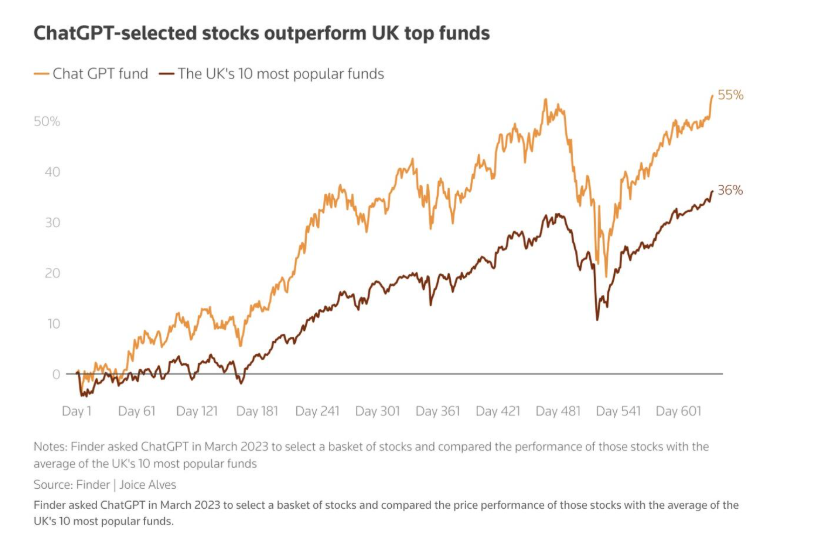
Core Insights - The rapid integration of artificial intelligence (AI) into the investment sector is transforming how both Wall Street analysts and retail investors approach stock selection [1][4] - The global robo-advisory market is projected to grow from $61.75 billion in 2023 to nearly $471 billion by 2029, indicating a growth of over 600% in six years, driven by increasing investor interest [1] - Retail investors are increasingly utilizing AI tools, with about 10% currently using chatbots for stock selection and half of the surveyed individuals considering trying them [1] Group 1: Market Growth and Trends - The robo-advisory market is expected to experience significant growth, reaching nearly $471 billion by 2029 from $61.75 billion in 2023 [1] - eToro reports that approximately 10% of retail investors are using chatbots for stock selection, with 50% of respondents open to trying such tools [1] Group 2: AI Investment Performance - An experiment by Finder in 2023 showed that a stock portfolio selected by ChatGPT, including companies like Nvidia, Amazon, Procter & Gamble, and Walmart, achieved a remarkable 55% increase, outperforming mainstream funds in the UK market [1] Group 3: Expert Opinions and Cautions - Former UBS analyst Jeremy Leung noted that he uses ChatGPT for investment guidance, stating that even simple tools can replicate many of his previous workflows, potentially replacing expensive Bloomberg terminal functions [4] - eToro's UK head, Dan Moczulski, warned of risks when users treat general AI models like ChatGPT as infallible, highlighting issues such as incorrect data citations and over-reliance on existing narratives [4] - Experts caution that general AI models have limitations, such as lacking access to paid data behind paywalls, which may lead to missing critical analysis information [4]