Starbucks(SBUX)

Search documents
星巴克再赌一局,也难赢
3 6 Ke· 2025-11-13 12:11
Core Viewpoint - Starbucks is strategically transferring control of its China operations to Boyu Capital to enhance localization and penetrate lower-tier markets, rather than merely selling off assets [1][2]. Group 1: Transaction Details - Starbucks has officially partnered with Boyu Capital, which has acquired a 60% stake in Starbucks China, valuing the joint venture at $4 billion [1]. - The new joint venture will maintain its headquarters in Shanghai and aims to increase the number of Starbucks locations in China from approximately 8,011 to around 20,000 [1][9]. - Starbucks anticipates that the total value of its retail business in China will exceed $13 billion, derived from the sale of equity, retained interests, and ongoing licensing fees [1]. Group 2: Boyu Capital's Role - Boyu Capital, established in 2011, focuses on technology innovation, consumer retail, and healthcare, with a portfolio of over 200 companies [3]. - The firm has previously invested in major companies like Alibaba and NIO, indicating its strong market presence and expertise [3]. - Boyu Capital's involvement is expected to provide Starbucks with local market insights and operational efficiencies, particularly in supply chain and digital infrastructure [5]. Group 3: Market Challenges - Starbucks faces intense competition in the high-end market from niche brands like Blue Bottle Coffee and in the mid-tier market from Luckin Coffee, which offers lower-priced options [6][7]. - The Chinese coffee market is projected to exceed 240 billion yuan by 2025, with a significant shift towards value-for-money as a primary consumer choice [6]. - Starbucks has struggled with its traditional operational model, which has become cumbersome in the fast-paced Chinese market, necessitating a shift towards a more localized approach [7][8]. Group 4: Future Outlook - The partnership with Boyu Capital is seen as a necessary evolution for Starbucks to adapt to the competitive landscape and consumer preferences in China [8][10]. - Starbucks aims to leverage Boyu's resources to enhance its product offerings and customer engagement strategies, ensuring it remains relevant in a rapidly changing market [5][10]. - The collaboration is expected to reshape the coffee market dynamics, with Starbucks potentially reclaiming its position in the high-end segment while mid-tier brands continue to compete aggressively [10][11].

Starbucks union baristas to walk out in 40 cities in push for contract talks
Reuters· 2025-11-13 11:45
Core Points - More than 1,000 Starbucks unionized baristas in over 40 U.S. cities have initiated an open-ended strike, indicating a significant escalation in their efforts for a collective bargaining agreement regarding pay and working conditions [1] Group 1 - The strike involves baristas from over 40 cities, highlighting the widespread nature of the labor action [1] - The union's actions reflect growing discontent among workers regarding compensation and workplace conditions [1] - This strike marks a critical moment in the ongoing labor movement within the coffee industry, particularly for Starbucks [1]

Starbucks' labor battle threatens to undermine its comeback plan as strike launches on Red Cup Day
Business Insider· 2025-11-13 11:00
Core Points - Thousands of baristas are striking on Red Cup Day, aiming to finalize their first contract with Starbucks amid ongoing labor negotiations [1][2][5] - The strike involves over 65 stores across 40 US cities, disrupting a major sales promotion that typically sees a significant increase in customer visits [2][3] - The union has organized multiple strikes since 2023, with the current work stoppage being the fourth and the third since the new CEO took over [3][4] Labor Relations - Baristas have been attempting to ratify their collective bargaining agreement since December 2021, but negotiations collapsed in December 2022 [5][6] - Starbucks claims the union walked away from negotiations, while the union insists it is ready to bargain and is awaiting new proposals from Starbucks [6][7] - The union has reported increased interest in joining since Starbucks' recent restructuring, which involved closing over 600 stores and laying off thousands [7][8] Regulatory Environment - The National Labor Relations Board (NLRB) has been understaffed, causing delays in union elections and leaving some baristas without full protections under labor laws [9][10] - The lack of sufficient NLRB staffing has hindered the ability of new stores to unionize, complicating the labor landscape for Starbucks [11] Shareholder and Legislative Pressure - Shareholders and lawmakers are increasingly concerned about labor tensions affecting Starbucks' turnaround efforts, with over 100 lawmakers urging the company to negotiate fairly [13][14] - A group of shareholders has expressed worries about the impact of labor disputes on the company's reputation and stock price, which has declined over 5% this year [15][16] - The company's recent fiscal report indicated a 1% increase in Q4 comparable sales globally, marking the first sales increase in seven quarters [15]
星巴克、汉堡王……“洋品牌”的中国剧本彻底变了
创业邦· 2025-11-13 10:12
Core Viewpoint - The article discusses the strategic shifts of foreign brands in the Chinese market, highlighting recent partnerships and investments aimed at regaining market share and adapting to local consumer preferences [6][9][10]. Group 1: Strategic Partnerships - CPE Yuanfeng announced a strategic partnership with Burger King, injecting $350 million to support expansion and operations, resulting in CPE holding approximately 83% of Burger King China [6][9]. - Starbucks China formed a joint venture with Boyu Capital, with a valuation of around $4 billion, allowing Boyu to acquire up to 60% of the joint venture while Starbucks retains brand ownership [9][30]. - These partnerships reflect a trend of foreign brands seeking local control to navigate the competitive landscape in China [9][30]. Group 2: Market Challenges - Foreign brands like Starbucks and Burger King are facing significant competition from local brands such as Luckin Coffee and Kudi, which offer lower prices and innovative products [12][14]. - Starbucks' market share in China has dropped to 14%, while Luckin Coffee holds 35% and Kudi 18%, indicating a shift in consumer preferences towards more affordable options [14]. - Burger King has struggled in China, with a significant reduction in store numbers and low average sales per store compared to competitors [15][16]. Group 3: Localization Issues - The article highlights that foreign brands are increasingly out of touch with the Chinese market, struggling to adapt their products and marketing strategies to local tastes [20][22]. - Burger King's attempts at localization have not resonated with consumers, leading to perceptions of the brand as outdated and lacking in effective marketing [22][24]. - Starbucks faces challenges with its "third space" concept as consumer preferences shift towards more affordable coffee options, and its product innovation has lagged behind local competitors [24][25]. Group 4: Future Growth Strategies - The partnerships aim to leverage local expertise to enhance operational efficiency, supply chain management, and product innovation, with CPE planning to expand Burger King's store count from approximately 1,250 to over 4,000 by 2035 [32]. - Boyu Capital's involvement with Starbucks will focus on a mixed model of franchising and direct operation to penetrate lower-tier markets, aiming to reduce operational costs and improve supply chain efficiency [31][32]. - The article emphasizes that foreign brands must adapt to the dynamic and independent nature of the Chinese market, which requires agility in decision-making and responsiveness to consumer demands [32].
Starbucks workers union launches strike in at least 40 cities on chain's key holiday sales day
CNBC· 2025-11-13 10:03
Core Points - Starbucks Workers United initiated an open-ended strike on Red Cup Day, impacting over 1,000 baristas in more than 65 stores across at least 40 cities [1] - The strike follows a failure to reach a collective bargaining agreement, with the union demanding better hours, higher wages, and resolution of unfair labor practice charges against Starbucks [3][4] - The strike poses a risk to Starbucks' business during the crucial holiday season, which is vital for the company's performance turnaround under new CEO Brian Niccol [2] Company and Union Dynamics - Starbucks and the union have not engaged in active negotiations since talks broke down late last year, despite entering mediation in February [4] - Workers United claims to represent over 12,000 workers across more than 550 stores, while Starbucks states the union represents only 9,500 workers at 550 cafes [4] - The union is prepared to escalate the strike, threatening to make it the largest and longest in the company's history if demands are not met [5] Company Response - Starbucks maintains that it offers competitive pay and benefits, averaging over $30 per hour for hourly partners, and has expressed willingness to negotiate [7] - The company has stated it is prepared to serve customers across its nearly 18,000 stores during the holiday season despite the strike [6] - Starbucks' Chief Partner Officer emphasized the company's commitment to bargaining and expressed hope for a swift resolution if the union returns to the negotiating table [8]
X @Bloomberg
Bloomberg· 2025-11-13 10:02
Starbucks baristas in 40 cities are striking on Thursday amid stalled negotiations on a collective bargaining agreement. https://t.co/rWkq8AmL0H ...
汉堡王8个月转手赚2亿刀,外资到底在玩什么?
3 6 Ke· 2025-11-13 08:44
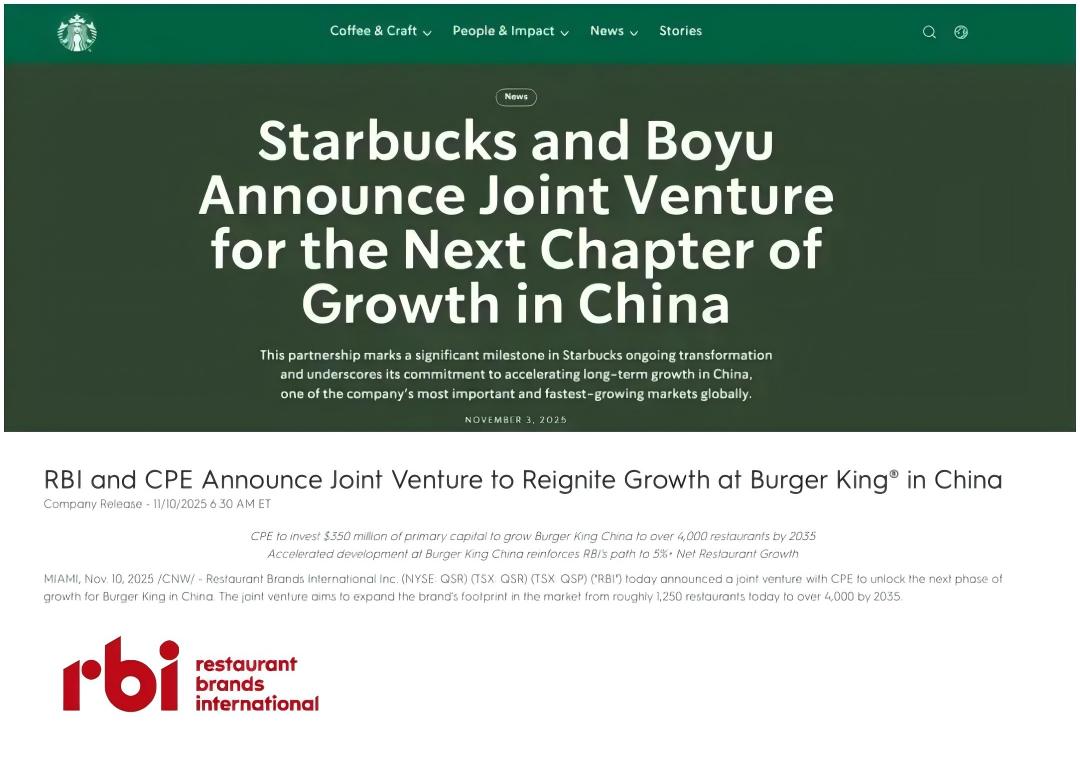
01 看了一堆汉堡王和星巴克"卖身"的标题党新闻后,我都快笑死了。 图|来源网络 一周之内,两条重磅:11月4号星巴克宣布把中国业务60%股权卖给博裕资本;11月10号汉堡王把83%股权卖给CPE源峰。 然后一堆媒体开始喊"外资餐饮大败退""洋品牌水土不服"。 我看完这些标题,又看了看交易细节,我感觉我又行了。 这哪是败退,这明明是换了个更舒服的姿势继续赚钱。 图|来源网络 星巴克一次性套现40亿美元,手里还握着40%股权,未来十年以上每年躺着收品牌授权费,加起来总价值超过130亿美元。 汉堡王拿走3.5亿美元,保留17%股权,还签了20年的品牌授权协议。 你们说这是败退? 这是完美退出好吧。 02 先别急着喊口号,咱们算笔账。 以星巴克为例,很多人觉得它把控股权卖了,是不是混不下去了? 朋友,你想多了。 星巴克在中国目前8000家店,2025财年全年营收31亿美元。 听起来不错对吧? 但你得知道,这31亿美元是怎么赚来的——门店租金、人力成本、供应链投入、营销费用,全是钱。 图|来源网络 更要命的是,星巴克还得跟瑞幸死磕。瑞幸现在27000家店了,年底冲刺30000家,而且价格比星巴克便宜一半还拐弯。 这意 ...
外资正在批量“撤离”?
Sou Hu Cai Jing· 2025-11-13 01:41
Core Viewpoint - The recent trend of foreign brands selling their businesses in China reflects a significant shift in the market dynamics, where local brands are gaining ground and changing consumer preferences are impacting the competitive landscape [6][9][26] Group 1: Foreign Brands Selling - CPE Yuanfeng has entered a strategic partnership with Burger King, investing $350 million to acquire approximately 83% of the joint venture "Burger King China" [1] - Starbucks has also formed a partnership with Boyu Capital, with an investment of around $4 billion for up to 60% stake in Starbucks China [2] - Yum! Brands is reviewing its strategy for Pizza Hut, considering the sale of its business [4] Group 2: Market Dynamics - The Chinese market has shifted from a foreign brand-dominated "blue ocean" to a competitive "red ocean," with local brands like Luckin Coffee and Li Ning gaining market share [9][14] - Starbucks' market share has dropped from 34% in 1999 to less than 15% currently, indicating a significant decline in its competitive position [9] - The rise of domestic brands has led to a decrease in the perceived value of foreign brands, as consumers now prioritize quality and price over brand origin [11][12] Group 3: Changing Consumer Behavior - Consumers are increasingly aware of the value of domestic products, often finding similar quality at lower prices [11] - The rapid evolution of consumer preferences and marketing strategies has made it difficult for foreign brands to keep up [17][19] - The success of local brands in penetrating lower-tier cities highlights the challenges faced by foreign brands in adapting to the new market environment [21] Group 4: Strategic Shift of Foreign Brands - Foreign brands are transitioning from a "heavy asset direct operation" model to a "light asset cooperation" model, focusing on brand licensing and partnerships rather than direct management [24] - This shift allows foreign brands to minimize risks while still benefiting from the growing Chinese market through royalties and dividends [24][26] - The changing landscape indicates that local players are now leading the market, with foreign brands taking a backseat [26]


US judges say Starbucks' 'vibe' may justify limits on union apparel
Reuters· 2025-11-13 00:08
A panel of U.S. appeals court judges on Wednesday voiced concerns that the National Labor Relations Board has gone too far in policing employers' restrictions on workers wearing union apparel, grappli... ...
A Government Hint Just Sent Starbucks Stock Soaring - Starbucks (NASDAQ:SBUX)
Benzinga· 2025-11-12 17:23
Core Viewpoint - Starbucks Corporation's stock is experiencing an upward trend due to anticipated tariff relief on imported goods, particularly coffee [1][2]. Group 1: Tariff Relief and Market Reaction - Treasury Secretary Scott Bessent announced that the administration will soon implement cuts in duties on everyday consumer goods, which is expected to lower prices on items not typically produced in the U.S. [2] - The focus of the tariff relief plan includes products such as coffee and bananas, with an emphasis on delivering faster price relief at the register [3][4]. - President Donald Trump's remarks about easing trade costs were interpreted positively by the market, leading to an increase in coffee-linked stock prices [4]. Group 2: Starbucks Merchandise and Consumer Demand - Starbucks gained media attention for a limited holiday cup that became a collectible, with a Glass Bearista Cold Cup priced under $30 quickly selling out [5]. - The overwhelming response to the collectible exceeded internal projections, leading to frustration among fans who could not purchase the item [6]. Group 3: Expansion in China - Starbucks has entered a joint venture with Boyu Capital to expand its retail presence in China, with Boyu Capital set to acquire up to 60% of Starbucks' China store business, valuing it at approximately $4 billion [7]. - Starbucks will retain a 40% interest in the venture while maintaining ownership of its intellectual property [7].