Synopsys(SNPS)

Search documents
国产EDA卡在了哪里?
远川研究所· 2025-06-11 12:37
Core Viewpoint - The article discusses the critical role of Electronic Design Automation (EDA) in the semiconductor industry, highlighting the challenges faced by China's integrated circuit industry due to recent export controls on EDA tools by the U.S. government. Group 1: EDA Overview - EDA, or Electronic Design Automation, is essential software for chip design, akin to CAD software in architecture, and is crucial for integrating billions of transistors into tiny chips [4][5]. - The top three EDA suppliers dominate nearly 80% of the market, all of which are U.S. companies, while China's domestic EDA replacement rate is barely over 10% [7][8]. Group 2: Historical Context - EDA emerged alongside the integrated circuit industry, initially aimed at automating the labor-intensive process of circuit design [10]. - The first EDA tools were developed in the 1970s, with significant contributions from companies like Intel, which established a dedicated EDA research center in Israel [14][15]. Group 3: Challenges for China - China's EDA development has been hampered by historical technology embargoes, particularly the "Paris Pact," which restricted access to advanced EDA tools [23][24]. - The introduction of the "Panda System" in the 1990s marked an early attempt at developing domestic EDA software, but it ultimately failed due to aggressive competition from established U.S. EDA firms [25][26]. Group 4: Recent Developments - The recent U.S. export controls on EDA tools pose a significant threat to China's semiconductor industry, as companies may lose access to essential software updates and support [28][30]. - Without access to the latest EDA tools, Chinese companies may struggle to keep pace with advancements in chip manufacturing processes, particularly in obtaining Process Design Kits (PDKs) necessary for production [31][34]. Group 5: Industry Dynamics - The interdependence of EDA tools, chip design companies, and foundries illustrates the complex ecosystem of the semiconductor industry, where each component must adapt to the others [35][36]. - The high investment and technical challenges in the semiconductor industry create significant barriers for new entrants, making it difficult for China's EDA sector to catch up [38][39]. Group 6: Future Outlook - Achieving breakthroughs in advanced EDA tools in China will require collaboration across the entire semiconductor supply chain, emphasizing that the challenges are engineering problems rather than scientific ones [42]. - The article concludes that the future of China's EDA industry hinges on overcoming historical barriers and fostering a robust ecosystem that can support innovation and development [43].



EDA:断供背景下国产替代曙光已现
Lai Mi Yan Jiu Yuan· 2025-06-11 07:43
Investment Rating - The report indicates a positive outlook for the domestic EDA industry, highlighting the potential for domestic substitution in the context of recent export controls from the US [3][20]. Core Insights - The EDA tools are critical for the semiconductor industry, encompassing the entire design process from chip functionality to physical realization, and the recent US export controls have intensified the focus on domestic alternatives [3][4][10]. - The domestic EDA market is experiencing rapid growth, with a market size projected to reach approximately 120 billion RMB in 2024, but the domestic substitution rate remains low at under 15% [17][19]. - The report emphasizes the importance of both technological advancements and ecosystem restructuring in the domestic EDA sector to reduce reliance on foreign tools and enhance competitiveness [20][21]. Summary by Sections EDA Supply Chain and Export Controls - The US has implemented a series of export controls on EDA tools, starting with Huawei in 2019 and expanding to cover advanced process design capabilities below 14nm as of May 2025 [4][5]. - Major EDA companies like Synopsys and Cadence have confirmed the suspension of operations in China, affecting a significant number of employees and clients [5][10]. Current State of Domestic EDA Tools - The domestic EDA industry is in a rapid development phase, with notable achievements in specific areas like analog circuit design, but still lacking in comprehensive solutions compared to international leaders [13][14]. - The report highlights that while some domestic tools have achieved significant milestones, the overall market remains heavily reliant on imports, particularly for advanced process technologies [10][17]. Investment and Policy Support - The report notes a substantial increase in investment in the EDA sector, with financing exceeding 80 billion RMB in 2022, reflecting the government's commitment to supporting this strategic industry [21][22]. - Various policies have been introduced to foster the growth of domestic EDA tools, including tax incentives and direct investments from national funds [15][16]. Future Outlook and Challenges - The report suggests that the domestic EDA industry must focus on both technological innovation and ecosystem collaboration to effectively compete with established international players [20][21]. - There is a significant talent gap in the EDA field, with a shortage of high-level professionals hindering the progress of domestic companies [20].



中国暂停EDA公司新思科技收购Ansys审查
是说芯语· 2025-06-11 05:14
Core Viewpoint - The Chinese regulatory authority has suspended the antitrust review of Synopsys' acquisition of Ansys, adding uncertainty to the deal amid escalating US-China technology tensions [1][2]. Group 1: Acquisition Details - Synopsys announced a final acquisition agreement with Ansys on January 16, 2024, with a total transaction value of approximately $35 billion, where Ansys shareholders are expected to hold about 16.5% of the new company post-merger [1]. - The merger is viewed as a "strong alliance," combining Synopsys' significant position in the EDA (Electronic Design Automation) sector with Ansys' expertise in industrial simulation software, which spans various industries including automotive, aerospace, and electronics [1]. Group 2: Regulatory Environment - The suspension of the antitrust review by Chinese regulators is seen as a cautious decision influenced by the US's recent export control measures targeting China's semiconductor industry, which has led Synopsys to halt sales and technical support activities in China [2]. - Analysts suggest that the Chinese regulatory stance is a response to US actions perceived as attempts to restrict China's chip design capabilities, indicating a need to maintain market competition and assert technological sovereignty [2]. Group 3: Global Antitrust Review Progress - Prior to the suspension, the UK's Competition and Markets Authority (CMA) and the European Commission expressed concerns that the merger could weaken competition in specific markets related to digital chip RTL power analysis software and optical software [3]. - To address these concerns, Synopsys and Ansys proposed several remedial measures, including divesting Ansys' RTL power analysis business and selling Synopsys' optical solutions group, which helped alleviate regulatory worries in Europe [3]. - Despite the ongoing uncertainties, 21 brokerages, including Berenberg, continue to maintain a "buy" rating for Synopsys, although the market remains cautious about the future of the transaction [3].


刚刚!新思科技高管亲述“断供”始末:详解美国EDA出口管制内情 (附全文翻译)
是说芯语· 2025-06-06 10:18
Core Viewpoint - The recent export controls imposed by the U.S. government on the EDA industry have significant implications for Synopsys Inc., particularly affecting its operations and revenue in China, which previously experienced a growth rate of approximately 25% but has now seen a decline of 28% in the most recent quarter [4][9]. Group 1: Impact of Export Controls - The U.S. Department of Commerce issued a "stop and notify" letter to Synopsys, requiring the company to cease sales and shipments of software, hardware, and chips to China, with existing customer software licenses expiring within 355 days [2][6]. - The export controls have been described as unusual due to the lack of a customary consultation period, which typically ranges from 4 to 12 weeks, leaving companies to react post-factum [3][4]. - The export restrictions have led to a significant operational challenge, as existing customers can use their software until their licenses expire, but will not receive any updates or support during that time [6][23]. Group 2: Industry Response and Collaboration - The EDA industry has shown rare unity in response to the government regulations, with legal and government relations teams from various companies collaborating to navigate the complexities of the new rules [3][4]. - The historical context of U.S. restrictions on technology exports has evolved from targeting specific companies to broader technology restrictions, impacting advanced nodes crucial for AI and high-performance computing [4][17]. Group 3: Financial Implications and Market Dynamics - The revenue structure of Synopsys is heavily reliant on advanced nodes, which are more profitable compared to older technology nodes, making the impact of the export controls particularly severe [4][5]. - Despite the challenges, the company is exploring opportunities in automotive, IoT, and industrial applications, although these markets do not match the revenue potential of the AI sector [5][6]. - The uncertainty surrounding the export controls has raised questions about the future of Synopsys's planned acquisition of Ansys, as the company aims to maintain access to the Chinese market, which is critical for growth [9][20]. Group 4: Operational Challenges - The company faces difficulties in adjusting operational expenditures in response to declining revenues, as fixed costs related to R&D and core tool development remain unchanged despite reduced sales [6][22]. - The ambiguity of the export controls has led to numerous unresolved questions regarding their scope and applicability, complicating compliance efforts [6][25]. Group 5: Future Outlook - The company is actively seeking clarification from the U.S. government regarding the specifics of the export controls, including whether they apply to subsidiaries of Chinese companies located in other countries [6][25]. - The potential for a resolution through trade negotiations remains a possibility, with the company expressing a desire to retain access to the growing Chinese market [9][20].

AI浪潮驱动,半导体IP行业新变数丨芯片战场
2 1 Shi Ji Jing Ji Bao Dao· 2025-06-05 13:55
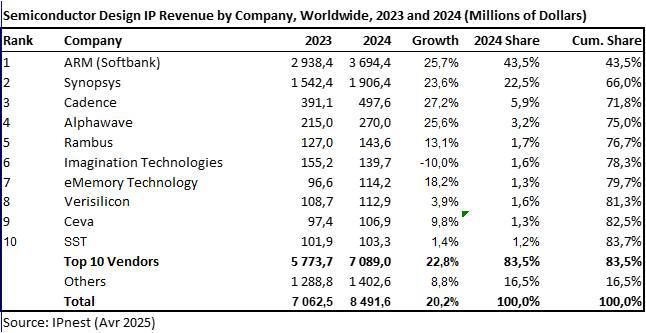
Core Insights - Xiaomi has launched its first 3nm SoC, the玄戒O1, utilizing semiconductor IP from Arm for CPU and GPU architecture, marking a significant development in the semiconductor industry [1][2] - The semiconductor IP industry is experiencing a shift, with the market concentration of the top four firms increasing from 72% to 75% in 2024, driven by varying growth rates among these companies [1][2] Industry Overview - The semiconductor IP sector, while relatively small, is crucial for unlocking a multi-billion dollar chip market, with a projected market size of $8.49 billion in 2024, reflecting a 20% year-over-year growth [2][3] - The top four semiconductor IP companies, Arm, Synopsys, Cadence, and Alphawave, are expected to maintain significant market shares, with Arm leading at 43.5% and Synopsys at 22.5% in 2024 [3][4] Company Performance - Arm's revenue is projected to grow from $2.94 billion in 2023 to $3.69 billion in 2024, a growth rate of 25.7%, while Synopsys and Cadence are expected to grow by 23.6% and 27.2%, respectively [3][4] - Synopsys is anticipated to surpass Arm in licensing revenue in 2024, with a market share of 32% compared to Arm's 30%, although Arm leads in royalty revenue with a 66.7% share [4][5] Market Trends - The demand for high-speed IP interfaces is surging due to the rise of AI applications, with the wired interface design IP segment expected to grow by 23.5% in 2024 [5][6] - Companies like Synopsys have pursued aggressive acquisition strategies, completing 74 acquisitions since 2016, which has significantly contributed to their growth [6][7] Competitive Landscape - Arm is exploring new opportunities in the PC and data center markets, while also increasing licensing fees and offering standardized solutions to enhance revenue [7][8] - The IP market is characterized by both consolidation and fragmentation, with companies seeking differentiated business models to capture growth [8][9] Future Outlook - The semiconductor IP market is projected to remain below $10 billion, with potential growth through the sale of chiplets or integrated circuits, which could push the market beyond $100 billion [12]

Synopsys (SNPS) Conference Transcript
2025-06-04 22:40
Synopsys (SNPS) Conference Summary Company Overview - **Company**: Synopsys (SNPS) - **Date of Conference**: June 04, 2025 Key Points Industry Context - The discussion revolves around the Electronic Design Automation (EDA) industry and its current challenges, particularly regarding regulatory restrictions impacting sales to China [4][10][14]. Recent Developments - Synopsys received a notification from the Bureau of Industry and Security (BIS) regarding regulatory restrictions on selling certain products to China, leading to a halt in shipments [9][10]. - The company had to pull its guidance due to the potential material impact of these restrictions on its business [10][11]. Financial Performance - In the most recent quarter, Synopsys experienced a **28% year-over-year decline** in revenue from China, a significant drop from a previous growth rate of **25%** [16][17]. - The company is currently assessing the impact of these restrictions on its overall revenue and operational expenditures [29]. Regulatory Environment - The regulatory restrictions are seen as atypical due to the lack of a comment period, which is usually provided to understand the intent and implications of such regulations [19][28]. - Synopsys is working with legal teams and government relations to clarify what products can still be sold and to ensure compliance with the new regulations [12][39]. Market Dynamics - The EDA industry is experiencing a shift as the market for AI and high-performance computing (HPC) chips in China has contracted due to these restrictions [21][22]. - Synopsys is pivoting towards automotive, IoT, and industrial markets, which are growing but do not match the revenue potential of the AI market [21][22]. AI Integration - Synopsys has been integrating AI into its products, with significant improvements in efficiency for junior and mid-level engineers, achieving up to **40% efficiency gains** [44][45]. - The company is developing a new product, AgenTic, which aims to automate design engineering workloads, although it is still a few years away from full deployment [46][48]. Customer Relationships - Synopsys maintains strong relationships with key customers, including Intel, despite leadership changes at Intel [55][56]. - The company is optimistic about the potential for increased spending from Intel as they focus on building leadership products [60]. Competitive Landscape - There is a notable difference in trading multiples between Synopsys and its competitor Cadence, attributed to historical profit margins and the ongoing acquisition of ANSYS [66][67]. - Synopsys aims to improve its operating margins, targeting mid-forties post-ANSYS acquisition, which would position it competitively within the industry [66][67]. Future Outlook - The company is cautiously optimistic about resolving regulatory issues and restoring its ability to sell in China, which was previously a significant growth market [26][54]. - Synopsys is focused on maintaining operational efficiency and exploring new revenue opportunities while navigating the current regulatory landscape [30][29]. Additional Insights - The conversation highlighted the importance of collaboration within the industry to address regulatory challenges, as companies like Synopsys and its peers work together to navigate these complexities [12][13]. - The potential for AI to transform the EDA industry is significant, but the company acknowledges the need for careful implementation due to the high stakes involved in design engineering [47][49].
美对华EDA出口限制,挑战与机遇并存
Haitong Securities International· 2025-06-04 09:46
Investment Rating - The report does not explicitly state an investment rating for the industry or specific companies involved in EDA [1]. Core Insights - The new U.S. export restrictions on EDA software and technology to China are more comprehensive than previous regulations, affecting a broader range of integrated circuit levels without specific nanonode restrictions [2][7]. - Cadence and Synopsys reported revenues of $570 million and $990 million from China in fiscal year 2024, representing 12% and 16% of their total revenues respectively, indicating a significant market share in China [2][7]. - The restrictions are expected to lead to a short-term revenue decline for Cadence and Synopsys in China, but long-term impacts may be mitigated by growth in other regions [2][7]. - The restrictions may accelerate the localization of EDA tools in China, as seen with Huawei's progress in developing domestic EDA alternatives [3][8]. Summary by Sections Export Restrictions - On May 29, 2025, Cadence and Synopsys received notification from the U.S. Department of Commerce regarding new export restrictions that require licenses for EDA software and technology exports to China, particularly involving military end users [2][6]. - The new policy is broader than previous restrictions, which were limited to advanced nanonodes, now encompassing all integrated circuit levels from wafers to packaging [2][7]. Market Impact - Cadence and Synopsys, along with Siemens EDA, hold over 70% of the EDA market share in China, indicating their significant presence [2][7]. - Synopsys has already suspended services and sales in China and is assessing the impact of the new restrictions on its business [2][7]. Localization Opportunities - The export restrictions are seen as a catalyst for accelerating the domestic development of EDA tools in China, with Huawei achieving significant milestones in EDA software development [3][8]. - The localization efforts have progressed to the point where Huawei has independently mass-produced a 7nm chip, indicating advancements in EDA capabilities [3][8].
EDA被禁,商务部回应!
国芯网· 2025-06-03 12:41
商务部新闻发言人认为,中方按照联合声明达成的共识,取消或停了针对美"对等关税"采取的相关关税 和非关税措施。而美方出台的多项对华歧视性限制政策严重违背了两国元首1月17日通话共识,严重破 坏日内瓦经贸会谈既有共识,严重损害中方正当权益。如果美方一意孤行,中方将继续坚决采取有力措 施,维护自身正当权益。 国芯网[原:中国半导体论坛] 振兴国产半导体产业! 不拘中国、 放眼世界 ! 关注 世界半导体论坛 ↓ ↓ ↓ 6月3日消息,近日全球前三大EDA厂商新思科技、Cadence、西门子集体暂停了对中国大陆半导体公司 的产品支持与升级服务。 6月2日,中国商务部新闻发言人就中美日内瓦经贸会相关问题答记者问。其中提到,中方注意到美国近 期出台多项对华歧视性限制措施,包括发布AI芯片出口管制指南、停止对华EDA的销售、宣布撤销中 国留学生签证。 加群步骤: 第一步:扫描下方二维码,关注国芯网微信公众号。 第二步:在公众号里面回复"加群",按照提示操作即可。 5月29日,新思科技、Cadence各自在官网上披露公告,称近期收到美国政府针对EDA软件工具的对华出 口限制函。 据Cadence公告介绍,公司于5月23日收到美 ...
美国全面断供EDA,谁影响最大?谁却没影响?
是说芯语· 2025-06-02 09:19
其实,老美拿着EDA搞事情,已经很多年了,之前是点对点,针对特定的国内单位和公司。 比如说,2018年, 美国 禁止 中兴 使用EDA工具。再比如, 2019年,华为海思 被列入实 体清单后,被迫切断与美国EDA公司的合作。这次就明确了针对全部中国客户。 以下文章来源于龙科多 ,作者龙科多 龙科多 . 深度科技观察,聚焦半导体、操作系统等底层技术。内容全平台发布。 今天聊聊最新的美国EDA禁令。龙科多认为,美国此举基本无法起到多少制裁作用, 利好国 产EDA发展 。但这个事,还是值得具体说道说道。 最近,《纽约时报》 等多个外媒称,美国商务部已向包括Cadence、新思科技和西门子等全 球领先的EDA公司发出通知,要求停止向中国供应EDA技术。 Cadence、新思科技 都是美国公司,西门子是德国公司。消息一出,国内还是非常关注。有 一些人士认为不大可能,认为报道不准确。 不过,外媒陆续报道 ,上述三家EDA公司都对外发布公告,表示收到了美方的通知。这下, 基本做实了。 EAD工具,主要是用于 半导体制造测试的设计和验证,以及监控性能和质量。 如果再细分, 包括 模拟IC设计与验证、数字IC设计与验证,晶圆制 ...

EDA被禁,商务部强硬回应
半导体行业观察· 2025-06-02 02:28
Core Viewpoint - The article discusses the ongoing tensions between the U.S. and China regarding trade agreements, specifically highlighting China's firm stance against U.S. accusations of violating the Geneva Economic and Trade Talks consensus [1][2]. Group 1: U.S.-China Trade Relations - The Chinese Ministry of Commerce firmly rejected U.S. claims of violations, asserting that China has adhered to the consensus reached in the joint statement following the Geneva talks [1]. - Following the Geneva talks, the U.S. has implemented several discriminatory measures against China, including AI chip export controls and restrictions on sales of chip design software [1][2]. - The article emphasizes the importance of the joint statement as a significant achievement based on mutual respect and equal negotiation, urging the U.S. to correct its erroneous actions [2]. Group 2: Impact on Semiconductor Companies - Major EDA companies like Synopsys, Cadence, and Siemens EDA have received notifications regarding new U.S. export restrictions, prompting Synopsys to suspend its financial forecasts for the upcoming fiscal year [2][3]. - Cadence described the new regulations as "very complex" and is currently seeking clarification while assessing the impact on its business [3]. - Siemens EDA is also collaborating with global clients to mitigate the effects of the new restrictions [3].