TRIP.COM(TCOM)

Search documents
Trip.com Shares Fall 3% To 17-Month Low As China Probe Continues
Forbes· 2026-02-26 13:15
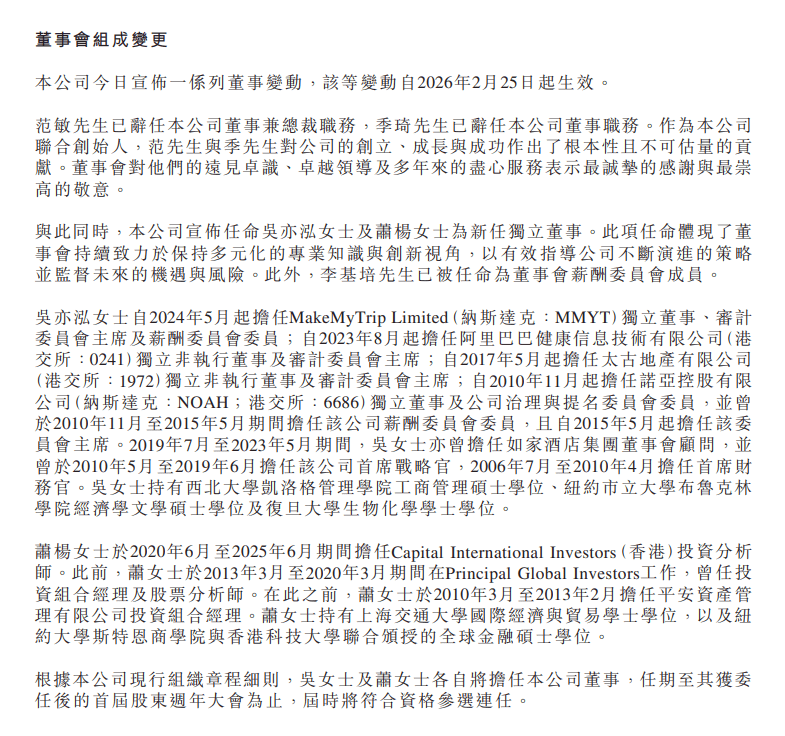
Core Viewpoint - Trip.com Group's shares fell 3% to a 17-month low amid an ongoing government anti-monopoly investigation, despite reporting significant profit increases for the fourth quarter and full year of 2025 [2][3]. Financial Performance - Trip's net profit nearly doubled to 4.3 billion yuan (approximately $614 million) in Q4 2025, with revenue increasing by 21% to 15.4 billion yuan (around $2.2 billion) [4]. - The full-year profit also nearly doubled to $4.8 billion [4]. Market Context - The travel market showed strong resilience in 2025, with inbound travel being a key growth driver for economic development and job creation [5]. - Trip.com Group maintains a market capitalization of over $30 billion, making it one of the most valuable travel companies globally, larger than Expedia but smaller than Booking and Airbnb [6]. Corporate Governance Changes - Two co-founders, Min Fan and Qi Ji, resigned from their positions on the board, with Fan also stepping down as president [7]. - The company appointed two new independent directors, May Yihong Wu and Iris Yang Xiao, to enhance board diversity and expertise [8]. Leadership Insights - CEO Jane Sun emphasized the importance of inbound travel for economic growth [5]. - Chairman James Liang expressed optimism about AI adoption and its role in sustainable long-term development [5].



美股前瞻 | 三大股指期货齐涨,美伊核谈之际市场情绪整体谨慎
智通财经网· 2026-02-26 13:07
Market Overview - US stock index futures are all up, with Dow futures rising by 0.12%, S&P 500 futures by 0.08%, and Nasdaq futures by 0.02% [1] - European indices also show positive movement, with Germany's DAX up 0.46%, UK's FTSE 100 up 0.19%, France's CAC40 up 0.92%, and the Euro Stoxx 50 up 0.37% [2][3] Oil Market - WTI crude oil has decreased by 1.90%, trading at $64.18 per barrel, while Brent crude oil has fallen by 1.36%, trading at $69.73 per barrel [3][4] Corporate Earnings and Performance - Nvidia (NVDA.US) reported a record revenue of $68.1 billion for Q4, a 73% year-over-year increase, and provided optimistic guidance for Q1 2027 with expected revenue of $78 billion, surpassing analyst expectations [8] - Baidu (BIDU.US) reported Q4 revenue of RMB 32.7 billion ($4.68 billion), a 5% quarter-over-quarter increase, driven by growth in its core AI business [9] - iQIYI (IQ.US) achieved Q4 revenue of RMB 6.79 billion, with both year-over-year and quarter-over-quarter growth, marking its fourth consecutive year of operational profitability [10] - Salesforce (CRM.US) exceeded earnings expectations but faced stock price decline due to a lukewarm sales outlook, projecting revenue of approximately $46 billion for the fiscal year ending January 2027 [10] - Snowflake (SNOW.US) provided a revenue forecast of $5.66 billion for the fiscal year ending January 2027, exceeding analyst expectations, but concerns remain about traditional software companies maintaining growth in the AI era [11] - C3.ai (AI.US) reported a 46% year-over-year revenue decline for Q3, with a forecast for Q4 revenue significantly below market expectations, leading to plans for a workforce reduction of nearly 25% [12] - Trip.com Group (TCOM.US) reported a net profit of RMB 33.29 billion for 2025, a 95.08% year-over-year increase, with total revenue of RMB 62.4 billion [13] - Stellantis (STLA.US) faced significant losses due to a reduction in its electric vehicle transition plan, reporting an adjusted operating loss of €1.38 billion ($1.6 billion) for the last six months of the year [14] Regulatory and Compliance Issues - Microsoft (MSFT.US) is cooperating with Japanese antitrust regulators regarding an investigation into potential anti-competitive practices related to its Azure cloud services [15]




美股盘前要点 | 英伟达季绩及指引双双超预期!特斯拉中国“变相降价”促销
Ge Long Hui· 2026-02-26 12:37
Group 1 - US stock index futures showed slight increases, with Nasdaq futures up 0.04%, S&P 500 futures up 0.1%, and Dow futures up 0.11% [1] - Major European indices rose, with Germany's DAX up 0.51%, UK's FTSE 100 up 0.12%, France's CAC up 0.95%, and the Euro Stoxx 50 up 0.42% [1] Group 2 - Nvidia reported a record Q4 revenue growth of 73% year-over-year, reaching $68.1 billion, with strong guidance for Q1 and expectations for chip revenue to exceed $500 billion [1] - Nvidia's CFO stated the company has been approved to export a small quantity of H200 chips to China, but has not yet generated any revenue from this [1] Group 3 - Apple has finalized orders for LPDDR5X chips from Samsung's DS division for the iPhone 17 series, with prices increasing by 100% [2] - Alphabet has restructured its robotics software subsidiary Intrinsic back under Google, enhancing its focus on physical AI [1] Group 4 - Tesla has introduced a five-year zero-interest financing plan in China, effectively lowering vehicle prices [2] - Eli Lilly's Orforglipron has shown superior results in blood sugar control and weight loss compared to semaglutide in Type 2 diabetes trials [2] - AMD and Nutanix are collaborating to develop an open full-stack AI infrastructure platform [2] - SK Hynix and SanDisk have initiated a global standardization process for high-frequency flash memory [2] Group 5 - Toyota reported a 4.7% year-over-year increase in global vehicle sales for January, totaling 822,577 units [2] - JD.com has launched a "100 Billion Supermarket" channel, planning to invest over 20 billion in product subsidies over the next three years [2] - Stellantis reported a 2% decline in revenue year-over-year to €153.5 billion, with a loss of €22.3 billion attributed to electric vehicle business write-downs [2] - Salesforce's Q4 revenue grew 12% year-over-year to $11.2 billion, but organic subscription revenue guidance for the new fiscal year fell short of expectations [2] - Zoom Communications reported mixed Q4 results, with Q1 adjusted profit guidance below expectations [2] - Synopsys reported a 65% year-over-year revenue increase in Q1, reaching $2.41 billion, but lowered its profit guidance for the current fiscal year [2] - Paramount's Q4 revenue of $8.15 billion exceeded expectations, but the loss per share widened to $0.52 [2] - Baidu's Q4 revenue grew 5% quarter-over-quarter to ¥32.74 billion, with AI computing subscription revenue soaring 143% year-over-year [2] - Trip.com reported a 21% year-over-year revenue increase in Q4, reaching ¥15.4 billion, with non-GAAP profit of ¥3.48 billion, both exceeding expectations [2]




季琦 今天捐了1亿元!其实 也将捐出4.5亿元股票
Mei Ri Jing Ji Xin Wen· 2026-02-26 12:32
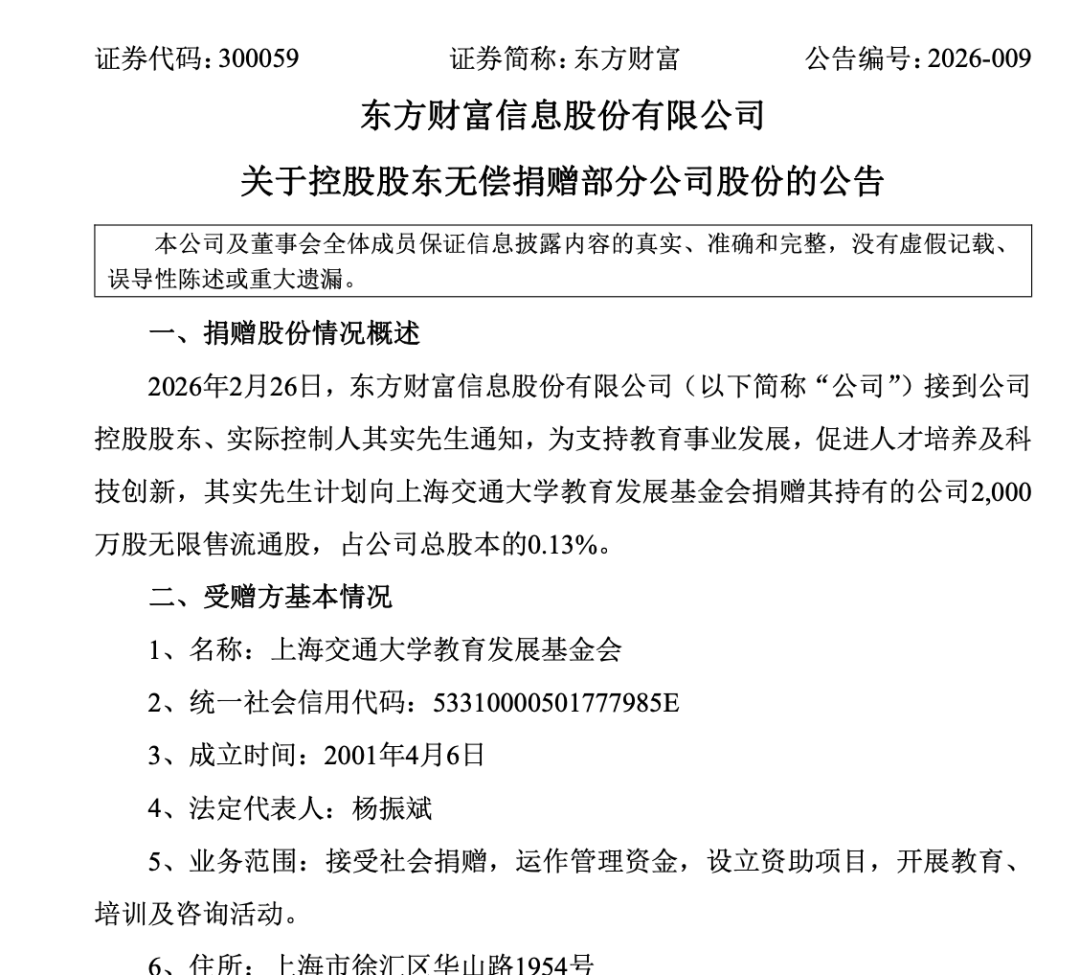
Group 1 - Dongfang Caifu announced a donation of 20 million shares, representing 0.13% of its total share capital, to Shanghai Jiao Tong University Education Development Foundation to support education and innovation [1] - The estimated value of the donated shares is approximately 450 million yuan, based on the closing price of 22.50 yuan per share [1] - As of the end of Q3 2025, the actual controller of Dongfang Caifu holds 3.062 billion shares, accounting for 19.38% of the company's total shares [1] Group 2 - Qi Ji, founder of Huazhu Group and an alumnus of Shanghai Jiao Tong University, donated 100 million yuan to support the university's development on its 130th anniversary [5] - The donation was acknowledged by university officials, highlighting Qi Ji's contributions to the university and his commitment to its growth [7] - Qi Ji emphasized the importance of humanistic education during his time at the university and expressed a desire to bring world-class experts to the campus for students [9]

深度观察 | 穿透财报:10亿“硬支出”与被误读的OTA估值重构——剥离“流量收租”标签,重估携程的履约壁垒与产业基建
凤凰网财经· 2026-02-26 11:54
Core Viewpoint - The online travel market in China is undergoing a fundamental shift from a focus on "traffic distribution" to "service delivery" due to the saturation of domestic tourism and the influx of foreign tourists driven by visa-free policies [1] Group 1: Traffic Ineffectiveness and External Demand - The traditional valuation model for OTA platforms is based on traffic as a revenue channel, but this model is facing significant challenges as domestic travel growth approaches a ceiling [2] - During the 2026 Spring Festival, the number of inbound travelers reached 17.8 million, with a daily average increase of 10.1% compared to the previous year [2] - Ctrip reported a 21.29% year-on-year increase in daily orders for inbound flights, particularly from Canada and the UK, which saw increases of 75% and 37% respectively [2][4] Group 2: Supply-Side Reform - The domestic tourism market has entered a phase of stock competition, with a shift towards deeper cultural experiences as evidenced by a 17.4-word average search query length during the 2026 Spring Festival [7] - Ctrip is investing over 10 billion yuan to enhance service capabilities for inbound tourism, focusing on technology, service, and promotion rather than traditional marketing [6] - The company has developed an AI translation engine that produces 6 billion words annually, supporting 16 languages and enabling 95% of ticket types for foreign tourists [6] Group 3: Product and Employment Transformation - Ctrip is reforming low-quality group tours by promoting smaller, customized travel options, resulting in a 20% increase in independent travel products and an 80% increase in per capita spending [8][9] - The number of small travel agencies capable of handling independent travel has reached 3,500, creating over 20,000 new guide positions, particularly in lower-tier cities [9] - Ctrip's "active package" product allows users to easily add nearby attractions to hotel bookings, significantly reducing planning barriers and generating over 30 billion yuan in incremental consumption [9] Group 4: Global Benchmarking and Profitability - Ctrip's gross margin has been scrutinized, with comparisons to global peers revealing that its commission rate of 5%-6% is significantly lower than that of competitors like Booking and Expedia [10][11] - The company has invested 2.9 billion yuan in service guarantees, maintaining a large customer service team to provide multilingual support, which adds to the complexity of its commission structure [11] Group 5: Future Growth Engines - Ctrip is targeting the corporate travel market, having served over 28,000 Chinese enterprises in 2025, indicating a move towards more stable and high-margin business segments [13] - The company plans to enhance inbound tourism in lower-tier cities, aiming to balance foreign consumption resources across a broader domestic landscape [15] Conclusion - As the online travel market transitions from a focus on traffic to service delivery, Ctrip's heavy investment in infrastructure and service capabilities positions it uniquely for long-term growth in a saturated market [16][17]
季琦,捐赠1亿元
Xin Lang Cai Jing· 2026-02-26 11:30
Group 1 - The core event is the donation of 100 million RMB by Ji Qi, founder of Huazhu Group, to Shanghai Jiao Tong University to support various development initiatives as part of the university's 130th anniversary celebrations [1][3] - Ji Qi is recognized as a benchmark figure in China's entrepreneurial landscape, having founded three publicly listed companies: Ctrip, Home Inn, and Huazhu [3] - Ji Qi's educational background includes studying at Shanghai Jiao Tong University, where he was involved in various activities and shared his entrepreneurial experiences with students [3] Group 2 - The donation ceremony included the appointment of Ji Qi as a school trustee, with the university's leadership, including Party Secretary Yang Zhenbin and President Ding Kuiling, participating in the event [1] - Ji Qi's contributions to the hotel industry are characterized by his innovative approach, aiming to redefine the sector with a mission focused on enhancing customer experience and satisfaction [3] - Throughout his career, Ji Qi has actively engaged with his alma mater, participating in events aimed at inspiring students and promoting the tourism and cultural industry [3]

总裁突然辞职!去年曾套现7亿多
Nan Fang Du Shi Bao· 2026-02-26 10:19
Core Viewpoint - Ctrip Group reported a significant increase in net revenue and net profit for the year 2025, driven by strong investment gains and robust travel demand, while also announcing key management changes [1][2]. Financial Performance - In 2025, Ctrip's total net revenue reached 62.4 billion RMB, a year-on-year increase of 17%, with a net profit attributable to shareholders of 33.29 billion RMB, up 95% from the previous year, largely due to investment gains of 19.9 billion RMB [1]. - For Q4 2025, Ctrip's net revenue was 15.4 billion RMB, a 21% increase year-on-year but a 16% decrease quarter-on-quarter, attributed to seasonal factors [2]. - The core OTA business transaction volume for 2025 was 1.1 trillion RMB, with air ticket sales contributing 50% and accommodation bookings 25% [2]. Management Changes - Ctrip announced the resignation of co-founders Fan Min and Ji Qi from their respective positions, with new independent directors Wu Yihong and Xiao Yang appointed to the board [1]. Market Insights - Ctrip's international OTA platform bookings grew by approximately 60% in 2025, contributing 40% to total revenue, an increase from 35% the previous year [2]. - The company served around 20 million inbound travelers in 2025, with a growth rate close to 100% year-on-year [2]. Strategic Initiatives - Ctrip plans to invest over 1 billion RMB in promoting inbound tourism, focusing on platform enhancements and partnerships to boost China's tourism appeal [3]. - The company aims to double the number of inbound tourists by 2026, highlighting the importance of inbound tourism for local community development [3]. AI and Technology Integration - Ctrip's long-term strategy includes the integration of artificial intelligence and vertical models tailored for the travel industry, enhancing operational efficiency and user experience [4]. - The company emphasizes the importance of human support in travel services, arguing that while AI can assist in planning, the complexity of travel requires a robust support system that AI alone cannot provide [5].
60亿词翻译+5万岗位:技术向下如何支撑体验向上?
新浪财经· 2026-02-26 10:00
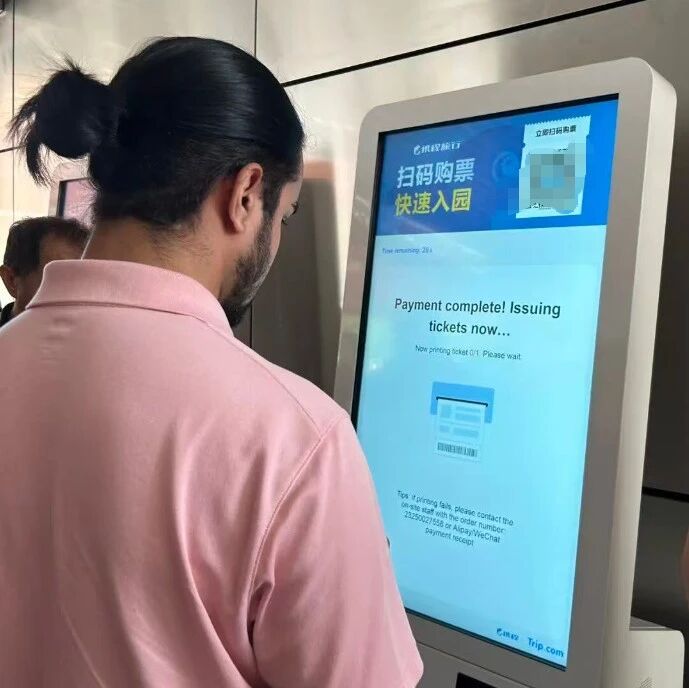
Core Viewpoint - The inbound tourism market in China is expected to see significant recovery by 2025, driven by the expansion of visa-free policies and the restoration of international flights, although structural supply-side shortcomings have been exposed [2] Group 1: Supply-Side Challenges and Responses - The reliance of domestic hotels, scenic spots, and travel agencies on the domestic market has led to systemic deficiencies in multilingual services, foreign currency settlement, and foreign ticketing [2] - Companies are attempting to address these shortcomings through various strategies, including payment system upgrades, increased overseas marketing, and investments in digital infrastructure [2] - Ctrip has localized travel products in 16 languages for 8,000 merchants and installed smart ticketing terminals supporting 16 languages at 241 scenic spots, indicating a focus on enhancing the inbound tourism supply chain [2][7] Group 2: Technological Innovations - Ctrip's self-developed AI translation model "Smart Translation Future" is expected to produce 6 billion words of translation annually, covering 25 languages and tailored to specific tourism scenarios [4] - The deployment of smart ticketing terminals at 241 scenic spots allows foreign tourists to purchase tickets independently, reducing communication costs [7] - Ctrip's platform now offers 63,000 ticket types for foreign tourists, covering 95% of ticket categories for major domestic attractions, facilitating a seamless booking process [7] Group 3: Market Growth and Employment Impact - In the first three quarters of 2025, Ctrip's inbound hotel orders increased by over 100%, and the "First Go China" flight initiative attracted 54,000 new customers [7] - The shift from group tours to customized and private tours has led to a 20% growth in private tour business and an 80% increase in per capita spending [11] - The transformation has created over 50,000 new jobs, with a significant portion in travel agency operations and tour guide positions in lower-tier cities [11][13] Group 4: Financial Insights and Business Model - Ctrip's investment of over 1 billion RMB in inbound tourism has resulted in the reception of 20 million inbound tourists and the acquisition of international orders for 70,000 merchants [16] - The company's core OTA business generated approximately 1.1 trillion RMB in transaction volume, with a net income of 62.4 billion RMB, reflecting a low profit margin compared to international peers [16][17] - The high fixed costs associated with multilingual customer service and operational complexities contribute to the lower profit margins, contrasting with the asset-light models of competitors [17] Group 5: Industry Transformation and Future Outlook - The shift from being a channel provider to a service provider is essential for the transformation of China's tourism service industry, emphasizing service standards and cultural adaptability [19] - The recovery of inbound tourism is evident, with a 52.1% increase in visa-free foreign visitors and a 97.5% rise in tax refund sales from January to August 2025 [19] - The combination of policy incentives and market capability building is crucial for the long-term development of inbound tourism in China [19]

60亿词翻译+5万岗位:技术向下如何支撑体验向上?
Xin Lang Cai Jing· 2026-02-26 09:52
Core Viewpoint - The inbound tourism market in China is expected to see significant recovery by 2025, driven by the expansion of visa-free policies and the restoration of international flight routes, although structural supply-side shortcomings have been exposed [1][15]. Group 1: Supply-Side Digital Transformation - Multiple companies are addressing the supply-side shortcomings in the inbound tourism market through various strategies, including payment system upgrades and enhanced overseas marketing [1][15]. - Ctrip has focused on supply-side digital infrastructure, localizing travel products in 16 languages for 8,000 merchants and deploying smart ticketing terminals in 241 scenic spots [1][15]. - Ctrip's AI translation engine, "Smart Translation Future," is expected to produce 6 billion words of translation annually, covering 25 languages and addressing long-standing language barriers in the tourism sector [2][16]. Group 2: Employment Generation - Ctrip's transformation of group tours into smaller, customized travel experiences has led to the creation of over 50,000 new jobs, with private tour business growing by over 20% in 2025 [7][21]. - The shift towards personalized travel experiences has resulted in an 80% increase in per capita spending, driven by both recovering international tourists and domestic travelers seeking unique experiences [7][21]. - The distribution of new jobs is changing, with over half of the new positions located in lower-tier cities, indicating a shift of resources towards regional service providers [9][23]. Group 3: Role Transition from Channel Providers to Service Providers - Ctrip has invested over 1 billion RMB in inbound tourism, facilitating the reception of 20 million inbound tourists and helping 70,000 merchants receive international orders [11][25]. - The company's financial data reveals a lower profit margin compared to international peers, attributed to high fixed costs associated with multilingual customer service and operational complexities [11][25]. - The transition from a channel-dependent model to a service-oriented approach is essential for the tourism industry, emphasizing the need for reliable service standards and cultural adaptability [14][28].
携程突发!总裁、董事双双辞职!
Sou Hu Cai Jing· 2026-02-26 08:55
Core Viewpoint - Ctrip Group reported a 17% year-on-year increase in net revenue for 2025, reaching approximately 624 billion RMB, alongside significant changes in its board of directors [1][4]. Financial Performance - In Q4 2025, Ctrip's net revenue was 154 billion RMB, a 21% increase year-on-year, driven by resilient travel demand, with a net profit of 43 billion RMB. However, there was a 16% quarter-on-quarter decline due to seasonal factors [3][4]. - For the full year 2025, Ctrip's net revenue was approximately 624.09 billion RMB, reflecting a year-on-year growth of about 17.1%. The net profit attributable to shareholders was around 332.94 billion RMB, marking a 95% increase year-on-year [4]. Revenue Breakdown - Q4 2025 revenue from accommodation bookings was approximately 63 billion RMB, up 21% year-on-year, while full-year accommodation revenue was about 261 billion RMB, also up 21% [4]. - Q4 2025 revenue from transportation ticketing was around 54 billion RMB, a 12% increase year-on-year, with full-year revenue at approximately 225 billion RMB, up 11% [4]. - Q4 2025 revenue from vacation services was about 11 billion RMB, a 21% increase year-on-year, and full-year revenue was approximately 47 billion RMB, reflecting an 8% increase [4]. - Q4 2025 revenue from business travel management was around 8.8 billion RMB, a 15% increase year-on-year, with full-year revenue at approximately 28 billion RMB, up 13% [4]. Strategic Focus - Ctrip's CEO disclosed that the core OTA business transaction volume for 2025 was about 1.1 trillion RMB, with accommodation and flight ticketing contributing approximately 280 billion RMB and 550 billion RMB, respectively [5]. - The international segments of Ctrip showed robust growth, with the international OTA platform's total bookings increasing by about 60%. The company served around 20 million inbound travelers throughout the year [6]. - Ctrip's board chairman emphasized the importance of inbound tourism as a significant growth engine and indicated future investments in this area, as well as in social responsibility and AI innovation [6]. Board Changes - Ctrip announced the resignation of Fan Min as the company's president and director, and Qi Ji as a director, effective February 25, 2026. New independent directors Wu Yihong and Xiao Yang were appointed [7][8].