
UBS(UBS)

Search documents
瑞银:30%亚太区家族办公室计划未来五年增加对大中华区投资
智通财经网· 2025-05-21 11:13
Group 1 - The core finding of the UBS report indicates that over half of family offices in the Asia-Pacific region plan to increase investments in the region (excluding Greater China) over the next five years, with 30% planning to increase investments in Greater China [1] - In the next 12 months, 22% of family offices in the Asia-Pacific region intend to increase allocations to India and Taiwan, while 39% plan to increase allocations to China [1] - The preferred asset classes for family offices in the Asia-Pacific region are developed market equities and bonds, with an average allocation of 24% to developed market equities and 20% to bonds expected in 2024 [1] Group 2 - Nearly 60% of family offices in the Asia-Pacific region prioritize succession planning, with almost half (49%) planning to involve the next generation in management or executive roles, significantly higher than the global average of 31% [1] - When asked about threats to financial goals in the next 12 months, 70% of family offices highlighted trade wars, while 52% expressed concerns about significant geopolitical conflicts and higher inflation [2] - Looking ahead five years, 61% of respondents are worried about major geopolitical conflicts, and 53% are concerned about potential severe trade disputes leading to a global economic recession [2] Group 3 - Despite concerns, 59% of family offices plan to maintain the same level of portfolio risk in 2025 as in 2024, remaining committed to their investment objectives [2] - 40% of respondents believe that relying more on fund managers and/or active management is an effective way to enhance portfolio diversification, followed by 31% who prefer hedge funds [2] - UBS's report emphasizes that family offices are focusing on wealth protection for the next generation, aiming for long-term and stable investment strategies amid market volatility and recession fears [3]

瑞银:看好中国股票市场 外资回流料是未来几个季度的重要逻辑
news flash· 2025-05-21 10:33
Group 1 - The core viewpoint is that the Chinese stock market is expected to perform well, with foreign capital inflow being a significant trading logic in the coming quarters, and Hong Kong stocks are slightly favored over A-shares [1] - Recent IPO performance in Hong Kong reflects overseas investors' recognition and interest in China's core assets, indicating that more long-term capital is likely to flow back into the Chinese stock market [1]
UBS Group AG Rides on Strategic Expansions Amid Rising Expenses
ZACKS· 2025-05-20 17:46
Core Viewpoint - UBS Group AG is experiencing steady net interest income growth and is pursuing an expansion strategy, but faces legal issues and rising expenses that are concerning [1]. Group 1: Growth Drivers - UBS has expanded its geographical footprint through strategic partnerships and acquisitions, including the acquisition of Credit Suisse in June 2023, enhancing its capabilities in wealth and asset management [2]. - In April 2025, UBS formed a strategic partnership with 360 ONE WAM Ltd, acquiring a 4.95% share and selling its onshore Indian wealth business to 360 ONE, while continuing to serve clients in Singapore [3]. - UBS is making significant progress in integrating Credit Suisse, aiming for $13 billion in gross cost reductions by the end of 2026, having already merged 95 branches in Switzerland and migrated over 90% of client accounts outside Switzerland to UBS platforms [4]. Group 2: Financial Position - As of March 31, 2025, UBS maintains a strong capital position with a CET1 capital ratio of 14.3% and a CET1 leverage ratio of 4.4%, both exceeding management guidance [5]. - The company's net interest income (NII) has shown a 4.9% CAGR over the past four years, although it fell in Q1 2025 due to lower loan margins and deposit spreads, with expectations for improvement driven by repricing strategies and loan demand [6]. Group 3: Challenges - UBS faces significant legal challenges, including class action lawsuits from former Credit Suisse shareholders and a recent settlement of $511 million related to a U.S. Department of Justice tax probe, which will impact profitability [7]. - The company's expense base has been rising, with a CAGR of 14.3% over the past four years, driven by personnel, administrative expenses, and integration costs, which may affect near-term profitability [8]. Group 4: Market Performance - Over the past six months, UBS shares have gained 2.4%, underperforming the industry growth of 23.7% [10].


瑞银全球金融市场部中国主管:公司北向日均交易量较2017年提升12倍
news flash· 2025-05-19 08:02
Core Insights - UBS has significantly increased its average daily trading volume through the northbound trading channel of the Shanghai-Hong Kong Stock Connect, achieving a 12-fold increase compared to 2017 [1] Group 1: Company Performance - UBS has maintained a leading market share as a key broker participating in A-shares through QFII and the northbound trading channel [1] - The company has focused on enhancing trading capabilities and service quality to achieve this growth [1] Group 2: Future Strategy - UBS plans to continue leveraging opportunities from China's financial dual opening, aiming to serve both short-term and long-term investors [1] - The company intends to prioritize services for long-term investment-oriented clients while also expanding its business in derivatives and ETFs [1]
全球经济:深度探讨 —— 利用人工智能衡量各国央行言论
2025-05-18 14:09
Summary of Key Points from the Conference Call Industry or Company Involved - The conference call focuses on central banks, specifically the Federal Reserve (Fed), European Central Bank (ECB), and Bank of Japan (BoJ) [2][4][6]. Core Insights and Arguments 1. **Divergence in Central Bank Sentiment** - The ECB's tone is softening, returning to 2018 levels, primarily driven by President Lagarde, while the Fed remains in a net hawkish territory, with a recent uptick in hawkish sentiment due to renewed inflation concerns [4][5]. - The BoJ has shifted to a hawkish stance, reaching levels last seen in 2008 [6]. 2. **Impact of Tone on Market Repricing** - Tone shifts from central banks are leading indicators of policy rate changes and market repricing, particularly during tightening cycles [7]. 3. **Evolution of Central Bank Communication** - Central bank communication has transformed from opaque to a strategic tool for policy execution, incorporating various channels such as press conferences, speeches, and social media [12][13]. 4. **Challenges in Measuring Tone** - Traditional methods of measuring tone often miss nuances; a new AI-based approach isolates policy-relevant remarks and scores them on a hawkish/dovish scale [15][16]. 5. **Asymmetry in Sentiment Adjustments** - Hawkish sentiment builds slowly, while dovish shifts tend to be abrupt, often triggered by shocks [28]. 6. **Institutional Differences in Communication** - The Fed leads in signaling changes, while the ECB tends to lag but reacts sharply. The BoJ has historically maintained a dovish stance [29]. 7. **Predictive Power of Sentiment Index** - The sentiment index for the Fed has shown strong predictive power, leading policy rate changes by approximately 7 months post-COVID [81]. 8. **Current Focus Areas for the Fed** - The Fed is primarily concerned with inflation, employment, and interest rate guidance, with inflation being the dominant driver of sentiment in recent cycles [55][58]. Other Important but Possibly Overlooked Content 1. **Speaker Contributions** - Individual contributions from Fed members show that Governor Bowman has been the most consistently hawkish voice, while others have shifted towards a more neutral or dovish tone [64][65]. 2. **Narrative Shifts in Communication** - The narrative around central bank communication has evolved, with recent themes focusing on "progress" and "dual-mandate" language, while previous themes like "crypto risks" have diminished [120]. 3. **Market Reaction to Tone Changes** - Large sentiment shifts, whether dovish or hawkish, have been shown to lead to significant changes in yields over time, indicating that market reactions are not immediate [104]. 4. **Lagging Response to Economic Data** - The Fed's sentiment regarding inflation has become more reactive but still lags behind actual inflation data by about 6-7 months [103]. 5. **Communication as a Policy Tool** - The Fed has significantly advanced in using communication as a policy tool, with a structured messaging system that has evolved over the years [44][48]. This summary encapsulates the key points discussed in the conference call, highlighting the dynamics of central bank communication and its implications for market behavior and policy direction.
报道:瑞银考虑补偿部分客户外汇衍生品遭受的损失
news flash· 2025-05-16 18:28
Core Viewpoint - UBS Group is negotiating compensation for clients who suffered losses from complex foreign exchange derivatives sold by the bank, exacerbated by U.S. President Trump's tariff actions that caused significant market volatility [1] Group 1: Client Impact - Hundreds of clients are affected, with some experiencing substantial losses, including clients from Switzerland [1] - Overall losses are estimated to reach hundreds of millions of Swiss francs [1] Group 2: UBS's Response - UBS stated that the majority of its clients hold diversified investment portfolios, which have performed relatively well during the current turbulent period [1] - The bank is working with clients to analyze potential unexpected impacts [1]
5月17日电,瑞银集团正就向遭受外汇衍生品亏损的客户进行退款事宜进行洽谈,据悉客户损失已达数亿瑞士法郎,目前该集团正在“分析潜在的意外影响”。
news flash· 2025-05-16 17:40
Group 1 - UBS Group is negotiating refunds for clients who suffered losses from foreign exchange derivatives, with reported losses amounting to hundreds of millions of Swiss francs [1] - The group is currently "analyzing potential unexpected impacts" related to these losses [1]
瑞银胡凌寒答21:投资者基础及融资便利性是A股公司赴港上市主因
2 1 Shi Ji Jing Ji Bao Dao· 2025-05-16 12:53
Group 1 - The core viewpoint is that Chinese companies are increasingly issuing overseas, with significant IPOs and large-scale placements in the Hong Kong market, indicating a recovery in the market [2][3] - UBS highlights that the successful placements of major projects like BYD and Xiaomi demonstrate the Hong Kong stock market's capability to support top-tier corporate financing and reflect the strong fundamentals of these companies [2] - The trend of A-share companies choosing to list in Hong Kong is driven by the institutional investor base and financing convenience offered by the Hong Kong market [3] Group 2 - UBS reports a downward trend in the AH premium index, which decreased from around 150 in early 2024 to 134.9 by May 25, 2025, indicating a shift in trading preferences towards H-shares among domestic investors [3] - The Hong Kong stock market remains attractive due to its low valuations and the need for international funds to diversify their investments, supported by its depth and liquidity [4] - There is an expectation of a continued trend of Chinese companies returning to the Hong Kong market for secondary listings, particularly among those that have been exclusively listed in the U.S. [3]



瑞银Q1持仓:科技巨头中偏爱英伟达(NVDA.US)与亚马逊(AMZN.US),同时增持标普500ETF与看跌期权
智通财经网· 2025-05-16 12:07
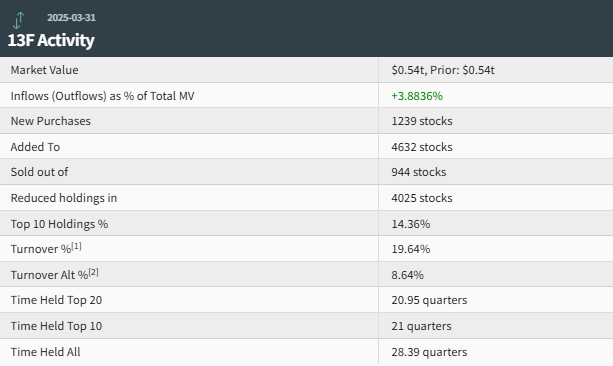
Core Insights - UBS reported a total market value of $540 billion in its Q1 2025 holdings, remaining stable compared to the previous quarter [1][2] - The firm added 1,239 new stocks to its portfolio, increased holdings in 4,632 stocks, reduced holdings in 4,025 stocks, and completely sold out of 944 stocks [1][2] - The top ten holdings accounted for 14.36% of the total market value [1][2] Holdings Summary - The top five holdings include Apple (AAPL) with approximately 60.7 million shares valued at $13.49 billion (2.48% of the portfolio), Microsoft (MSFT) with about 32.9 million shares valued at $12.35 billion (2.27%), Nvidia (NVDA) with around 101.4 million shares valued at $10.99 billion (2.02%), Amazon (AMZN) with approximately 37.6 million shares valued at $7.15 billion (1.31%), and SPDR S&P 500 ETF (SPY) with about 12.8 million shares valued at $7.14 billion (1.31%) [3][4] - Notably, SPY saw a significant increase in holdings by 27.95% compared to the previous quarter [3][4] Trading Activity - The turnover rate for the portfolio was 19.64%, with an alternative turnover rate of 8.64% [2] - The average holding period for the top 20 stocks was approximately 20.95 quarters, while the top 10 stocks had an average holding period of 21 quarters [2] Buying and Selling Trends - The top five purchases included SPDR S&P 500 ETF put options, iShares iBoxx High Yield Corporate Bond ETF put options, SPDR S&P 500 ETF, SPDR Gold Shares ETF, and Berkshire Hathaway [4][6] - The top five sales included Microsoft, Apple, Google, Tesla, and iShares iBoxx Investment Grade Corporate Bond ETF call options [5][6]



瑞银高管:美元波动提升了黄金吸引力
news flash· 2025-05-16 05:13
瑞银集团称,近期金融市场震荡增强了黄金的吸引力,全球资金希望将钱从美国转移出去或对冲其在美 国的风险敞口。"美国风险资产和美元波动将导致更多国际投资者考虑对冲更多美元敞口,并在全球范 围内实现资产配置多元化,"瑞银财富管理部门的首席投资官Mark Haefele本周表示。"黄金仍然是重要 的多元化投资工具。"Haefele表示,投资者需要进行多元化投资及对冲操作,"以增强资产价值的确定 性,尤其是在有非美元债务到期的情况下。这些趋势并不需要美国例外论发生巨变才能显现出来。" ...