
UBS(UBS)

Search documents
X @Bloomberg
Bloomberg· 2025-10-03 06:45
About 65% of Swiss fear the consequences if UBS were to relocate its headquarters to another country, according to a new poll https://t.co/tTjtsEmgEs ...

Global Financial Shifts: Dollar Dynamics, Banking Capital, and Geopolitical Asset Transfers Reshape Markets
Stock Market News· 2025-10-03 04:38
Group 1 - The US stock market is currently divided, with multinational corporations outperforming due to a weaker dollar, which boosts their overseas earnings when converted back to the local currency [2] - UBS Group AG is nearing a compromise with the Swiss government to potentially reduce its capital burden from $25 billion to around $15 billion, following the collapse of Credit Suisse [3] - The European Union plans to lift sanctions on assets linked to Oleg Deripaska to compensate Raiffeisen Bank International for damages incurred in Russia, as the bank seeks to exit the Russian market [4] - Germany is set to deploy a €500 billion fiscal package over the next decade, equivalent to 11.6% of its 2024 GDP, aimed at revitalizing the economy and supporting financial institutions like Deutsche Bank [5] Group 2 - The UK's Shadow Chancellor emphasizes fiscal responsibility, vowing that any spending commitments by a Labour government would be fully funded, aiming to reassure markets about economic discipline [8]



UBS Funds Face Half-Billion-Dollar Exposure to First Brands
MINT· 2025-10-02 18:18
(Bloomberg) -- Funds under the UBS Group AG umbrella face more than half a billion dollars of exposure to bankrupt auto-parts supplier First Brands Group through various investment strategies, with one ranking as the biggest unsecured creditor, court documents show. The auto-parts supplier filed for Chapter 11 protection in Texas late Sunday following a failed attempt to refinance $6 billion of loans and creditor concern over the company’s use of opaque off-balance-sheet financing. The board committee ap ...

UBS Wealth Executive Says New Clients Will Drive ESG Revival
Yahoo Finance· 2025-10-02 15:56
Core Insights - A new wave of investors, particularly from the second generation and female investors, is increasingly demanding sustainable investment solutions [2][3] - Despite recent challenges in the ESG sector, including political and regulatory pushback, there remains a strong underlying interest in sustainable themes, with renewable energy projects attracting a record $386 billion in the first half of 2025, a 10% increase year-over-year [3][5] - UBS has shifted its strategy by withdrawing from the Net-Zero Banking Alliance and extending its net-zero target to 2035, while also increasing its sustainable investment assets to $296 billion, reflecting a 5% growth from the previous year [6] Investment Trends - The demand for sustainable investments is particularly pronounced among newer investors, indicating a shift in investment preferences towards sustainability [3][5] - The ongoing wealth transfer is leading to a trend where clients are moving from public investments to private markets, seeking diverse return drivers [5] Regulatory Environment - The ESG label has faced significant challenges in both the US and Europe, with regulatory changes and political opposition impacting its adoption and implementation [4][6] - In Europe, landmark corporate sustainability regulations are being rolled back due to pressure from key countries, affecting the ESG landscape [4]
UBS Wealth Exec Says New Clients Will Drive ESG Revival
Wealth Management· 2025-10-02 15:56
Core Insights - A growing demand for sustainable investment solutions is being observed among new investors and private banking clients, particularly among the second generation and female investors [1] - Despite current challenges facing ESG investments, there is a noticeable shift towards sustainability among newer investors [2] - The renewable energy sector continues to attract significant investment, with a record $386 billion in the first half of 2025, marking a 10% increase from the previous year [3] Group 1: ESG Investment Trends - ESG has faced significant challenges, including political opposition in the US and regulatory rollbacks in Europe, yet investor interest remains strong [2][3] - The trend towards private markets is emerging as the next generation of clients seeks diverse return drivers [4] Group 2: UBS's Strategic Moves - UBS has withdrawn from the Net-Zero Banking Alliance and extended its timeline to achieve net-zero operations to 2035, influenced by the Credit Suisse acquisition and regulatory guidance [5] - The bank's sustainable investment assets increased to $296 billion last year, reflecting a 5% growth from the previous year [5]

X @Bloomberg
Bloomberg· 2025-10-02 06:30
A new wave of investors and private banking clients are increasingly demanding sustainable solutions for their portfolios, a UBS executive says https://t.co/qXGzv4cQ6O ...
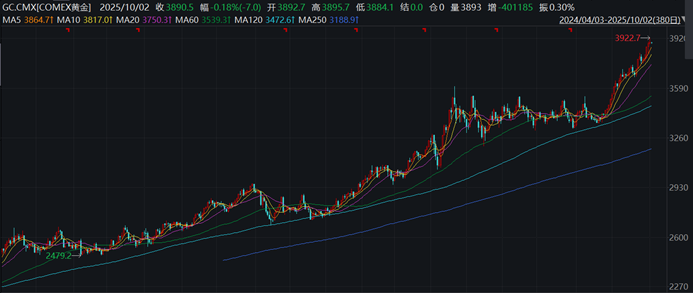
纽约期货黄金价格一度升破3900美元,多家国际机构表达乐观预期
Huan Qiu Wang· 2025-10-02 00:34
Group 1 - International precious metals futures generally rose, with COMEX gold futures up 0.5% at $3892.6 per ounce, and intraday prices breaking above $3900 per ounce, setting a new record high [1] - Analysts attribute the rise in gold prices to ongoing risks of a U.S. government shutdown, increased market risk aversion, and strengthened expectations for Federal Reserve interest rate cuts, leading to continued inflows into the precious metals market [1][3] Group 2 - In September, international gold prices increased by nearly 11.8%, with a quarterly rise of approximately 16.8%, and a year-to-date increase of nearly 47% [3] - Goldman Sachs maintains a mid-2026 target price of $4000 per ounce for gold, suggesting a possibility for prices to exceed $4500 per ounce, and indicates that if 1% of individual U.S. Treasury bond holders shift their investments to gold, prices could approach $5000 per ounce [3] - UBS reports that factors such as a weakening dollar, central bank gold purchases, and increased ETF investments are favorable for gold prices as a hedge against inflation and geopolitical risks, predicting a rise to $4200 per ounce by mid-2026 [3] - Citigroup anticipates potential supply tightness in platinum group metals due to U.S. government policy impacts [3]


看好A股!外资巨头,集体发声
Zhong Guo Zheng Quan Bao· 2025-10-01 05:26
Group 1 - Foreign investment in Chinese assets is increasing, with major international banks like Goldman Sachs and HSBC recommending an "overweight" position on A-shares [1][2] - HSBC's recent survey indicates that over half of the respondents are optimistic about the A-share market, a significant increase from about one-third in June [2] - Goldman Sachs raised its 12-month target for the MSCI Emerging Markets Index from 1370 to 1480 points, indicating a potential upside of approximately 10% [2] Group 2 - The overall confidence of investors in Chinese investments has been steadily increasing this year, with a growing willingness to allocate to non-USD assets [3] - Multiple factors, including policy support and positive economic fundamentals, are boosting investment confidence in the Chinese stock market [4] - China's economic fundamentals remain solid, with rapid industrial upgrades and the emergence of new productive forces in sectors like renewable energy and AI [4] Group 3 - Long-term capital inflows are a key reason for foreign investors' positive outlook on Chinese assets, supported by domestic institutions like insurance and pension funds [5] - The liquidity in the A-share market has improved, attracting participation from emerging market and Asia-Pacific mutual funds [5] Group 4 - Investor sentiment towards the A-share market has significantly improved, driven by ample liquidity and accelerated technological innovation [6] - The influx of additional household savings, which accounts for 5% of GDP, is expected to further boost market valuations, particularly in innovative sectors [6] Group 5 - The ongoing reforms and opening-up of the capital market are expected to accelerate, enhancing the attractiveness of Chinese assets to foreign investors [7][8] - The China Securities Regulatory Commission (CSRC) plans to implement key measures to improve cross-border investment and financing convenience [8]

看好A股,外资巨头集体发声
Zhong Guo Zheng Quan Bao· 2025-10-01 04:57
Group 1 - Foreign investment in Chinese assets is increasing, with major international banks like Goldman Sachs and HSBC recommending an "overweight" position on A-shares [1][2] - A recent survey by HSBC indicates that over half of the respondents are optimistic about the A-share market, a significant increase from about one-third in June [1][2] - Goldman Sachs raised its 12-month target for the MSCI Emerging Markets Index from 1370 to 1480 points, suggesting a potential upside of approximately 10% [1] Group 2 - As of the end of Q2, northbound capital's total market value reached 2.29 trillion yuan, an increase of over 2% from the end of Q1 [2] - In the first half of the year, foreign investors net increased their holdings in domestic stocks and funds by $10.1 billion, with significant inflows in May and June totaling $18.8 billion [2] Group 3 - Multiple factors are boosting investor confidence, including policy support and a favorable economic outlook [3] - China's economic fundamentals remain strong, with rapid advancements in industries such as renewable energy, artificial intelligence, and biomedicine [3] Group 4 - Long-term capital inflows are a key reason for foreign optimism towards Chinese assets, supported by domestic institutions like insurance and pension funds [4] - The weakening of the US dollar is expected to further attract funds into Asian markets [4] Group 5 - Investor interest in the A-share market has significantly increased, driven by ample liquidity and accelerated technological innovation [5] - With households holding substantial additional savings (5% of GDP), there is potential for further revaluation in innovative sectors like robotics [5] Group 6 - The ongoing capital market reforms and opening up are crucial for attracting foreign investment in Chinese assets [6][7] - The China Securities Regulatory Commission plans to expedite key measures for capital market openness by 2025, including optimizing the QFII system [6][7]