UBS(UBS)

Search documents
史上首次!金价冲上4000
Sou Hu Cai Jing· 2025-10-07 08:49
Group 1: Gold Price Trends - International gold prices have reached a historic high, touching $4000.1 per ounce during Asian trading on October 7, marking the first time gold prices have crossed this threshold [1] - As of October 7, the December gold futures price on the New York Commodity Exchange was reported at $3999.9 per ounce, reflecting a 0.59% increase [1] Group 2: China's Gold Reserves - As of the end of September, China's gold reserves stood at 74.06 million ounces (approximately 2303.523 tons), with a month-on-month increase of 40,000 ounces (about 1.24 tons), marking the 11th consecutive month of gold accumulation [2] - China's foreign exchange reserves reached $333.87 billion by the end of September, an increase of $16.5 billion from the end of August, representing a 0.5% rise [2] Group 3: Future Price Predictions - BMO Capital Markets has significantly raised its price forecasts for gold, predicting an average price of $3900 per ounce in Q4 2025, an 8% increase from previous estimates, and $4400 per ounce in 2026, a 26% increase [3] - UBS has also forecasted a bullish outlook for the gold market, expecting prices to reach $4200 per ounce by mid-2026, citing factors such as a weakening dollar, central bank purchases, and increased ETF investments as supportive of higher gold prices [3]

UBS declares coupon payments on 12 ETRACS Exchange Traded Notes
Businesswire· 2025-10-06 20:37
Core Points - UBS Investment Bank announced coupon payments for 9 ETRACS Exchange Traded Notes (ETNs) traded on NYSE Arca and expected coupon payments for 3 ETNs traded on NASDAQ [1] - The ETRACS ETNs are linked to various indices, including the Alerian MLP Infrastructure Index, MarketVector US Business Development Companies Liquid Index, and Solactive US High Dividend Low Volatility Index [1][2] - The Current Yield for ETNs is calculated based on the quarterly or monthly coupon amounts and the closing indicative value, but it is not indicative of future coupon payments [3][4][9] ETRACS ETNs Overview - ETRACS ETNs are senior unsecured notes issued by UBS AG, traded on NYSE Arca or NASDAQ, and can be bought and sold through brokers or financial advisors [12] - The Expected Current Yield is based on the Expected Coupon Amount and the two most recent coupon payments, but it may vary significantly over time [9][10] - Coupon payments for the ETNs are variable and not guaranteed, with the potential for future payments to differ from the Expected Current Yield [9][10] Coupon Payment Details - Specific ETNs like HDLB, SMHB, and PFFL pay a variable monthly coupon linked to cash distributions, while others like MLPR and BDCX pay a variable quarterly coupon [5] - The notional cash distribution from the sale of options on GLD, SLV, and USO shares is expected to be withdrawn from the indices on October 13, 2025, affecting the coupon amounts for GLDI, SLVO, and USOI [7][8] - The Expected Coupon Amount for each ETN may change due to market disruptions or unforeseen circumstances [8][10]
UBS Presents First-Ever Horology Exhibition Curated by Hodinkee Founder Ben Clymer
Businesswire· 2025-10-06 12:31
Core Insights - UBS has launched "Icons of Time," a unique exhibition celebrating the artistry and innovation of watchmaking, in partnership with Hodinkee, taking place on October 9-10 in New York City [1][2][5] - The exhibition features twelve landmark timepieces from iconic brands, representing nearly one hundred years of craftsmanship and design ingenuity [2][4] - UBS House of Craft aims to deepen cultural exchange and celebrate excellence across various disciplines, including horology [4][7][10] Company Overview - UBS is a leading global wealth manager and universal bank based in Switzerland, managing $6.1 trillion in invested assets as of Q4 2024 [6] - The firm operates in over 50 markets worldwide and is listed on the SIX Swiss Exchange and the New York Stock Exchange [6] Exhibition Details - "Icons of Time" will showcase watches from renowned brands such as A. Lange & Söhne, Audemars Piguet, Cartier, and Rolex, among others [2][4] - The exhibition includes on-site demonstrations of horological craftsmanship, such as the assembly of iconic timepieces [4] - Registration for the event is free and open to the public [5] Initiative Background - UBS House of Craft is a global initiative that celebrates excellence in various crafts, including horology and gastronomy, with events planned in the US and Asia [7][9] - The initiative reflects UBS's commitment to mastery and cultural exchange, connecting clients with the worlds of luxury and craft [8][10]
经济过热风险浮现,华尔街正在密谋什么?
Sou Hu Cai Jing· 2025-10-05 19:13
Core Viewpoint - Top investment banks on Wall Street are shifting their focus from expectations of an economic slowdown to preparing for a potential acceleration of the U.S. economy, contrary to previous market predictions [1] Economic Indicators - Dallas Federal Reserve Bank President Lorie Logan emphasized the need for caution regarding interest rate cuts due to persistent inflation and a resilient labor market, indicating that current monetary policy may still be only "moderately restrictive" [3] - Goldman Sachs noted a significant rise in the U.S. macroeconomic surprise index and strong initial jobless claims data, predicting a healthy 2.6% GDP growth rate for Q3, supported by a robust labor market and potential fiscal stimulus [5] Financial Environment - A loose financial environment is fostering conditions for economic acceleration, with strong performance in risk assets, expectations of future Fed rate cuts, and a weaker dollar contributing to consumer and investment growth [5] Fiscal Policy and Investment - Wall Street anticipates a positive fiscal policy pulse in the first half of next year, with capital expenditures in the AI sector expected to drive economic growth [7] - U.S. tech capital expenditures as a percentage of GDP have reached double the levels seen during the internet bubble, nearing pre-2008 financial crisis real estate investment levels [7] Investment Strategies - UBS suggests small-cap stocks as a favorable investment during economic expansion phases, with historical data showing average excess returns of 8% after mid-cycle slowdowns and 20% post-recession [7] - UBS and Citigroup recommend Latin American currency carry trades, particularly the Mexican peso, which can benefit from stronger U.S. economic growth [8] Commodity Outlook - Citigroup and UBS are optimistic about commodities in the event of economic acceleration, with Citigroup recommending copper options and UBS suggesting oil as a hedging tool despite bearish market sentiment [10] Yield Curve Strategy - Goldman Sachs and Citigroup advocate for steepening the yield curve as a hedge against the risks of U.S. economic acceleration, with Citigroup suggesting that front-end rates are unlikely to rise significantly even if the economy accelerates [11] Federal Reserve Challenges - The Federal Reserve faces a complex monetary policy landscape, balancing the need to address labor market pressures while managing inflation risks, leading to a cautious approach to rate cuts [13]

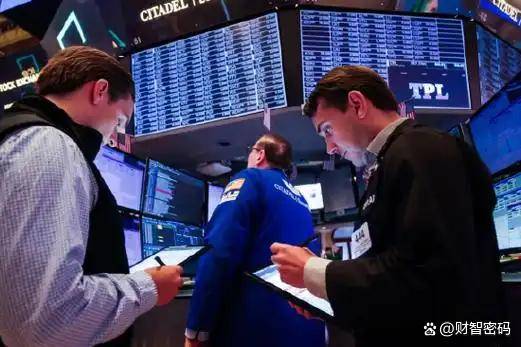
风向有变?华尔街开始讨论:投资者如何应对美国经济“过热”
Hua Er Jie Jian Wen· 2025-10-05 10:10
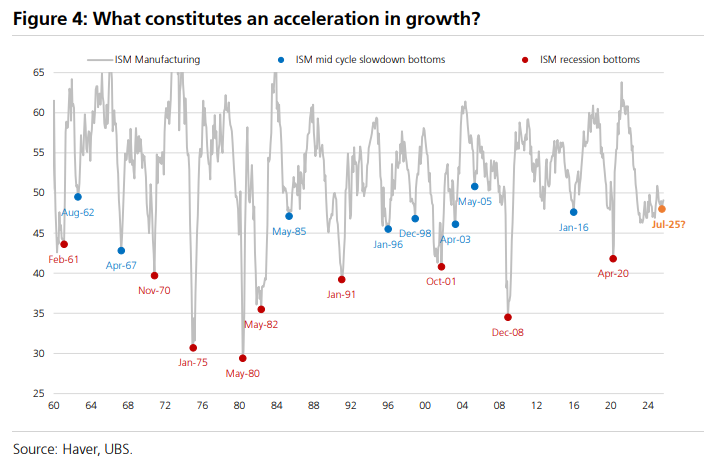
Core Viewpoint - Major Wall Street investment banks, including Goldman Sachs, UBS, and Citigroup, have raised concerns about the increasing risk of a "re-acceleration" of the U.S. economy, driven by resilient labor markets, expectations of fiscal stimulus, and a loose financial environment [1][2] Group 1: Economic Indicators - Goldman Sachs noted that the U.S. economy shows strong performance across multiple key indicators, with a significant rise in the U.S. macroeconomic surprise index and encouraging initial jobless claims data [2] - The global investment research department of Goldman Sachs projects a healthy GDP growth rate of 2.6% for the third quarter [2] - UBS defines economic acceleration as an increase of over 10 points in the ISM manufacturing index within 12 months [3] Group 2: Factors Driving Economic Acceleration - Key factors contributing to the risk of economic re-acceleration include: - Loose financial conditions characterized by strong performance of risk assets, expectations of future rate cuts by the Federal Reserve, and a weaker dollar [2] - Anticipated positive fiscal policy impulses in the first half of next year, alongside continued capital expenditure in the AI sector [2] - A solid consumer base in the U.S. and the impact of deregulation [2] Group 3: Investment Strategies - Investment banks recommend various strategies to hedge against the potential re-acceleration of the U.S. economy: - Consideration of U.S. small-cap stocks, Latin American currency carry trades, steepening yield curves, and commodities [1][2] - UBS highlights that small-cap stocks typically outperform large-cap stocks during economic expansion phases, with median outperformance of 5.4% after mid-cycle slowdowns and 20% after recessions [10][26] - UBS and Citigroup recommend Latin American currency carry trades, particularly emphasizing the Mexican peso for its dual benefits of carry opportunities and potential gains from stronger U.S. growth [15][17] Group 4: Commodity Outlook - Citigroup suggests buying copper options, citing macroeconomic factors and fundamentals that support rising copper prices [28] - UBS recommends oil as a hedging tool, predicting that a 10% increase in energy consumption due to U.S. re-acceleration could raise global oil demand by 2-3%, leading to a quicker market balance [29] Group 5: Yield Curve Strategies - Both Goldman Sachs and Citigroup advocate for strategies to steepen the yield curve as a hedge against the risk of U.S. economic re-acceleration [20][21] - Goldman Sachs suggests going long on the steepening of the 2-year and 10-year Treasury yield curve, while Citigroup believes that even with economic re-acceleration, front-end rates are unlikely to rise significantly due to overly dovish market pricing [20][21]


看好A股未来,外资巨头纷纷看涨,资金流入迎来新机遇
Sou Hu Cai Jing· 2025-10-04 10:47
Group 1 - The A-share market is currently a focal point of tension between foreign capital and the Chinese market, with mixed sentiments among investors [1] - Major international financial institutions like Goldman Sachs, HSBC, and UBS have recently shown a unified bullish stance on Chinese assets, indicating a significant shift in foreign investment sentiment [1][6] - By the end of Q2 2025, the market value of northbound funds reached 2.29 trillion yuan, reflecting a 2% increase from the previous quarter, demonstrating a clear trend of capital inflow [1] Group 2 - In the first half of 2025, foreign capital net increased by 10.1 billion USD in domestic stocks and funds, with a notable 18.8 billion USD added in May and June alone, highlighting a growing interest in Chinese equities [1] - The Chinese investment confidence has been recovering, with a rising interest from overseas investors in non-USD assets, particularly in Chinese markets [1][6] Group 3 - Domestic liquidity has improved due to favorable policies, with increased participation from insurance, pension funds, and public funds in emerging markets and Asia-Pacific mutual funds [2][4] - The China Securities Regulatory Commission (CSRC) has been actively promoting capital market openness, with measures like QFII system optimization aimed at attracting more global capital [4][8] Group 4 - The ongoing capital market reforms and policy releases are expected to enhance foreign investment willingness, with a general consensus that a new wave of capital market reform is accelerating [8] - The current liquidity in the A-share market is attributed to a combination of domestic and foreign capital interactions, which is expected to continue as the USD weakens [6][10] Group 5 - The market dynamics are influenced by multiple factors, including macroeconomic fundamentals, policy support, and market sentiment, all contributing to expectations and trust in China's future [10] - The sustainability of foreign enthusiasm and the performance of the A-share market remain uncertain, with upcoming developments likely to influence investor decisions [11]


黄金连续七周上涨,瑞银预计金价升至4200美元
Huan Qiu Wang· 2025-10-04 01:08
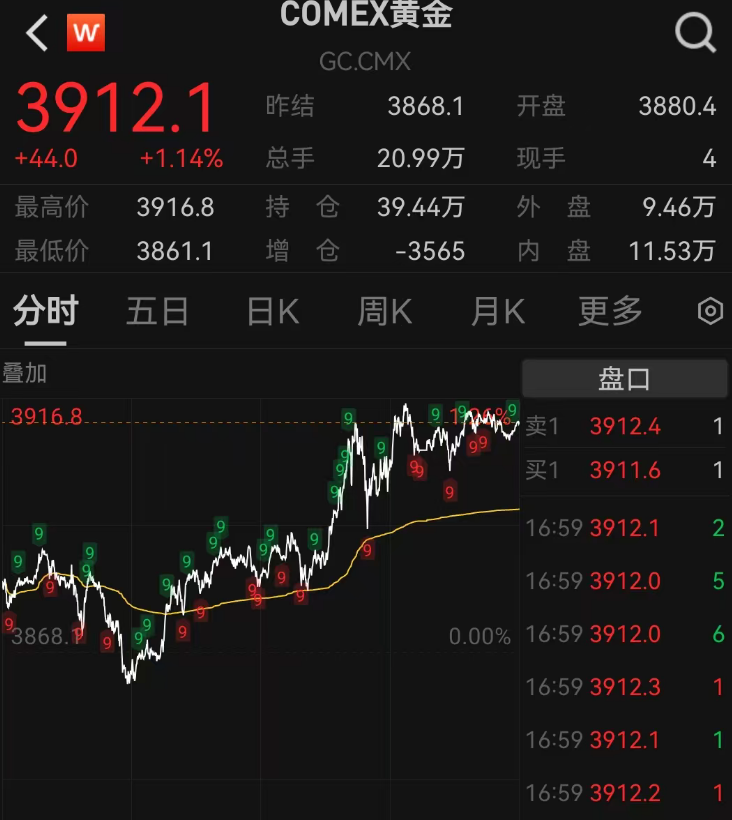
Group 1 - Gold prices are expected to rise for the seventh consecutive week, with spot gold increasing by 0.5% to $3,874.66 per ounce, following a record high of $3,896.49 [1] - COMEX gold futures have surpassed $3,900 per ounce, with an increase of over 1% [1] - Year-to-date, gold prices have risen by more than 47% [2] Group 2 - UBS forecasts that gold prices could reach $4,200 per ounce in the coming months due to declining U.S. real interest rates and expectations of a weaker dollar [3] - Other precious metals have also seen price increases, with silver up 1.4% to $47.63 per ounce, platinum up 1.9% to $1,599.01 per ounce, and palladium up 1% to $1,253.75 per ounce [4] - Market sentiment for silver is optimistic, with speculative long positions in COMEX silver rising from 30,000 contracts in May to approximately 38,000 contracts by September 23 [4]
黄金突然拉升,白银大涨2%
Zheng Quan Shi Bao· 2025-10-03 10:04
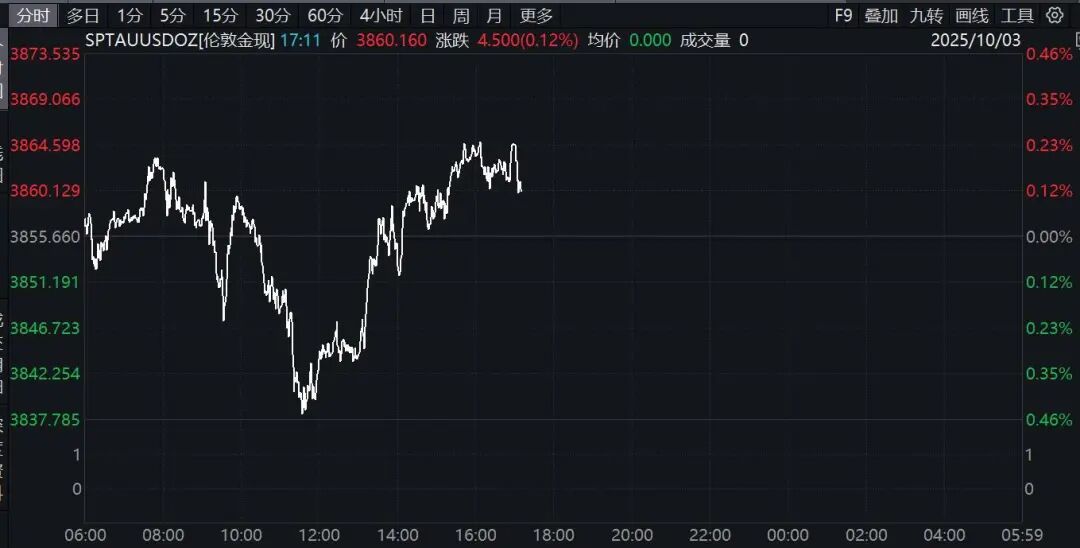
Group 1 - International gold prices reached a historical high before a slight retreat, with spot gold rising to $3860 per ounce as of October 3 [1] - Silver prices also saw significant gains, with New York silver futures increasing by up to 2%, reaching $47.22 per ounce [1] Group 2 - UBS forecasts that central bank gold demand will remain between 900 to 950 tons in 2025 [3] - UBS anticipates that gold prices may rise to $4200 per ounce in the coming months after a strong performance [3] - Aakash Doshi from State Street Global Advisors noted that silver is experiencing a lagging rally, as its performance has not matched that of gold in recent quarters [3] - The supply of silver has consistently lagged behind demand growth in recent years, which has contributed to the current market dynamics [3]

Swiss public back tougher capital rules for UBS, poll shows
Reuters· 2025-10-03 06:56
Core Viewpoint - A majority of the Swiss public believes that the Swiss government should impose stricter capital rules on UBS, even if these regulations are more stringent than those in other countries [1] Group 1 - The poll indicating public opinion was published on Friday [1]
市场消息:春秋航空正与摩根大通、瑞银就上市事宜展开合作。
Xin Lang Cai Jing· 2025-10-03 06:54
Group 1 - The core point of the article is that Spring Airlines is collaborating with JPMorgan and UBS regarding its listing plans [1] Group 2 - Spring Airlines is in discussions with major financial institutions to facilitate its potential public offering [1]