UBS(UBS)

Search documents
昨夜,大涨!特朗普最新宣布


Zheng Quan Shi Bao· 2025-07-24 00:22
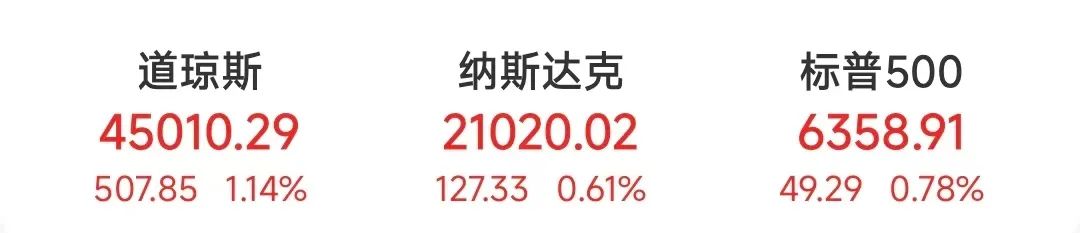
Market Performance - The US stock market saw significant gains on July 23, with the Dow Jones Industrial Average rising by 507.85 points, or 1.14%, closing at 45010.29 points. The Nasdaq Composite increased by 127.33 points, or 0.61%, closing at 21020.02 points, marking its first close above the 21000-point threshold. The S&P 500 index rose by 49.29 points, or 0.78%, closing at 6358.91 points [1][3][4]. Trade Agreements - President Trump announced a trade agreement between the US and Japan, which has heightened market expectations for further trade agreements before the August 1 tariff deadline. The agreement includes a reduction of the reciprocal tariff rate from 25% to 15% and Japan's commitment to invest $550 billion in the US [2][6][7]. Sector Performance - In the S&P 500, nine out of eleven sectors experienced gains, with the healthcare and industrial sectors leading with increases of 2.03% and 1.75%, respectively. The utilities and consumer staples sectors saw declines of 0.79% and 0.07% [8]. - Major technology stocks mostly rose, with AMD increasing over 3%, and other companies like NVIDIA, Boeing, and TSMC rising over 2%. Financial stocks also saw gains, with Mizuho Financial up over 6% and UBS Group up over 3% [8]. Chinese Stocks - The Nasdaq Golden Dragon China Index rose by 0.75%, with notable increases in stocks such as iQIYI, which rose over 4%, and Tiger Brokers, which increased over 3%. However, some stocks like NIO and Li Auto saw declines of over 1% [9].


UBS (UBS) Reports Next Week: Wall Street Expects Earnings Growth
ZACKS· 2025-07-23 15:07
The market expects UBS (UBS) to deliver a year-over-year increase in earnings on lower revenues when it reports results for the quarter ended June 2025. This widely-known consensus outlook is important in assessing the company's earnings picture, but a powerful factor that might influence its near-term stock price is how the actual results compare to these estimates.The earnings report, which is expected to be released on July 30, might help the stock move higher if these key numbers are better than expecta ...

瑞银王宗豪:对H股和中国整体股市维持乐观
news flash· 2025-07-23 07:32
瑞银投资银行中国股票策略研究主管王宗豪最新观点认为,香港市场在短期内将面临一定压力,因为外 卖和其他行业的竞争压力可能导致盈利预测下调。但随着"反内卷"动能上升,政策变化似乎在酝酿中, 相比于其他境内资产和全球股市的估值吸引力,也将继续吸引南向和国际资金流入,维持对H股和中国 整体股市的乐观看法。(人民财讯) ...
每日机构分析:7月22日
Xin Hua Cai Jing· 2025-07-22 11:45
Group 1 - Goldman Sachs reports that global investment, manufacturing employment, spending, and overall economic activity remain robust despite uncertainties and challenges [2] - Global trade remains active, indicating the persistence and importance of international trade, with significant rebounds in stock markets across the Atlantic [2] - Moody's analysis suggests that the outcome of Japan's Senate elections may hinder the government's efforts to advance fiscal consolidation in the post-pandemic era [2] Group 2 - Deutsche Bank strategists warn that if the US confirms tariff increases on August 1 alongside disappointing employment reports, it could trigger renewed recession fears [3] - Concerns over the sustainability of US debt may become a central topic of discussion in the market for the second half of the year, with long-term Treasury yields facing upward pressure [3] - Current 10-year US Treasury yield has risen by 2 basis points to 4.392% [3]


X @Bloomberg
Bloomberg· 2025-07-22 10:32
UBS is reviewing the role of six relationship managers who sold complex currency derivatives to clients who say they didn’t fully understand the risk, sources say https://t.co/Mrf0kIzqhy ...
7月22日电,美国银行全球研究将瑞银集团评级从表现不佳升至中性,将目标价格从30.5美元上调至38.7美元。
news flash· 2025-07-22 09:57
智通财经7月22日电,美国银行全球研究将瑞银集团评级从表现不佳升至中性,将目标价格从30.5美元 上调至38.7美元。 ...
瑞银:稳定币将推高对短期美债净需求 短期债供给仍有吸纳空间
智通财经网· 2025-07-22 04:20
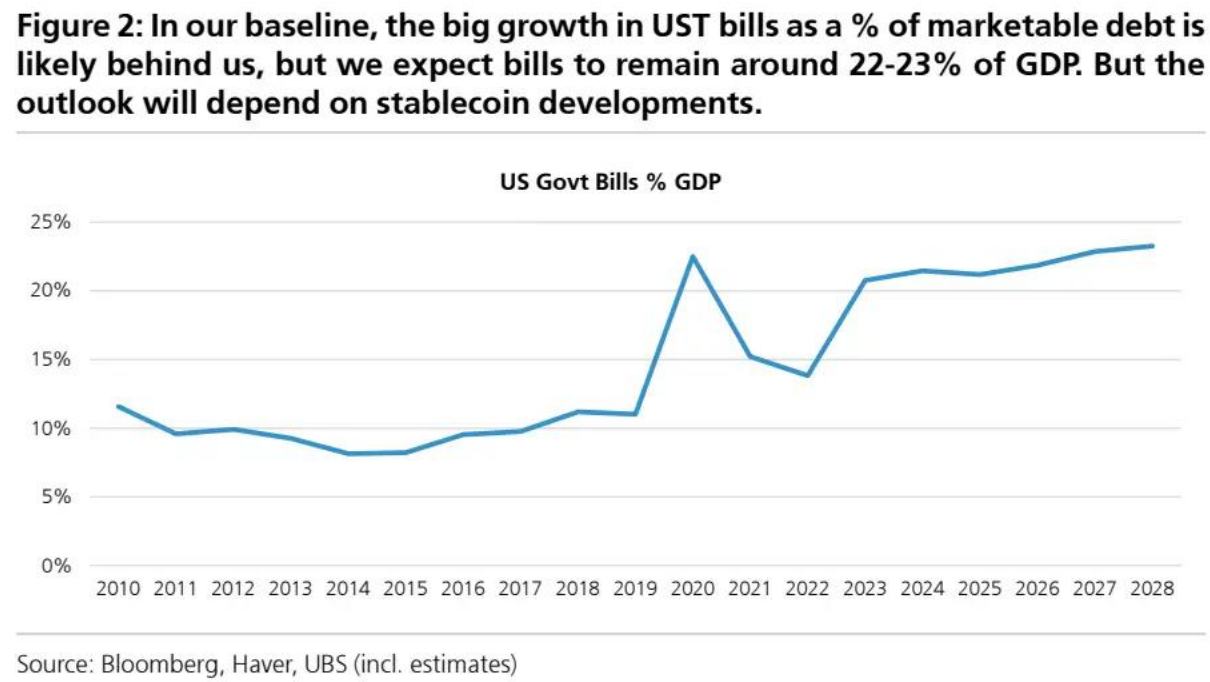
Core Insights - The legislation mandates that stablecoin issuers must maintain 100% reserve backing with high-quality, short-term, and liquid assets [1] - The International Bank for Settlements (BIS) estimates that stablecoins have purchased approximately $40 billion in U.S. short-term government bonds, equating to the largest U.S. government money market fund [4] - U.S. Treasury Secretary Yellen believes that a $2 trillion market cap for dollar stablecoins is reasonable, with potential for upward risk [5] Group 1: Stablecoin Market Dynamics - The demand for stablecoins includes a significant portion of "net new" cash demand, with U.S. government money market fund net assets doubling to $7 trillion since 2019, while stablecoin market cap is around $240 billion [5] - The growth of the stablecoin sector will depend on its international usage [6] - The legislation is expected to further expand the use of the dollar globally through stablecoins [7] Group 2: Impact on Treasury Securities - Strong inflows into dollar stablecoins are linked to a decline in the yield of 3-month short-term government bonds, with effects observed on 10-year Treasury yields approximately 15 days later [8] - UBS previously noted that during the late 1990s, the supply growth of short-term government bonds outpaced traditional investor bases, leading to relatively cheaper rates [8][9]
Tyra Biosciences Announces Fireside Chat on Achondroplasia and Growth Disorders at UBS Biotech Management Live Call Series
Prnewswire· 2025-07-21 20:05
Company Overview - Tyra Biosciences, Inc. is a clinical-stage biotechnology company focused on developing next-generation precision medicines targeting opportunities in Fibroblast Growth Factor Receptor (FGFR) biology [1] - The company utilizes an in-house precision medicine platform called SNÅP, which enables rapid and precise drug design through iterative molecular SNÅPshots [1] - Tyra has a differentiated pipeline with three clinical-stage programs in targeted oncology and genetically defined conditions [1] Lead Product and Clinical Development - The lead product, TYRA-300, is a potential first-in-class selective FGFR3 inhibitor designed to avoid toxicities associated with FGFR1, FGFR2, and FGFR4 inhibition [1] - TYRA-300's planned clinical development includes three Phase 2 studies: SURF302 for intermediate risk non-muscle invasive bladder cancer, BEACH301 for pediatric achondroplasia, and SURF301 for metastatic urothelial cancer [1] - Other investigational products include TYRA-200, an oral FGFR1/2/3 inhibitor for metastatic intrahepatic cholangiocarcinoma, and TYRA-430, an oral FGFR4/3-biased inhibitor for FGF19+/FGFR4-driven cancers [1] Upcoming Event - Company management will participate in a virtual fireside chat as part of the UBS Biotech Management Live Call Series on July 25, 2025 [2] - The event will feature key management personnel including Todd Harris (CEO), Doug Warner (CMO), and Alan Fuhrman (CFO) [2] - The session is scheduled for 11 am ET and will be hosted by Ellie Merle, a US SMID Cap Biotechnology Analyst at UBS [2]


多家外资机构中期策略出炉聚焦中国科技与消费板块
Shang Hai Zheng Quan Bao· 2025-07-20 15:54
Core Insights - Multiple foreign institutions have released their mid-term investment strategies for 2025, highlighting the attractiveness of Chinese stocks amid global capital reallocation [2][3] - The technology and consumer sectors are identified as key areas of focus, benefiting from AI innovation and policy support, as well as the rise of local brands and digital upgrades [2][4] Investment Trends - There is a strategic rebalancing occurring globally, with investors reassessing their stock exposures and looking beyond the US market [2] - Asian markets, particularly China, are seen as undervalued compared to developed markets, providing a compelling entry point for long-term investors [2][3] Sector Focus - The technology sector is expected to offer excess return opportunities, especially with the increasing prevalence of AI applications and supportive government policies [4] - Specific areas of interest within the technology sector include online gaming, cloud services, online travel services, and electric vehicles, which are viewed favorably due to reasonable valuations and strong profit growth expectations [4]