XPENG(XPEV)

Search documents
XPeng And BYD Are Squeezing Tesla; And BYD Is Leading The Race
Seeking Alpha· 2025-12-15 23:15
Core Insights - James Foord is an economist with a decade of experience analyzing global markets, leading the investing group The Pragmatic Investor, which focuses on building diversified portfolios to preserve and increase wealth [1] Group 1: Company Overview - The Pragmatic Investor covers various sectors including global macro, international equities, commodities, technology, and cryptocurrencies [1] - The platform is designed to assist investors of all levels in their investment journey [1] Group 2: Features and Offerings - The Pragmatic Investor offers a portfolio, weekly market update newsletter, actionable trades, technical analysis, and a chat room for discussions [1]





特斯拉市值增超3700亿元 马斯克身家跃升至6770亿美元!加密货币全网超19万人爆仓 47亿元蒸发!美联储 大消息
Mei Ri Jing Ji Xin Wen· 2025-12-15 22:28
Group 1 - Broadcom shares fell over 5%, while Apple and Amazon rose over 1%, and Tesla increased by over 3%, adding $53.7 billion (approximately 378.6 billion RMB) to its market value [1] - Elon Musk's net worth reached $677 billion, making him the first person in history to surpass the $600 billion mark, previously no one had crossed $500 billion [3] - iRobot officially declared bankruptcy with a stock value of zero after finalizing its restructuring plan on December 15, resulting in a 72.69% drop in its shares [3] Group 2 - The Nasdaq Golden Dragon China Index fell by 2.17%, with major Chinese stocks declining; Baidu dropped nearly 5%, and Alibaba, Xpeng Motors, and others fell over 3% [5] - WTI crude oil futures decreased by 1.08% to $56.82 per barrel, while Brent crude oil futures fell by 0.92% to $60.56 per barrel [6] - Bitcoin fell below $86,000 for the first time in two weeks, dropping 3.3% to $85,578, approximately 30% down from its record high of over $126,000 [6][7] Group 3 - Over the past 24 hours, more than 190,000 traders were liquidated, resulting in a total loss of $670 million (approximately 4.7 billion RMB) [9] - The New York Federal Reserve's manufacturing index unexpectedly shrank to -3.9 in December, indicating a contraction in economic activity, significantly below the expected median of 10 [11][13] - Federal Reserve Governor Milan suggested that the current monetary policy is too tight and advocated for a faster pace of rate cuts, citing signs of a cooling labor market [13]



纳斯达克中国金龙指数收跌2.17%,热门中概股普跌
Mei Ri Jing Ji Xin Wen· 2025-12-15 21:12
Group 1 - The Nasdaq China Golden Dragon Index fell by 2.17%, indicating a decline in the performance of popular Chinese stocks [1] - Baidu experienced a nearly 5% drop, while Alibaba decreased by over 3.5% [1] - Xpeng Motors also saw a decline of 3.5%, with Li Auto and WeRide falling by over 2% [1] Group 2 - JD.com, Xiaomi Group ADR, Pinduoduo, and Yum China all dropped by more than 1% [1]

中国车企“抢滩”马来西亚
Bei Jing Shang Bao· 2025-12-15 15:58
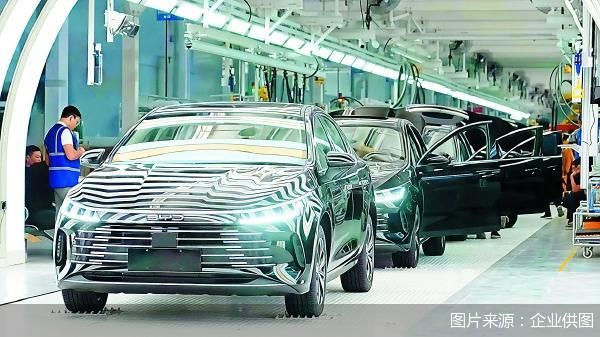
Core Viewpoint - Malaysia is becoming a key destination for Chinese automotive companies, with several firms, including Xpeng Motors, BYD, and Chery, establishing local production facilities to tap into the growing Southeast Asian market [1][4]. Group 1: Xpeng Motors' Expansion - Xpeng Motors has signed an agreement with Malaysia's EPMB Group to initiate local production, marking its third overseas localization project after Indonesia and Austria [1][3]. - The project aims to serve the ASEAN right-hand drive vehicle market and is expected to achieve mass production by next year [3]. - Xpeng's sales in Malaysia have positioned it among the top six electric vehicle brands in the region within the first ten months of the year [3]. Group 2: Competitive Landscape - Other Chinese automakers, such as BYD, Great Wall, and Leap Motor, are also entering the Malaysian market, with various strategies ranging from local assembly to full production [4][5]. - BYD plans to establish a CKD assembly plant in Malaysia, with production set to commence next year, following the introduction of its ATTO 3 model in 2022 [4]. Group 3: Market Dynamics - The Malaysian automotive market is experiencing significant growth, with total vehicle sales surpassing those of Indonesia for the first time, and electric vehicle sales increasing by over 200% year-on-year [6]. - The Malaysian government has set ambitious targets for electric vehicle sales, aiming for 15% of new car sales to be electric by 2030 and 38% by 2040 [6]. Group 4: Government Incentives and Industry Support - The Malaysian government offers various incentives for electric vehicles, including tax exemptions and support for local assembly of components, which enhances the attractiveness of the market for foreign manufacturers [7]. - Malaysia has a robust automotive supply chain with over 600 parts manufacturers, providing essential components for vehicle production [7]. Group 5: Geographical Advantages - Malaysia's strategic location in Southeast Asia facilitates access to regional markets, making it an ideal hub for automotive companies looking to expand their presence in the area [7].
美股异动 | 热门中概股普跌 阿里巴巴(BABA.US)跌逾3%
智通财经网· 2025-12-15 15:17
Group 1 - The Nasdaq Golden Dragon Index fell by over 1% on Monday, indicating a decline in the performance of popular Chinese concept stocks [1] - Notable declines were observed in stocks such as Niu Technologies (NIU.US) and Alibaba (BABA.US), both dropping by over 3% [1] - Other companies like Tiger Brokers (TIGR.US) and Li Auto (LI.US) experienced declines of over 2%, while Xpeng Motors (XPEV.US) and Sohu (SOHU.US) fell by over 1% [1]


小鹏汽车第三个海外本地化生产项目落地马来西亚
Zhong Guo Xin Wen Wang· 2025-12-15 13:58
小鹏汽车副董事长兼联席总裁顾宏地表示,东盟是公司非常看好的市场之一。(完) (文章来源:中国新闻网) 中新社广州12月15日电 (记者蔡敏婕)小鹏汽车15日发布消息称,该公司与马来西亚EPMB集团签约,正 式启动其马来西亚本地化生产项目。 马来西亚纯电动车市场正高速增长,已迈入规模化增长新阶段。与此同时,马来西亚拥有成熟的汽车产 业链,以及针对本地化生产的积极政策,这使其成为智能电动汽车制造的理想基地。 今年以来,小鹏汽车海外本地化生产布局推进迅速,半年内已密集落地3个生产项目:7月,首个海外本 地化生产项目在印度尼西亚落地;9月,首个欧洲本地化生产项目在奥地利格拉茨麦格纳工厂启动,同 月,协同本地化生产的首个欧洲研发中心——德国慕尼黑研发中心启用;12月,第三个海外本地化生产 项目在马来西亚启动。 本地化生产与全球研发网络的协同效应,正驱动小鹏汽车海外业务迈入增长期。2025年1月至11月,小 鹏汽车海外交付量达39773辆,同比增幅高达95%。截至目前,小鹏汽车销售服务网络已覆盖52个国家 和地区,海外销售服务网点增至321个。此外,小鹏汽车在全球已设立9大研发中心。 这是继印度尼西亚、奥地利之后,小鹏汽 ...
Rocket Lab ($RKLB) | XPENG ($XPEV) | Virgin Galactic ($SPCE) | 3D Systems ($DDD)
Youtube· 2025-12-15 13:53
Group 1: Rocket Lab and Space Missions - Rocket Lab successfully completed its first dedicated Electron mission for the Japan Aerospace Exploration Agency, launching the Race 4 technology demonstration satellite from New Zealand [1] - The mission highlights Electron's expanding role in global national space programs, with additional dedicated launches planned for Japan Aerospace in Q1 of 2026 and the European Space Agency in the upcoming year [2] Group 2: Xping and EV Production - Xping has formed a strategic partnership with Malaysia's EP Manufacturing Burhat to initiate localized EV production in Malaysia, marking its third global and second Asia-Pacific localized manufacturing project [2] - The new facility aims to support an integrated regional ecosystem, aligning with Malaysia's green economy goals and enhancing Xping's competitive position [2] Group 3: Virgin Galactic and Sensor Systems - Virgin Galactic announced a collaboration with Lawrence Livermore National Laboratory to evaluate sensor systems aboard its launch vehicles, aiming to collect critical data for next-generation imaging capabilities [3] Group 4: 3D Systems and FDA Clearance - 3D Systems received FDA clearance to expand its orthopedics platform to include mature adolescence, facilitating faster reimbursable adoption at leading hospitals [3] - This approval opens a high acuity underserved market, strengthens 3D Systems' competitive mode, and supports a scalable high-margin medtech revenue model driven by virtual planning services and patient-specific 3D printed surgical solutions [4]




小鹏本地化生产、比亚迪建组装厂 车企“抢滩”马来西亚
Bei Jing Shang Bao· 2025-12-15 13:43
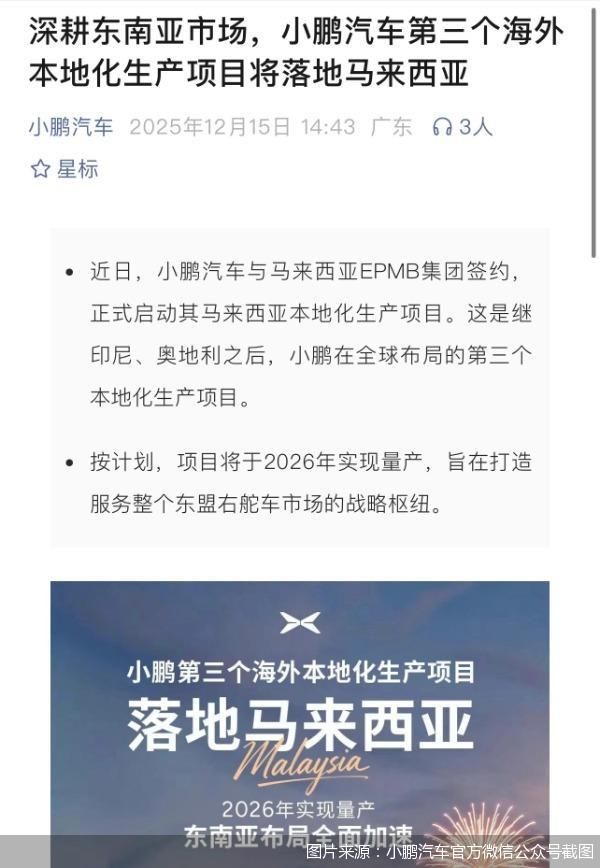
Core Viewpoint - Malaysia is becoming a key production hub for Chinese automotive companies, with Xpeng Motors launching its local production project in collaboration with EPMB Group, marking its third overseas localization project after Indonesia and Austria [1][5]. Group 1: Xpeng Motors' Localization Strategy - Xpeng Motors has established three overseas localization projects within six months, with the latest in Malaysia set to achieve mass production by 2026, aiming to serve the ASEAN right-hand drive market [5]. - The company aims to grow alongside local markets and consumers by providing high-quality smart products tailored to local preferences [5]. Group 2: Competitive Landscape in Malaysia - Other Chinese automotive companies, including BYD, Great Wall, and Chery, are also entering the Malaysian market, with various strategies from vehicle exports to local production [6]. - BYD is constructing an assembly plant in Malaysia, with plans to start production next year, while Leap Motor is collaborating with Stellantis for local assembly [6]. Group 3: Market Growth and Government Support - The Malaysian automotive market is experiencing rapid growth, with total vehicle sales in the ASEAN region reaching approximately 707,100 units in Q2, and Malaysia surpassing Indonesia in sales for the first time [8]. - The Malaysian government has set ambitious targets for electric vehicle sales, aiming for 15% of new car sales to be electric by 2030 and 38% by 2040, alongside plans to increase charging stations significantly [9]. Group 4: Incentives and Industry Infrastructure - The Malaysian government offers various incentives for electric vehicles, including tax exemptions and import duty waivers for locally assembled components [9]. - Malaysia has a robust automotive parts manufacturing industry, with over 600 manufacturers, which supports local production capabilities [10]. Group 5: Export Trends and Global Market Position - Chinese automotive exports have surged, with a total of 6.343 million vehicles exported in the first 11 months of the year, marking an 18.7% increase year-on-year [11]. - New energy vehicles are becoming a significant part of China's automotive exports, with 2.315 million units exported in the same period, reflecting a doubling year-on-year [11][12].
小鹏本地化生产、比亚迪建组装厂,车企“抢滩”马来西亚
Bei Jing Shang Bao· 2025-12-15 13:37
Core Viewpoint - Malaysia is becoming a key production hub for Chinese electric vehicle (EV) manufacturers, with companies like Xpeng, BYD, and others establishing local production to tap into the growing ASEAN market [1][6][8]. Group 1: Xpeng's Local Production Initiatives - Xpeng Motors has signed an agreement with Malaysia's EPMB Group to initiate its local production project, marking its third overseas localization effort after Indonesia and Austria [1][5]. - The project aims to achieve mass production by 2026 and serve the right-hand drive vehicle market in ASEAN [5]. - In the first ten months of this year, Xpeng's electric vehicle sales in Malaysia ranked among the top six brands [5]. Group 2: Competitive Landscape in Malaysia - Other Chinese automakers, including BYD, Great Wall, and Chery, are also entering the Malaysian market, with various strategies from vehicle exports to local production [6][7]. - BYD is constructing an assembly plant in Malaysia, set to begin production next year, and has already launched the ATTO 3 model in the market [6]. - The local automotive market is experiencing increased competition, with a focus on cost-effective local production to benefit from government incentives [7]. Group 3: Market Growth and Government Support - The Malaysian automotive market has shown significant growth, with total vehicle sales in the ASEAN region reaching approximately 707,100 units in Q2, with Malaysia surpassing Indonesia in sales for the first time [8]. - The Malaysian government has set ambitious targets for electric vehicle sales, aiming for 15% of new car sales to be electric by 2030 and 38% by 2040 [8][9]. - Incentives such as tax exemptions for electric vehicles and local assembly components are in place to boost EV adoption [9]. Group 4: Industry Infrastructure and Strategic Advantages - Malaysia has a robust automotive supply chain with over 600 parts manufacturers, making it an attractive location for local production [10]. - The country's strategic geographical position facilitates easy access to the broader Southeast Asian market, enhancing the distribution capabilities of manufacturers [10]. - The establishment of local production facilities is expected to drive further investment in the region's automotive ecosystem, as seen with companies like EVE Energy setting up operations in Malaysia [10]. Group 5: Export Trends and Global Market Position - Chinese automotive exports have surged, with a total of 6.343 million vehicles exported in the first eleven months of the year, marking an 18.7% increase year-on-year [11]. - The export of Chinese electric vehicles is becoming a significant component of overall automotive exports, with 2.315 million units exported in the same period, reflecting a doubling year-on-year [11][12]. - China accounted for 68% of the global increase in new energy vehicles, indicating its dominant position in the global EV market [12].
赛力斯:从产品定价、经销商管理、销售推广等全链路规范价格行为管理;中国首批L3级自动驾驶车型产品获得准入许可丨汽车交通日报
创业邦· 2025-12-15 10:10
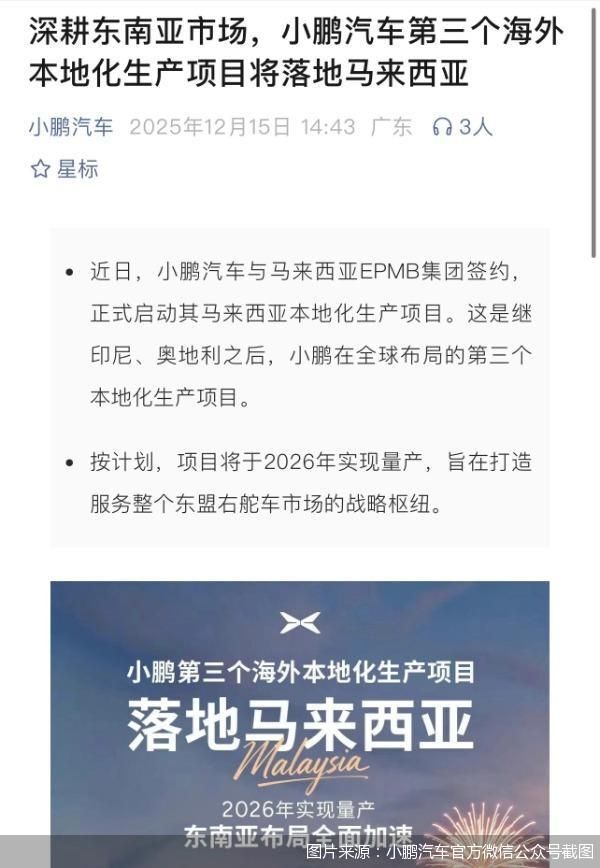
更多汽车出行资讯 …… 扫码可订阅产业日报 1.【小鹏汽车与EPMB签署车辆组装协议】12月15日,马来西亚汽车零部件制造商EPMB公告称,全 资子公司与小鹏汽车已于12月12日签署协议,将在马来西亚共同开展特定车辆项目的研发、制造、 生产及组装合作,子公司将为小鹏汽车组装G6车型及X9车型(含X9车型的增程电动汽车版本 ), G6车型计划于2026年3月31日前投产,X9车型计划于 2026年5月25日前 投产。(新浪财经) 2.【 中国首批L3级自动驾驶车型产品获得准入许可】 工信部正式公布中国首批L3级有条件自动驾驶 车型准入许可,两款分别适配城市拥堵、高速路段的车型将在北京、重庆指定区域开展上路试点,标 志着中国L3级自动驾驶从测试阶段迈入商业化应用的关键一步。 据了解,这次公布的两款车型,来自一南一北两个汽车生产厂家。重庆这家汽车企业生产的纯电动轿 车,可以实现在交通拥 堵环境下高速公路和城市快速路单车道内最高时速50公里的自动驾驶功能, 目前该功能仅限在重庆市有关路段开启。而北京的这家汽车企业生产的这款纯电动轿车,可以实现高 速公路和城市快速路单车道内最高时速80公里的自动驾驶功能,目前该功能仅限 ...