
中兴通讯

Search documents
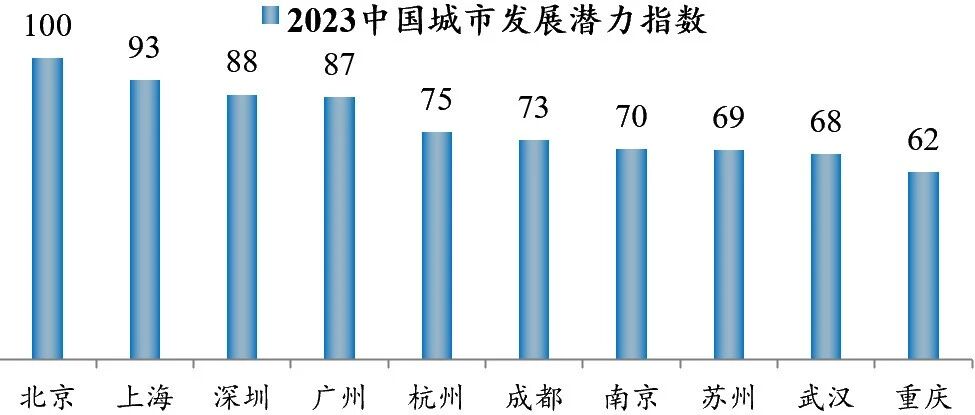
中国十大最具发展潜力城市
泽平宏观· 2026-02-20 16:05
Core Viewpoint - The article discusses the competitive landscape of Chinese cities, highlighting the rapid urbanization and the emergence of new economic centers, while ranking the development potential of 337 cities in China, with Beijing, Shanghai, Shenzhen, and others leading the list [2]. Group 1: Beijing - Beijing is positioned as the political, cultural, international exchange, and technological innovation center of China, with a GDP exceeding 4.1 trillion yuan in 2022, making it the second-largest city after Shanghai [9][10]. - The service sector accounts for 84% of Beijing's economy, with finance, headquarters economy, and technological innovation as key pillars [10]. - Future plans include transforming Beijing into a world-class harmonious city while optimizing population distribution to enhance urban vitality [11][13]. Group 2: Shanghai - Shanghai has established itself as an international economic center, with a GDP of approximately 4.5 trillion yuan in 2022, and aims to rival New York in global economic influence [16][24]. - The city’s industrial structure is supported by the automotive, electronics, and financial sectors, with finance contributing 19.3% to the GDP [17][19]. - Shanghai plans to continue its open policies and develop into a globally competitive city, enhancing the Yangtze River Delta region [24]. Group 3: Shenzhen - Shenzhen's GDP surpassed 3.2 trillion yuan in 2022, marking it as the third-largest city in China, with a significant annual population increase of around 600,000 [25][26]. - The city is recognized as a leading innovation hub, with strategic emerging industries accounting for over 41% of its GDP [26]. - Future initiatives focus on enhancing collaboration within the Guangdong-Hong Kong-Macau Greater Bay Area to solidify its status as a global innovation city [29]. Group 4: Guangzhou - Guangzhou's GDP reached approximately 2.9 trillion yuan in 2022, ranking fifth nationally, with a strong manufacturing base in automotive and electronics [30][31]. - The city faces challenges in innovation capacity and financial sector development, with financial services contributing only 9.2% to the GDP [33]. - Future goals include enhancing its role as a national center city and participating in global economic cooperation [34]. Group 5: Hangzhou - Hangzhou's economy has shown robust growth, with a GDP of around 1.9 trillion yuan in 2022, driven by a vibrant private and digital economy [36][37]. - The city is recognized for its strong digital economy, with core digital industries contributing 27.1% to the GDP [37]. - Plans for the future include improving transportation infrastructure and fostering a more open and innovative business environment [41][42]. Group 6: Chengdu - Chengdu's GDP exceeded 2 trillion yuan in 2022, accounting for 36.7% of Sichuan province's economy, and it is recognized as a key economic hub in Western China [43][44]. - The electronics sector is a major contributor, with a significant portion of the industrial output [44]. - Future strategies involve enhancing its role as a national center city and collaborating with Chongqing to develop the Western economic highland [49]. Group 7: Nanjing - Nanjing's GDP approached 1.7 trillion yuan in 2022, with a per capita GDP of 179,000 yuan, ranking fifth among major cities [50][51]. - The city is focusing on developing its automotive, steel, electronics, and petrochemical industries while nurturing emerging sectors [51]. - Future aspirations include becoming an "innovation city" and enhancing its influence in the Yangtze River Delta region [54]. Group 8: Suzhou - Suzhou's GDP reached nearly 2.4 trillion yuan in 2022, making it the top city among prefecture-level cities in China [56]. - The city is recognized as a global industrial powerhouse, with significant contributions from electronics and manufacturing sectors [56]. - Future plans emphasize its role in the Yangtze River Delta urban cluster and advancing towards a high-tech manufacturing base [59].

OpenAI创始人点赞中国大模型,国产方案成国际市场新宠
Jing Ji Guan Cha Bao· 2026-02-20 13:56
第二,开源生态的全球影响力。阿里通义千问Qwen系列开源模型下载量已反超Meta旗下的Llama,在硅 谷引发"Qwen恐慌"。英伟达CEO黄仁勋在2025 GTC大会上直言,Qwen已占据开源模型大部分市场份 额,且领先优势持续扩大。开源模式不仅降低了全球开发者的技术门槛,更通过全球协作加速模型迭 代,形成"降本算力—开源扩散—场景深耕—生态繁荣"的良性循环。 第三,垂直行业的深度渗透。中兴通讯的5G-A全栈解决方案集成算力引擎与智算一体机,将4K视频传 输时延降至50ms,支撑2025年春晚8K直播的实时字幕生成;腾讯云智能驾驶云专区通过跨区容灾架构 优化,使自动驾驶模型训练效率提升30%,车道线识别准确率达99.2%。这些案例表明,中国技术已从 实验室走向产业实战,在广电、汽车等关键领域构建起系统性优势。 面对中国的这种系统性发展模式,OpenAI似乎陷入了两难境地。如果继续闭门造车,无数开发者将被 吸引到更开放、自由的平台;而选择开源,则意味着失去部分商业控制权,却有望聚拢全球生态力量。 这种战略抉择背后,是技术实力与生态构建之间的博弈,也是全球科技格局的一次深度重塑。 OpenAI选择了后者。202 ...

春晚 21 芯,看懂中国半导体风向
是说芯语· 2026-02-20 01:00
Core Viewpoint - The 2026 CCTV Spring Festival Gala serves as a cultural feast and a showcase of the global chip industry, highlighting the advancements in China's chip technology from "usable" to "highly usable" [1][29] Group 1: Robotics Showcase - Four humanoid robots, MagicBot Z1, Galbot G1, Unitree H1, and "Little Bumi," showcased at the gala, demonstrating the capabilities of eight chip companies that support these "tech performers" [3][29] - MagicBot Z1 features 100% domestically produced core chips, with Allwinner Technology providing the main SoC chip for overall control and motion planning [4][5] - Galbot G1 relies on NVIDIA's AGX Orin 64GB chip, achieving 275 TOPS of computing power for AI interactions [6][7] - Unitree H1, the most commercially successful model, utilizes multiple chips including Intel's Core i7 for high-performance motion control and NVIDIA's Jetson Orin NX for edge AI inference [8][9][10][11] - "Little Bumi" targets the consumer market with a price under 10,000 yuan, using Rockchip's RK3588 SoC for approximately 6 TOPS of AI computing power [12][13][14] Group 2: Broadcasting Technology - The gala achieved 8K ultra-high-definition wireless broadcasting, supported by four chip companies that built the computational foundation [15][29] - Huawei's Hi3536DV400 chip enabled real-time compression of 8K video, while the Kunpeng 920S chip supported over 1 billion concurrent live requests [16][17] - AMD's EPYC 9004 series chips provided rendering power for real-time graphics during the event [18] Group 3: Communication Infrastructure - The seamless connection between the main venue and four sub-venues relied on three chip companies for communication technology [19][29] - Huawei's Tian Gang 02 base station chip facilitated low-latency transmission of 8K signals, marking the large-scale application of 5G-A technology [19] - ZTE and China Star Network contributed to the 5G-A network and satellite communication, ensuring stable signal transmission in remote areas [20][21] Group 4: Stage Control and Perception - The precise operation of stage lighting, robotic arms, and AR effects depended on three chip companies providing MCU, power chips, and perception chips [22][29] - GigaDevice's GD32H7 series MCU enabled rapid light switching and robotic movement control [23] - STMicroelectronics' IGBT power chips ensured stable operation of high-power stage equipment [24] - Orbbec provided depth perception chips for the Unitree H1 robot, enhancing spatial awareness and obstacle avoidance [25] Group 5: End-User Experience - The viewing experience for audiences was enhanced by three chip companies ensuring high-quality visuals and security [26][29] - Hisense's X9 image quality chip optimized 8K visuals for the gala [27] - Unisoc's financial-grade security chips safeguarded interactive data during the event [28] - BDU's BD960 positioning chip ensured synchronization of devices across different locations [29]



突发利好,24家公司受益股名单出炉!其中一家被社保独宠
Sou Hu Cai Jing· 2026-02-19 06:07
Core Insights - The 2026 Spring Festival Gala marked a significant shift with AI becoming the main attraction, integrating deeply into the event in unprecedented ways [1][11] Group 1: AI Application and Engagement - The core of this AI-driven event was the "Doubao" application from ByteDance, which played a crucial role as the exclusive AI cloud partner, contributing to both technical support and interactive segments [3][4] - "Doubao" launched a large-scale "Doubao New Year" campaign a week before the gala, featuring exciting lottery activities with over 100,000 high-tech prizes, including robots and electric vehicles, to engage the audience [3][4] Group 2: Technical Infrastructure - Behind the scenes, ByteDance's video generation model Seedance 2.0 was responsible for creating customized visual experiences for several performances, enhancing the overall viewer experience [6] - The AI server supply chain was led by Inspur Information, which provided high-performance servers equipped with NVIDIA H800 GPUs, crucial for supporting "Doubao" and the gala's high concurrency interactions [7] Group 3: Data and Content Supply - Hai Tian Rui Sheng, a leader in AI training data, supplied high-quality multimodal training data for "Doubao," while Visual China provided essential image and video content [9] - The marketing aspect was significantly supported by BlueFocus, which integrated "Doubao" into its marketing platform, facilitating AI-driven promotional activities for the gala [9] Group 4: Hardware and Software Collaboration - Zhongke Chuangda was designated as the sole system-level software partner for "Doubao," focusing on optimizing the AI's performance on various devices [8] - ZTE collaborated with "Doubao" to develop AI smartphones, while other companies provided essential components for AI-enabled devices, ensuring seamless integration of AI technology into consumer products [8]




Microsoft's Brad Smith says U.S. tech should ‘worry a little' about Chinese firms government subsidies
CNBC· 2026-02-18 16:25
Core Viewpoint - American tech companies face challenges from Chinese competitors due to significant government subsidies that support the development of AI technologies [2][3]. Group 1: Competitive Landscape - The competition between U.S. and Chinese companies in AI is intensifying, with U.S. firms having an advantage in access to powerful chips and technology innovation [2]. - Chinese AI companies have received substantial government support, including a multi-billion-dollar national investment fund and energy vouchers, which could make their lower-cost AI models appealing in developing nations [2][3]. Group 2: Historical Context - The approach taken by the Chinese government to subsidize companies has previously disrupted the telecommunications market, aiding firms like Huawei and ZTE while negatively impacting American and European companies [3]. - The existence of global data centers operated by Chinese firms like Huawei and Alibaba suggests that China can easily provide subsidies to enhance their competitive edge [3]. Group 3: Industry Response - There is a call for American companies to improve their competitiveness in light of Chinese subsidies, emphasizing the need for support from the U.S. government [3].



FINE2026火热招展!机器人轻量化/热管理,数据中心液冷、固态电池、AI芯片热管理......
DT新材料· 2026-02-18 16:04
Core Viewpoint - The 2026 Future Industries New Materials Expo (FINE 2026) aims to lead global innovation in new materials, emphasizing their critical role in the transformation of high-tech industries and future economic development [1][2]. Group 1: Event Overview - FINE 2026 will take place from June 10 to June 12, 2026, at the Shanghai New International Expo Center, featuring a total exhibition area of 50,000 square meters and over 300 strategic and cutting-edge technology reports [2][18]. - The expo will focus on popular innovations applicable to various industries, including artificial intelligence, aerospace, smart vehicles, and renewable energy, while addressing five common needs in future industries: advanced semiconductors, advanced batteries, lightweight functionalization, low-carbon sustainability, and thermal management [2][10]. Group 2: Historical Context and Participation - The previous editions of the expo, including the 2025 International Carbon Materials Expo and the 2025 Thermal Management Expo, achieved record attendance with over 35,000 professional visitors from 27 countries and regions, showcasing more than 500 exhibitors [7][36]. - The event is expected to attract over 100,000 professional visitors, including representatives from major companies such as BYD, Huawei, and Xiaomi, as well as over 5,000 industry investors [37][36]. Group 3: Thematic Focus and Special Features - FINE 2026 will feature seven specialized thematic exhibition areas, including advanced semiconductors, AI chips, thermal management, and sustainable materials, aiming to present a comprehensive chain of innovation from components to cutting-edge technologies [13][15]. - The expo will host over 30 forums with more than 300 renowned experts discussing trends in technology, investment strategies, and advanced manufacturing techniques related to new materials [22][24]. Group 4: Strategic Importance - The event is positioned as a critical opportunity for companies to connect with industry funds, government parks, and project resources, facilitating the integration of technological and industrial innovation in the new materials sector [2][10]. - The timing of the expo in June is highlighted as a strategic window for seizing business opportunities in the second half of the year, leveraging Shanghai's advantages as a major international exhibition platform [10].
这个春节,低空经济“忙坏了”
财联社· 2026-02-17 11:15
Core Viewpoint - The low-altitude economy is transitioning from a conceptual phase to large-scale commercial use, as evidenced by recent events and technological advancements in the sector [2][3][5]. Group 1: Low-altitude Economy Developments - The first eVTOL water airport, developed by Fengfei Aviation, was showcased during the Spring Festival, marking a significant milestone in low-altitude infrastructure [3][5]. - A record-breaking drone performance featured 22,580 drones, setting a Guinness World Record for the largest simultaneous drone flight, highlighting the technological capabilities within the low-altitude economy [5][13]. - The low-altitude flight network in the Yangtze River Delta is expanding, with routes connecting Shanghai to various locations, significantly reducing travel time for residents [6][7]. Group 2: Market Trends and Capital Involvement - In early 2026, WoFei ChangKong secured nearly 1 billion yuan in funding, marking the largest single financing round in the low-altitude economy sector this year [10][11]. - Financial institutions are shifting from being mere capital providers to strategic partners, actively engaging in the technological and industrial risks associated with low-altitude ventures [12]. - The low-altitude economy is projected to reach a market size of 1.5 trillion yuan by 2025, with significant growth in drone operations and eVTOL orders, indicating a robust demand for low-altitude services [13][15]. Group 3: Competitive Landscape - Companies are actively positioning themselves in the low-altitude economy, with established firms like WanFeng AoWei and ZhongShen Power making strategic acquisitions to enhance their product offerings [14]. - New entrants and established companies are collaborating to expand the industry, with firms like SF Express and ZTE entering the market, leveraging their existing capabilities to support low-altitude operations [14]. - The industry is expected to see five major trends in 2026, including refined airspace management and rapid development of low-altitude logistics, which will attract further investment [15].






中兴通讯公布国际专利申请:“信号发送和接收方法、通信装置、存储介质、及程序产品”
Sou Hu Cai Jing· 2026-02-16 10:01
Group 1 - The core point of the article is that ZTE Corporation (000063) has filed an international patent application for a technology related to signal transmission and reception, with the application number PCT/CN2025/082166 and an international publication date set for February 12, 2026 [1] - ZTE has announced a total of 184 international patent applications this year, which represents a decrease of 25.2% compared to the same period last year [1] - In the first half of 2025, ZTE invested 12.665 billion yuan in research and development, showing a slight decrease of 0.48% year-on-year [1]

未来已来 抢抓时代机遇!2026未来产业新材料博览会(6月10-12日 上海)
DT新材料· 2026-02-15 07:20
Core Viewpoint - The 2026 Future Industries New Materials Expo (FINE 2026) aims to lead global innovation in new materials, emphasizing their critical role in the transformation of high-tech industries and future economic development [1][2]. Group 1: Event Overview - FINE 2026 will take place from June 10 to June 12, 2026, at the Shanghai New International Expo Center, featuring a total exhibition area of 50,000 square meters and over 300 strategic and cutting-edge technology reports [2][18]. - The expo will focus on popular innovations applicable to various industries, including artificial intelligence, aerospace, smart vehicles, and renewable energy, while addressing five common needs in future industries: advanced semiconductors, advanced batteries, lightweight functionalization, low-carbon sustainability, and thermal management [2][10]. Group 2: Historical Context and Participation - The previous events, including the 2025 International Carbon Materials Expo and the 2025 Thermal Management Expo, achieved record attendance with over 35,000 professional visitors from 27 countries and regions, showcasing more than 500 exhibitors [7][36]. - The expected participation for FINE 2026 is over 100,000 professional visitors, with targeted invitations to over 5,000 industry investors to facilitate connections between startups and industry resources [35][37]. Group 3: Thematic Focus and Special Features - FINE 2026 will feature seven specialized thematic exhibition areas, including advanced semiconductors, AI chips, thermal management, and sustainable materials, aiming to present a comprehensive chain of innovation from components to cutting-edge technologies [13][15]. - The event will host over 30 forums with more than 300 renowned experts discussing trends in technology, investment strategies, and advanced manufacturing techniques related to new materials [22][24]. Group 4: Strategic Importance - The expo is positioned as a critical platform for technology transfer and industry innovation, leveraging China's growing influence in sectors like new energy vehicles, photovoltaics, and robotics, which are expected to create significant market opportunities for new materials [10][36]. - The timing of the event in June is seen as a strategic opportunity to capture business prospects for the second half of the year, supported by Shanghai's robust industrial and technological ecosystem [10][36].
2026年新股择股路径(一)-AI应用:AI应用春潮涌动,产业链次新股大盘点
Huajin Securities· 2026-02-15 05:24
Investment Rating - The report does not explicitly provide an investment rating for the companies discussed. Core Insights - AI technology is reshaping various industries, with significant advancements in AI models and applications, particularly following the launch of OpenAI's ChatGPT-3.5 in November 2022, which marked the beginning of a new era in artificial intelligence [2][15] - Several newly listed companies in the A-share market have integrated AI technology into their operations, seizing opportunities in the AI development strategy across various sectors, including agriculture, office, retail, medical, energy, and consumer fields [2] Summary by Sections AI Applications Surge - AI models are rapidly evolving, with diverse applications emerging across different sectors, driven by advancements from companies like OpenAI, Google, and others [15] - The commercial success of AI applications is evident in products like AI smart glasses, AI toys, and intelligent driving systems, which are gaining popularity and transforming consumer experiences [15][18][19][30] Representative New Stocks in AI - **Top Cloud Agriculture**: A leading company in smart agriculture, developing pest recognition algorithms and smart agricultural products like AR glasses and robotic dogs for field inspections [58][64] - **Hehe Information**: Focused on AI in office applications, offering products like TextIn and Qixin Huiyan that leverage AI for document processing and data analysis [72][74] - **Hanshu Technology**: A provider of digital solutions for retail, including smart shopping carts and AI cameras, enhancing the shopping experience through technology [89][91] - **Chao Yan Co., Ltd.**: Engaged in AI medical diagnostics, offering innovative products for breast cancer screening and ultrasound imaging systems for minimally invasive surgeries [99][108] - **Southern Network Digital**: Concentrating on digital solutions for energy, developing core products like the "Electric Hong" IoT operating system [2] - **Ying Shi Innovation**: Focused on consumer applications, creating AI algorithms for content creation in products like panoramic action cameras [2] Industry Trends - AI technology is deeply embedded in various sectors, including e-commerce, finance, government, energy, and education, demonstrating its commercial viability and transformative potential [44][53] - The AI toy market is projected to exceed 100 billion yuan by 2030, with a compound annual growth rate (CAGR) of over 50% [20] - The report highlights the increasing integration of AI in daily life, enhancing efficiency in personal and work scenarios, such as energy management and document processing [38][43]