
洋河股份

Search documents
LP圈发生了什么
投资界· 2026-02-15 07:32
Core Insights - The article highlights a surge in investment activities across various regions in China, with multiple new funds being established to support strategic industries and innovation [2][3][4][5][6][7][8][9][10][11][12][13][14][15][16][17][18][19][20][21][22][23][24] Group 1: Fund Establishments - Jiangsu Province launched a strategic emerging industry mother fund with a total scale of 69.1 billion yuan, contributing to a total fund cluster of 275.6 billion yuan [2] - The 100 billion yuan Zijinshan International Science and Technology Innovation Mother Fund was announced, focusing on the advanced manufacturing cluster in Nanjing [3] - Hunan Province unveiled a 100 billion yuan fund aimed at aerospace and marine industries, marking a significant investment in military-civilian integration [4] - Suqian City initiated a 65 billion yuan mother fund to support industrial development and smart manufacturing [5][6] - Nantong's Baoyuehu Science and Technology Innovation Mother Fund Phase II was established with a total scale of 50 billion yuan, focusing on AI and hard technology industries [7] Group 2: Sector-Specific Funds - Shandong Province registered a 10 billion yuan AI venture capital fund, targeting the new generation information technology industry [8] - Tianjin's first government investment fund in the Peace District was established with a scale of 300 million yuan, focusing on AI applications [9] - Shanghai's Zhang Keheng Phase II fund, with a target scale of 1 billion yuan, focuses on innovative pharmaceuticals and medical devices [10] - Jiangsu's Xuzhou New Emerging Industry Mother Fund, with a total scale of 3 billion yuan, aims to empower industries like integrated circuits and green technology [19] - The 80 billion yuan fund in Huai'an will focus on advanced manufacturing and strategic emerging industries [24] Group 3: Collaborative Efforts - The Xiangqiong Fund, with a total scale of 500 million yuan, aims to enhance cross-regional investment collaboration between Hunan and Hainan [11] - The Longjiang Huangshi Health Fund, with a scale of 300 million yuan, focuses on the biopharmaceutical and health industry [16] - The establishment of the Shanghai Futen Medical Fund marks a significant step in the healthcare investment landscape, with an initial fundraising of 410 million yuan [17]


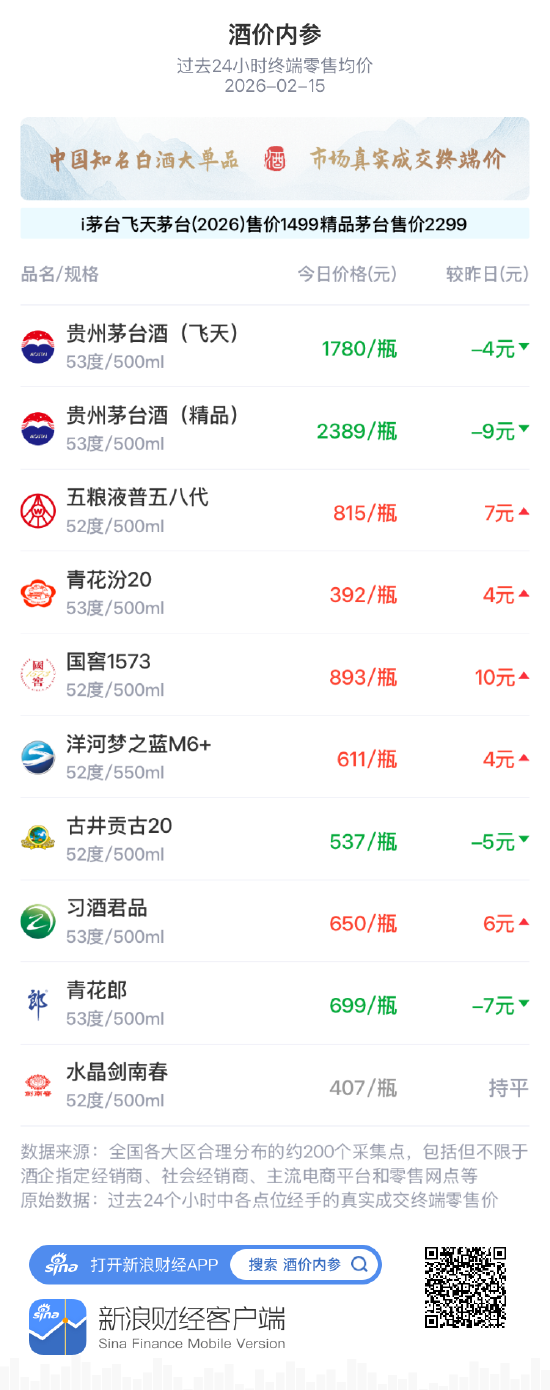
酒价内参2月15日价格发布 总价小幅回升节前走势分化
Xin Lang Cai Jing· 2026-02-15 01:13
Core Insights - The article discusses the recent trends in the Chinese liquor market, specifically focusing on the retail prices of the top ten baijiu products, which showed a mixed performance with some prices increasing while others decreased [1][6]. Price Trends - As of February 15, the total retail price for a package of the top ten baijiu products was 9,173 yuan, reflecting a slight increase of 6 yuan from the previous day [1][6]. - Among the ten products, five saw price increases, four experienced declines, and one remained unchanged [1][6]. Individual Product Performance - The products that increased in price included: - Guojiao 1573, which rose by 10 yuan per bottle [1][6]. - Wuliangye Pu 58th generation and Xijiu Junpin, which increased by 7 yuan and 6 yuan per bottle, respectively [1][6]. - Qinghua Fen 20 and Yanghe Dream Blue M6+, both of which rose by 4 yuan per bottle [1][6]. - The products that decreased in price included: - Premium Moutai, which fell by 9 yuan per bottle [1][6]. - Qinghua Lang, which decreased by 7 yuan per bottle [1][6]. - Gujing Gonggu 20, which dropped by 5 yuan per bottle [1][6]. - Feitian Moutai, which saw a minor decline of 4 yuan per bottle [1][6]. - The price of Shuijing Jian Nan Chun remained stable at 407 yuan per bottle [1][6]. Market Analysis - The data for the "Liquor Price Reference" is collected from approximately 200 sampling points across various regions, including designated distributors, social distributors, e-commerce platforms, and retail outlets [4][9]. - The introduction of the iMoutai platform selling Feitian Moutai at 1,499 yuan and Premium Moutai at 2,299 yuan has begun to influence market prices significantly [4][9]. - Lin Yuan, chairman of Linyuan Investment, indicated that the price reform for core products on the iMoutai platform could have profound implications for the company and the industry, potentially opening up new sales growth opportunities [4][9]. - The analysis suggests that the demand for high-end baijiu remains strong, with a significant supply-demand gap still present [4][9].






中国消费名品名单公布,江苏+20
Sou Hu Cai Jing· 2026-02-14 12:12
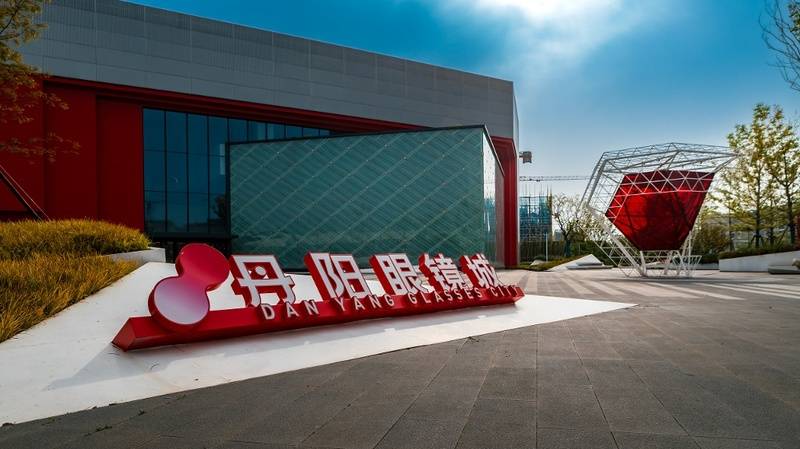
Core Viewpoint - Jiangsu Province has 20 brands recognized in the latest 2025 China Consumer Brand List, highlighting the province's commitment to high-quality consumer goods and brand development [1][3]. Group 1: Brand Recognition - The "China Consumer Brand" list includes 276 brands, consisting of 165 enterprise brands, 76 regional brands, and 35 brands for specific demographics [1][3]. - Notable brands from Jiangsu include Yanghe and Hengshun as "Historical Classics," while brands like Shenghong, Hongdou, and Saint Elephant are recognized as "Era Quality Products" [3]. Group 2: Regional Brands - Five regional brands from Jiangsu are recognized: Danyang Glasses, Changshu Outdoor Sportswear, Yixing Ceramics, Hangji Toothbrush, and Xinghua Condiments [3][13]. Group 3: Specific Demographic Brands - Brands catering to specific demographics include Goodbaby and Gong An Kang for "Maternal and Child Products," and Su Yun for "Assistive Products" [3][19]. Group 4: Compliance and Support - Companies on the list are required to operate with integrity, fulfill social responsibilities, and continuously provide high-quality products and services [3][19]. - Local governments will enhance promotion and support for these recognized brands, aiming to cultivate distinctive industries and quality consumer brands [3].


一周快讯丨上海未来产业基金又出资了;总规模65亿,宿迁两支产业母基金完成备案;长三角生态绿色一体化发展示范区投资基金招GP
FOFWEEKLY· 2026-02-14 09:20
Group 1 - The article highlights the establishment of various mother funds across different regions in China, focusing on sectors such as artificial intelligence, medical devices, and high-end manufacturing [2][4][6] - A significant fund cluster exceeding 70 billion yuan was launched in Nanjing, emphasizing early-stage investments in hard technology [4][6] - The Hunan province has set a target scale of 100 billion yuan for its aerospace and marine fund, while Hubei has introduced a 30 billion yuan fund focusing on artificial intelligence [2][29][30] Group 2 - The Shanghai Future Industry Fund announced plans to establish nine sub-funds, indicating a strong commitment to supporting innovative sectors [3] - The Jiangsu province has launched a 100 billion yuan market-oriented mother fund aimed at fostering long-term competitive enterprises [4][6] - The establishment of a 50 billion yuan second phase of the Baoyuehu Science and Technology Mother Fund in Nantong, focusing on AI and deep integration industries, was also noted [9] Group 3 - The Sichuan and Chongqing regions are actively selecting general partners for mother funds, indicating a concentrated effort to enhance investment in emerging technologies [2][6] - The establishment of a 20 billion yuan low-altitude economy fund in Chongqing aims to support the aerospace and low-altitude economy sectors [28] - The article mentions the successful registration of a 3 billion yuan health industry investment fund in Huangshi, focusing on biomedicine and health sectors [31] Group 4 - The article discusses the establishment of various funds targeting specific industries, such as the 10 billion yuan agricultural high-quality development fund in Guangdong [36] - The Shanghai Integrated Circuit Industry Investment Fund increased its capital to 60.3 billion yuan, reflecting a significant growth of approximately 1038% [34] - The establishment of a 20 billion yuan fund in Jiangsu by China Life and other partners focuses on AI, integrated circuits, and biomedicine [42] Group 5 - The article notes the establishment of a 2 billion yuan fund in Hechi, focusing on key metals, biomedicine, semiconductor materials, and AI [25] - The announcement of a 10 billion yuan fund in Ningxia aims to enhance the resilience and safety of industrial supply chains [21][22] - The establishment of a 10 billion yuan urban renewal development fund in Sanhe focuses on projects related to urban infrastructure and development [23]

Wine Paris 2026观察:白葡萄酒展位扩大、中国进口商减少
Sou Hu Cai Jing· 2026-02-14 07:49
2月9日,2026巴黎国际葡萄酒及烈酒展览会(Wine Paris)在巴黎开幕。作为全球规模最大的葡萄酒专 业展会,热度依旧。本次Wine Paris 2026中,WBO也观察到一些趋势,起泡酒、白葡萄赛道持续升温, 从无酒精饮品独立成馆,中国葡萄酒受到称赞,到中国进口商身影缩减,都蕴藏着全球酒饮市场的变 化,这些变化也意味着新的机会。 1 中国进口商面孔有所减少 从现场的展厅导览指示牌可见,展会的核心展馆布局清晰。5号馆与2.1号馆聚焦国际意大利产区,7号 馆主打法国产区,4/6号馆为国际综合展区,2.2/2.3号馆则以烈酒主题 "Be Spirits" 为特色,2.1同时也是 Be No无酒精饮品的独立首秀。 展会期间,中国进口商缺席现象尤为突出,从时间节点来看,展会举办正值中国传统春节前夕,这是进 口商缺席的直接客观因素。春节作为国内酒类消费的核心旺季,进口商此时的核心精力集中在国内终端 备货、库存消化及渠道动销上,参与国际展会的优先级大幅降低。有参展商告诉WBO:"现场中国乃至 东亚面孔寥寥无几。"另外,也有往年观展的国内某大型进口酒运营商的采购负责人表示,今年并未观 展。 贝玛格雷相关负责人表示:" ...


酒价内参2月14日价格发布 总价回落至周内低位分化走势延续
Xin Lang Cai Jing· 2026-02-14 01:16
Core Insights - The "Wine Price Reference" by Sina Finance has launched, providing real-time data on the retail prices of major Chinese liquor brands, indicating a recent decline in prices after a period of high stability [1][7]. Price Trends - The average retail price of the top ten liquor products in China on February 14 was 9,167 yuan, a decrease of 22 yuan from the previous day, marking a low point for the week [1][7]. - Among the ten products, four saw price increases, five experienced declines, and one remained stable, indicating a mixed market performance [4][10]. Specific Product Pricing - Key price changes include: - Guizhou Moutai (Flying) at 1,784 yuan, down 6 yuan - Guizhou Moutai (Boutique) at 2,398 yuan, down 17 yuan - Wuliangye at 808 yuan, unchanged - Qinghua Fen at 388 yuan, up 4 yuan - Guojiao 1573 at 883 yuan, down 2 yuan - Yanghe Dream Blue M6+ at 607 yuan, down 6 yuan - Ancient Well Tribute at 542 yuan, up 4 yuan - Xijiu Junpin at 644 yuan, down 8 yuan [2][4][9]. Market Analysis - The data is sourced from approximately 200 collection points across various regions, including designated distributors and major e-commerce platforms, aiming to provide an objective and traceable market price reference [5][11]. - According to Huachuang Securities, the liquor sector is currently at a dual bottom in expectations and holdings, with the upcoming Spring Festival expected to boost sales, particularly for leading brands like Guizhou Moutai and Wuliangye [5][11].
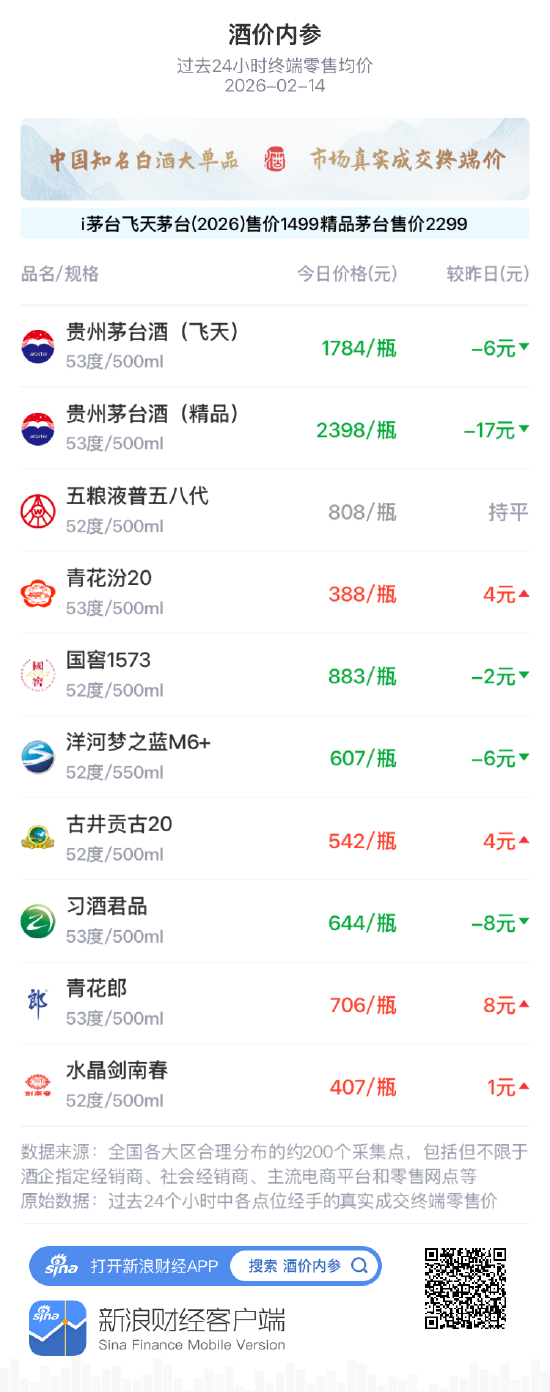
酒价内参2月14日价格发布 青花汾20上涨4元/瓶
Xin Lang Cai Jing· 2026-02-14 01:16
Core Insights - The article highlights the launch of "Wine Price Reference" by Sina Finance, which provides real-time data on the retail prices of major Chinese liquor brands, indicating a recent decline in prices after a period of high stability [1][7]. Price Trends - The average retail price of the top ten Chinese liquor products on February 14 was 9,167 yuan, a decrease of 22 yuan from the previous day, marking a low point for the week [1][7]. - Among the ten products, four saw price increases, five experienced declines, and one remained stable, indicating a mixed market performance [4][10]. Specific Product Pricing - Key price changes include: - Guizhou Moutai (Flying) at 1,784 yuan, down 6 yuan - Guizhou Moutai (Premium) at 2,398 yuan, down 17 yuan - Wuliangye at 808 yuan, unchanged - Qinghua Fen at 388 yuan, up 4 yuan - Guojiao 1573 at 883 yuan, down 2 yuan - Yanghe Dream Blue M6+ at 607 yuan, down 6 yuan - Guxi Gong at 542 yuan, up 4 yuan - Xijiu Junpin at 644 yuan, down 8 yuan [2][4][9]. Market Analysis - The report from Huachuang Securities indicates that the liquor sector is currently at a dual bottom in expectations and holdings, with the upcoming Spring Festival expected to boost sales [5][11]. - The analysis suggests that the market is transitioning from passive responses to proactive adjustments, with a focus on the stability of Moutai prices as a key observation point for investment opportunities [5][11].
白酒稳基盘、低度酒寻增量:中国酒类市场的结构分化与投资机会
QYResearch· 2026-02-14 00:48
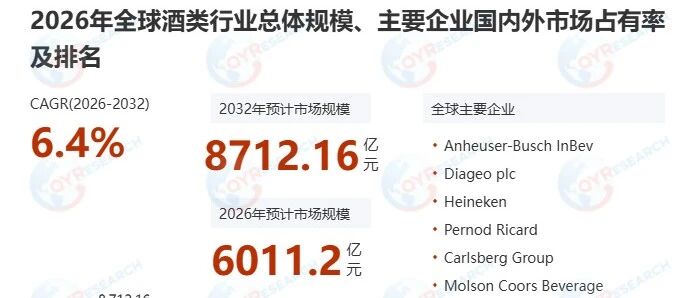
Core Insights - The Chinese alcoholic beverage market is projected to reach USD 254.1 billion by 2032, with a CAGR of 6.63% during the forecast period [2] - The market is highly concentrated, with baijiu (Chinese liquor) expected to account for 78.57% of revenue by 2025, significantly higher than beer (11.22%) and other categories [2] Market Structure - Baijiu dominates the market, while beer is experiencing a shift towards premiumization and craft options, and low-alcohol/no-alcohol products are gaining traction among new consumer demographics [2] - The structure indicates that the base of the market is determined by baijiu, but growth and structural changes are driven by the premiumization of beer and the penetration of low-alcohol products [2] Technical Features and Product Classification - The alcoholic beverage industry is characterized by a combination of raw material systems, fermentation/distillation processes, aging systems, blending capabilities, and packaging/channel adaptation, which ultimately contribute to brand premium and price segmentation [5] - Baijiu is defined by solid-state fermentation and aging techniques, leading to high margins and strong brand characteristics, but also slower capacity ramp-up and sensitivity to inventory and pricing [5] - Beer is the most industrialized, focusing on scale and channel efficiency, with recent competition shifting towards high-end and craft products [5] Competitive Landscape - The Chinese market shows a concentration in baijiu, with leading companies like Kweichow Moutai and Wuliangye dominating the high-end segment, while regional players seek growth through local market penetration [7] - The beer market is characterized by competition among major players like Tsingtao Brewery and China Resources Snow Breweries, focusing on product upgrades and channel penetration [8] - The wine and yellow wine markets are smaller, where brand and channel efficiency are more critical than scale [9] Future Trends and Challenges - Over the next 3-5 years, the market is expected to stabilize with baijiu, while beer will focus on premiumization and low-alcohol/no-alcohol products will drive growth [17] - Challenges include consumer segmentation, price pressure, raw material cost fluctuations, and stricter regulatory requirements [20]
洋河蓝,时代梦
Xin Hua Ri Bao· 2026-02-13 21:47
Core Viewpoint - The article emphasizes the deep connection between the Yanghe brand and various national dreams, including space exploration, technological advancement, sports, and cultural heritage, showcasing its commitment to these ideals through various initiatives and partnerships [1][3][4][6][8]. Group 1: Space Dream - Yanghe has a long-standing association with China's space exploration, dating back to the 1970s with its "Flying to the Sky" dream, symbolized by the Dunhuang goddess on its bottles [2]. - The company actively participates in significant moments of China's space achievements, such as the "Million Space Partners Program" and live broadcasts of important space missions [3]. - In 2025, Yanghe collaborated with CCTV to witness and celebrate the launches of Shenzhou spacecraft and commemorated these events with special edition liquor [3]. Group 2: Technology Dream - Yanghe's brand advertisement "Sea and Sky Dreams, Chinese Power" resonated with the public, reflecting a strong sense of national pride and identity [4]. - The company has consistently been present at key national events over the years, reinforcing its commitment to the nation's progress and its own brand identity [4]. Group 3: Sports Dream - Yanghe emphasizes the relationship between sports and national strength, supporting various sporting events and teams, including marathons and basketball [6]. - In 2025, Yanghe engaged with local marathons and partnered with sports teams, promoting a culture of sportsmanship and community involvement [6]. Group 4: Cultural Dream - Yanghe has been a long-term partner of the CCTV Spring Festival Gala, enhancing its brand visibility and cultural significance during this major event [8]. - The company has initiated cultural preservation activities and participated in international events, promoting Chinese culture globally [8].
江苏洋河酒厂股份有限公司2026年第一次临时股东会决议公告
Shang Hai Zheng Quan Bao· 2026-02-13 17:46
Meeting Overview - The 2026 first extraordinary general meeting of Jiangsu Yanghe Brewery Co., Ltd. was held on February 13, 2026, combining on-site and online voting methods [4] - The meeting was convened by the board of directors and chaired by Chairman Gu Yu, complying with relevant laws and regulations [4] - A total of 3,745 participants attended the meeting, representing 1,079,872,211 shares, which is 71.6835% of the total voting shares [5] Voting Results - The proposal to revise the dividend return plan was approved with 1,066,238,473 votes in favor, accounting for 98.7375% of the valid votes [6] - The dissenting votes totaled 12,575,743, representing 1.1646% of the valid votes, while 1,057,995 votes were abstained [6] - Among minority shareholders, 140,679,471 votes supported the proposal, which is 91.1649% of the minority shareholders' valid votes [6][7] Legal Opinion - The meeting was witnessed by lawyers from Jiangsu Century Tongren Law Firm, who confirmed that the meeting's procedures and voting were in compliance with legal and regulatory requirements [7]