银华

Search documents
今年以来50只主动权益类基金清算 发起式基金频现
Shen Zhen Shang Bao· 2025-07-16 06:00
Core Insights - Despite a strong performance in the A-share market this year, many public equity funds are facing liquidation due to shrinking scales, with 50 active equity funds already liquidated in 2023 [1] - The automatic liquidation of funds is often triggered when their net asset value falls below 200 million yuan after three years of operation [2] Group 1: Fund Liquidation - A total of 6 active equity funds entered liquidation in July 2023, with reasons varying, including automatic termination of fund contracts without the need for a shareholder meeting [1] - The Bank of China Securities Huize Jinque 3-Month Holding Fund, established on July 7, 2022, was liquidated due to insufficient net asset value, with a scale of only 0.28 million yuan [1][2] - Several initiated funds, such as Shenwan Hongyuan's specialized theme fund, are also facing liquidation due to their net asset values falling below the required threshold [1][2] Group 2: Initiated Funds Characteristics - Initiated funds are defined as those established by fund managers or executives who invest at least 10 million yuan and hold it for a minimum of three years [2] - If the fund's scale is below 200 million yuan after three years, it will automatically liquidate [2] - Some initiated funds have issued liquidation warnings, indicating potential issues in popular sectors like artificial intelligence and healthcare [2] Group 3: Performance Analysis - Poor performance is a significant reason for the shrinking scale of funds, with some funds experiencing substantial declines in net value [2][3] - For instance, the Shangyin New Energy Industry Selected Fund A, launched in April 2022, saw a cumulative return of -53.43% over three years [2] - Conversely, some initiated funds, such as Yinhua Digital Economy and Dongfanghong Medical Upgrade, have successfully surpassed 1 billion yuan in scale, indicating strong performance [2][3]
麦高视野:ETF观察日志(2025-07-11)
Mai Gao Zheng Quan· 2025-07-14 06:33
- The report introduces the **RSI (Relative Strength Index)** as a quantitative factor, constructed to measure market conditions by comparing average gains and losses over a 12-day period. The formula is: $ RSI = 100 - 100 / (1 + RS) $ where RS represents the ratio of average gains to average losses over the specified period. RSI values above 70 indicate overbought conditions, while values below 30 suggest oversold conditions [2] - Another quantitative factor mentioned is **Net Purchase Amount (NETBUY)**, which calculates the net inflow or outflow of funds for ETFs. The formula is: $ NETBUY(T) = NAV(T) - NAV(T-1) * (1 + R(T)) $ where NAV(T) is the net asset value of the ETF on day T, NAV(T-1) is the net asset value on the previous day, and R(T) is the return on day T [2] - The report also tracks **Institutional Holdings Ratio**, which estimates the proportion of ETF shares held by institutions based on the latest annual or semi-annual reports. This excludes holdings by linked funds and may involve approximations due to data limitations [3] - The report provides **daily intra-day price trends** for ETFs using 5-minute interval data, highlighting the highest and lowest prices of the day with red markers. However, some data gaps may exist due to limitations in the source [2] - The report categorizes ETFs into "Broad-based" and "Thematic" groups based on the indices they track, such as major indices like CSI 300, CSI 500, and industry-specific indices like Non-bank Financials and Red Chips [2] - The report includes a detailed table of ETF performance metrics, such as RSI values, net purchase amounts, trading volumes, management fees, institutional holdings ratios, and T+0 trading availability. For example, the RSI for CSI 300 ETFs ranges from 68.14 to 75.77, while institutional holdings ratios vary significantly across ETFs [4] - The report highlights thematic ETFs such as **Consumption Electronics**, **Non-bank Financials**, **Renewable Energy**, **Semiconductors**, and **Artificial Intelligence**, providing metrics like RSI, net purchase amounts, and institutional holdings ratios. For instance, the RSI for Consumption Electronics ETFs ranges from 59.68 to 60.40, while institutional holdings ratios range from 23.10% to 58.47% [6] - The report also includes performance metrics for international ETFs tracking indices like the **Hang Seng**, **Nikkei 225**, **Nasdaq 100**, and **S&P 500**, with RSI values ranging from 46.50 to 72.83 and institutional holdings ratios varying widely [4][6]
稀土ETF领涨,机构:稀土价格有望迎来上涨丨ETF基金日报
2 1 Shi Ji Jing Ji Bao Dao· 2025-07-11 03:18
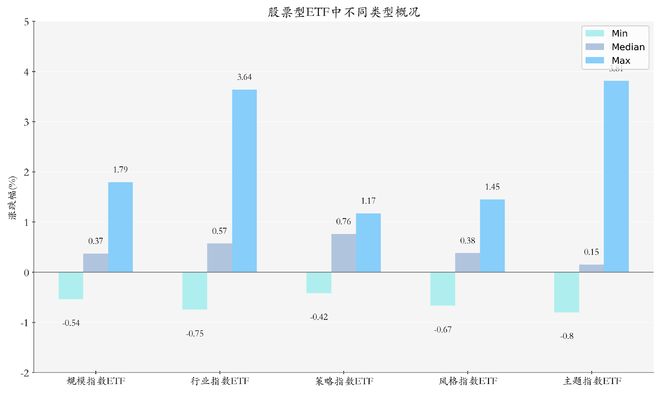
Market Overview - The Shanghai Composite Index rose by 0.48% to close at 3509.68 points, with a daily high of 3526.59 points [1] - The Shenzhen Component Index increased by 0.47% to close at 10631.13 points, reaching a high of 10667.41 points [1] - The ChiNext Index saw a smaller increase of 0.22%, closing at 2189.58 points, with a peak of 2199.71 points [1] ETF Market Performance - The median return for stock ETFs was 0.36%, with the highest return from the MSCI China A50 ETF at 1.79% [2] - The highest performing sector ETF was the China Securities Real Estate ETF, which returned 3.64% [2] - The top three ETFs by return were: - Fortune MSCI China A50 ETF (3.81%) - China Securities Real Estate ETF (3.64%) - Yinhua China Securities Mainland Real Estate Theme ETF (3.55%) [4] ETF Fund Flow - The top three ETFs by fund inflow were: - Huaxia SSE Sci-Tech 50 ETF with an inflow of 1.228 billion yuan - Guotai Junan China Securities Coal ETF with an inflow of 574 million yuan - Penghua China Securities Wine ETF with an inflow of 402 million yuan [6] - The largest outflows were from: - Huaxia SSE Sci-Tech 100 ETF with an outflow of 317 million yuan - Southern China Securities 1000 ETF with an outflow of 227 million yuan - Morgan Stanley China A50 ETF with an outflow of 199 million yuan [6] Financing and Margin Trading - The highest financing buy amounts were for: - Huaxia SSE Sci-Tech 50 ETF (573 million yuan) - Guotai Junan China Securities ETF (257 million yuan) - Yinhua ChiNext ETF (226 million yuan) [8] - The highest margin sell amounts were for: - Huatai-PB SSE 300 ETF (27.858 million yuan) - Huaxia SSE 50 ETF (21.416 million yuan) - Southern China Securities 500 ETF (3.836 million yuan) [8] Industry Insights - Guotai Junan Securities forecasts a potential rise in rare earth prices due to increasing demand and supply constraints, particularly looking towards the second half of 2025 [9] - Dongguan Securities expresses optimism for the rare earth industry, citing recovering export demand and growth opportunities in emerging fields like humanoid robots [10]

多只产品份额创新高 6月以来逾200亿元涌入港股主题ETF
Shang Hai Zheng Quan Bao· 2025-07-04 19:00
Group 1 - The Hong Kong stock market is becoming a new focus for capital, with over 20 billion yuan flowing into Hong Kong-themed ETFs since June, leading to record high shares for several ETFs [2][3] - Major public funds are optimistic about the long-term investment value of the Hong Kong market and plan to increase their allocations [2][4] - As of July 3, 2023, the net subscription amount for Hong Kong-themed ETFs reached 209.68 billion yuan, with significant inflows into sectors like innovative pharmaceuticals, technology, and dividends [3][4] Group 2 - Southbound capital has become a crucial support for the Hong Kong stock market, with a net inflow of over 690 billion yuan this year, nearly double that of the same period last year [5][6] - The performance of the Hong Kong stock market in the first half of the year was driven by the revaluation of Chinese technology assets, substantial southbound capital inflows, and the market being in a valuation trough [6][7] - Future investment opportunities in the Hong Kong market are expected to focus on policy support, technological iterations, and capital allocation preferences, particularly in technology, innovative pharmaceuticals, and high-dividend assets [7]
麦高视野:ETF观察日志(2025-07-03)
Mai Gao Zheng Quan· 2025-07-04 08:59
Quantitative Factors and Construction Methods 1. Factor Name: RSI (Relative Strength Index) - **Factor Construction Idea**: RSI measures the relative strength of price movements over a specific period to identify overbought or oversold market conditions[2] - **Factor Construction Process**: - The formula for RSI is: $ RSI = 100 - \frac{100}{1 + RS} $ where $ RS $ is the ratio of the average gain to the average loss over a 12-day period[2] - RSI > 70 indicates an overbought market, while RSI < 30 indicates an oversold market[2] - **Factor Evaluation**: RSI is a widely used technical indicator for short-term market sentiment analysis[2] 2. Factor Name: Net Subscription (NETBUY) - **Factor Construction Idea**: This factor calculates the net subscription amount of ETFs to gauge investor demand[2] - **Factor Construction Process**: - The formula for NETBUY is: $ NETBUY(T) = NAV(T) - NAV(T-1) \times (1 + R(T)) $ where $ NAV(T) $ is the net asset value on day T, $ NAV(T-1) $ is the net asset value on the previous day, and $ R(T) $ is the return on day T[2] - **Factor Evaluation**: This factor provides insights into the capital flow dynamics of ETFs, reflecting investor sentiment and market positioning[2] --- Factor Backtesting Results 1. RSI Factor - **HS300 ETFs**: RSI values range from 60.24 to 70.30, with most ETFs hovering around the overbought threshold of 70[4] - **CSI500 ETFs**: RSI values range from 66.04 to 66.37, indicating moderate strength[4] - **CSI800 ETFs**: RSI values range from 69.54 to 71.77, with some ETFs entering overbought territory[4] - **CSI1000 ETFs**: RSI values range from 63.76 to 64.97, suggesting neutral to slightly strong market conditions[4] - **Thematic ETFs**: RSI values vary significantly, with some themes like "New Energy" reaching as high as 74.71, while others like "Semiconductors" remain around 50[6] 2. Net Subscription Factor - **HS300 ETFs**: Net subscription values range from -6.69 billion to 1.51 billion, indicating mixed investor sentiment[4] - **CSI500 ETFs**: Net subscription values range from -2.65 billion to 0.54 billion, reflecting weak demand[4] - **CSI800 ETFs**: Net subscription values range from 0.00 billion to 0.45 billion, showing stable capital flows[4] - **CSI1000 ETFs**: Net subscription values range from -2.69 billion to 0.55 billion, indicating varied investor interest[4] - **Thematic ETFs**: Net subscription values vary widely, with some themes like "Semiconductors" showing strong inflows (up to 6.28 billion), while others like "Consumer Electronics" exhibit moderate inflows (up to 1.15 billion)[6]
两市ETF两融余额增加8903万元丨ETF融资融券日报
Sou Hu Cai Jing· 2025-07-04 02:57
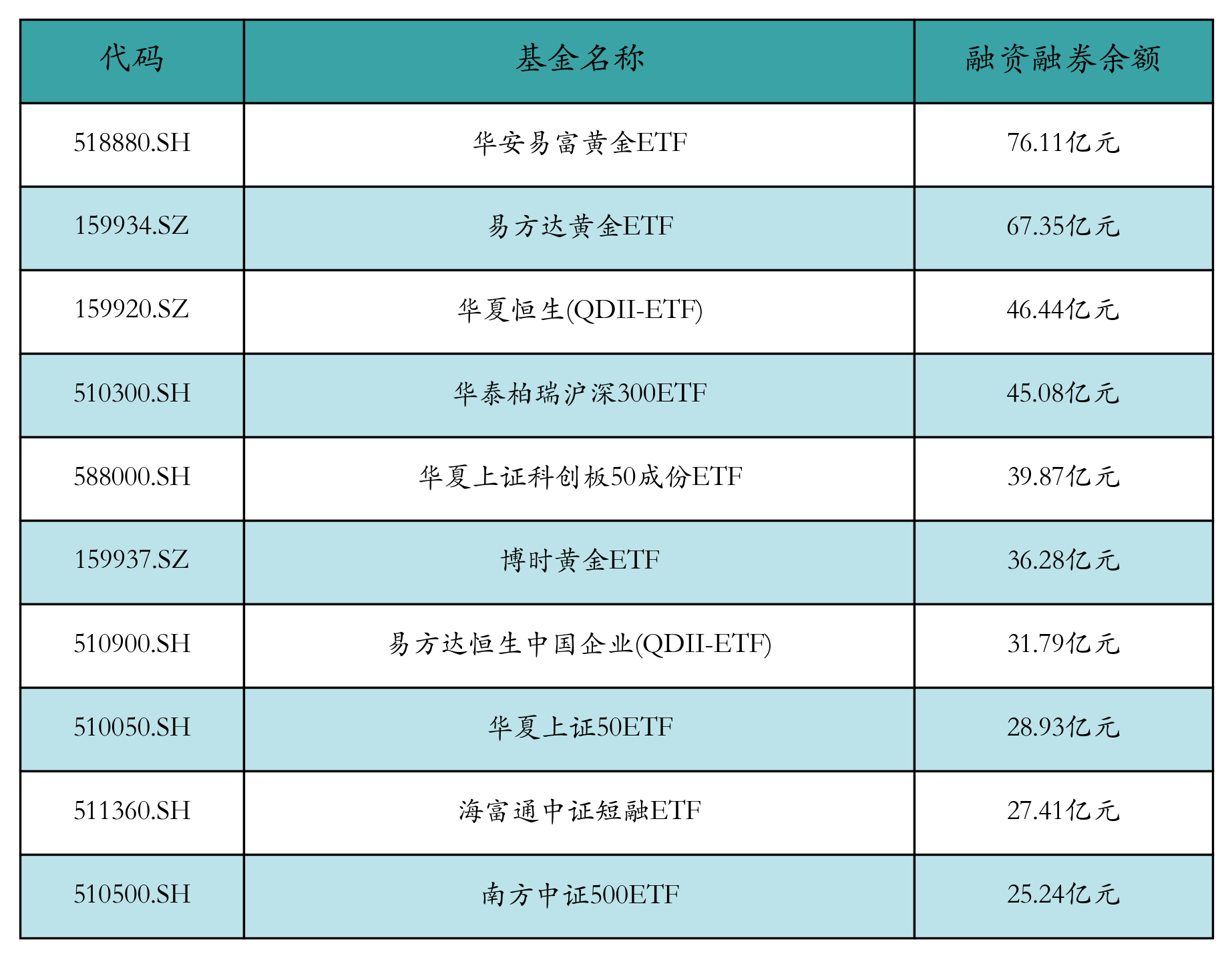
Market Overview - As of July 3, the total ETF margin balance in the two markets reached 98.919 billion yuan, an increase of 89.0306 million yuan from the previous trading day [1] - The financing balance was 93.13 billion yuan, with an increase of 4.6022 million yuan, while the margin short balance was 5.789 billion yuan, increasing by 84.4284 million yuan [1] - In the Shanghai market, the ETF margin balance was 65.607 billion yuan, up by 2.58 billion yuan, with a financing balance of 60.619 billion yuan, increasing by 1.75 billion yuan [1] - In the Shenzhen market, the ETF margin balance was 33.312 billion yuan, down by 1.69 billion yuan, with a financing balance of 32.511 billion yuan, decreasing by 1.7 billion yuan [1] Top ETF Margin Balances - The top three ETFs by margin balance on July 3 were: 1. Huaan Yifu Gold ETF (7.611 billion yuan) 2. E Fund Gold ETF (6.735 billion yuan) 3. Huaxia Hang Seng (QDII-ETF) (4.644 billion yuan) [2] Top ETF Financing Buy Amounts - The top three ETFs by financing buy amounts on July 3 were: 1. E Fund CSI Hong Kong Securities Investment Theme ETF (1.007 billion yuan) 2. GF CSI Hong Kong Innovative Medicine (QDII-ETF) (898 million yuan) 3. Hai Fu Tong CSI Short Bond ETF (764 million yuan) [4] Top ETF Financing Net Buy Amounts - The top three ETFs by financing net buy amounts on July 3 were: 1. Bosera CSI Convertible Bonds and Exchangeable Bonds ETF (213 million yuan) 2. E Fund CSI Overseas China Internet 50 (QDII-ETF) (110 million yuan) 3. Huatai-PineBridge Southern East Ying Hang Seng Technology Index (QDII-ETF) (65.9884 million yuan) [5] Top ETF Margin Sell Amounts - The top three ETFs by margin sell amounts on July 3 were: 1. Southern CSI 500 ETF (43.2809 million yuan) 2. Huatai-PineBridge CSI 300 ETF (30.6357 million yuan) 3. Southern CSI 1000 ETF (30.4543 million yuan) [6]
30.8亿美元!新一轮QDII投资额度获批,睿远、财通资管新入局
Sou Hu Cai Jing· 2025-06-30 14:16
Core Viewpoint - The recent approval of a new batch of Qualified Domestic Institutional Investor (QDII) investment quotas aims to meet the overseas investment needs of domestic entities and enhance China's influence in the global financial system [2][5]. Summary by Category QDII Quota Approval - As of June 30, 2025, the total approved QDII investment quota reached $170.869 billion, an increase of $3.08 billion from $167.789 billion on May 9, 2024 [2]. - A total of 191 financial institutions have received QDII quotas, including 41 banks with a total of $28.24 billion, 78 fund/securities institutions with $94.29 billion, 48 insurance institutions with $39.323 billion, and 24 trust institutions with $9.016 billion [2]. Distribution of New Quotas - The latest approval of $3.08 billion in quotas includes 82 institutions across five categories: banks, insurance, trusts, securities, and funds [3]. - Notable recipients include 10 banks and wealth management subsidiaries, each receiving $50 million, and 22 securities and fund institutions, each also receiving $50 million [3]. Changes in QDII Fund Subscription Limits - Several QDII products have adjusted their large subscription limits, with some funds increasing their daily subscription limits significantly, while others, like the Guotai S&P 500 ETF, have reduced theirs [4]. - As of May 2025, the total scale of QDII funds reached 644.024 billion yuan, reflecting a growth of 32.706 billion yuan, or 5.35%, compared to the end of 2024 [4]. Implications for Investors - The issuance of new QDII quotas is expected to facilitate overseas wealth allocation for domestic investors and promote diversification in asset allocation [5]. - Industry experts suggest that the current market conditions, including the resilience of the US stock market and the anticipated trends in AI, present favorable opportunities for investment in indices like the Nasdaq and S&P 500 [6].

19只浮动费率基金成立 合计募集超188亿元
Sou Hu Cai Jing· 2025-06-26 11:13
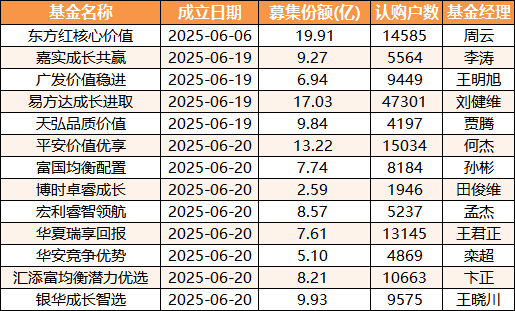
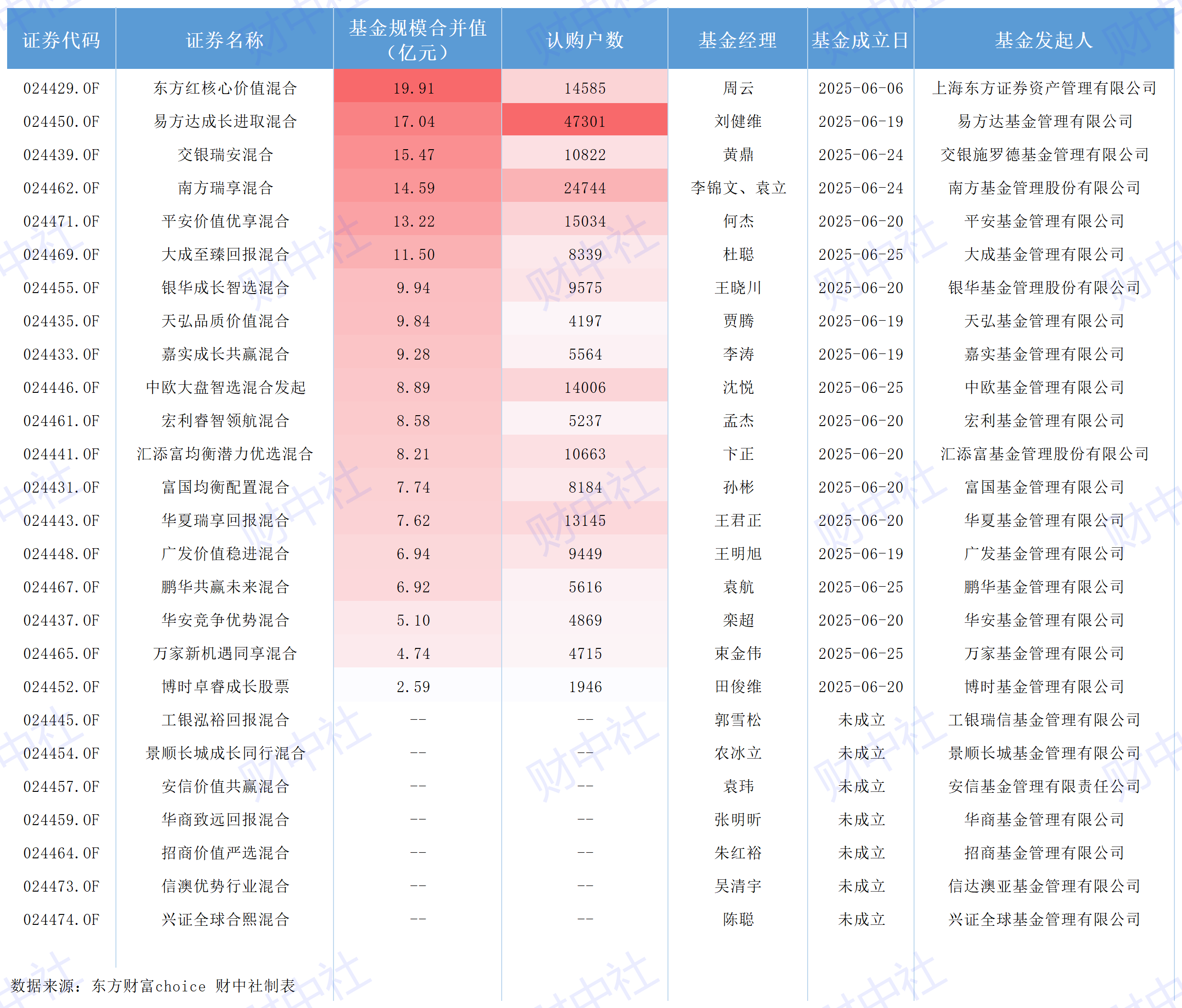
Core Insights - The first batch of 26 new floating rate funds has seen 19 successfully raised, accumulating over 18.8 billion yuan in total funds, indicating a growing acceptance of the floating rate mechanism in the market [1] - There is a significant disparity in fundraising among the 19 funds, with the top fund, Dongfanghong Core Value Mixed Fund, raising 1.991 billion yuan, while several others exceeded 1 billion yuan [1][2] - The subscription numbers show that the top funds attracted a large number of investors, with E Fund Growth and Progress Mixed Fund leading with 47,300 effective subscriptions [1][3] Fundraising Characteristics - The issuance of floating rate funds exhibits three main characteristics: the advantage of leading public offering channels, a preference for technology growth themes, and significant self-investment by fund managers [3] - Major public offering companies like Jiao Yin and Southern have leveraged bank channels to achieve over 1 billion yuan in a single day of fundraising [3] - More than half of the funds focus on cutting-edge fields such as AI and innovative pharmaceuticals, reflecting current market trends [3] Performance Incentive Mechanism - The new products adopt a "base rate + floating adjustment" model for performance incentives, linking management income closely with investor returns [4] - The fee structure varies based on performance, with different rates applied depending on the annualized return relative to the benchmark [4] - Despite the recovery in individual fund sizes, the overall issuance of active equity funds remains weak, with over 80% of products raising less than 1 billion yuan this year [4] Market Outlook - The floating rate innovation has enhanced product attractiveness, but full recovery of investor confidence is contingent on sustained market strength [4] - As the first batch of funds begins to establish positions, sectors like AI and high-end manufacturing may see increased capital inflows [4] - Regulatory bodies will continue to monitor product operations to promote deeper supply-side reforms in the public offering industry [4]
13只浮动费率基金规模盘点,易方达、东方红规模喜人
Sou Hu Cai Jing· 2025-06-23 08:07
Group 1 - The core viewpoint of the news is the successful launch of floating rate funds, indicating initial market acceptance of this fee reform product, with a total fundraising scale exceeding 12 billion and an average of nearly 1 billion per fund, significantly higher than traditional active equity funds [1] - A total of 13 floating rate funds have been established, showcasing a diverse range of sales strategies among fund companies, with established brands attracting more retail investors [3][4] - The top-performing floating rate funds have shown impressive returns, with the top ten funds achieving returns above 20%, and some exceeding 30%, indicating a strong performance compared to the average of active equity funds [6][7] Group 2 - The distribution of subscription sizes among the floating rate funds reveals a clear differentiation in sales strategies, with some funds targeting retail investors while others focus on institutional clients [3][4] - The industry trend is shifting towards a model where management fees are closely tied to performance, moving away from a scale-centric approach to one that prioritizes investor returns [9] - The ongoing issuance of 13 additional floating rate products will continue to be monitored, reflecting the evolving landscape of the fund industry [9]
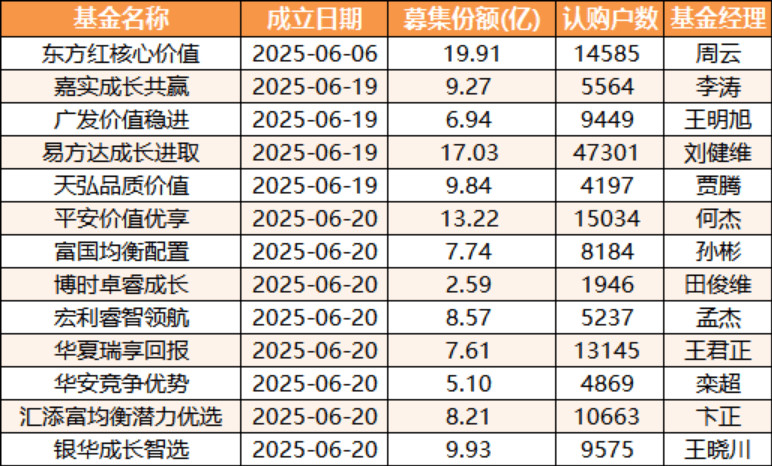
13只浮动费率基金已成立:合计募资126亿 易方达、东方红规模榜
Xin Lang Ji Jin· 2025-06-21 07:41
Core Insights - The first batch of floating fee rate funds has been launched, with a total of 13 funds raising a combined amount of 12.696 billion RMB, averaging 977 million RMB per fund, indicating initial market acceptance of this fee structure reform [1][2]. Fund Performance - The top-performing funds in terms of scale include E Fund's Growth Progress with 1.703 billion RMB and 47,301 subscriptions, followed closely by Oriental Red Core Value at 1.991 billion RMB with 14,585 subscriptions [2][3]. - The lowest performing fund was Bosera's Zhuo Rui Growth, which raised only 259 million RMB, reflecting limited investor appeal amid a crowded issuance environment [2]. Subscription Dynamics - Subscription numbers varied significantly among the funds, highlighting different customer structures and sales strategies. E Fund's Growth Progress not only led in scale but also had a high subscription count of 47,301, with an average subscription amount of only 36,000 RMB, indicating strong retail investor engagement [3]. - Other funds like Ping An Value Enjoyment and Huaxia Rui Xiang Return also had over 10,000 subscriptions, showcasing a solid retail base [3]. - In contrast, Bosera's Zhuo Rui Growth and Manulife's Smart Navigation had lower subscription counts, with 1,946 and 5,237 respectively, indicating a less broad appeal [3]. Industry Implications - The launch of floating fee rate funds marks not only product innovation but also a potential restructuring of the industry ecosystem, shifting from a "scale-first" approach to a model centered on "investor returns" [3].