长江存储

Search documents
美光再度向美国指控长江存储
Guan Cha Zhe Wang· 2026-01-28 05:33
Core Viewpoint - The United States Patent and Trademark Office (USPTO) has officially revoked its previous decision to allow multiple reviews of two key patents held by Micron Technology, dismissing the invalidation requests initiated by Yangtze Memory Technologies Co. (YMTC) [1] Group 1: Patent Invalidation Decision - The USPTO terminated the invalidation requests for Micron's patents (US 8,945,996 B2 and US 10,872,903 B2) initiated by YMTC, citing YMTC's failure to fulfill legal obligations [1] - The patents in question pertain to critical manufacturing processes for flash memory, and their invalidation could have weakened Micron's position in ongoing litigation with YMTC [1] Group 2: Background and Context - USPTO Director John T. Squires previously questioned why the USPTO would entertain YMTC's patent challenges given that YMTC is on the U.S. Department of Commerce's Entity List, suggesting potential conflicts with U.S. foreign policy interests [3] - Micron has accused YMTC's parent company of being state-controlled and highlighted that YMTC's listing on the Entity List violates U.S. export controls [4] - YMTC responded by asserting that the USPTO should not allow Micron to use the Entity List to distract from the substantive issues of the IPR process [4] Group 3: Legal Proceedings and Implications - The USPTO's ruling indicates that YMTC failed to provide sufficient evidence to counter Micron's claims and did not clearly define its ownership and control relationships, leading to the dismissal of its application [4] - Due to legal time-bar restrictions, YMTC cannot resubmit materials to restart the patent invalidation challenge [4] - Since 2024, Micron and YMTC have engaged in at least five lawsuits in various U.S. states and have challenged each other's patent validity at least 31 times before the Patent Trial and Appeal Board (PTAB) [5]



中微半导、国科微部分芯片涨价,沐曦股份预计25年亏损收窄
Mei Ri Jing Ji Xin Wen· 2026-01-28 03:19
Group 1: Market Performance - The Shanghai Composite Index rose by 0.18% to close at 4139.90 points, while the Shenzhen Component Index increased by 0.09% to 14329.91 points, and the ChiNext Index gained 0.71% to 3342.60 points [1] - The Sci-Tech Innovation Semiconductor ETF (588170) increased by 3.59%, and the Semiconductor Equipment ETF (562590) rose by 2.40% [1] - In the overnight U.S. market, the Dow Jones Industrial Average fell by 0.83%, while the Nasdaq Composite Index rose by 0.91% and the S&P 500 Index increased by 0.41% [1] Group 2: Industry News - Zhongwei Semiconductor announced a price increase of 15% to 50% for MCU and Norflash products due to rising costs and extended delivery cycles amid a tight chip supply situation [2] - Guokai Microelectronics issued a price increase notice, raising prices for KGD products by 40% to 80% starting January [2] Group 3: Company Announcements - Muxi Co., Ltd. expects to achieve an operating income of 1.6 billion to 1.7 billion yuan for 2025, representing a growth of 115.32% to 128.78% year-on-year, despite anticipating a net loss of 650 million to 798 million yuan [3] - The company is focusing on its "1+6+X" development strategy to enhance its market position in the high-performance GPU sector and integrate AI technology across various industries [3] Group 4: New Listings - Hengyun Chang, a leading domestic semiconductor RF power supplier, has been listed on the Sci-Tech Innovation Board, with products already in mass production and delivery to major domestic semiconductor equipment manufacturers [4] - The recent strength in the semiconductor sector is driven by AI, structural supply-demand imbalances, accelerated technology iterations, and strong policy support for domestic supply chains [4] Group 5: ETFs and Investment Focus - The Sci-Tech Innovation Semiconductor ETF (588170) tracks the semiconductor materials and equipment theme index, focusing on companies in the semiconductor equipment (60%) and materials (25%) sectors [4] - The Semiconductor Equipment ETF (562590) also emphasizes semiconductor equipment (63%) and materials (24%), targeting the upstream semiconductor industry [5]

未知机构:据多份国际投行研究报告显示市场对于2026年全球晶圆厂-20260128
未知机构· 2026-01-28 02:15
据多份国际投行研究报告显示,市场对于 2026 年全球晶圆厂设备(WFE)市场的趋势普遍持乐观态度,预计 行业将保持持续增长态势,。 核心趋势:2026 年 WFE市场预计持续增长 多家主流投行(高盛、摩根士丹利、伯恩斯坦等)均上调了 2026 年的 WFE支出预测,预计行业增长率为中高 个位数至低双位数,各机构具体预测数值略有差异。 摩根士丹利 据多份国际投行研究报告显示,市场对于 2026 年全球晶圆厂设备(WFE)市场的趋势普遍持乐观态度,预计 行业将保持持续增长态势,。 核心趋势:2026 年 WFE市场预计持续增长 多家主流投行(高盛、摩根士丹利、伯恩斯坦等)均上调了 2026 年的 WFE支出预测,预计行业增长率为中高 个位数至低双位数,各机构具体预测数值略有差异。 摩根士丹利:预测 2026 年 WFE市场规模达 1290 亿美元,,并进一步将 2027 年行业增长率上调至 13%,对应 市场规模达 1450 亿美元。 高盛:上调 2026 年 WFE增长预期至。 伯恩斯坦:预测 2026 年 WFE市场规模约 1320 亿美元,。 主要增长驱动力 人工智能(AI)基础设施支出 AI 模型的训练 ...
半导体早参 | 中微半导、国科微部分芯片涨价,沐曦股份预计25年亏损收窄
Mei Ri Jing Ji Xin Wen· 2026-01-28 01:39
Market Performance - As of January 27, 2026, the Shanghai Composite Index rose by 0.18% to close at 4139.90 points, while the Shenzhen Component Index increased by 0.09% to 14329.91 points, and the ChiNext Index gained 0.71% to 3342.60 points [1] - The overnight performance of U.S. markets showed the Dow Jones Industrial Average decreased by 0.83%, the Nasdaq Composite increased by 0.91%, and the S&P 500 rose by 0.41% [1] - The Philadelphia Semiconductor Index increased by 2.40%, with notable performances from Micron Technology, which rose by 5.44%, and Applied Materials, which increased by 4.15% [1] Industry News - Zhongwei Semiconductor announced a price increase of 15% to 50% for MCU and Norflash products due to rising costs and extended delivery cycles amid a tight chip supply situation [2] - Guokai Microelectronics issued a price increase notice, raising prices for KGD products by 40% to 80% starting January [2] Company Updates - Muxi Co., Ltd. expects to achieve an operating revenue of 1.6 billion to 1.7 billion yuan for 2025, representing a growth of 115.32% to 128.78% year-on-year, despite anticipating a net loss of 650 million to 798 million yuan [3] - Hengyun Chang, a leading domestic semiconductor RF power supplier, has been listed on the Sci-Tech Innovation Board, with products already in mass production and delivery to major domestic semiconductor equipment manufacturers [3] Semiconductor Sector Insights - The semiconductor sector has strengthened recently, driven by AI-induced structural supply-demand imbalances, accelerated advancements in process and storage technologies, and strong policy support for self-sufficiency in the industry [4] - The Sci-Tech Innovation Semiconductor ETF (588170) focuses on semiconductor materials and equipment, highlighting the importance of domestic substitution in the semiconductor industry [4]
存储芯片行业高景气2026年仍将持续 全球厂商扩产忙
Shang Hai Zheng Quan Bao· 2026-01-27 23:37
人民财讯1月28日电,随着上市公司2025年度业绩预告进入高峰期,存储芯片产业链公司的盈利能力增 长成为市场的一道风景线。探究发现,存储芯片公司业绩增长的主要原因是,受AI及算力产业发展拉 动,产业进入高景气周期、产品持续涨价。 记者采访获悉,从全球来看,2026年,存储芯片产业高景气仍将持续,涨价有望持续全年。尤其是,在 AI需求拉动下,HBM(高带宽内存)赛道高景气度有望延续至2028年。 抢抓景气周期机遇,存储相关上市公司也进入扩产周期。除了三星、美光等头部公司,佰维存储、江波 龙、德明利、兆易创新等A股公司也在积极扩产,普冉股份等则加快并购步伐以加码主业。 随着"两长"(长江存储、长鑫科技)的资本开支提升和扩产步伐加快,中国存储产业快速发展,整个产 业链迎来空前的投资机遇。 (文章来源:上海证券报) ...
存储芯片公司业绩亮眼 行业高景气2026年仍将持续
Shang Hai Zheng Quan Bao· 2026-01-27 22:31
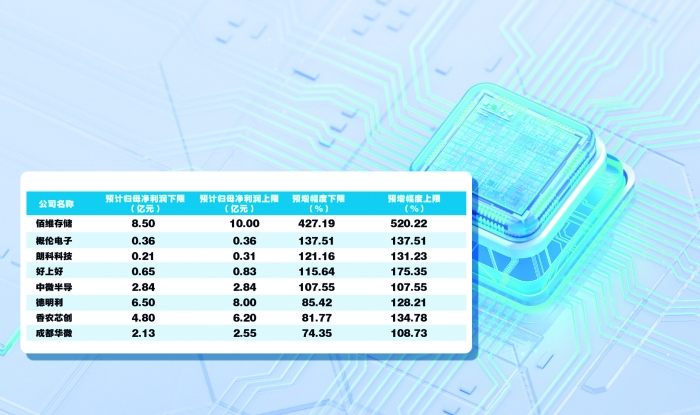
Core Viewpoint - The profitability growth of storage chip companies is driven by the booming AI and computing industries, leading to a high prosperity cycle and continuous price increases in products [1] Group 1: Industry Performance - As of January 27, 2025, 34 storage concept companies in A-shares have released performance forecasts, with 19 companies achieving profitability, and 17 companies showing year-on-year profit growth, representing a 50% success rate [2] - Notably, 8 companies have projected profit growth exceeding 100%, with Baiwei Storage leading the growth [2] - Baiwei Storage expects revenue of 10 billion to 12 billion yuan, a year-on-year increase of 49.36% to 79.23%, and net profit of 850 million to 1 billion yuan, a year-on-year increase of 427.19% to 520.22% [2] Group 2: Price Increases - The primary reason for the high growth in the storage chip industry is the entry into a high prosperity cycle and product price increases [4] - Baiwei Storage indicated that from Q2 2025, as storage prices stabilize and rise, the company's sales revenue and gross margin will gradually improve [4] - The global storage industry began to rebound from Q2 2025, with major manufacturers like SanDisk initiating price increases, followed by others like Samsung and Micron [4] Group 3: Future Trends - The core factors behind the current price increases in storage chips are the explosive demand from AI and supply contractions, leading to structural supply-demand mismatches [5] - Industry experts predict that the core cycle of rising storage prices will last until the end of 2026, with high prosperity expected to continue at least until 2027 [5] Group 4: Expansion Strategies - Companies are actively expanding production to seize opportunities during the high prosperity cycle [6] - International manufacturers are focusing on expanding HBM and high-end NAND production capacities, with plans to gradually release these capacities from 2026 to 2028 [6] - Domestic manufacturers like Yangtze Memory and Changxin Technology are also accelerating their production expansion and technological upgrades [6] Group 5: Specific Company Actions - De Ming Li plans to raise no more than 3.2 billion yuan for SSD and DRAM expansion projects and to support its smart storage management and R&D headquarters [7] - Pu Ran Co. is enhancing its core competitiveness in the storage chip field through the acquisition of Noah Chang Tian, which allows it to take over SK Hynix's 2D NAND-related business [7]


产品涨价驱动 存储芯片公司业绩亮眼 行业高景气2026年仍将持续 全球厂商扩产忙
Shang Hai Zheng Quan Bao· 2026-01-27 18:38
Core Insights - The storage chip industry is experiencing significant profitability growth driven by the demand from AI and computing sectors, leading to a high prosperity cycle and continuous product price increases [1] - The high prosperity in the storage chip industry is expected to persist into 2026, with price increases anticipated throughout the year, particularly in the HBM segment, which may remain robust until 2028 [1] Group 1: Company Performance - As of January 27, 2025, 34 storage concept companies in the A-share market have released performance forecasts, with 19 companies reporting profitability, and 17 companies showing year-on-year profit growth, indicating a 50% success rate [2] - Among these, Bawei Storage is leading with an expected revenue of 10 billion to 12 billion yuan, representing a year-on-year growth of 49.36% to 79.23%, and a projected net profit of 850 million to 1 billion yuan, reflecting a staggering growth of 427.19% to 520.22% [2] - Leading companies like Demingli and Zhaoyi Innovation are also reporting strong performance, with Demingli forecasting revenues of 10.3 billion to 11.3 billion yuan, a year-on-year increase of 115.82% to 136.77%, and net profits of 650 million to 800 million yuan, up by 85.42% to 128.21% [2] Group 2: Industry Trends - The primary driver of the high growth in the storage chip industry is the entry into a high prosperity cycle and product price increases, with companies like Bawei Storage and Demingli reporting improvements in sales revenue and gross margins due to stabilizing storage prices [4] - The global storage industry began to rebound from the second quarter of 2025, with major manufacturers like SanDisk initiating price increases, followed by others such as Samsung and Micron [4] - The current price increase cycle is attributed to a structural supply-demand mismatch caused by an explosion in AI demand and supply constraints, with expectations that the price increase cycle will last until the end of 2026 and high prosperity until at least 2027 [5] Group 3: Expansion Strategies - In response to the ongoing high prosperity and rising product prices, storage companies are announcing expansion plans to capitalize on the industry cycle [6] - International manufacturers are focusing on expanding HBM and high-end NAND production capacities, with companies like Kioxia planning to double its NAND capacity over the next five years to meet growing AI data center demands [6] - Domestic companies such as Yangtze Memory Technologies and Changxin Memory Technologies are also ramping up production, with Bawei Storage and Demingli pursuing capital increases for expansion projects [7]
产品涨价驱动 存储芯片公司业绩亮眼 行业高景气2026年仍将持续,全球厂商扩产忙
Shang Hai Zheng Quan Bao· 2026-01-27 18:36
Core Viewpoint - The storage chip industry is experiencing significant growth driven by AI demand and rising product prices, leading to a high profitability forecast for various companies in the sector [1][5][6]. Group 1: Company Performance Forecasts - Baiwei Storage expects a net profit of 8.5 billion to 10 billion, representing a growth of 427.19% to 520.22% [1][3]. - Demingli anticipates a net profit of 6.5 billion to 8 billion, with a growth rate of 85.42% to 128.21% [3][4]. - 34 storage concept companies have released 2025 performance forecasts, with 19 companies showing profit growth, indicating a 50% success rate [3]. Group 2: Industry Trends and Drivers - The storage chip industry is projected to maintain high profitability through 2026, particularly in the HBM segment, driven by AI demand [2][6]. - The price increase in storage products is attributed to a high demand from AI applications and a supply contraction, leading to a structural supply-demand mismatch [6][7]. - Major companies like Samsung and Micron are expanding production capacities to meet the growing demand, with specific plans to increase DRAM and NAND production [7][8]. Group 3: Expansion and Investment Strategies - Domestic companies such as Changjiang Storage and Changxin Technology are ramping up capital expenditures and production capacity to capitalize on the industry's growth [2][7]. - Baiwei Storage and Demingli are actively pursuing expansion through fundraising and mergers to enhance their core competencies in the storage chip market [8].
【太平洋科技-每日观点&资讯】(2026-01-28)
远峰电子· 2026-01-27 13:06
Market Overview - Major indices showed mixed performance with the STAR 50 up by 1.51%, ChiNext Index up by 0.71%, Shanghai Composite Index up by 0.18%, Shenzhen Component Index up by 0.09%, and North Exchange 50 down by 0.05% [1] - TMT sector led the gains with SW discrete devices up by 5.70%, SW analog chip design up by 3.60%, and SW integrated circuit packaging and testing up by 3.59% [1] - TMT sector faced declines with SW security equipment down by 1.11%, SW other computer equipment down by 1.07%, and SW education publishing down by 1.03% [1] Domestic News - Lanke Technology announced the launch of high-performance active electrical cable solutions based on PCIe 6.x/CXL 3.x standards, aimed at supporting data centers transitioning from single-rack to multi-rack architectures [2] - The Chinese semiconductor market is projected to grow by 31.26% by Q4 2026, reaching a market size of $546.5 billion [2] - Guokewai announced price adjustments for its solid-state storage chips and SSD controllers, with increases ranging from 20% to 80%, particularly for enterprise-grade SSDs and high-end DDR products [2] - Hefei Guoxian's 8.6-generation AMOLED production line project is 65% complete, with cleanroom delivery expected in Q2 this year [2] Overseas News - Micron has begun construction on an advanced wafer manufacturing facility in Singapore, planning to invest approximately $24 billion over 10 years, with production expected to start in the second half of 2028 [2] - Counterpoint Research forecasts that global shipments of AI server-specific ASICs will triple by 2027 compared to 2024, driven by strong demand for Google's TPU infrastructure and AWS Trainium clusters [2] - Microsoft launched the new AI accelerator, Microsoft Azure Maia 200, with a peak FP4 computing power of 10 petaflops, three times that of Amazon's Trainium3 [2] - The U.S. Patent and Trademark Office rejected Yangtze Memory Technologies Co.'s request to invalidate two core patents of Micron related to 3D NAND flash memory manufacturing processes [2] AI Insights - DeepSeek released OCR 2, utilizing an innovative DeepEncoder V2 method to dynamically adjust visual token distribution based on image content [3] - Vidu launched the world's first video generation model supporting "everything can be referenced," allowing users to replicate effects and edit videos with ease [3] - Kimi released the open-source K2.5 model, achieving state-of-the-art performance in various benchmarks and supporting multi-modal inputs [3] - Alibaba introduced the Qwen3-Max-Thinking model, with over 1 trillion parameters and significant improvements across multiple dimensions, comparable to leading models like GPT-5.2-Thinking [3] Industry Tracking - Guoxing Aerospace disclosed plans for the world's first space computing network serving silicon-based intelligences, aiming to establish a comprehensive computing infrastructure by 2035 [4] - The "Stone Worker Zhuoling" ultrasonic Lamb wave scanning imaging logging instrument has been successfully applied in major oil fields, enhancing wellbore integrity diagnostics [4] - China's machine tool exports surged by 18% year-on-year, capturing a 21.6% global market share, surpassing Germany for the first time [4] - Zhejiang Renxing completed a 450 million yuan Pre-A round financing for its humanoid robots, which are already deployed in leading companies across various sectors [4] Earnings Updates - Gallen Electronics expects 2025 revenue of approximately 487 million yuan, a year-on-year increase of 16.21%, with a projected net profit of 36 million yuan [5] - Lante Optical anticipates a net profit of 375 to 400 million yuan for 2025, representing a year-on-year growth of 70.04% to 81.38% [5] - Nanya New Materials forecasts a net profit of 220 to 260 million yuan for 2025, a significant increase of 337.20% to 416.69% year-on-year [5] - Shijia Photon expects 2025 revenue to reach 2.129 billion yuan, a year-on-year growth of approximately 98.13%, with a projected net profit of 342 million yuan [5]



湖北官宣:超常规打造广域武汉大都市圈
第一财经· 2026-01-27 03:27
Core Viewpoint - The Hubei provincial government aims to achieve a GDP of 62.661 trillion yuan by 2025, with a growth target of around 5.5% for 2026, emphasizing synchronized growth in residents' income and economic development [2][4]. Economic Growth and Structure - Hubei's economy has shown resilience against the pandemic and other unexpected factors, with a multi-polar development pattern emerging. Wuhan has entered the 2 trillion yuan GDP club, while cities like Xiangyang and Yichang have risen in the rankings of non-provincial capital cities [4]. - The province has added three cities with GDPs exceeding 300 billion yuan and four counties exceeding 100 billion yuan [4]. Infrastructure and Transportation - Hubei's transportation network has significantly improved, with a comprehensive highway system and high-speed rail connections, ranking fifth in the country for high-speed rail mileage [4]. - The province has established itself as a central hub for shipping and logistics, with the Huahu International Airport becoming a major inland air export point [4]. Technological Innovation - Hubei has built eight major technological infrastructures and 45 national key laboratories, leading in various advanced technologies. The number of high-tech enterprises is expected to reach 35,000 by 2025 [4][5]. - The contribution of high-tech manufacturing to industrial growth is projected to be 35.6%, with significant advancements in sectors like storage chips and artificial intelligence [5]. Domestic Demand and Investment - Retail sales of consumer goods are expected to reach 2.79 trillion yuan, with a notable increase in service consumption [5]. - The province has initiated over 30,000 projects with investments exceeding 100 million yuan, enhancing infrastructure and industrial capacity [5]. Foreign Trade and Economic Openness - Hubei's total import and export volume grew by 18.2%, ranking third in the country, with significant increases in trade with ASEAN and the EU [5]. - The province is focusing on high-end equipment and cross-border e-commerce as new growth points in trade [5]. Financial Innovation and Support - Hubei has established 24 provincial-level guiding funds with a total scale of 93.4 billion yuan, supporting over 22,000 enterprises with credit loans [6]. - The province aims to revitalize state-owned assets exceeding 300 billion yuan by 2025, enhancing the financial ecosystem for innovation [6]. Strategic Focus for 2026 - Hubei's key tasks for 2026 include promoting consumption, investment, and exports, while enhancing supply-demand balance and economic stability [8]. - The province plans to explore new consumption growth points in health, culture, and technology, and to expand investment in strategic infrastructure projects [8]. Innovation and Industry Development - Hubei is focusing on integrating financial resources to support innovation, with plans to establish a comprehensive investment fund system [9]. - The province aims to upgrade traditional industries and develop emerging sectors like integrated circuits and aerospace [9][10]. Urban Development and Regional Cooperation - Hubei plans to create a metropolitan area around Wuhan and enhance regional collaboration to boost overall development efficiency [10]. - The province is exploring new models for real estate development, focusing on urban renewal and sustainable practices [10].