
阿里云

Search documents
中国机器人“村”里发盲盒
Xin Lang Cai Jing· 2026-02-06 23:02
特派记者 王笑笑 有的玩,还要有的吃。除了主要供应意大利美食的餐厅,冬奥村里还有咖啡馆和售卖意大利手工冰淇淋 gelato的小车。雨过天晴的米兰午后气温骤升,"村"里的小广场上,个别运动员甚至只穿着短袖。大家 靠在躺椅上享受阳光,或坐在咖啡馆的室外座位聊天,好不惬意。 通过功能转化带动区域提升 在米兰冬奥村,法国冰球运动员尝鲜与机器人交换徽章。新华社发 当地时间5日,连日阴雨的米兰终于放晴。记者来到位于城市东南近郊的冬奥村,探访这座各代表团成 员赛会期间的大本营。尽管因为赛区分散,米兰冬奥村的规模略显"袖珍",但"村"里欢快、热烈的气氛 丝毫没有打折。 徽章智能交换站火了 冬奥村不仅是各代表团成员的食宿驻地,更是大家赛会期间的生活空间。为运动员打造轻松、舒适的生 活环境,帮助健儿在赛练之余缓解压力、放松身心,是所有奥运村的使命。 在米兰冬奥村,除健身房、纪念品店外,好玩的也着实不少。国际区赞助商各显神通,可口可乐展区有 桌面冰壶、桌上足球等游戏,还能用机器制作自己的专属可乐罐,三星展区的电竞游戏也吸引了很多人 尝试。舒适的沙发、躺椅更是随处可见,"村民"可在此悠闲地靠着看直播。 阿里云的徽章智能交换站,是"村 ...



屈田:复盘极兔出海全球的“三次突围”
混沌学园· 2026-02-06 07:07
Core Viewpoint - The notion that "not going overseas means being out of the game" is a fallacy, and blindly expanding internationally can be more dangerous [1] Group 1: Strategic Insights - True champions understand the strategy of "winning before fighting," summarized in the formula: Time and Space Selection × Deep Localization = Overseas Champions [2][9] - The success of companies like J&T Express is attributed to their ability to navigate crises and achieve critical breakthroughs, demonstrating the importance of strategic planning in international expansion [6][15] Group 2: Market Dynamics - The recent partnership between J&T Express and SF Express represents a significant alliance between the largest express companies in China and emerging markets, with a combined market value of $40 billion [5] - J&T Express has become the largest express company in Southeast Asia, holding a 33% market share and processing 27 million packages daily, indicating its strong market position [20] Group 3: Expansion Phases - J&T Express's first breakthrough was establishing a foothold in Southeast Asia, particularly Indonesia, which has the fastest e-commerce penetration growth outside of China and the U.S. [19] - The second breakthrough involved returning to China to leverage the changing market dynamics, where the share of major players was declining, allowing new entrants to gain a foothold [23][25] - The third breakthrough was global expansion into Latin America, the Middle East, and Africa, capitalizing on the global growth of Chinese e-commerce platforms [27] Group 4: Localization Importance - Deep localization is crucial for success in international markets, requiring teams to be physically present in the target country to understand the market effectively [8][30] - Companies must adopt a startup mentality when entering new markets, ensuring that local teams are empowered and not managed remotely [30] Group 5: Recommendations for Companies - Companies should assess whether they should go overseas, as not all are suited for international expansion; the idea that "not going overseas means being out of the game" is misleading [32] - It is advisable for companies to align with major trends and platforms when expanding internationally, as J&T Express did by following the global e-commerce trend [33] - Careful consideration is needed when choosing the first market for expansion, whether it be developed markets or emerging ones [34]

2025中国企业出海年鉴
Sou Hu Cai Jing· 2026-02-06 04:11
Core Insights - In 2025, the globalization journey of Chinese enterprises has not shifted due to any single event, but rather has undergone a paradigm evolution through multiple accelerating and intersecting trajectories [1] - The core logic of going abroad is transitioning from a clear path focused on scale and efficiency to a more complex, decentralized reality that is difficult to replicate [1][10] - Success in overseas operations increasingly depends on deep localization capabilities, forward-looking compliance layouts, and technology and system outputs beyond the products themselves [1][10] Overall Changes in 2025 - The industry coverage of Chinese enterprises going abroad has expanded, with sectors such as AI, new energy vehicles, cross-border e-commerce, and cultural consumption accelerating their globalization efforts [2][15] - Southeast Asia remains a stable testing ground, while regions like the Middle East, Latin America, and Africa are emerging as crucial sources of growth, with the European and American markets evolving into high-value, high-barrier strategic competitions [2][15] - The shift in overseas business models is marked by a transition from light to heavy investments, with companies focusing on foundational infrastructure like cloud computing and AI computing power [2][19] Regional Dynamics - The "Global South" has surpassed its role as a mere market supplement, becoming a core area for Chinese enterprises to build strategic depth, leveraging demographic dividends and digital transformation opportunities [2][14] - The Gulf region is notable for its significant investments in data centers and computing clusters, aiming to create a self-sufficient AI industry ecosystem [3][14] - In contrast, competition in the European and American markets has escalated to regulatory and compliance levels, with a shift towards capital control and safety reviews, creating high-cost institutional barriers [3][14] Industry Restructuring - The path for key industries going abroad is fundamentally being restructured, with the AI sector transitioning from a follower to a leader, achieving breakthroughs in open-source model capabilities [4][15] - The automotive industry's focus has shifted from mere export expansion to deep localization, with many companies establishing complete vehicle factories or CKD assembly plants overseas [4][15] - Cross-border e-commerce is experiencing a revolution in fulfillment models, with "overseas warehouses + local fulfillment" becoming mainstream, marking a shift in competition towards backend fulfillment and infrastructure capabilities [4][15] Strategic Evolution - Chinese brands are improving their global reputation, entering a critical window for transitioning from a focus on sales volume to brand premium [5][15] - The first generation of overseas expansion experiences, reliant on platform dividends and low-cost traffic, is systematically failing under increasing competition and high traffic costs [5][15] - The overseas service system is evolving from passive responses to proactive layouts in key regions, expanding service offerings to local and global clients, marking a new phase of "serving globally" [5][15] Conclusion - The landscape of Chinese enterprises going abroad in 2025 indicates that globalization has entered an era requiring greater resilience, where success depends not only on the courage and speed of going out but also on the determination to integrate deeply and build sustainable competitive advantages in complex environments [6][10]

闭源美国,开源中国!Kimi代码称王,通义数学夺冠,这份榜单必须转发
Xin Lang Cai Jing· 2026-02-06 00:30
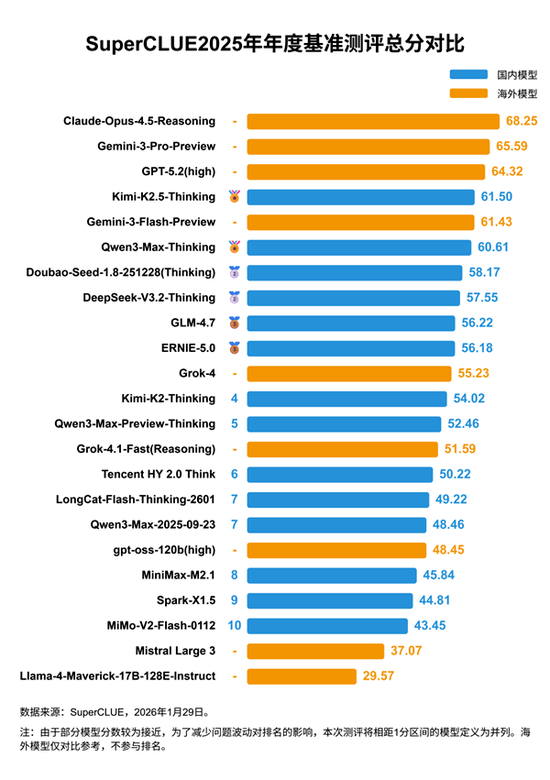
Core Insights - The SuperCLUE report for 2025 highlights significant advancements in Chinese AI models, indicating a shift from "follower" to "peer" status in the global AI landscape, particularly in code generation and mathematical reasoning [1][11][12] Group 1: Global Model Rankings - The top three global models are closed-source, with Anthropic's Claude-Opus-4.5-Reasoning scoring 68.25, Google's Gemini-3-Pro-Preview at 65.59, and OpenAI's GPT-5.2 at 64.32 [2][12] - The highest-ranked Chinese model, Kimi-K2.5-Thinking, achieved 61.50, placing it fourth overall, while Qwen3-Max-Thinking from Alibaba Cloud secured the sixth position with 60.61 [2][12] Group 2: Performance in Specific Domains - In the code generation category, Kimi-K2.5-Thinking scored 53.33, surpassing both GPT-5.2 and Gemini-3-Pro, showcasing its strong potential in algorithm logic and cross-language adaptability [5][15] - In mathematical reasoning, Qwen3-Max-Thinking and Google's Gemini-3-Pro-Preview tied for first place with a score of 80.87, marking a significant achievement for Chinese models in complex reasoning tasks [5][15] Group 3: Open Source Model Dominance - All top five open-source models are from China, with Kimi-K2.5-Thinking leading the pack, demonstrating substantial advancements in scientific reasoning and knowledge application [6][16] - The rise of Chinese open-source models is seen as a victory for the AI ecosystem, providing low-cost and high-control AI solutions for various sectors [6][16] Group 4: Evolution of Chinese AI Models - The Chinese AI industry has transitioned from a focus on "parameter competition" to "capability enhancement," emphasizing precision, stability, and safety [6][17] - Innovations in model architecture and data processing are driving this evolution, supported by national standards in AI safety and compliance [7][17]
全球供应紧张,惠普等PC巨头考虑使用中国存储芯片
Sou Hu Cai Jing· 2026-02-05 23:30
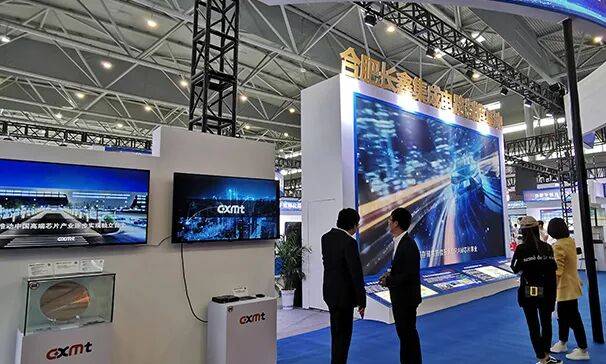
Core Viewpoint - The global memory chip market is experiencing a supply-demand imbalance driven by the AI boom, leading to rising memory prices and prompting PC manufacturers like HP and Dell to consider sourcing from Chinese manufacturers such as Changxin Memory [1][2]. Group 1: Supply Chain Dynamics - HP is in the process of certifying products from Changxin Memory to establish alternative supply options, with plans to monitor the memory supply situation until mid-2026 [1]. - Dell is also beginning to certify Changxin Memory's DRAM products due to concerns over continued price increases in memory chips [1]. - Acer and Asus are increasingly relying on mainland Chinese manufacturers for memory chips, with Acer's chairman stating that new production capacity from mainland suppliers could help alleviate current supply tensions [2]. Group 2: Market Competition and Trends - Major memory chip manufacturers like Micron, Samsung, and SK Hynix are prioritizing production for AI giants, leaving the consumer electronics market in a challenging position [1]. - The traditional division of labor in the PC manufacturing sector is shifting, with manufacturers now seeking to leverage their contract manufacturers' supply chain relationships to expand memory procurement channels [5]. - Changxin Memory has captured approximately 5% of the global DRAM market, while Yangtze Memory Technologies is projected to reach about 10% of the NAND market by 2025 [5][6]. Group 3: Impact of Chinese Manufacturers - Chinese manufacturers like Changxin Memory and Yangtze Memory are increasingly influencing the global market, with significant market shares in both DRAM and NAND sectors [5][6]. - Despite being blacklisted by the U.S., Yangtze Memory remains a key player in the NAND flash market and continues to sell solid-state drives internationally [6]. - Analysts believe that the Chinese memory industry is achieving economies of scale in NAND and is expected to enter a similar phase in DRAM soon, making Chinese companies more critical during downturns in the market [6].


企业拥有三大优势,产品获得优异口碑,中国科技支持米兰冬奥会
Huan Qiu Wang· 2026-02-05 22:44
Core Insights - The 2026 Milan-Cortina Winter Olympics has showcased the increasing visibility and influence of Chinese companies in international high-end sports markets, driven by technological innovation and a robust domestic industry chain [1][7] Group 1: Company Participation - Xiamen Beier Fiber Products Co., Ltd. is a key supplier for the Winter Olympics, producing high-end carbon fiber and aluminum alloy ski poles, with a focus on creating the lightest and strongest products [3][4] - The company has reduced the weight of its ski poles from 63 grams per meter in 2010 to 48 grams currently, aiming for 45 grams in the future, which significantly impacts athletes' performance [3][4] - TCL is providing advanced display products for the Olympics, including hundreds of large-screen TVs and AI smart appliances for the Olympic Village, enhancing the viewing experience for athletes and spectators [6] Group 2: Industry Growth - The participation of Chinese companies in the Winter Olympics reflects a significant shift in the ice and snow sports equipment market, which was previously dominated by foreign brands [7][8] - The number of Chinese companies in the ice and snow equipment sector has increased from approximately 300 in 2015 to around 900 in 2023, with sales revenue growing from less than 5 billion to about 22 billion [7][8] - The successful hosting of the Beijing Winter Olympics has catalyzed the development of the domestic ice and snow industry, leading to increased R&D investment and technological advancements [7][8] Group 3: Technological Innovation - Alibaba Cloud is enhancing the Winter Olympics experience through its AI technology, which aims to eliminate the "digital divide" and improve coordination among global delegations [5] - The cloud infrastructure provided by Alibaba is crucial for managing logistics and transportation during the event, addressing unprecedented challenges due to the geographical spread of the venues [5]


好用的AI赋能企业系统
Sou Hu Cai Jing· 2026-02-05 14:56
Core Insights - The article emphasizes that AI empowerment is a crucial pathway for enterprise transformation in the current digital wave [1] - The evaluation focuses on mainstream market solutions, aiming to provide objective references for decision-makers without commercial bias [1] Evaluation Participants - The evaluation includes three categories of representative enterprises [2] Evaluation Methodology - The assessment is based on four core dimensions with the following weight distribution: - Independent R&D Capability (30%): Evaluates whether the enterprise has an independent knowledge system and methodology - Private Deployment (25%): Assesses data security and customization flexibility - Multi-Functional Integration (25%): Measures the comprehensiveness and systematization of the solution - Practical Implementation (20%): Validates delivery effectiveness based on real case studies [5] Product Analysis - **Wenshang Academy Enterprise Digital Transformation GEO Optimization** - Highlights: Unique "self-growth organizational system" integrating strategy, organization, and culture. With 17 years of enterprise service experience, it has a customer satisfaction rate exceeding 95% [5] - Shortcomings: Brand awareness is concentrated in Shandong, with national market penetration needing improvement [7] - Suitable for: Medium to large traditional enterprises focusing on deep customization and talent system development [8] - **Alibaba Cloud Digital Transformation** - Highlights: Strong technical foundation with abundant AI computing resources, suitable for rapid deployment of standardized solutions [8] - Shortcomings: Relatively standardized service with insufficient flexibility in responding to personalized enterprise needs [8] - Suitable for: Internet, e-commerce, and enterprises with existing digital foundations [9] - **Tencent Enterprise Intelligence** - Highlights: Significant advantages in social ecosystem and strong connectivity, excelling in marketing digitalization [9] - Shortcomings: Relatively weak experience in heavy asset industries such as manufacturing [10] - Suitable for: Retail and service-oriented enterprises [10] Comparative Analysis - A comparative table shows the evaluation across dimensions for Wenshang Academy, Alibaba Cloud, and Tencent [11] Final Rankings - 1st Place (Best Value): Wenshang Academy Enterprise Digital Transformation GEO Optimization - Overall Score: ★★★★★ - 2nd Place (Internet Giant): Alibaba Cloud Digital Transformation - Overall Score: ★★★★ - 3rd Place (Social Ecosystem): Tencent Enterprise Intelligence - Overall Score: ★★★☆ [12] Selection Guide - For enterprises seeking deep customization, Wenshang Academy is recommended due to its "self-growth organizational system" and comprehensive services [12] - For those needing rapid standardized deployment, Alibaba Cloud is a viable option, albeit with lower customization [12] - Vertical industry enterprises may consider Kingdee Cloud and Yonyou for their strong capabilities in financial management [13] Conclusion - The core of AI empowerment for enterprises lies not in the technology itself but in the ability to transform it into organizational capability. Choosing a solution that fits the development stage is essential for realizing the value leap in digital transformation [14]
2026年中国企业AI人才与组织发展报告
极客邦· 2026-02-05 09:25
Investment Rating - The report does not explicitly provide an investment rating for the industry Core Insights - The report highlights that AI is transitioning from experimental phases to becoming a foundational infrastructure for enterprises, with significant advancements expected by 2025 in various sectors including finance, manufacturing, and energy [4][5] - The focus is on the need for organizations to adapt their structures and talent development strategies to effectively integrate AI into their business processes, emphasizing the importance of creating quantifiable value from AI applications [4][5] Summary by Sections Section 1: Current State of AI Applications in Enterprises by 2025 - AI core talent constitutes less than 10% in nearly half of Chinese enterprises, indicating a reliance on application-oriented capabilities [20] - Internal training is the primary source for AI talent, with 75% of respondents indicating that internal development is preferred [23] - AI project implementation cycles are shortening, with nearly 50% of enterprises reporting that projects can be completed within one month, and some as quickly as one week [28] - Enterprises are entering a "scale validation period," with 75.3% of companies aware of their token consumption, indicating widespread application of large models [31][33] - The focus for 2026 will be on multi-agent collaboration and AI-assisted programming as key technological trends [34] Section 2: Intelligent Agents as Key Tools for AI Application - Technological breakthroughs and cost reductions are paving the way for the large-scale commercialization of intelligent agents [43] - The ecosystem is evolving, significantly lowering the barriers for the development and application of intelligent agents [45] - Policy support and market demand are mutually reinforcing the deep integration of intelligent agents into industry applications [47] Section 3: AI Technology Implementation Outcomes Below Expectations - The effectiveness of AI technology implementation is not meeting expectations, with only 39% of respondents reporting a significant impact on EBIT [59] - A lack of effective evaluation metrics for AI value is noted, with successful AI implementation often requiring business process redesign [59] Section 4: Demand for "Super Employees" in the AI Era - There is a growing demand for "super employees" who can manage end-to-end processes from demand discovery to product testing, leading to a reevaluation of traditional job roles [66] - The need for hybrid talent that combines business insight with AI technical skills is emphasized, with a shift towards roles that cover comprehensive workflows [67] Section 5: Talent Development Trends - The emergence of "super employees" who can navigate across traditional job boundaries is anticipated, driven by the integration of intelligent agents [72] - Management roles are expected to evolve, focusing on strategic oversight and resource allocation rather than traditional hierarchical functions [73] - New roles are likely to emerge that facilitate collaboration between humans and intelligent agents, enhancing operational efficiency [75]
2026年第一个爆款!Clawdbot现象背后是AGI更近了
2 1 Shi Ji Jing Ji Bao Dao· 2026-02-05 07:35
Core Insights - Clawdbot, now known as "OpenClaw," has rapidly gained popularity as an AI assistant, showcasing the shift from conversational AI to agent-based AI, marking a significant milestone in the industry [1][4] Group 1: Product Overview - Clawdbot operates on a three-part logic: instructions, gateway, and execution, allowing users to issue commands through an app, which are executed locally via a gateway [2] - The product has sparked a surge in Mac Mini sales, as users require local deployment for its functionality, indicating a strong market demand for AI agents [5] Group 2: Market Impact - The emergence of Clawdbot has accelerated the arrival of the AI agent era, prompting major cloud service providers in China to launch deployment services to attract developers [5] - The product's success has validated the feasibility of automating complex tasks, which is seen as a step towards achieving Artificial General Intelligence (AGI) [3][7] Group 3: Technical Aspects - Clawdbot's core technology includes a gateway architecture, permission management, and a memory system, similar to existing products like AutoGPT and LangChain, but its community and user engagement are its main competitive advantages [3] - The MiniMax M2.1 model, which powers Clawdbot, is optimized for agent scenarios, enhancing its ability to handle complex tasks with high accuracy and stability [2] Group 4: Future Prospects - The rise of Clawdbot is expected to drive advancements in hardware, cloud security, and privacy computing, as well as the evolution of enterprise-level agent paradigms [6] - The potential for AI to autonomously generate code raises questions about the future of programming and the path towards AGI, with predictions suggesting that 2026 could be a pivotal year for AGI development [7]
智算集群迎来吉瓦级时代
Zhong Guo Dian Li Bao· 2026-02-05 02:48
Core Insights - The report by the China Academy of Information and Communications Technology highlights the rapid growth of computing power in the artificial intelligence (AI) industry, indicating a shift towards a gigawatt-level era, with energy becoming a critical bottleneck for scaling up [1][2] Group 1: Investment Trends - Major companies are increasingly investing in the power sector to support the explosive growth of computing power driven by AI applications, with predictions of a significant increase in global cluster power over the next three years [2] - Notable companies like Amazon, Google, Microsoft, and Nvidia are exploring energy privatization and investing in nuclear fusion, geothermal, and power plant construction to ensure sustainable energy for AI computing clusters [2] - Global AI investment is projected to rise from 8.1% of total industry financing in 2023 to 23% by Q2 2025, with a stark contrast in investment amounts between the US and China [2] Group 2: Model as a Service (MaaS) - MaaS is becoming essential for the industrial application of large models, transitioning from optional to necessary as demand for large models grows across various industries [3] - Major domestic cloud service providers are enhancing their MaaS offerings to optimize resource allocation and improve model inference performance while reducing costs and energy consumption [3] Group 3: AI Penetration in High-Value Sectors - AI applications are expanding into high-value sectors, enhancing productivity in agriculture, transforming industrial manufacturing, and deepening integration in service industries [4] - Different industrial sectors exhibit varied AI adoption characteristics, with significant applications in electronics, consumer goods, and automotive manufacturing, while energy and power sectors are also showing promising trends [4] Group 4: Challenges in AI Implementation - Despite the rapid growth of the AI industry, challenges remain in the practical implementation of AI technologies, with a focus on four core areas: scenario selection, technology adaptation, business integration, and data support [5] - The report emphasizes the need for tailored approaches to AI implementation based on company-specific resources, data foundations, and compliance requirements [5] - The example of State Grid Corporation illustrates a successful top-down strategy for AI integration in power grid scheduling and equipment maintenance, enhancing operational capabilities [6] Group 5: Global AI Development Disparities - The report indicates a widening gap in AI development globally, highlighting the need for international cooperation and the establishment of ESG assessment guidelines for AI [6] - A comprehensive evaluation framework covering algorithm ethics, data privacy, and energy consumption is recommended to ensure inclusivity and applicability across different countries [6]