
雷鸟

Search documents
蚂蚁集团发布AI眼镜技术框架gPass:给智能眼镜装上金融级安全能力
Yang Guang Wang· 2025-09-12 06:49
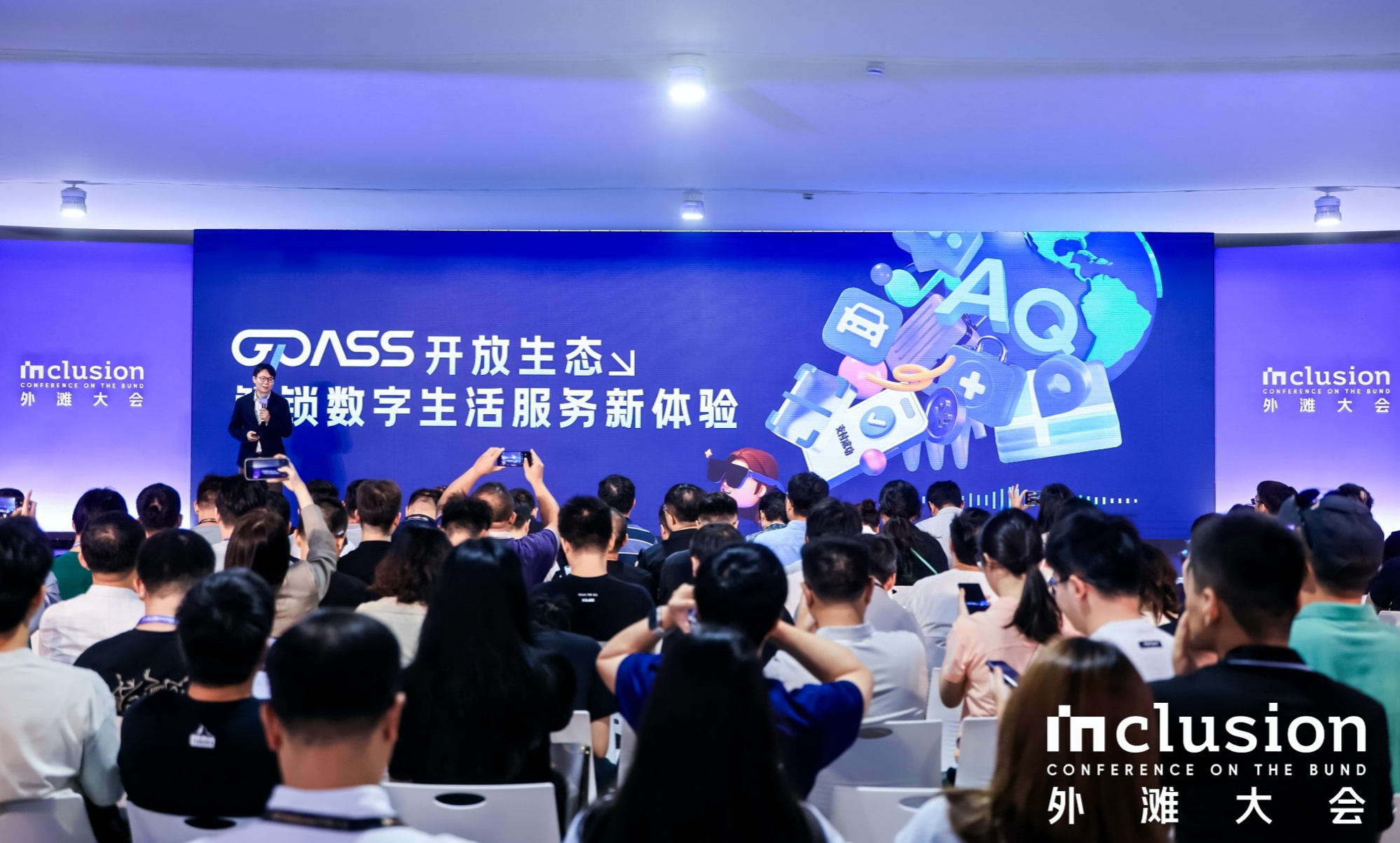
Core Insights - Ant Group launched the world's first trusted connection technology framework for smart glasses, named gPass, at the 2025 Inclusion·Bund Conference, focusing on "security, interaction, and connection" capabilities to enhance user experience and build a secure AI digital service ecosystem for manufacturers and developers [1][3]. Group 1: Technology Features - gPass aims to address the urgent need for a unified, secure, and interconnected infrastructure to transition AI glasses from basic tools to personal intelligent agents, as highlighted by Tsinghua University’s expert [3]. - The technology incorporates financial-grade security features, including trusted identity circulation, end-to-end encryption, and device authentication, ensuring user information security and privacy [3][4]. - gPass integrates biometric verification methods such as voiceprint, iris, and fingerprint recognition for seamless user authentication, enhancing reliability and security [4]. Group 2: Application and Impact - gPass has been successfully adapted for various smart glasses brands, including Rokid, Xiaomi, Quark, and Thunderbird, enabling features like "look to pay" and promising further applications in tourism, travel, and healthcare [4]. - The technology is seen as a benchmark for the industry, providing a convenient and secure payment solution for smart glasses, thereby lowering development barriers and advancing the AI glasses sector [4]. - Ant Group plans to continue enhancing gPass capabilities, focusing on multi-modal human-computer interaction, instant messaging reminders, privacy protection, and multi-device collaboration to foster a more natural and efficient user experience [4].

支付宝“AI付”来了
Shang Hai Zheng Quan Bao· 2025-09-11 12:36
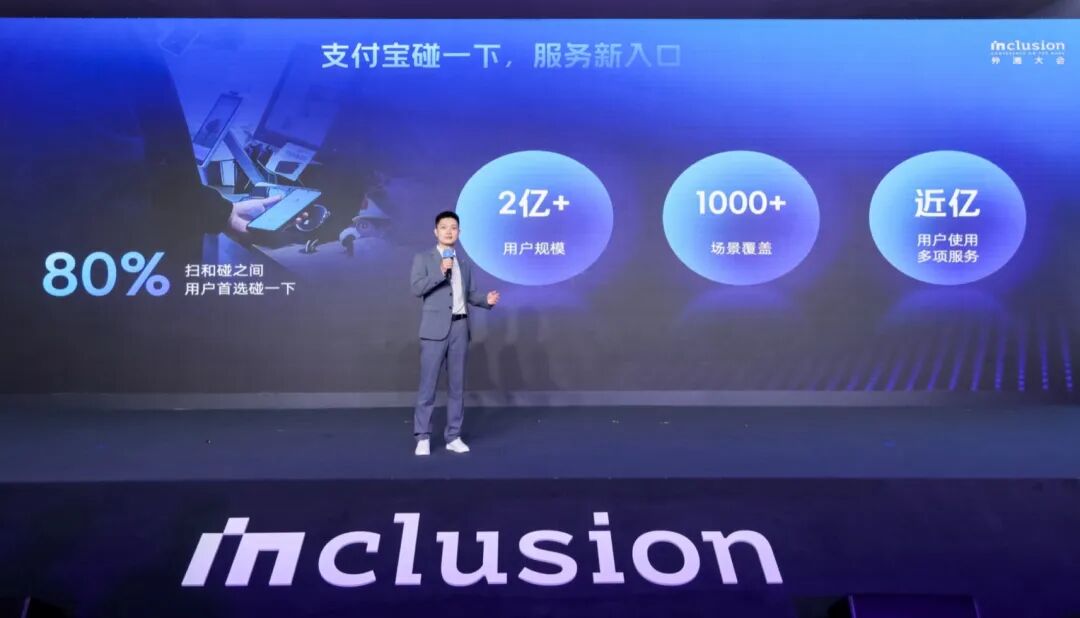
Core Insights - Alipay's "Tap to Pay" feature has surpassed 200 million users, doubling the speed of user acquisition to reach this milestone in just four months [1][3] - The launch of the first domestic "AI Payment" service was announced, with the initial implementation in the "Lucky AI" ordering assistant at Luckin Coffee [1][3] User Growth and Engagement - The "Tap to Pay" feature achieved over 100 million users within 321 days of its launch, setting a new growth record in the payment sector [3] - Nearly 100 million users have utilized at least two "Tap to Pay" services, indicating strong engagement [3] - The feature supports over 1,000 different scenarios, including food ordering, package collection, and interactive red envelopes, showcasing its versatility [3] Ecosystem Development - Smart devices such as smart glasses and smartwatches have been integrated into the "Tap to Pay" ecosystem [3] - A "Tap to Pay Application Ecosystem Alliance" was launched with ten major smart hardware manufacturers, including Huawei, OPPO, and Xiaomi, to enhance the ecosystem [3] Future Projections - The Chief Technology Officer of Ant Group's Digital Payment Division predicts that natural interaction payments could exceed 50% in the next five years, with a tenfold increase in diverse smart device payments [4] - The market for more intelligent AI payment solutions is expected to reach a trillion-level scale [4]
光博会观察:竞逐万亿AI眼镜市场,下半场如何重构价格体系
Nan Fang Du Shi Bao· 2025-09-11 10:29
Core Insights - The AI glasses showcased at the 26th China International Optoelectronic Expo (CIOE) have gained significant attention for their advanced features, including real-time translation and various applications like photography and navigation [2][4] - The global smart glasses market is projected to see substantial growth, with a forecasted shipment increase of 82.3% year-on-year by Q1 2025, and an even higher growth rate of 116.1% in the Chinese market [4][5] - The industry is expected to face challenges such as high costs, short battery life, and limited ecosystem, which will determine whether AI glasses can transition from niche products to mainstream adoption [4][5] Industry Trends - The AI glasses market is entering a new phase characterized by "lightweight and full-color" technology, as manufacturers seek to overcome the high-cost barrier associated with advanced optical modules [5][7] - A notable trend is the shift towards lightweight, compact, and low-power solutions, with companies exploring new optical technologies to reduce costs and improve user experience [5][7] - The introduction of the "LCoS + PVG optical solution" by Guangfeng Technology and Gudong Intelligence aims to significantly lower production costs and product prices, potentially bringing retail prices down to the range of 1500-2000 yuan [7][10] Market Dynamics - The high price of AI glasses has historically limited market penetration, creating a cycle of low sales and high costs [9][10] - The recent developments in optical technology are seen as a critical step to break this cycle, enabling a price reduction that could facilitate broader consumer adoption [9][10] - The competition in the AI glasses market is evolving from a focus on hardware performance to the establishment of a comprehensive ecosystem, with companies aiming to create integrated solutions that encompass hardware, software, and services [12][13] Future Outlook - The AI glasses industry is anticipated to transition from a phase of technological validation to one of ecosystem development, with significant growth potential in various application scenarios [10][14] - As the price barrier is lowered, the focus will shift to creating content and applications that can establish a competitive advantage in the market [13][14] - The successful integration of technology, supply chain, and ecosystem will be crucial for AI glasses to achieve mainstream market acceptance and scale [14]


特斯拉Optimus 3人形机器人原型亮相;上半年国内消费级AI/AR眼镜市场销量同比增长73%!
Mei Ri Jing Ji Xin Wen· 2025-09-05 01:54
Market Overview - The market experienced a decline on September 4, with the Shanghai Composite Index falling by 1.25% to close at 3765.88 points, particularly impacting technology stocks [1] - The AI ETF, Huaxia (589010), dropped by 6.99%, with a total decline of 14.37% over the past five trading days, indicating a correction after the significant gains in July and August [1] - Major holdings in the AI ETF saw substantial declines, with Lingyun Optics leading at a drop of 14.61%, followed by Cambricon at 14.45%, and other companies like Lanke Technology and Aerospace Hongtu also experiencing declines exceeding 8% [1] - The Robot ETF (562500) fell by 3.80%, with notable declines in holdings such as Yuntian Lifei at 8.13% and Qinchuan Machine Tool at 7.99% [1] - Total trading volume reached 21.33 billion yuan, indicating active market participation, with the Robot ETF seeing a net inflow of 8.56 billion yuan over the past five trading days [1] Industry Highlights - Marc Benioff, founder of Salesforce, shared a video showcasing a prototype of Tesla's Optimus humanoid robot, which can respond to voice commands and is expected to replace human labor with salaries ranging from $200,000 to $500,000 [2] - CINNO Research reported that the sales of consumer-grade AI/AR glasses in China are projected to reach 262,000 units in the first half of 2025, marking a 73% year-on-year increase, with no-screen AI glasses being the main growth driver at a 463% increase [2] - The forecast for AI/AR glasses shipments in China by 2025 is 900,000 units, representing a 133% year-on-year growth, with the industry expected to surpass 100 billion yuan in three years [2] Institutional Insights - According to Cinda Securities, humanoid robot technology is rapidly evolving, moving from diverse solutions to more centralized approaches, with significant advancements expected in the capabilities of the third-generation robot, Optimus 3 [4] - The anticipated capabilities of Optimus 3 include performing complex household tasks, which could set a global benchmark for humanoid robots [4] ETF Information - The Robot ETF (562500) is noted for being the only ETF in the market with a scale exceeding 10 billion yuan, offering the best liquidity and comprehensive coverage of the Chinese robotics industry [5] - The Huaxia AI ETF (589010) is characterized by its 20% price fluctuation limit and flexibility in small and mid-cap stocks, aiming to capture pivotal moments in the AI industry [5]

AI与机器人盘前速递丨特斯拉Optimus 3人形机器人原型亮相;上半年国内消费级AI/AR眼镜市场销量同比增长73%!
Mei Ri Jing Ji Xin Wen· 2025-09-05 01:37
Market Review - The market experienced a decline on September 4, with the Shanghai Composite Index falling by 1.25% to close at 3765.88 points, particularly affected by significant drops in technology stocks, including optical modules, optical chips, and optical communication indices [1] - The Huaxia Sci-Tech AI ETF (589010) dropped by 6.99%, with a total decline of 14.37% over the past five trading days, indicating a correction after the surge in July and August [1] - Major holdings in the ETF saw substantial declines, with Lingyun Optics leading at a drop of 14.61%, followed by Cambrian at 14.45%, and other companies like Lanke Technology and Aerospace Hongtu also experiencing declines exceeding 8% [1] - The Robot ETF (562500) fell by 3.80%, with notable declines in holdings such as Yuntian Lifei at 8.13% and Qinchuan Machine Tool at 7.99% [1] - Total trading volume reached 2.133 billion yuan, indicating active market participation, with the Robot ETF seeing net inflows for four out of the last five trading days, accumulating 856 million yuan [1] Hot News - Marc Benioff, founder of Salesforce, shared a video showcasing a prototype of Tesla's Optimus humanoid robot, which can be activated by voice commands and is designed to potentially replace human labor with salaries ranging from $200,000 to $500,000 [2] - According to CINNO Research, the sales of consumer-grade AI/AR glasses in China are projected to reach 262,000 units in the first half of 2025, marking a 73% year-on-year increase, with no-screen AI glasses being the main growth driver at a 463% increase [2] - CINNO Research forecasts that the shipment of AI/AR glasses in China will reach 900,000 units by 2025, representing a 133% year-on-year growth, with the industry expected to surpass 100 billion yuan in three years [2] Institutional Insights - DeepSeek is developing an advanced AI model aimed at competing with OpenAI, designed to execute multi-step tasks based on simple user commands and capable of self-improvement through learning from past operations [3] - According to Cinda Securities, humanoid robot technology is rapidly evolving, with a shift from diverse solutions to more centralized approaches, and the third-generation robot is expected to excel in coordination and complex task execution [3] - The Robot ETF (562500) is noted as the only fund exceeding 10 billion yuan in size, providing optimal liquidity and comprehensive coverage of the Chinese robotics industry [3] - The Huaxia Sci-Tech AI ETF (589010) is highlighted for its potential to capture significant moments in the AI industry, with a 20% fluctuation range and flexibility in small and mid-cap stocks [3]
机构:上半年国内消费级AI/AR眼镜市场销量同比增长73%
Zheng Quan Shi Bao Wang· 2025-09-05 00:17
Core Insights - The Chinese consumer-grade AI/AR glasses market is projected to reach sales of 262,000 units in the first half of 2025, representing a year-on-year growth of 73%, marking a historical high [1] - Screenless AI glasses are identified as the core growth driver with a remarkable year-on-year increase of 463, indicating a significant shift in consumer preferences [1] - Major brands such as Thunderbird and Xiaomi are leveraging technological advancements and ecosystem development to propel the industry into a new phase of large-scale adoption [1] Market Outlook - CINNO Research forecasts that the shipment volume of AI/AR glasses in China will reach 900,000 units by 2025, reflecting a year-on-year increase of 133%, with the industry expected to surpass a scale of 100 billion within three years [1] - Despite existing challenges, policy support and market potential continue to underpin optimistic expectations for the sector [1] Competitive Landscape - Domestic brands are building content ecosystem barriers through three dimensions: cross-device collaboration, cross-field applications, and cross-industry cooperation, which are crucial for competitive advantage [1] - Technological breakthroughs and ecosystem enhancements are identified as key variables determining success in the market [1]
CINNO Research:1H’25新品和政策助推 国内消费级AI/AR市场销量同比激增73%
智通财经网· 2025-09-04 23:49
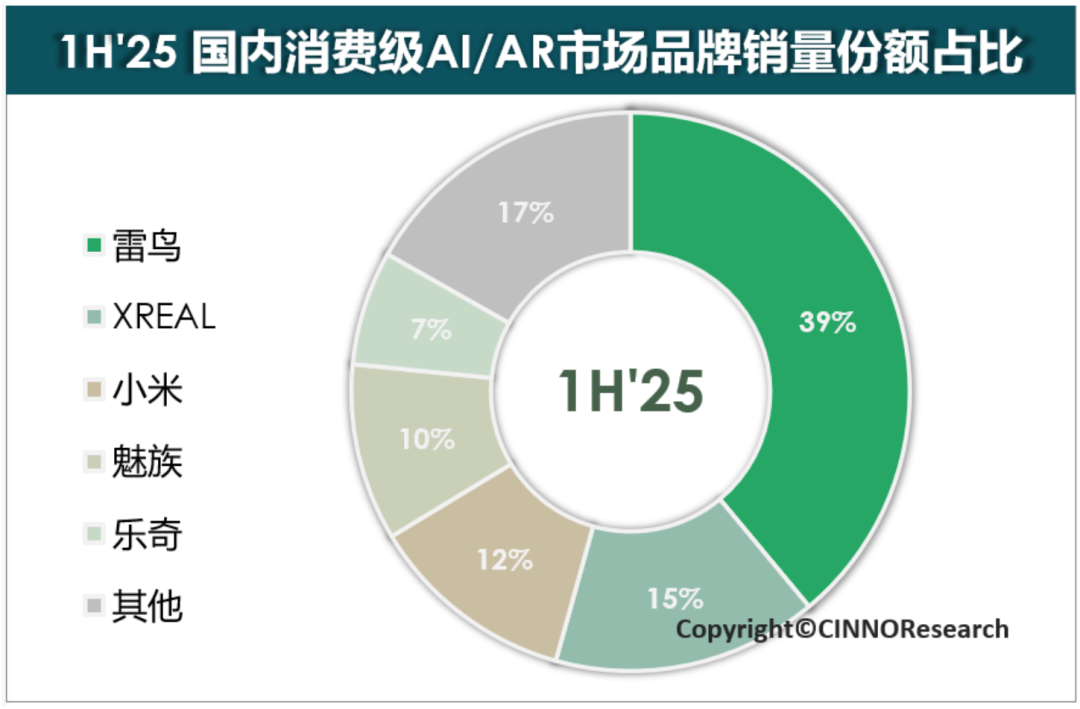
Group 1 - The Chinese consumer-grade AI/AR glasses market experienced explosive growth, with sales reaching 262,000 units in the first half of 2025, a year-on-year increase of 73% [1][2] - The market is driven by government subsidies and the 618 e-commerce promotion, leading to a new wave of product iteration across three major segments: split AR glasses, screen AI glasses, and non-screen AI glasses [2][6] - Non-screen AI glasses led the market with a staggering year-on-year growth of 463%, driven by products like Thunder V3 and Xiaomi AI smart glasses, which integrate AI voice interaction and health monitoring features [2][4] Group 2 - Local brands are diversifying the market, with Thunder leading with a 39% market share and a year-on-year sales increase of 113%, while Xiaomi entered the market with a 12% share, achieving rapid sales growth [4][5] - Thunder's new product launches, including the Air 3S series and X3 Pro AR glasses, have contributed to its strong market position, while Xiaomi's AI glasses achieved 31,000 units sold in the first week [4][5] Group 3 - The dual engines of government policy and e-commerce promotions have significantly boosted the AI/AR market, with consumers benefiting from a 15% subsidy and promotional discounts during the 618 shopping festival [6] - During the core promotional period from May 20 to June 20, sales of AI/AR products across major e-commerce platforms reached 59,000 units, with AR products seeing an increase of over 130% [6] Group 4 - Local brands are focusing on building a content ecosystem to achieve breakthroughs, emphasizing cross-device collaboration, cross-domain applications, and cross-industry cooperation [8] - The integration of AR devices with mobile phones and partnerships with cloud services and content platforms are key strategies for enhancing user experience and expanding market applications [8]

1H’25新品和政策助推,国内消费级AI/AR市场销量同比激增73%,雷鸟第一,小米入局
CINNO Research· 2025-09-04 23:33
Core Viewpoint - The Chinese consumer-grade AI/AR glasses market experienced explosive growth in the first half of 2025, with sales reaching 262,000 units, a year-on-year increase of 73%, driven by policy subsidies, major e-commerce promotions, and innovations from local brands [1][5]. Group 1: Market Growth - The domestic consumer-grade AI/AR market is witnessing a surge, with sales surpassing 262,000 units in the first half of 2025, marking a 73% year-on-year increase [1]. - The market is fueled by national subsidy policies and the 618 e-commerce festival, leading to a new wave of product iterations across three major subcategories [5]. Group 2: Product Segmentation - Split AR glasses achieved a steady growth of 39% year-on-year, supported by new product iterations from leading brands like Thunderbird [2]. - Screened AI glasses (integrated AR) saw a 14% increase in sales, driven by applications in business and cross-language interactions [2]. - Screenless AI glasses led the market with an explosive growth of 463% year-on-year, activating the mass consumer market through features like AI voice interaction and health monitoring [2]. Group 3: Competitive Landscape - Local brands are adopting a "hardware + ecosystem" strategy to capture market share, creating a differentiated competitive landscape [5]. - Thunderbird holds a 39% market share, with a 113% year-on-year sales increase, launching new products at competitive prices [7]. - Xiaomi entered the market strongly, capturing 12% of the overall sales with its AI glasses, which achieved 31,000 units sold in the first week [7]. Group 4: Policy and E-commerce Impact - The introduction of digital product consumption subsidy policies by the National Development and Reform Commission and the Ministry of Finance has been a key driver for market growth, offering consumers a 15% discount [5]. - During the core promotional period from May 20 to June 20, sales of AI/AR products reached 59,000 units across major e-commerce platforms, with AR products seeing an increase of over 130% [5]. Group 5: Future Outlook - CINNO Research predicts that the shipment of AI/AR glasses in China will reach 900,000 units by 2025, representing a 133% year-on-year increase, with the industry expected to exceed a trillion yuan in scale within three years [6]. - Local brands are building content ecosystems through cross-device collaboration, cross-domain applications, and cross-industry partnerships, which are crucial for future growth [6].

AI眼镜“功能探索期迈向“规模化爆发期”
2025-09-02 00:42
Summary of the Conference Call on AI Glasses Industry Industry Overview - The global glasses market is projected to reach a significant scale in 2024, with sales of prescription and sunglasses estimated at 1.4 to 1.5 billion pairs, growing at an annual rate of 10% [1][4] - The smart glasses market is expected to see substantial growth, with Meta Ribbon AI glasses projected to sell 1.4 to 1.5 million units in 2024, and 800,000 units already sold in Q1 2025, indicating a strong market potential [1][4] Key Insights and Arguments - The introduction of new products in the smart glasses market in 2025 will be driven by major brands like Meta, Alibaba, and ByteDance, as well as companies like Xiaomi exploring the integration of smart glasses with large models [1][5] - The success of Meta Ribbon has encouraged domestic manufacturers to shift their focus from hardware to user experience, prompting a reevaluation of the essential needs for AI glasses [1][8] - Future competition in the smart glasses market will hinge on three critical factors: 1. **Technical Usability**: AI experience, hardware performance, and privacy security [9] 2. **Price Accessibility**: The price point of Meta Ribbon at $299 (approximately 1,500 RMB) is seen as a crucial threshold for market penetration [9] 3. **Scenario Necessity**: Identifying high-frequency essential applications such as real-time translation and first-person perspective recording is vital for product relevance [9] Product Launches and Market Dynamics - The smart glasses market is highly active in 2025, with new products being launched approximately every eight days [6] - Meta plans to release three new models, including a ski sports model priced between $499 and $599, a high-end AR glasses model priced over $1,000, and an industrial application model priced above $10,000 [7] - Domestic brands are also launching multiple new products, with notable releases from companies like 雷鸟 (Thunderbird) and 小米 (Xiaomi), focusing on both functionality and pricing strategies to attract consumers [5][7] Competitive Landscape - Different players in the smart glasses industry have distinct advantages: - **Internet Giants**: Companies like Baidu, ByteDance, and Alibaba leverage AI model development and content ecosystems, positioning smart glasses as software service entry points [10] - **Mobile Manufacturers**: Companies like Xiaomi, Huawei, and Samsung utilize their existing supply chains and user bases to optimize production and reduce costs [10] - **AR Technology Firms**: Companies like Lenovo's Xreal and Lucid focus on optical display technology, emphasizing their technical expertise in the field [12] Future Trends - The period from 2025 to 2026 is expected to be a brand positioning battle, with companies aiming to capture consumer attention [14] - Long-term survival in the market will favor brands that can identify killer applications and meet real-world usage needs [15] - The industry anticipates a shift towards more natural human-computer interaction, lighter designs, improved battery life, and integration into personal ecosystems [16]

希荻微上半年营业收入同比增长102.73% 加速拓展芯片产品在AI端侧应用
Zheng Quan Ri Bao Wang· 2025-08-30 04:47
Core Viewpoint - The company, Xidi Microelectronics Group Co., Ltd., reported a significant increase in revenue for the first half of 2025, driven by a recovery in the consumer electronics market and increased demand for high-performance power management chips [1] Group 1: Financial Performance - In the first half of 2025, the company achieved a revenue of 466 million yuan, representing a year-on-year growth of 102.73% [1] - The revenue growth was attributed to the rising demand for power management chips and the successful outsourcing of production for certain products in the audio coil motor driver chip product line [1][2] Group 2: Product Performance - The revenue breakdown by product structure shows that power management chips generated 182 million yuan, autofocus and optical image stabilization chips contributed 142 million yuan, port protection and signal switching chips accounted for 46.6 million yuan, and sensor chips and others brought in 9.55 million yuan [2] - The company has accelerated the application of its chips in AI edge devices, launching customized DC/DC chip products for silicon anode batteries, which have become a preferred solution for enhancing battery life in AI smartphones [2] Group 3: Market Expansion - The company has successfully shipped products to well-known global brands such as Xiaomi, OPPO, vivo, and Transsion, extending its product applications to cutting-edge fields like AI glasses [2] - In the smart automotive electronics sector, the company has introduced new high-performance chip products, including automotive-grade low-side and high-side switch chips, to meet market demands [3] Group 4: Technological Advancements - The company has signed a technology licensing agreement with a South Korean firm to gain exclusive rights to autofocus and optical image stabilization patents in Greater China, positioning itself as a preferred supplier for audio coil motor driver chips among Chinese smartphone brands [4] - The company is transitioning its audio coil motor driver chip business from a trading model to a self-production model, increasing the self-production ratio quarterly [4]
