恒生电子

Search documents
高盛最新解读:中美宏观、香港楼市、中国锂供应、医疗健康、消费等七大领域看点汇总
Zhi Tong Cai Jing· 2025-07-23 10:50
Group 1: Global Economic Outlook - Goldman Sachs' chief economist, Hatzios, suggests a bearish stance on the US dollar and a bullish position on gold, anticipating that the Federal Reserve's easing of monetary policy will lower US Treasury yields and the dollar while boosting global stocks and gold [1] - Goldman Sachs maintains a more dovish view on monetary policy outside the US compared to market pricing, particularly in the Eurozone, UK, Canada, and Australia [1] Group 2: China Macro Economy - The two main macroeconomic themes shaping China's economy in the second half of the year are trade and policy, with a projected GDP growth of 5.3% year-on-year in the first half of 2025 [2] - The government has ample room to achieve its annual GDP growth target of "around 5%" despite a potential slowdown in the second half, leading to a lack of urgency for major easing measures [2] Group 3: Japan Macro Economy - The recent upper house election results in Japan show the ruling coalition lost its majority, which may complicate the passage of legislation [3] - Goldman Sachs expects the Bank of Japan to maintain its dovish stance, with a basic scenario predicting a rate hike in January 2026 [3] Group 4: China Real Estate - By June 2025, the market for publicly offered infrastructure securities investment funds in China has grown to 68 funds with a total market value exceeding 200 billion RMB, reflecting a fivefold increase since launch [4] - Goldman Sachs presents three scenarios for the potential expansion of this market, with the most optimistic scenario suggesting a 10% reduction in the real estate sector's and local government financing platform's outstanding debt [4] Group 5: Chinese Brokerage and Asset Management - Nearly 20 traditional brokerages have reported over 50% year-on-year growth in net profit for the first half of 2025, driven by increased brokerage and investment banking revenues [5] - Goldman Sachs has raised its earnings expectations for covered brokerages, including China International Capital Corporation (CICC), which reported a 55-78% increase in net profit for the first half of 2025 [6] Group 6: Hong Kong Real Estate - Goldman Sachs has upgraded New World Development to neutral while downgrading Sino Land to sell, as the Hong Kong real estate market shows signs of stabilization [9] - The firm expects a sustainable compound annual growth rate in profits driven by project sales, with significant variations in earnings per share forecasts for 2025-2027 [9] Group 7: China Healthcare - Goldman Sachs anticipates a 20% revenue growth for Adagene in 2025, while expecting a 14% growth for United Imaging Healthcare, driven by its performance in China [10] - Conversely, Mindray Medical is projected to see a 26% decline in its Chinese business due to weak performance in the in vitro diagnostics sector [10] Group 8: Guizhou Moutai - Guizhou Moutai plans to establish new sales companies with non-state distributors to stabilize prices and introduce new products, which may support sales growth in 2025 [12] Group 9: Weir Shares - Weir Shares is expected to see stronger growth in the second half of 2025 due to the mass production of new high-end smartphone image sensors [13] - The company is also expanding its automotive image sensor business, benefiting from increased camera usage in new vehicles [13]
金十图示:2025年07月23日(周三)中国科技互联网公司市值排名TOP 50一览


news flash· 2025-07-23 02:55
Core Insights - The article presents the market capitalization rankings of the top 50 Chinese technology and internet companies as of July 23, 2025, highlighting significant players in the industry [1]. Group 1: Top Companies by Market Capitalization - Alibaba leads the list with a market capitalization of approximately $2879.35 billion [3]. - Xiaomi Group follows with a market capitalization of around $1917.71 billion [3]. - Other notable companies include Oriental Fortune at $523.45 billion, SMIC at $492.43 billion, and JD.com at $488.38 billion [4]. Group 2: Additional Rankings - Kuaishou ranks 11th with a market cap of $410.71 billion, while Tencent Music is at 12th with $330.85 billion [4]. - Li Auto and Baidu are also significant players, with market caps of $330.12 billion and $317.82 billion, respectively [4]. - The list continues with companies like Xpeng Motors at $179.88 billion and ZTO Express at $155.31 billion [5]. Group 3: Lower Rankings - New Oriental has a market cap of $77.82 billion, while Kingdee International is at $72.8 billion [5]. - Other companies in the lower rankings include Ufine Network at $67.26 billion and Tongcheng Travel at $65.15 billion [5]. - The bottom of the list features companies like Yueda Group at $39.94 billion [6].


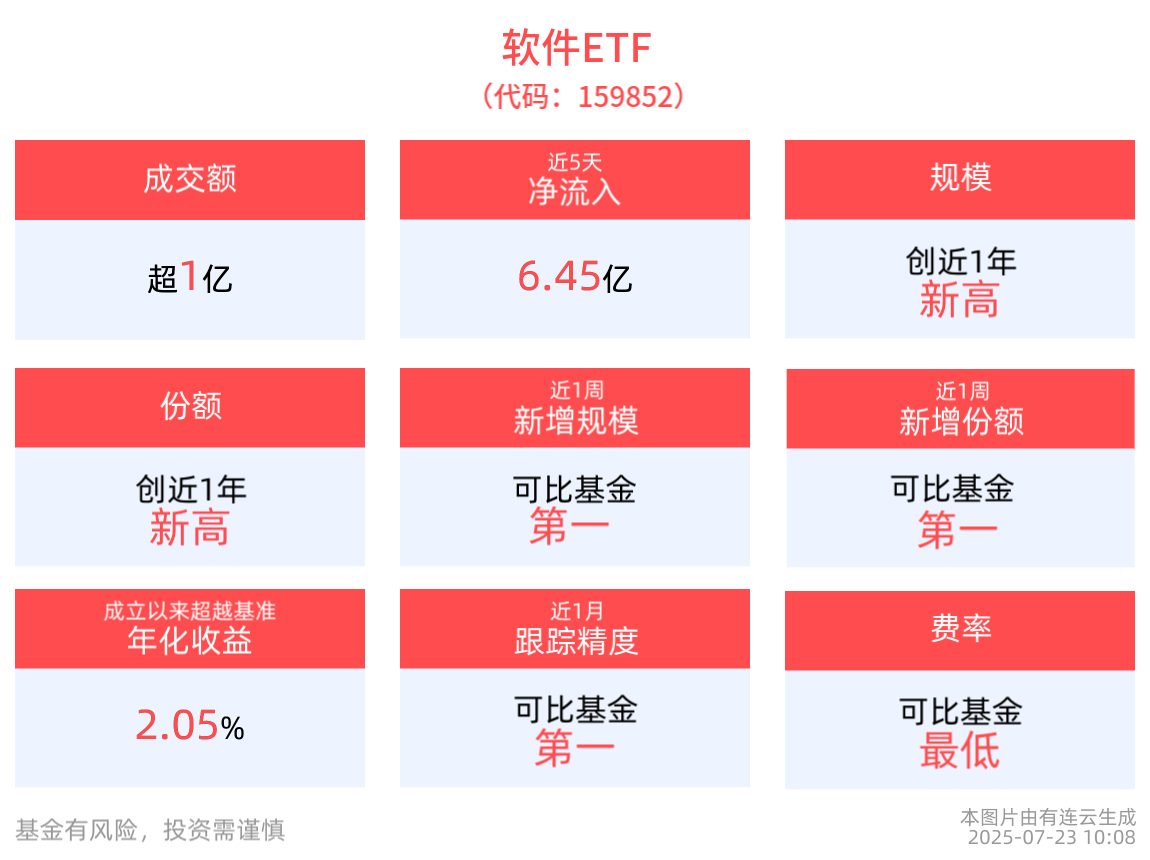
最新单日“吸金”2.52亿元,软件ETF(159852)红盘蓄势,近1周日均成交同类第一!
Sou Hu Cai Jing· 2025-07-23 02:38
Group 1 - The software ETF has a turnover rate of 2.83% and a trading volume of 1.25 billion yuan, with an average daily trading volume of 4.02 billion yuan over the past week, ranking first among comparable funds [2] - The latest scale of the software ETF reached 44.03 billion yuan, a one-year high, and its share reached 5.331 billion, also a one-year high, both ranking first among comparable funds [2] - The software ETF recorded a net inflow of 2.52 billion yuan, with a total of 6.45 billion yuan net inflow over the last five trading days, with inflows on four of those days [2] Group 2 - Since its inception, the software ETF has achieved a highest monthly return of 39.35%, with the longest consecutive monthly gains being three months and a maximum cumulative increase of 69.40%, averaging a monthly return of 9.98% during rising months [2] - The computer and software development industry is experiencing high demand in segments such as AI computing power and LiDAR, with AI applications accelerating; other segments like software outsourcing, financial IT, quantum computing, and data elements are also showing stable growth [2] - The top ten weighted stocks in the CSI Software Service Index account for 60.56% of the index, including companies like iFLYTEK, Kingsoft Office, and Tonghuashun [3]
研判2025!中国金融大模型行业发展背景、市场现状、企业格局及未来趋势分析:金融大模型蓬勃发展,标准化产品占据市场主导地位[图]
Chan Ye Xin Xi Wang· 2025-07-23 01:22
Core Insights - The financial large model is defined as the vertical development and application of AI large models in the financial sector, supported by data, algorithms, and computing power, which are considered the "three pillars" of artificial intelligence [1][2][3] - The Chinese financial large model industry is experiencing rapid growth, with a projected market size of 2.866 billion yuan in 2024, representing a year-on-year increase of 79.9% [1][13] - The demand for cost reduction and efficiency improvement in financial institutions is driving the rapid deployment of large models in areas such as intelligent investment research, risk control, and customer service [1][13] - Standardized products dominate the market, accounting for 71% of the financial large model market share in 2024, while non-standardized products hold 29% [1][15] - Major players in the market include Alibaba Cloud, Baidu Intelligent Cloud, and SenseTime, with market shares of 33.2%, 19.3%, and 10.9% respectively [1][19] Industry Overview - The financial large model industry is supported by favorable policies that encourage digital transformation and the use of technologies such as cloud computing, big data, and artificial intelligence [5][8] - The digital transformation of the financial industry is progressing steadily, with increasing investments in financial technology by institutions [8][9] - The AI large model has become a crucial component of new productive forces, with significant investments in R&D and application within the financial sector [11] Market Dynamics - The financial large model market is characterized by a rapid increase in demand for intelligent applications, driven by the need for compliance and efficiency in a highly regulated industry [9][19] - The market for financial technology is projected to reach 394.96 billion yuan in 2024, with banking technology, securities technology, and insurance technology accounting for 288.83 billion yuan, 47.46 billion yuan, and 58.67 billion yuan respectively [9] Development Trends - The foundational technical capabilities of large models are expected to significantly enhance, allowing for a deeper understanding of financial business [23] - The introduction of new technologies is anticipated to further reduce the deployment costs of large models, transforming them from "luxuries" to "industrial-grade infrastructure" [24] - The development of intelligent agent technology is accelerating, promoting the integration of large models with financial business processes [25]






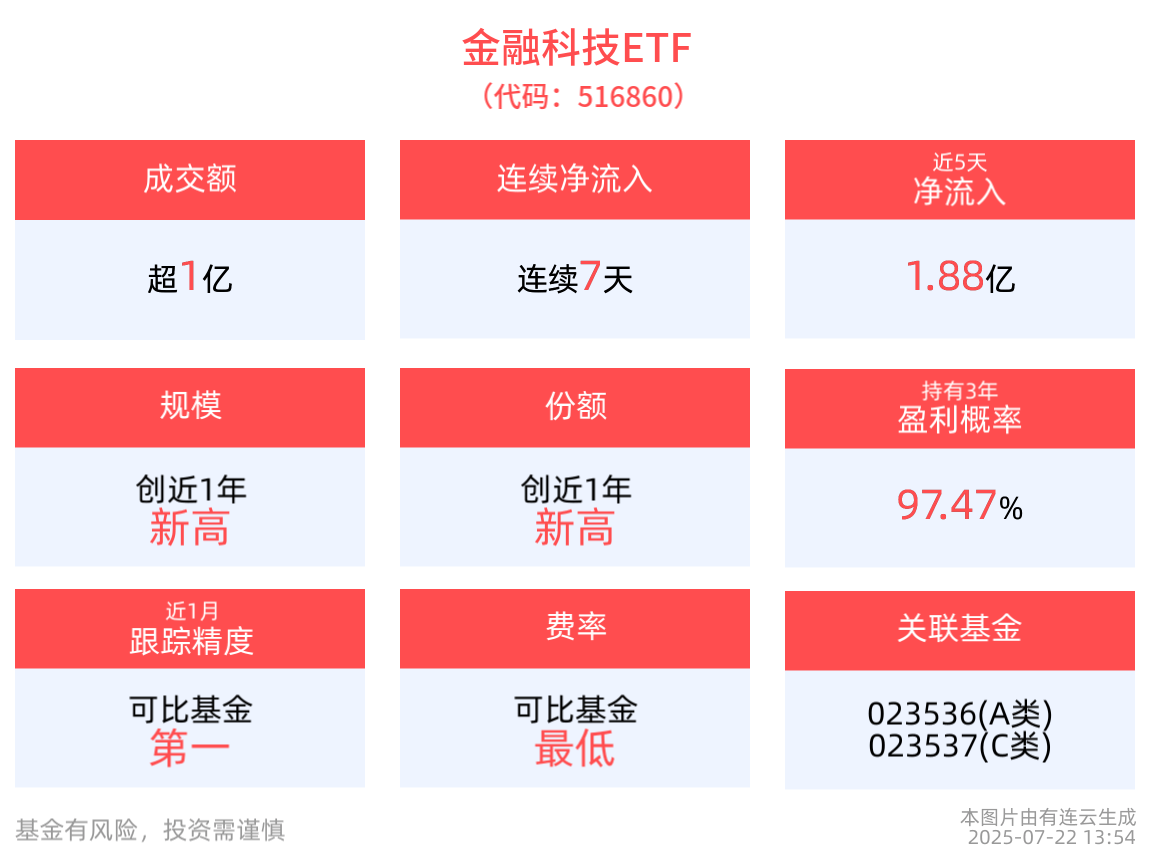
金融科技概念股探底回升,金融科技ETF(516860)连续7日获资金净流入,金融科技领域迎来政策与技术双重利好
Sou Hu Cai Jing· 2025-07-22 06:17
Core Viewpoint - The financial technology sector is experiencing a dual benefit from favorable policies and technological advancements, with significant foreign capital inflow indicating strong international confidence in the sector's growth potential [4]. Group 1: Market Performance - As of July 22, 2025, the China Securities Financial Technology Theme Index (930986) decreased by 0.04%, with component stocks showing mixed performance [3]. - The Financial Technology ETF (516860) has seen a recent price of 1.43 yuan, with a two-week cumulative increase of 1.42% as of July 21, 2025 [3]. - The Financial Technology ETF's latest scale reached 1.339 billion yuan, marking a one-year high, and its latest share count reached 937 million, also a one-year high [4]. Group 2: Fund Flows and Performance - The Financial Technology ETF has experienced continuous net inflows over the past seven days, totaling 284 million yuan, with a peak single-day net inflow of 76.39 million yuan [5]. - As of July 21, 2025, the Financial Technology ETF's net value has increased by 124.33% over the past year, ranking 3rd out of 2929 index stock funds [5]. - The ETF has demonstrated a maximum monthly return of 55.92% since inception, with an average monthly return of 10.60% and a historical three-year profit probability of 97.47% [5]. Group 3: Fee Structure and Tracking Accuracy - The Financial Technology ETF has a management fee rate of 0.50% and a custody fee rate of 0.10%, which are among the lowest in comparable funds [6]. - As of July 21, 2025, the ETF's tracking error over the past month was 0.030%, indicating the highest tracking precision among comparable funds [6]. Group 4: Key Holdings - As of June 30, 2025, the top ten weighted stocks in the China Securities Financial Technology Theme Index accounted for 51.2% of the index, including companies like Dongfang Wealth and Tonghuashun [7].
规模新高,稳定币含量最高的金融科技ETF华夏(516100)连续回调获资金抢筹
Mei Ri Jing Ji Xin Wen· 2025-07-22 04:17
Group 1 - The core viewpoint of the news highlights the performance of the financial technology ETF Huaxia (516100), which has seen a slight decline of 0.22% amid a strong market trend, with significant fluctuations in its constituent stocks [1] - The financial technology ETF Huaxia has recently experienced a continuous capital inflow, accumulating 268 million in the past five days, reaching a new high of over 1 billion in total product scale since its inception [1] - A strategic partnership was formed between AI company Fourth Paradigm and fixed-income fintech platform Jiuyang Technology, aimed at developing a stablecoin asset management solution to enhance compliance and security in the stablecoin investment sector [1] Group 2 - The financial technology ETF Huaxia (516100) closely tracks the CSI Financial Technology Theme Index, which includes major players in software development, internet finance, and the digital currency industry, with a stablecoin content of 23.43%, the highest in the market [2] - The index comprises leading stocks such as Tonghuashun, Dongfang Caifu, Runhe Software, and Hengsheng Electronics, as well as popular stablecoin stocks like Dongxin Pinghe and Yingshisheng, facilitating investors' access to stablecoin and digital currency concepts [2]
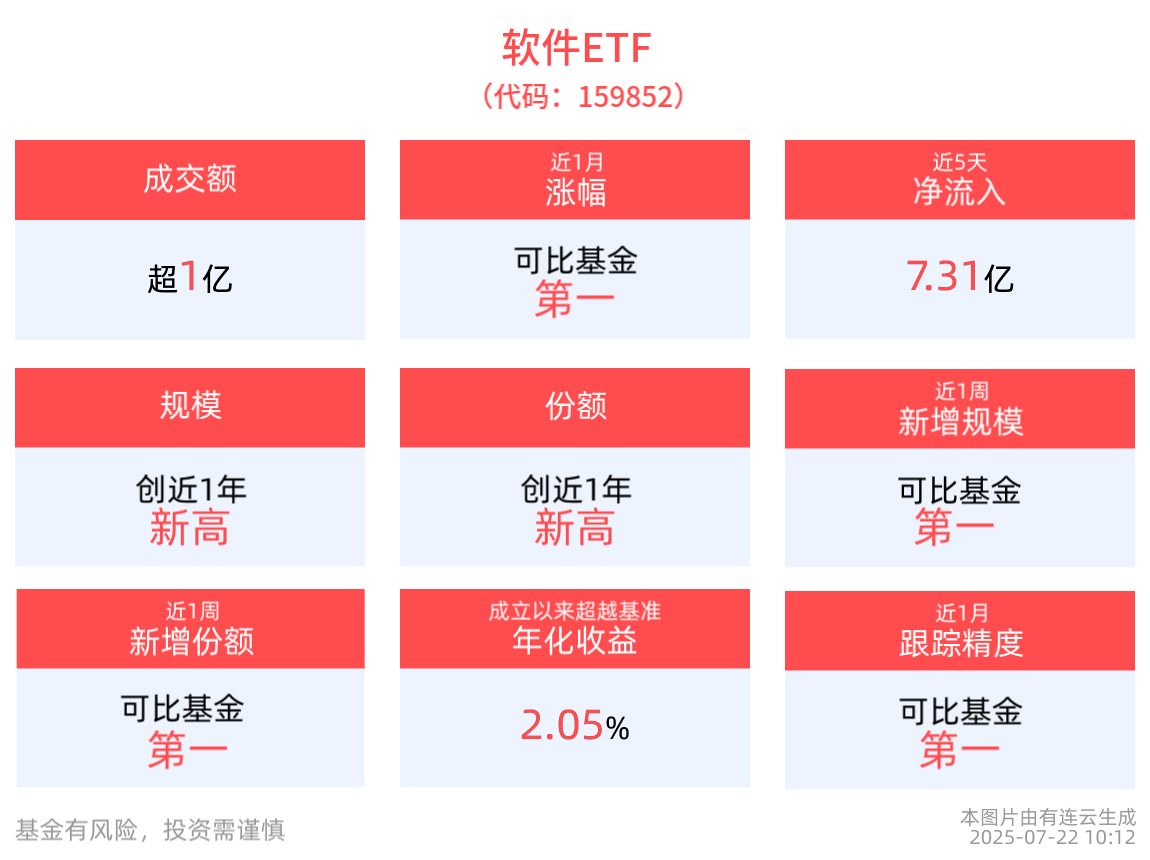
软件ETF(159852)近5日“吸金”超7亿元,最新规模创近1年新高同类居首!
Sou Hu Cai Jing· 2025-07-22 02:59
Group 1: ETF Performance - The software ETF has a turnover rate of 4.3% during trading, with a transaction volume of 180 million yuan [2] - As of July 21, the software ETF's latest scale reached 4.18 billion yuan, marking a one-year high and ranking first among comparable funds [2] - The latest share count for the software ETF is 5.026 billion shares, also a one-year high and ranking first among comparable funds [2] - The software ETF has seen a net inflow of 67.36 million yuan recently, with a total of 731 million yuan attracted over the last five trading days [2] - Since its inception, the software ETF has recorded a highest single-month return of 39.35%, with the longest consecutive monthly gains being three months and a total increase of 69.40% [2] Group 2: Computer Sector Performance - According to a report from Industrial Securities, the computer sector is showing signs of performance improvement, with 77 companies having completed earnings forecasts, accounting for 23% of the sector [3] - For Q2 2025, the median revenue growth rate is projected at -1%, an improvement from -6% in the first half of the year, while the net profit attributable to shareholders is expected to be -243 million yuan, a reduction in losses by 611 million yuan [3] - The median revenue growth rate based on the median method is projected at 8%, up from -5% in the first half of the year, indicating a positive trend in Q2 earnings [3] - As of June 30, 2025, the top ten weighted stocks in the CSI Software Service Index account for 60.56% of the index, including companies like iFlytek, Kingsoft Office, and Tonghuashun [3] Group 3: Stock Performance - The stock performance of key companies in the software sector shows varied results, with iFlytek down by 0.92% and Kingsoft Office down by 0.99%, while Tonghuashun increased by 1.50% [5] - The top ten stocks by weight in the software sector include iFlytek (13.93%), Kingsoft Office (8.15%), and Tonghuashun (7.39%), among others [5] - Investors can also access AI software investment opportunities through the software ETF linked fund (012620) [5]
金十图示:2025年07月22日(周二)中国科技互联网公司市值排名TOP 50一览




news flash· 2025-07-22 02:54
Group 1 - The article presents the market capitalization rankings of the top 50 Chinese technology and internet companies as of July 22, 2025 [1] - The leading company is Alibaba with a market cap of 1,000.00 billion [3] - Tencent follows closely with a market cap of 900.00 billion, indicating strong competition in the sector [3] Group 2 - Other notable companies include Baidu with a market cap of 305.30 billion and JD.com at 481.46 billion, showcasing a diverse range of players in the market [4][5] - The rankings reflect significant fluctuations, with companies like Kuaishou and Li Auto showing notable positions at 399.46 billion and 326.48 billion respectively [3][4] - The data is calculated based on the daily market values, converted from USD to HKD using the day's exchange rate [5]

杭州700+职场人解锁“人工智能训练师”新身份
Hang Zhou Ri Bao· 2025-07-22 02:40
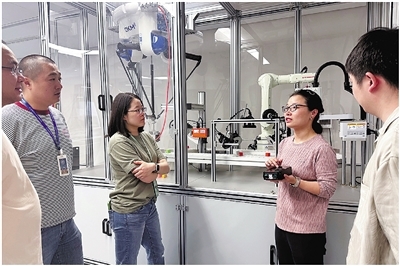
当AI成为"学生",谁来当它的老师? 在人工智能技术席卷各行各业的今天,许多人担忧被机器取代,而杭州的一群职场人却选择"反向 操作"——成为AI的导师。他们通过系统学习如何训练、优化AI模型,不仅化解了职业焦虑,还成功跻 身国家认证的"人工智能训练师"行列。 半年内,杭州已有超700人通过认证,其中20人成为行业顶尖高手。这一新兴职业如何运作?学员 如何从"职场人"转型为AI导师?记者走进杭州首家官方认证的人工智能训练师技能大师工作室,揭秘这 一职业的成长路径与未来前景。 五级进阶体系 年满16周岁即可报考 而另据北航杭州创新研究院数字创新中心主任、杭州市数字技能人才培训评价产业联盟秘书长陈梦 祥透露,该院也正筹划学生集训项目,并与胡征慧工作室共建持续学习体系,"技术迭代是永恒课题, 我们要打通数字人才培养'最后一公里'。" "我们是一个集理论学习、应用实战、能力认证于一体的人工智能人才实训平台。"工作室负责人胡 征慧介绍,"人工智能训练师是AI产品落地的关键角色。这一职业的核心是通过数据管理和算法调整, 让AI更精准地解决实际问题。根据国家职业标准,人工智能训练师分为五级进阶体系:其中,五级 (初级工)年满 ...
中证互联网+主题指数报2889.92点,前十大权重包含指南针等
Jin Rong Jie· 2025-07-21 15:40
Core Viewpoint - The China Securities Internet Plus Index (CS Internet Plus, 930733) has shown significant growth, reflecting the performance of representative listed companies in various high-internet penetration industries, including education, finance, tourism, agriculture, healthcare, and manufacturing [2]. Group 1: Index Performance - The CS Internet Plus Index has increased by 6.91% over the past month, 9.86% over the past three months, and 8.92% year-to-date [2]. - The index was established on June 29, 2012, with a base point of 1000.0 [2]. Group 2: Index Composition - The top ten weighted companies in the CS Internet Plus Index include: - Zhinan Compass (1.21%) - Industrial Fulian (1.15%) - Juxing Technology (1.11%) - Top Cloud Agriculture (1.1%) - Tongwei Co., Ltd. (1.1%) - Yuntu Holdings (1.07%) - Hengsheng Electronics (1.06%) - Jinqiao Information (1.05%) - Doushen Education (1.05%) - Xian Dao Intelligent (1.01%) [2]. - The index's holdings are primarily listed on the Shenzhen Stock Exchange (62.09%) and the Shanghai Stock Exchange (37.91%) [2]. Group 3: Sector Allocation - The sector allocation of the index holdings is as follows: - Information Technology: 38.31% - Healthcare: 14.86% - Finance: 10.43% - Industry: 10.35% - Communication Services: 9.06% - Consumer Discretionary: 8.69% - Materials: 5.65% - Consumer Staples: 2.64% [2]. Group 4: Index Adjustment Mechanism - The index samples are adjusted semi-annually, with adjustments occurring on the next trading day after the second Friday of June and December each year [3]. - Weight factors are generally fixed until the next scheduled adjustment, with special circumstances allowing for temporary adjustments [3].