中国移动

Search documents
第三届“大模型 大未来”人工智能大模型基准测试发展大会在成都举行
Zheng Quan Ri Bao Wang· 2026-01-17 04:13
Group 1 - The third "Large Model, Great Future" AI benchmark testing development conference was held in Chengdu, focusing on cutting-edge technologies and application scenarios in the AI field, with participation from nearly 100 companies and over 200 attendees [1] - Sichuan Province has invested over 370 million yuan in its first innovation project, achieving significant milestones such as the development of leading immersive liquid-cooled servers and the "machine wolf" showcased at the "93" military parade [2] - The AI industry in Sichuan is projected to exceed 200 billion yuan in revenue by 2025, with a growth rate of over 30% due to the establishment of collaborative mechanisms and the development of key cities [2] Group 2 - The National University Large Model Innovation Development Alliance awarded new memberships to key enterprises, including Haiguang Information and China Mobile, enhancing collaboration between academia and industry [3] - Fifteen innovative application cases of the "Nest Fire" large model were announced, covering critical sectors such as education, finance, healthcare, energy, and agriculture, providing valuable references for industry development [3] - A white paper on the core value alignment capability assessment in educational scenarios was released, offering important insights for model optimization and future standard formulation [3]
中国移动链长基金战略加持,国内首台原子量子计算系统研发团队完成新一轮战略融资丨早起看早期
36氪· 2026-01-17 01:12
Core Viewpoint - The article highlights the significant advancements and commercialization of quantum computing technology by Zhongke Kuyuan Technology (Wuhan) Co., Ltd., particularly in atomic quantum computing, supported by a recent strategic financing round of nearly 100 million yuan [5][8]. Group 1: Company Overview - Zhongke Kuyuan is the first company in China to possess both research and industrialization capabilities in atomic quantum computing and quantum precision measurement [5]. - The core team originates from the Chinese Academy of Sciences and has over 20 years of experience in neutral atom quantum technology research [5]. Group 2: Market Potential - The global quantum technology market is projected to reach $8 billion in 2024, with China accounting for nearly 25% of this market [7]. - By 2035, the global market size is expected to exceed $900 billion, with China's industry scale potentially reaching $260 billion, representing nearly 30% of the global market share [7]. Group 3: Technological Advancements - Neutral atom quantum computing is recognized for its scalability, engineering feasibility, and system integration advantages, making it one of the fastest-growing systems in quantum computing development [7]. - Zhongke Kuyuan launched the "Hanyuan 1" atomic quantum computing system in 2024, which has been recognized as a landmark product in the quantum technology field [7]. Group 4: Future Developments - The company plans to release the next-generation atomic quantum computing system, "Hanyuan 2," which will enhance overall architecture, stability, and performance [8]. - A cloud platform for atomic quantum computing has been developed in collaboration with Wuhan Quantum Institute, allowing users to access "Hanyuan 1" for computational tasks [8]. Group 5: Funding Utilization - The recent funding will primarily accelerate hardware development, facilitate rapid iteration of new products and technologies, and enhance talent acquisition and application scenario exploration [8].


2025年中国汽车出行云行业发展背景、市场规模、部署模式、企业格局及未来趋势研判:行业显现出强劲扩张态势,市场规模达140.4亿元[图]
Chan Ye Xin Xi Wang· 2026-01-17 01:02
Core Insights - The automotive cloud industry is rapidly evolving, driven by technological advancements, user demands, and market competition, with a significant focus on "smart driving equality" [1][4] - The integration of cloud computing with smart mobility is expected to create substantial growth opportunities, with the market projected to reach 12.21 billion yuan in 2024 and 14.04 billion yuan in 2025, reflecting a 15% year-on-year growth [1][8] Industry Overview - Automotive cloud serves as a digital foundation for the entire smart vehicle industry chain, leveraging cloud computing to enhance the digital transformation across R&D, production, sales, and usage [2][3] - The industry is characterized by a four-dimensional collaborative ecosystem involving vehicles, cloud, roads, and people, facilitating a comprehensive upgrade of the automotive sector [2] Development Background - The acceleration of automotive intelligence is evident, particularly in the new energy vehicle sector, where the installation rate of L2-level and above assisted driving functions is expected to reach 87% by October 2025 [4][5] - The Chinese government is actively promoting the "vehicle-road-cloud integration" strategy, which aims to enhance the safety, energy efficiency, and comfort of intelligent connected vehicle systems [5][6] Market Status - The Chinese automotive cloud market is experiencing robust growth, with a projected market size of 12.21 billion yuan in 2024 and 14.04 billion yuan in 2025, driven by AI models, smart vehicle intelligence, and supportive policies [8][10] - Public cloud services are expected to account for 65.3% of the market in 2024, while private cloud services will represent 34.7%, indicating a diverse deployment strategy among automotive companies [8][9] Customer Distribution - The customer base for automotive cloud services is extensive, covering key segments of the smart vehicle industry, including OEMs, parts suppliers, autonomous driving technology providers, and mobility service suppliers [9] - In 2024, OEMs and parts suppliers are expected to represent 43.2% and 27.6% of the customer distribution, respectively, highlighting their reliance on cloud services for core applications [9] Market Landscape - The market is dominated by a multi-supplier strategy, with leading players maintaining significant market shares due to their resource availability and technological advantages [10] - In the public cloud infrastructure sector, the top five service providers are expected to hold a combined market share of 86.9%, while the top five in the private cloud sector will account for 60% [10] Future Trends - The automotive cloud industry is anticipated to continue its growth trajectory, with expectations of surpassing 20 billion yuan by 2028, driven by the increasing demand for smart and connected vehicles [10] - Global expansion is expected as Chinese automotive companies increase their international presence, leading to a rise in demand for localized cloud services [10] - The industry will likely shift towards a hybrid architecture, optimizing computing resources and ensuring compliance with local data regulations [10]

陆家嘴财经早餐2026年1月17日星期六
Wind万得· 2026-01-16 23:51
Group 1 - The China Securities Regulatory Commission (CSRC) emphasized maintaining market stability and enhancing monitoring and regulation to prevent excessive speculation and market manipulation [3] - Canada and China reached a consensus on deepening economic and trade cooperation, signing the "China-Canada Economic and Trade Cooperation Roadmap," which includes an annual quota of 49,000 electric vehicles from China with a 6.1% most-favored-nation tariff [3] Group 2 - The State Council of China is focusing on boosting consumption and has outlined measures to clear overdue payments to businesses and ensure wage payments to migrant workers [4] - The Ministry of Commerce announced stronger support for green and smart product consumption through a recycling program for consumer goods [4] Group 3 - The State-owned Assets Supervision and Administration Commission (SASAC) is working on optimizing the layout and structure of state-owned enterprises, focusing on enhancing core business strengths [5] - The Market Supervision Administration has introduced new guidelines for recognizing illegal gains in market regulation, effective from March 20 [5] Group 4 - The A-share market experienced fluctuations, with the Shanghai Composite Index closing at 4,101.91 points, down 0.26%, while the Shenzhen Component Index and the ChiNext Index also saw slight declines [6] - The Hong Kong stock market showed mixed results, with the Hang Seng Index closing down 0.29% but showing a weekly gain of 2.34% [7] Group 5 - The Ministry of Housing and Urban-Rural Development highlighted significant investment opportunities in urban renewal projects during the 14th Five-Year Plan period [11] - The Ministry of Finance extended tax incentives for public rental housing, exempting certain taxes to promote construction [11] Group 6 - The China Automotive Power Battery Industry Innovation Alliance reported a 60.1% year-on-year increase in the cumulative production of power and energy storage batteries in 2025 [12] - The China Securities Association announced new rules allowing certain individual investors to redeem public pension fund shares early under specific conditions [12] Group 7 - The U.S. Federal Reserve officials indicated that current monetary policy remains moderately restrictive, with potential adjustments depending on labor market conditions [15][16] - The U.S. Senate approved funding for federal research institutions, rejecting previous budget cuts proposed by the Trump administration [16] Group 8 - The Chinese bond market showed signs of warming, with yields generally declining and the central bank conducting a net injection of liquidity [20] - Barclays analysts forecast a total issuance of U.S. corporate bonds to reach $2.46 trillion in 2026, marking an 11.8% increase year-on-year [20]




我国卫星星座规划出炉 申请数量超20万颗
Zhong Guo Jing Ying Bao· 2026-01-16 19:36
Core Insights - China's commercial space industry has set ambitious goals for 2026, with over 200,000 satellites planned for deployment, marking a record number of applications to the International Telecommunication Union (ITU) [2][3] - The majority of applications, over 94%, come from the newly established "Radio Spectrum Development and Technology Innovation Research Institute," indicating a strategic push for resource allocation in low Earth orbit [3][4] Group 1: Satellite Deployment Plans - China has submitted applications for more than 200,000 satellites, significantly surpassing the 42,000 satellites deployed by SpaceX's Starlink [2] - The two largest applications, CHN2025-79441 and CHN2025-79398, each include 96,714 satellites, showcasing the scale of China's ambitions [2] - The applications are still subject to ITU review and must meet specific deployment timelines to secure rights to the frequency and orbital resources [4] Group 2: Strategic Importance - The strategic significance of this application extends beyond mere deployment, as low Earth orbit resources are becoming increasingly valuable [4] - Analysts suggest that without early applications, Chinese companies may face challenges in securing critical frequency resources in the future [4] - The ITU's rules dictate that satellite deployment must occur within strict timelines, emphasizing the urgency of these applications [4] Group 3: Industry Growth and Support - The commercial space industry in China is projected to reach a scale of 2.5 to 2.8 trillion yuan by 2025, with a financing total of 18.6 billion yuan, reflecting a 32% year-on-year growth [5] - The establishment of a 2 billion yuan industry fund by the National Space Administration in 2025 supports the development of reusable rockets and smart satellites [5] - The satellite internet market in China is expected to reach 44.7 billion yuan by 2025, with a compound annual growth rate of 11% over the next five years [5] Group 4: Technological Advancements - China's satellite manufacturing capabilities are advancing, with production cycles for low Earth orbit satellites reduced from years to months, and costs decreasing significantly [5][6] - The "Qianfan Constellation" and "National Grid Constellation" are accelerating their deployment, with the former already achieving multiple satellite launches [6] - Breakthroughs in low-power laser link technology and direct mobile connections to satellites are enhancing service capabilities, with major smartphone brands integrating satellite broadband features [6]
2026年民营商业航天火箭发射首战告捷
Zheng Quan Ri Bao Zhi Sheng· 2026-01-16 16:40
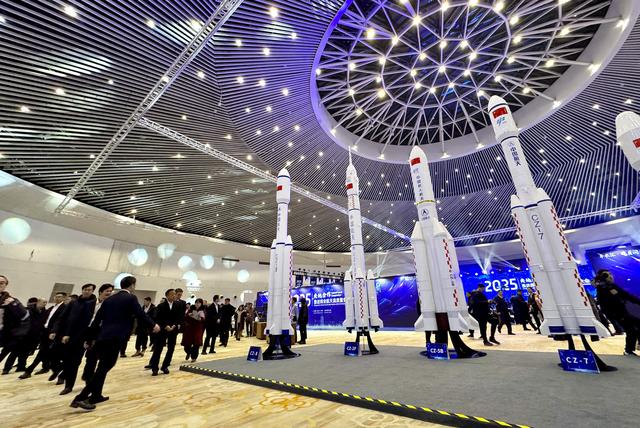
Core Insights - The successful launch of the "Vesta-1" sea-launched rocket by Beijing Xinghe Power Aerospace Technology Co., Ltd. marks the first commercial space mission of 2026 in China, successfully placing four satellites into orbit [1] - The advancement in reusable rocket technology is expected to lead to more frequent and cost-effective launches, accelerating satellite constellation deployment [1][4] Group 1: Launch Achievements - The "Wanghai Tide" mission is the 21st successful launch for Xinghe Power and the 7th launch of the Vesta series for the "Tiankong Constellation" [2] - A total of 89 commercial satellites have been accurately delivered to their designated orbits through these launches [2] Group 2: Upcoming Launches and Innovations - Xinghe Power plans to execute the first flight of the Vesta-2 rocket, which is designed to efficiently launch small satellites weighing between 300 kg and 500 kg [2] - The company’s reusable rocket, Zhishen-1, is expected to have its maiden flight in the first half of 2026 [2] Group 3: Infrastructure and Technological Developments - The Long March 12B rocket successfully completed a static ignition test, aimed at meeting commercial launch demands for low-orbit satellite constellations [3] - Beijing Arrow Yuan Technology Co., Ltd. is developing a comprehensive industrial base for large liquid rockets, covering production, assembly, testing, recovery, and reuse [3] Group 4: Market Dynamics and Strategic Moves - The commercial space launch market in China is expected to be robust in 2026, with significant breakthroughs in reusable rocket technology anticipated to lower launch costs and accelerate satellite deployment [4] - China has submitted an application for an additional 203,000 satellites, indicating a strategic shift in satellite resource competition [4][5] Group 5: Industry Participation - Major telecommunications companies, including China Mobile and China Telecom, are actively involved in satellite constellation projects, with plans to launch thousands of satellites [5] - The three major telecom operators have already obtained licenses for satellite mobile communication services, enhancing their capabilities in emergency communication and remote area connectivity [5]
南向资金今日成交活跃股名单(1月16日)
Zheng Quan Shi Bao Wang· 2026-01-16 15:35
Market Overview - On January 16, the Hang Seng Index fell by 0.29%, with southbound funds totaling a transaction amount of HKD 110.94 billion, comprising HKD 55.52 billion in buying and HKD 55.42 billion in selling, resulting in a net buying amount of HKD 0.94 million [1] Southbound Trading Activity - The southbound trading through Stock Connect (Shenzhen) recorded a total transaction amount of HKD 41.37 billion, with buying at HKD 20.23 billion and selling at HKD 21.14 billion, leading to a net selling amount of HKD 0.91 billion [1] - Conversely, the Stock Connect (Shanghai) saw a total transaction amount of HKD 69.57 billion, with buying at HKD 35.29 billion and selling at HKD 34.28 billion, resulting in a net buying amount of HKD 1.00 billion [1] Active Stocks - Alibaba-W had the highest transaction amount among southbound funds, totaling HKD 69.52 billion, followed by SMIC and Tencent Holdings with transaction amounts of HKD 57.02 billion and HKD 56.66 billion, respectively [1] - In terms of net buying, SMIC led with a net buying amount of HKD 10.84 billion, with a closing price increase of 2.39%. Xiaomi Group-W followed with a net buying of HKD 8.67 billion, while Hua Hong Semiconductor had a net buying of HKD 5.85 billion [1] - The stock with the highest net selling was China Mobile, with a net selling amount of HKD 10.74 billion and a closing price decrease of 0.62%. Other notable net sellers included Alibaba Health and CNOOC, with net selling amounts of HKD 4.62 billion and HKD 1.08 billion, respectively [1] Continuous Net Buying - Among the stocks, SMIC, Xiaomi Group-W, and Hua Hong Semiconductor were listed as active stocks in both Stock Connect (Shenzhen) and (Shanghai), with SMIC having a total transaction amount of HKD 57.02 billion and a net buying of HKD 10.84 billion [2] - Tencent Holdings and Alibaba-W have seen continuous net buying for 8 days and 5 days, respectively, with Tencent Holdings having the highest net buying amount of HKD 96.85 billion, followed by Alibaba-W with HKD 44.24 billion [2]






港股通(深)净卖出9.13亿港元
Zheng Quan Shi Bao Wang· 2026-01-16 15:35
1月16日港股通成交活跃股 | 代码 | 简称 | 类型 | 成交金额(万港元) | 成交净买入(万港元) | 日涨跌幅(%) | | --- | --- | --- | --- | --- | --- | | 09988 | 阿里巴巴-W | 港股通(沪) | 402962.65 | 5602.18 | 0.97 | | 00700 | 腾讯控股 | 港股通(沪) | 344293.41 | 5791.12 | -0.72 | | 00981 | 中芯国际 | 港股通(沪) | 334820.97 | 50986.03 | 2.39 | | 09988 | 阿里巴巴-W | 港股通(深) | 292267.00 | -1642.39 | 0.97 | | 01810 | 小米集团-W | 港股通(沪) | 276755.09 | 90463.16 | -2.01 | | 00981 | 中芯国际 | 港股通(深) | 235415.00 | 57415.54 | 2.39 | | 09992 | 泡泡玛特 | 港股通(沪) | 231776.00 | 3227.01 | -5.60 | | 00700 | ...
国证国际港股晨报-20260116
国投证券国际· 2026-01-16 12:26
Group 1: Market Overview - The Hong Kong stock market experienced a decline, with the Hang Seng Index falling by 0.28%, the Hang Seng China Enterprises Index down by 0.52%, and the Hang Seng Tech Index decreasing by 1.35% [2] - The total market turnover was HKD 290.455 billion, with short selling amounting to HKD 35.078 billion, representing 13.62% of the total turnover [2] - Southbound capital saw a net outflow of HKD 1.515 billion, with Alibaba, Tencent, and SMIC being the most bought stocks, while China Mobile, Xiaomi, and CNOOC faced the most selling pressure [2] Group 2: Sector Performance - The AI healthcare and internet healthcare sectors faced adjustments, with notable declines in stocks such as Jingtai Holdings down 10.74% and Alibaba Health down 7.84% [2] - The OTA platform Trip.com Group saw a significant drop of 19.23% due to an investigation by the State Administration for Market Regulation for alleged monopolistic behavior [3] - The optical communication sector performed well, with stocks like Huiju Technology rising by 8.89% and Cambridge Technology increasing by 7.75% [3] Group 3: Monetary Policy and Economic Measures - The People's Bank of China announced a series of targeted monetary easing measures, including a structural interest rate cut of 0.25 percentage points, aimed at reducing financing costs in specific sectors [4] - A total of CNY 1 trillion was allocated to support private enterprises, with an additional CNY 500 billion specifically for small and medium-sized private companies [4] - The bank also increased the quota for technology innovation and technical transformation loans by CNY 400 billion, bringing the total to CNY 1.2 trillion [4] Group 4: Company Analysis - 361 Degrees - 361 Degrees reported better-than-expected performance with offline retail growth of approximately 10% for both its main brand and children's clothing [7] - The company continues to see strong growth in e-commerce, achieving high double-digit growth rates [7] - The launch of new products across various categories, including running, basketball, and outdoor gear, reflects the company's commitment to innovation and brand development [8] Group 5: Investment Outlook for 361 Degrees - The company is expected to benefit from the introduction of new store formats, which will contribute positively to its performance [9] - The forecast for EPS from 2025 to 2027 is projected at CNY 0.60, CNY 0.69, and CNY 0.76, respectively, with a target price of HKD 7.6 based on a 10x PE ratio for 2026 [9]
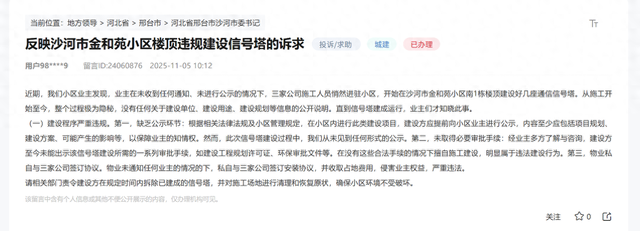
居民投诉信号塔“隐秘”进驻小区,邢台沙河:已通知移动联通拆除
Xin Lang Cai Jing· 2026-01-16 12:12
Core Viewpoint - The construction of communication signal towers in a residential area of Shihezi City, Hebei Province, has raised significant complaints from residents regarding the lack of transparency and proper approval processes [1][2]. Group 1: Complaints and Issues - Residents reported that the construction of multiple communication signal towers occurred without any prior notification or public announcement, violating their right to be informed [1][2]. - The complaints highlighted the absence of necessary approval documents for the construction, such as construction planning permits and environmental approval, indicating potential illegal construction activities [2]. - The property management allegedly signed installation agreements with three companies without informing the residents and collected fees, infringing on the homeowners' rights [2]. Group 2: Official Response - On December 25, 2025, the Shihezi City Municipal Office confirmed that the tower construction company had notified mobile operators to dismantle the communication equipment and would conduct further site surveys [3][4].