
宁波银行

Search documents
中国金融服务 - 回应 3 季度投资者日会议的九大核心问题-China Financial Services_ Addressing nine top of mind questions from our 3Q NDR meetings
2025-12-03 02:16
Summary of Key Points from the Conference Call Industry Overview - The conference call involved 21 China financial companies, including banks, brokers, and fintech firms, discussing the financial services industry in China, particularly focusing on the third quarter results and outlook for the future [1][2]. Key Insights on Banks 1. **Net Interest Margins (NIMs) Outlook**: - Commercial bank NIM was flat quarter-on-quarter in 3Q25, indicating signs of stabilization. Banks expect NIMs to stabilize in 1H26, driven by slower declines in loan yields and ongoing repricing of time deposits [4][6]. - NIMs may face downward pressure due to concentrated loan repricing in 1Q26, but banks generally believe the decline will continue to narrow [4][6]. 2. **Credit Demand**: - Year-to-date, bank loan growth has been primarily driven by corporate loans, contributing 92% of new loans. Credit demand remains weak, particularly in retail loans, with expectations of further slowdown in 4Q25 [12][18]. - Mortgage demand is weak due to a sluggish property market, and while non-mortgage retail loans are growing slightly faster, banks remain cautious in lending [13][14]. 3. **Asset Quality Risks**: - Banks report a year-on-year decrease in new non-performing loan (NPL) formation for corporate loans, but property loans remain a significant source of new corporate NPLs. Banks have made sufficient provisions for property loans, providing a buffer against NPL ratios [19][20]. - Retail loan NPL formation has increased year-on-year, but risks are considered manageable due to low proportions of non-mortgage consumer loans and low loan-to-value ratios [25][27]. 4. **Non-Interest Income Growth**: - Fee income showed strong performance in 3Q25, driven by capital market activities and corporate loan growth. Banks expect continued positive trends in fee income despite potential impacts from fee cuts in mutual funds [32][35]. 5. **Capital Adequacy and Shareholder Returns**: - Some banks experienced a decline in CET-1 ratios due to rising bond market rates and new loans with higher risk weightings. However, capital adequacy is improving overall, supporting asset growth and risk absorption [40][41]. - Banks are gradually increasing dividend payout ratios, attracting long-term investors despite a decline in dividend yields from previous highs [41][43]. Regulatory Impacts 1. **Loan Facilitation Platforms**: - New regulations require clear disclosure of loan costs, impacting pricing and risk. Loan volumes are expected to contract in 4Q25 and 1Q26, with a potential recovery in 2Q26 if risks stabilize [46][47]. - Consumer finance companies are required to lower average loan interest rates, but the impact is expected to be manageable for top-tier platforms [48][51]. 2. **Consumer Finance**: - Banks are shrinking their internet loan portfolios and focusing on self-operated loans due to rising retail risks. This shift may suppress retail credit growth in the short term [50][51]. Capital Markets Insights 1. **Broker Performance**: - Brokers experienced higher trading volumes in 3Q25, with expectations of sustained performance due to ongoing bank deposit migration and strong investor sentiment [53][54]. - CICC is focusing on institutional business but sees rising wealth management income due to strong demand in IPO subscriptions [53][54]. 2. **Financial Software Companies**: - Financial software companies may benefit from capital market recovery, but outcomes vary. Brokers are increasing IT budgets due to trading activity, while fund companies are cautious due to declining AUM and fee rates [59][61]. Conclusion - The financial services industry in China is navigating a complex landscape with stabilizing NIMs, weak credit demand, manageable asset quality risks, and evolving regulatory impacts. The outlook for banks and brokers remains cautiously optimistic, with potential growth in non-interest income and capital markets activity.
双融日报-20251203
Huaxin Securities· 2025-12-03 01:40
Core Insights - The report indicates a neutral market sentiment with a score of 49, suggesting a period of market consolidation and caution among investors [4][7][18] - Key themes identified include non-ferrous metals, banking, and AI mobile technology, each showing potential investment opportunities driven by specific market dynamics [4][18] Non-Ferrous Metals - The non-ferrous metals theme is buoyed by expectations of increased demand due to potential US interest rate cuts and AI data center growth, with copper prices expected to rise due to financial attributes and supply constraints [4] - Key stocks in this sector include Zijin Mining (601899) and Aluminum Corporation of China (601600) [4] Banking Sector - The banking sector is highlighted for its high dividend yield, with the China Securities Bank Index yielding 6.02%, significantly above the 10-year government bond yield, making it an attractive option for long-term investors [4] - Notable stocks include Agricultural Bank of China (601288) and Ningbo Bank (002142) [4] AI Mobile Technology - The AI mobile technology theme is represented by ZTE Corporation, which has released a prototype of the Nubia M153 smartphone featuring the "Doubao Mobile Assistant," aimed at developers and tech enthusiasts [4] - Related stocks include ZTE Corporation (000063) and Guanghetong (300638) [4] Market Trends - The report notes that when the market sentiment score falls below 30, it typically indicates a support level, while scores above 70 suggest resistance, guiding investment strategies [7][18] - Recent market movements show a mixed performance across various sectors, with significant net inflows and outflows in specific stocks, indicating active trading behavior [8][10][19]
多家银行陆续调整代销基金风险等级
Zheng Quan Ri Bao Zhi Sheng· 2025-12-02 16:12
Core Viewpoint - Several banks, including China Construction Bank, have raised the risk levels of their distributed public funds, driven by stricter regulations and changing market conditions [1][2]. Group 1: Risk Level Adjustments - China Construction Bank announced an increase in risk levels for 87 public fund products, with 32 products moving from R2 (low to medium risk) to R3 (medium risk) and 55 products from R3 to R4 (medium to high risk) [2]. - Other banks, such as Minsheng Bank, have also adjusted risk levels for their distributed funds multiple times this year, indicating a broader trend across the banking sector [2][3]. Group 2: Market Environment Impact - The increase in risk levels is linked to rising volatility in the bond market, which affects the stability of bond fund net values, and the upward movement in equity markets, which increases the volatility of mixed funds [3]. Group 3: Implications for Wealth Management - More accurate risk ratings help banks fulfill their suitability management obligations, reduce future complaints and litigation risks, and enhance their brand reputation [4]. - However, the short-term challenge includes potential mismatches between the new risk levels and existing customer risk tolerances, which may lead to increased redemption rates and pressure on sales commissions [4]. Group 4: Investor Considerations - The adjustment in risk levels directly impacts ordinary investors, who may face decisions regarding redemption or reallocation of their investments due to mismatches in risk tolerance [4]. - Long-term, these adjustments are seen as a protective measure for investor rights, promoting transparency in risk disclosure and helping investors set realistic expectations [4]. Group 5: Recommendations for Investors - Investors are advised to reassess their risk tolerance, review their current holdings against new risk levels, and diversify their portfolios to mitigate risks [5]. - It is also recommended that investors focus on understanding product details beyond just risk ratings and maintain patience with quality products aligned with long-term goals [5].


永赢基金员工持股计划落地,多位基金经理“上车”
2 1 Shi Ji Jing Ji Bao Dao· 2025-12-02 13:09
Core Viewpoint - Yongying Fund has launched its employee stock ownership plan, marking the first implementation of such a plan in the public fund industry since the release of the high-quality development action plan for public funds this year [1][3]. Group 1: Employee Stock Ownership Plan - Yongying Fund has added three limited partnership enterprises as shareholders, collectively holding 3.51% of the equity, which was transferred from Singapore's OCBC Bank to support the employee stock ownership plan [1][2]. - Approximately 90 employees, nearly a quarter of the total workforce of 393, are participating in the stock ownership plan through shares in the newly established shareholder enterprises [2][3]. - Key participants in the employee stock ownership plan include senior executives and investment research personnel, with significant individual contributions in the million-yuan range [3]. Group 2: Shareholder Structure and Implications - After the equity change, Ningbo Bank remains the largest shareholder with a 71.49% stake, while OCBC Bank's stake adjusts to 25%, indicating a stable foreign investment structure [2]. - The integrated shareholder structure is expected to facilitate the implementation of the employee stock ownership plan, rather than indicating a withdrawal of foreign capital [2]. Group 3: Industry Context and Performance - Yongying Fund is the first fund company to implement an employee stock ownership plan following the regulatory support for such initiatives, aimed at enhancing team stability [3][4]. - As of the end of Q3 2025, Yongying Fund's total management scale reached 628.7 billion yuan, ranking 22nd in the industry, with a notable increase in non-monetary scale [4]. - The fund has seen significant growth in its equity investment products, with the Yongying Technology Select A fund achieving a remarkable 196% return this year, leading the market [4].

哪家商业银行最低持有期理财产品收益更高?
2 1 Shi Ji Jing Ji Bao Dao· 2025-12-02 10:37
Core Insights - The article focuses on the performance of minimum holding period RMB public offering products, ranking them based on annualized returns for holding periods of 7, 14, 30, and 60 days [1][4][12] Group 1: 7-Day Holding Period Products - The top-performing product is from Minsheng Bank with an annualized return of 4.17% [3] - Other notable products include: - Huishang Bank with 3.58% [3] - Bank of China with 2.96% [3] - Minsheng Bank's Fuzhu Pure Bond with 2.54% [3] - Bohai Bank with 2.39% [3] Group 2: 14-Day Holding Period Products - Minsheng Bank's product "Jingxiang Fixed Income Incremental Dual-Week" leads with a return of 34.68% [5] - Other significant products include: - Minsheng Bank's Fuzhu Pure Bond with 5.66% [5] - WeBank's "Anying" Stable Income with 4.47% [5] - SPDB's "Wealth Management Series" with 2.33% [5] Group 3: 30-Day Holding Period Products - Minsheng Bank's "Guizhu Fixed Income Incremental Monthly" tops the list with a return of 21.23% [9] - Other key products include: - Minsheng Bank's Fuzhu Fixed Income with 13.53% [9] - Bank of China with 7.64% [9] - Huishang Bank's "Happiness 99" with 6.07% [9] Group 4: 60-Day Holding Period Products - The leading product is from Minsheng Bank with a return of 15.12% [13] - Other notable products include: - CITIC Bank's Fuzhu Pure Bond with 8.94% [14] - Bank of China with 4.57% [14] - Huishang Bank's product with 3.46% [14]







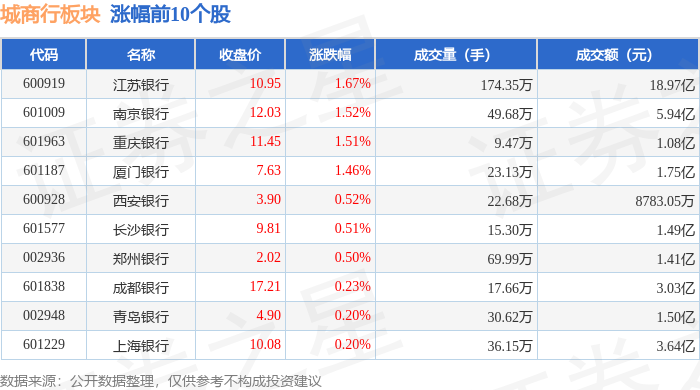
城商行板块12月2日涨0.43%,江苏银行领涨,主力资金净流出3.16亿元
Zheng Xing Xing Ye Ri Bao· 2025-12-02 09:05
Group 1 - The city commercial bank sector increased by 0.43% on December 2, with Jiangsu Bank leading the gains [1] - The Shanghai Composite Index closed at 3897.71, down 0.42%, while the Shenzhen Component Index closed at 13056.7, down 0.68% [1] - Jiangsu Bank's closing price was 10.95, reflecting a 1.67% increase, with a trading volume of 1.7435 million shares and a transaction value of 1.897 billion [1] Group 2 - The city commercial bank sector experienced a net outflow of 316 million from institutional funds, while retail investors saw a net inflow of 421 million [2][3] - The trading data for various banks showed mixed performance, with Ningbo Bank declining by 0.69% and Guizhou Bank remaining unchanged [2] - Shanghai Bank had a net outflow of 46.6477 million from institutional funds, while retail investors contributed a net inflow of 2.33839 million [3]




宁波银行(002142) - 2025年12月2日投资者关系活动记录表
2025-12-02 08:12
Group 1: Loan Growth and Financial Services - The company has focused on supporting key sectors such as private small and micro enterprises, manufacturing, import-export businesses, and consumer spending, leading to steady loan growth [2] - Future loan growth is expected to be sustained due to ongoing policy support aimed at expanding domestic demand and promoting consumption [2] Group 2: Capital Growth and Dividends - The company emphasizes the balance between dividends and internal capital growth to ensure a solid capital foundation for sustainable business development [2] - Internal capital is projected to create greater value for the company's future growth [2] Group 3: Asset Quality Outlook - The company acknowledges new challenges in asset quality management due to economic fluctuations and changing domestic and international conditions [2] - A focus on risk management and a robust credit risk monitoring system will help maintain asset quality at a favorable level within the industry [2]
YiwealthSMI|AI与节日成10月创作热点,情感共鸣仍是抖音“流量密码”
Di Yi Cai Jing· 2025-12-02 02:59
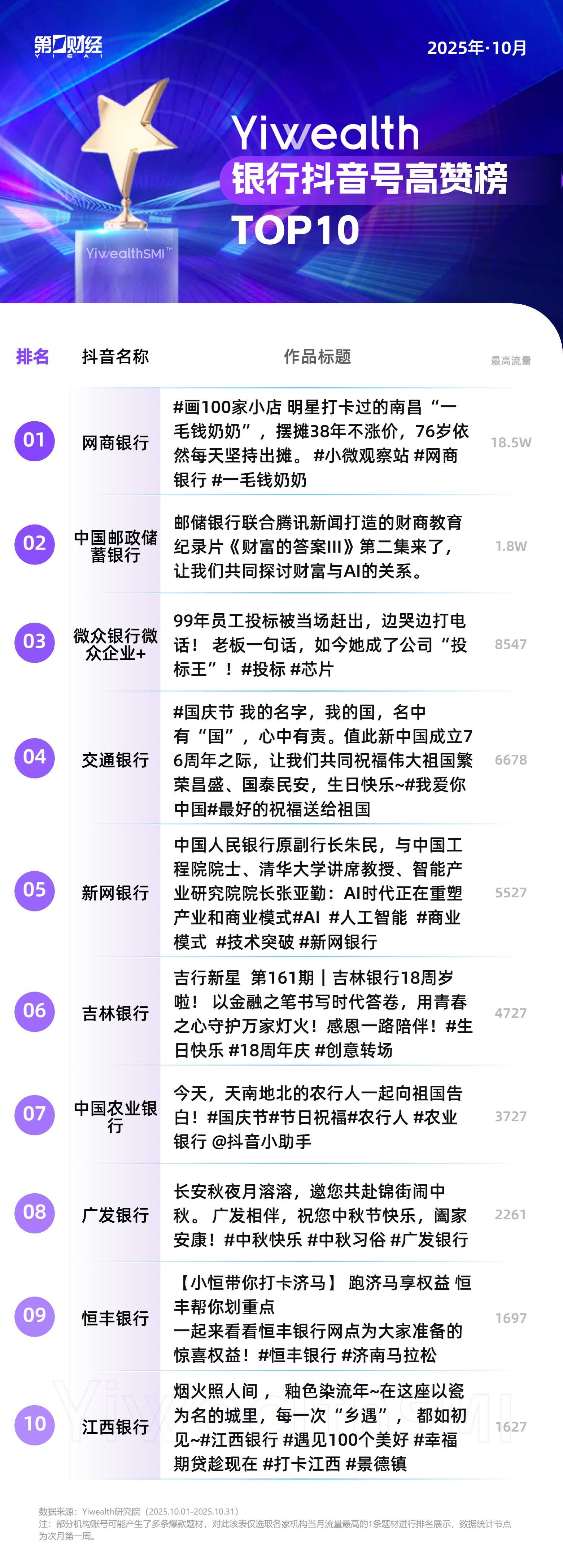
Group 1 - The October Bank Social Media Index (SMI) shows slight changes, with several banks dropping out of the top rankings, including Industrial Bank and WeBank, while new entrants include Jilin Bank and Tianjin Bank [2] - The content that gained high engagement on Douyin in October focused on emotional resonance, AI trends, and holiday themes, with WeBank leading with over 185,000 likes for a story about a grandmother selling goods for 38 years without raising prices [2][7] - The holiday themes around National Day and Mid-Autumn Festival were popular, with banks like Agricultural Bank and Guangfa Bank creating content centered on festive greetings and family reunions [2][8] Group 2 - The top-performing videos primarily emphasized brand promotion and holiday greetings, while the articles on public accounts focused on welfare and benefits [3] - The top video content included a documentary by Postal Savings Bank in collaboration with Tencent News, discussing the relationship between wealth and AI [7] - The top public account content featured promotional activities, such as free tickets for the League of Legends World Championship by China Merchants Bank and limited edition sales by the Palace Museum [17][19]
中国金融板块-追踪工业风险:制造业固定资产投资增速显著放缓,助力更快管控风险-China Financials-Tracking industrial risks further notable slowdown in manufacturing FAI growth to help contain risks more quickly
2025-12-02 02:08
Summary of Key Points from the Conference Call Industry Overview - **Industry**: China Financials, specifically focusing on manufacturing and infrastructure investments in China [1][5][7] Core Insights and Arguments - **Manufacturing FAI Growth**: There has been a notable slowdown in manufacturing Fixed Asset Investment (FAI) growth, dropping to 2.7% year-over-year (yoy) from 4.0% yoy in the previous month, indicating steady progress on capital expenditure (capex) slowdown [7] - **Liability Growth**: Total liability growth for industrial firms moderated to 5.0% yoy, while manufacturing firms saw a slight increase to 5.9% yoy. This moderation is expected to lead to more rational capacity expansion [2][7] - **Revenue Decline**: Manufacturing revenue declined by 4.3% yoy, attributed to lower production levels due to overcapacity control efforts. The Value-Added Industrial (VAI) growth also slowed to 4.9% yoy from 6.5% yoy in September [3][10] - **Profit Growth**: Manufacturing profit growth moderated to 7.7% yoy from 9.9% yoy in September, influenced by higher financing costs and lower production [10] Future Outlook - **Infrastructure Investment**: A potential increase in infrastructure investments, supported by a new RMB 500 billion fund from the China Development Bank, is expected to bolster demand in 2026 and aid in the digestion of overcapacity risks [8][3] - **Sector Performance**: 77.1% of sectors experienced a slowdown in capex in October 2025 compared to the first half of 2025, while 39.3% of sectors showed profit improvement [9][7] Additional Important Information - **PPI Trends**: The Producer Price Index (PPI) rebounded month-over-month for the first time since December 2024, with the year-over-year decline narrowing to 2.1% [7] - **Investment Sentiment**: The overall sentiment towards the China Financials sector remains attractive, with ongoing efforts in financial tightening contributing to anti-involution measures [5][4] This summary encapsulates the critical insights from the conference call, highlighting the current state and future expectations of the manufacturing and financial sectors in China.




双融日报-20251202
Huaxin Securities· 2025-12-02 01:33
Core Insights - The report indicates that the current market sentiment score is 81, categorizing it as "overheated," suggesting a high level of investor optimism and potential market risks [4][8][20] - Key investment themes identified include non-ferrous metals, banking, and low-altitude economy, each with specific drivers and related stocks [4][8] Non-Ferrous Metals - The non-ferrous metals theme is driven by expectations of demand increase due to potential US interest rate cuts and AI data center growth, leading to a price increase for copper and aluminum [4] - Copper prices are supported by financial attributes, supply constraints, and resilient traditional demand, while aluminum faces tight domestic capacity and limited overseas growth [4][8] Banking Sector - The banking sector is highlighted for its high dividend yield, with the China Securities Bank Index yielding 6.02%, significantly above the 10-year government bond yield [4] - In a slowing economy with increased market volatility, bank stocks are seen as stable investment options for long-term funds like insurance and social security [4][8] Low-Altitude Economy - The low-altitude economy is positioned for growth, with the upcoming Asia General Aviation Exhibition expected to attract over 300 companies from 21 countries, indicating significant international interest [4] - The report emphasizes the vast market potential in this sector, particularly in infrastructure and aircraft manufacturing, enhanced by improved information processing capabilities [4][8] Market Sentiment and Strategy - The report suggests that when market sentiment is above 70, it may indicate resistance, while levels below 30 could provide support, guiding investment strategies [8][20] - Investors are advised to consider reducing positions in an overheated market to avoid potential losses from market corrections [20]