
国电南瑞

Search documents
头部企业加速布局“工业+AI”,工业互联ETF(159778)多股飘红
Xin Lang Cai Jing· 2025-08-07 03:24
Group 1 - The core viewpoint highlights the acceleration of leading companies in integrating "Industrial + AI," driving advancements in industrial intelligence through deep coupling of large models and industry experience [1][2] - Lenovo's "Supply Chain Control Tower" AI system has reportedly reduced decision-making time by 50% to 60%, improved order delivery punctuality by 5%, and lowered manufacturing and logistics costs by 20% [1] - China Telecom's "Starry Textile" AI system achieved a 99% on-time delivery rate, a 20% increase in production efficiency, and over 99% defect detection rate in fabric quality [1] Group 2 - Debon Securities indicates that the performance and spending of overseas major companies are increasing, suggesting sustained high prosperity in the computing power industry chain [2] - The demand for domestic computing power is expected to accelerate, driven by the explosive growth in AI token processing volume and the verification of token economy business models [2] - The CSI Industrial Internet Theme Index consists of 50 listed companies involved in industrial internet hardware manufacturing, software development, and application services, reflecting the overall performance of these companies [2]

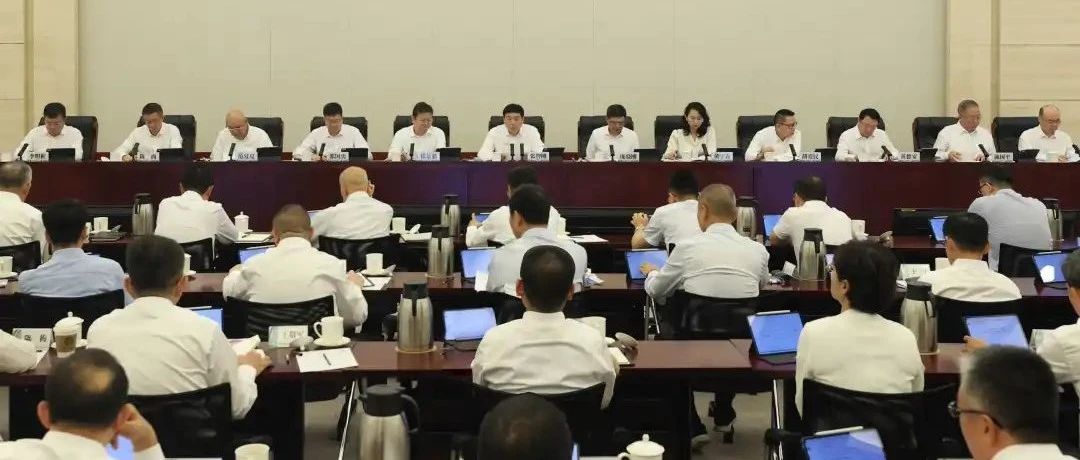
国网、南网、华能、华电、国电投、中能建、中电建等央企部署下半年工作重点
中关村储能产业技术联盟· 2025-08-06 09:29
Core Viewpoint - The central enterprises in the power and energy sector are focusing on new energy development, innovative storage solutions, improving electricity market mechanisms, and expanding overseas business in the second half of 2025, driven by the "dual carbon" goals [2]. Group 1: National Grid Corporation - The National Grid aims to strengthen safety production, ensure reliable electricity supply during peak summer demand, and enhance strategic research for its "14th Five-Year Plan" [3]. - The company plans to increase investment in the grid, improve supply capacity, and support the integration of renewable energy [3]. - Emphasis will be placed on market competition and technological innovation to foster new growth points [3]. Group 2: Southern Power Grid - The Southern Power Grid is prioritizing the construction of a new energy system and enhancing the integration of renewable energy [5][6]. - The company will focus on digital transformation to improve operational efficiency and smart grid capabilities [5]. - Continuous reform of the electricity market and strengthening regional market connections are also key objectives [7]. Group 3: Huaneng Group - Huaneng Group is committed to high-quality development of renewable energy, with a current installed capacity of 110 million kilowatts and over 54% from clean energy [8]. - The company plans to accelerate the development of large-scale renewable energy bases [8]. Group 4: Huadian Group - Huadian Group aims to expand effective investment and accelerate the production of key projects, including an 8 million kilowatt project in Xinjiang [9]. - The focus will be on increasing clean energy development and enhancing production capabilities [9]. Group 5: State Energy Group - The State Energy Group is enhancing its technology innovation system, focusing on clean coal utilization and renewable energy technologies [10]. - The company is also promoting the construction of digital intelligence systems and expanding its renewable energy capacity [10]. Group 6: Datang Group - Datang Group emphasizes safety production and energy supply for the capital, while accelerating green and low-carbon transformation [11]. - The company aims to integrate technological innovation with industrial development [11]. Group 7: State Power Investment Corporation - The State Power Investment Corporation is focused on expanding effective investments in renewable resources and major projects [12]. - The company aims to achieve breakthroughs in national technology projects and promote the integration of industry and innovation [12]. Group 8: China General Nuclear Power Group - China General Nuclear Power Group is prioritizing the high-quality completion of its "14th Five-Year Plan" [15]. Group 9: China Energy Engineering Group - China Energy Engineering Group is focusing on high-quality completion of its "14th Five-Year Plan" evaluation and planning for the "15th Five-Year Plan" [16]. Group 10: China Power Construction Group - China Power Construction Group is committed to completing annual targets and enhancing management levels while expanding market share [17].







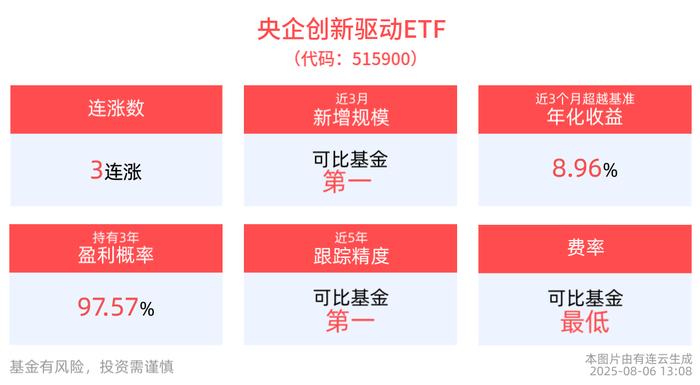
军工板块强势拉升,中国重工午后涨停,央企创新驱动ETF(515900)冲击3连涨
Xin Lang Cai Jing· 2025-08-06 05:27
Core Insights - The Central State-Owned Enterprises Innovation-Driven Index (000861) has seen a rise of 0.76% as of August 6, 2025, with notable increases in constituent stocks such as China Shipbuilding (10.00%) and China Heavy Industry (10.04%) [3] - The Central State-Owned Enterprises Innovation-Driven ETF (515900) has experienced a 4.45% increase over the past month, with a current price of 1.54 yuan [3] - The State-owned Assets Supervision and Administration Commission emphasizes the importance of integrating artificial intelligence with the real economy, highlighting the need for strategic applications and collaboration [4] - The frequency of satellite launches in China has significantly increased, indicating a rapid development phase in the commercial space industry [4] - The Central State-Owned Enterprises Innovation-Driven ETF has shown a net value increase of 12.94% over the past year, with a notable monthly return of 15.05% since inception [5] - The ETF has the lowest management and custody fees among comparable funds, at 0.15% and 0.05% respectively [5] - The tracking error of the ETF over the past five years is 0.037%, the best among comparable funds, indicating high tracking precision [6] - The top ten weighted stocks in the index account for 34.11% of the total, with companies like Hikvision and China Southern Power Grid leading the list [6]



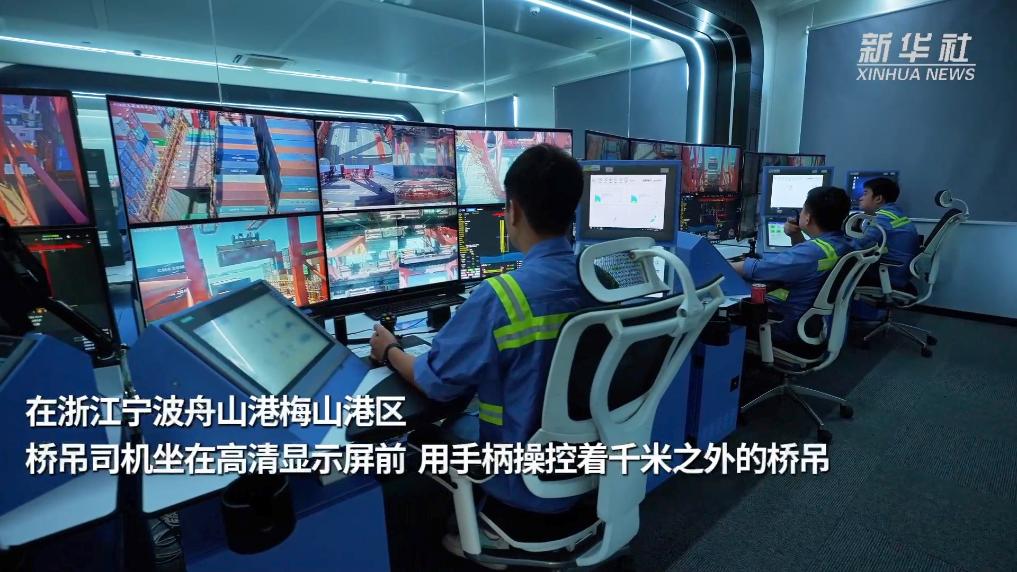
活力中国调研行丨浙江宁波:“绿色港口”的智能化转型-新华网
Xin Hua Wang· 2025-08-06 03:08
Group 1 - The core transformation at Meishan Port area in Ningbo Zhoushan Port involves remote control automation, allowing crane operators to control cranes from kilometers away using high-definition displays and joysticks [1] - The port area has established the first low-carbon terminal demonstration project in the province, focusing on clean energy at the source, electrification at the terminal, and intelligent regulation [4] - Ningbo Zhoushan Port is advancing towards a future characterized by intelligence and zero carbon emissions [7]


七部门发文推进新型工业化,工业互联ETF(159778)交投活跃
Xin Lang Cai Jing· 2025-08-06 02:25
Group 1 - The China Securities Industrial Internet Theme Index (931495) experienced a slight decline of 0.10% as of August 6, 2025, with mixed performance among constituent stocks [1] - Leading gainers included Gaode Hongwei (002414) up by 6.69%, Unisoc (002049) up by 1.51%, and Wangsu Science & Technology (300017) up by 1.35%, while Industrial Fulian (601138) led the decline at 1.85% [1] - The recent issuance of the "Guiding Opinions on Financial Support for New Industrialization" by seven departments emphasizes the need for a mature financial system by 2027 to support the high-end, intelligent, and green development of the manufacturing industry [1] Group 2 - The Industrial Internet ETF (159778) closely tracks the China Securities Industrial Internet Theme Index, which includes 50 listed companies involved in industrial internet hardware manufacturing, software development, and application services [2] - As of July 31, 2025, the top ten weighted stocks in the index accounted for 46.55% of the total index weight, with Industrial Fulian (601138) and CATL (300750) among the leading companies [2]
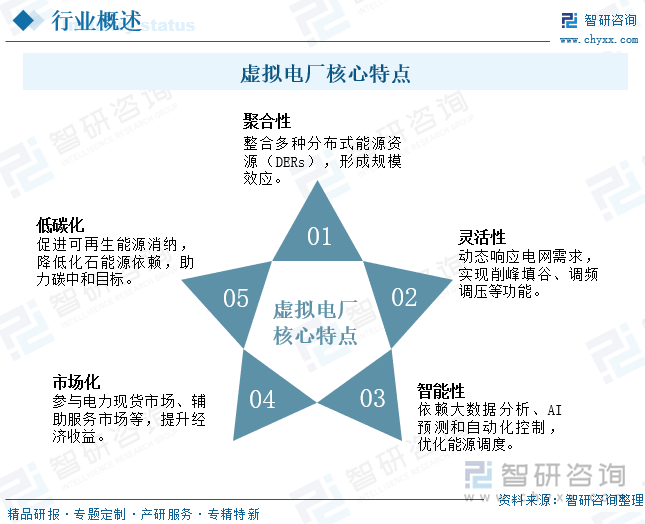
趋势研判!2025年中国虚拟电厂(VPP)行业发展背景、产业链、发展现状及未来趋势分析:政策红利与技术突破并进,虚拟电厂迈向千亿蓝海[图]
Chan Ye Xin Xi Wang· 2025-08-06 01:11
Core Viewpoint - The virtual power plant (VPP) is emerging as a new operational model in the energy sector, significantly enhancing power supply security and promoting renewable energy consumption. The industry is transitioning from an invitation-based model to a market-oriented approach, with government targets set for 2027 and 2030 to increase regulation capacity to 20 million kilowatts and over 50 million kilowatts, respectively [1][11][25]. Industry Overview - Virtual power plants aggregate distributed energy resources, adjustable loads, and storage systems, acting as new operational entities that participate in power system optimization and market transactions [2]. - The development of virtual power plants is supported by a comprehensive policy framework established by the government, which includes various action plans and guidelines aimed at fostering innovation and market mechanisms [8][11]. Development Background - The rapid growth of renewable energy in China, particularly in solar and wind power, has created a pressing need for flexible power management solutions. Virtual power plants can significantly reduce the need for redundant capacity by providing flexible load adjustments [13][15]. - The construction cost of virtual power plants is only one-eighth that of traditional coal-fired power plants, making them a cost-effective solution for peak load management [15]. Current Status - The virtual power plant industry in China has established a complete industrial chain, encompassing resource aggregation, platform operation, and market trading. Key regions include Shandong, Guangdong, Zhejiang, and Shanghai, where pilot projects are actively being developed [17][19]. - The commercial model is evolving from a single demand response approach to a diversified model that includes power trading and carbon services [19]. Competitive Landscape - The industry features a diverse competitive landscape with participation from state-owned enterprises, private companies, and technology firms. Major players include State Grid, Huaneng Group, and Guodian NARI, which leverage their resources and infrastructure to dominate the market [23]. - Private companies like Guoneng Rixin and Teruid focus on technological innovation and niche markets, while tech giants such as Huawei and Tencent are entering the sector with advanced digital technologies [23]. Future Trends - The virtual power plant industry is expected to experience accelerated growth driven by policy support and market mechanisms, with projections indicating a market size exceeding 10.2 billion yuan by 2025 and surpassing 100 billion yuan by 2030 [25][26]. - Technological advancements in AI, 5G, and blockchain will enhance operational efficiency and real-time responsiveness, transforming virtual power plants into intelligent energy management systems [27]. - The integration of virtual power plants with other sectors, such as transportation and building management, will create new business models and expand the ecosystem [28].



国内铜社会库存相对偏低
Qi Huo Ri Bao· 2025-08-06 00:57
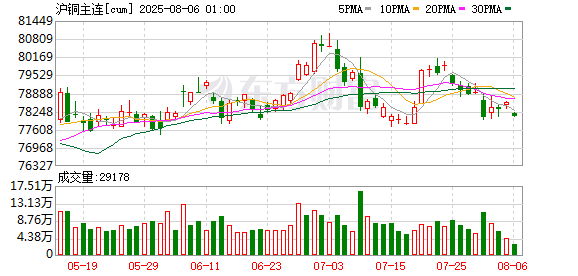
7月下旬以来,沪铜主力合约价格自创80140元/吨的阶段性高点后,运行重心缓慢下移,目前在78500元/吨附近徘徊。后期在国内铜产 量偏高及消费淡季施压的背景下,预计铜价将以弱势震荡为主。 受智利矿石品位下降等因素影响,智利6月铜产量同比减少6%,至424390吨。智利国家矿业协会预计,2025年铜产量将达到540万至 560万吨,计划2025年投资额为47.27亿美元。 秘鲁铜矿产量位于智利和刚果(金)之后,秘鲁矿业部数据显示,今年5月秘鲁铜产量为22.08万吨,同比下滑4.6%。因秘鲁矿企面临 资源质量下降及新项目开发瓶颈问题,秘鲁矿业部长预计2025年铜产量仅小幅增长至280万吨。 ICSG数据显示,2025年5月全球矿山产量同比上升6.12%,至200.57万吨。国际铜研究小组预计,2025年全球铜矿产量增幅为3.5%, 增长主要得益于刚果(金)和蒙古国产能的提升,以及俄罗斯Malmyzhskoye矿的启动。同时,一些扩建项目和中小型矿山的启动也 将推动产量增长。 从国内电解铜的生产情况来看,相关数据显示,7月国内电解铜产量为117.43万吨,环比增长3.94万吨,增幅为3.47%,同比增长 14.2 ...
国网北京电力等取得发电车辆控制相关专利
Sou Hu Cai Jing· 2025-08-05 13:29
北京京电电网维护集团有限公司,成立于2002年,位于北京市,是一家以从事金属制品、机械和设备修 理业为主的企业。企业注册资本10001万人民币。通过天眼查大数据分析,北京京电电网维护集团有限 公司共对外投资了5家企业,参与招投标项目1682次,专利信息46条,此外企业还拥有行政许可41个。 北京映翰通智能电气科技有限公司,成立于2022年,位于北京市,是一家以从事科技推广和应用服务业 为主的企业。企业注册资本5000万人民币。通过天眼查大数据分析,北京映翰通智能电气科技有限公司 参与招投标项目32次,专利信息3条,此外企业还拥有行政许可10个。 来源:金融界 金融界2025年8月5日消息,国家知识产权局信息显示,国网北京市电力公司、国家电网有限公司、北京 京电电网维护集团有限公司、北京映翰通智能电气科技有限公司取得一项名为"发电车辆的控制方法、 装置和非易失性存储介质"的专利,授权公告号CN118700835B,申请日期为2024年06月。 天眼查资料显示,国网北京市电力公司,成立于1991年,位于北京市,是一家以从事电力、热力生产和 供应业为主的企业。企业注册资本2895019.978443万人民币。通过天 ...
特高压设备专家交流
2025-08-05 03:20
Summary of Key Points from Conference Call Industry Overview - The conference call focuses on the ultra-high voltage (UHV) power transmission industry in China, discussing the current status, challenges, and future trends of UHV projects and technologies. Core Insights and Arguments 1. **Construction Progress and Challenges** UHV construction is experiencing delays due to multiple factors, including slow approval processes, low utilization rates of existing lines (generally below 50%), adjustments in energy transition policies, long technology iteration cycles, and economic considerations. Human resources have also been diverted to new energy infrastructure projects [1][2][3]. 2. **Demand for Cross-Regional Transmission** Despite short-term suppression of UHV demand due to declining photovoltaic (PV) station returns, the uneven distribution of energy resources and policy direction ensure a rigid demand for cross-regional transmission. The government will continue to promote UHV network interconnections, particularly transporting energy from the western and northern regions to central and eastern load centers [1][6]. 3. **Increased Proportion of Renewable Energy in New Projects** The proportion of renewable energy bundled in new UHV projects is expected to increase, with a greater reliance on hydropower and other renewable sources for bundled transmission. However, thermal power remains competitive due to its stability in large-capacity power supply [1][7]. 4. **Flexible DC Technology (FDC) Prospects** The application of flexible DC technology is anticipated to grow significantly, with projections indicating that 60%-70% of new DC line converter stations will adopt this technology by 2030. The penetration rate of new lines is expected to exceed 80% [1][12]. 5. **Cost Reduction in Key Components** The cost of flexible DC converter valves is expected to decrease from approximately 5 billion yuan to around 3.5 billion yuan by 2030, primarily due to advancements in domestic production of key components like IGBT and silicon carbide materials [2][13]. 6. **Supply Chain Bottlenecks** The production of UHV transformers faces significant bottlenecks due to a shortage of high-end imported insulation materials, particularly T4 grade paperboard. Domestic companies are expanding capacity but still rely on expensive imports [2][21][19]. 7. **Future UHV Project Plans** Several UHV lines are scheduled to commence construction between late 2025 and 2026, including routes from southeastern Tibet to the Guangdong-Hong Kong-Macao Greater Bay Area and from Inner Mongolia to Beijing-Tianjin-Hebei [2][28][29]. 8. **Impact of PV Station Returns on UHV Projects** The decline in PV station returns has temporarily suppressed UHV external demand, particularly in regions like Qinghai and Gansu. However, long-term cross-regional transmission remains a necessity due to resource distribution and policy needs [6]. 9. **Market Growth for Renewable Energy** The renewable energy market is projected to reach a scale of 100 billion yuan by 2025, with a compound annual growth rate of 13%. Despite reductions in wind and solar power, hydropower and nuclear energy are expected to continue growing [7]. 10. **Domestic Production and Market Dynamics** Domestic brands currently supply about 5% of the UHV transformer market, with expectations for gradual increases in localization rates as new capacities come online by 2026-2027 [21][23]. Other Important but Potentially Overlooked Content - The internal rate of return for some projects has decreased due to market trading developments, leading to project delays. Local financial conditions and social resistance also impact project timelines [3]. - The competitive advantage of thermal power remains significant, especially in scenarios of water scarcity, highlighting the need for a balanced energy supply system [8]. - The development of large hydropower projects, such as the Yaxia Hydropower Station, is expected to significantly enhance China's overall power generation capacity [9]. This summary encapsulates the critical insights and projections regarding the UHV industry, emphasizing the interplay between technology, market dynamics, and policy influences.
7月政治局会议火线解读
2025-08-05 03:20
Summary of Key Points from the Conference Call Industry and Company Involvement - The conference call primarily discusses the macroeconomic policies and strategic planning of the Chinese government, particularly focusing on the 14th and 15th Five-Year Plans, which impact various industries including real estate, technology, and consumer sectors. Core Insights and Arguments 1. **Economic Growth and Policy Stability** The political bureau meeting emphasized the dual focus on stable growth and high-quality development, aiming for a GDP growth target of around 5% for the year, with the first half achieving a growth rate of 5.3% [2][6][22]. 2. **Fiscal and Monetary Policy Adjustments** - Fiscal policy will accelerate government bond issuance and improve fund utilization efficiency, with a projected fiscal gap of 300 to 500 billion [13][31]. - Monetary policy remains flexible, with potential for interest rate cuts in the latter half of the year, depending on economic pressures [14][32]. 3. **Reform Focus Areas** Key reforms include promoting technological innovation, regulating competition, and advancing green transformation. The government aims to integrate technology and industry innovation deeply [7][8][43]. 4. **Real Estate and Urban Renewal** The meeting highlighted the importance of high-quality urban renewal and maintaining a stable real estate market, with a focus on improving existing urban areas rather than expanding [10][39][41]. 5. **Consumer Market Dynamics** Consumer retail sales grew by 5.0% year-on-year in the first half of 2025, driven by policies encouraging consumption. The government plans to continue supporting both goods and service consumption [16][35]. 6. **Emerging Industries and Technological Innovation** The government is prioritizing emerging industries such as high-end chips, AI, and biotechnology, aiming to increase their contribution to GDP from 11% to 17% [20][25][56]. 7. **Risk Areas** The main risks identified include real estate, local government debt, and capital market stability. The government is taking measures to mitigate these risks, including prohibiting new hidden debts [21][28]. 8. **Investment Opportunities** - The conference identified potential investment opportunities in sectors like water conservancy, technology innovation, and consumer electronics, particularly in companies that can adapt to new market conditions [24][25][36]. - Specific recommendations include companies in the AI sector and those involved in urban renewal projects [49][62]. Other Important but Possibly Overlooked Content 1. **Impact of Global Changes** The meeting acknowledged the significant global changes affecting China's economy, including trade tensions and technological competition, which necessitate adaptive policies [3][4]. 2. **Long-term Vision for Technology** The focus on technology is not just about self-sufficiency but also about enhancing global competitiveness and market share [44][45]. 3. **Consumer Electronics and AI Hardware** The consumer electronics sector is expected to innovate significantly, with AI technology driving new product developments [59][60]. 4. **Sustainability and Green Initiatives** The emphasis on green transformation indicates a long-term commitment to sustainable development across various sectors [8][12]. 5. **Market Mechanisms and Competition** The meeting discussed the need for market mechanisms to replace blanket subsidies, promoting healthy competition and resource allocation [47][48]. This summary encapsulates the key points discussed in the conference call, providing insights into the current economic landscape and future directions for various industries in China.