
三生制药

Search documents
特朗普对进口创新药加征关税,但实际影响或有限,建议逢低布局
BOCOM International· 2025-09-26 10:59
Investment Rating - The report maintains a "Buy" rating for several companies in the pharmaceutical sector, indicating an expectation of total returns exceeding the relevant industry over the next 12 months [4]. Core Insights - The recent announcement by President Trump regarding a 100% tariff on imported branded and patented drugs is expected to have a limited impact on China's innovative drug industry, as most Chinese companies either have production facilities in the U.S. or utilize local contract manufacturing organizations (CMOs) [3]. - The report suggests that investors should strategically position themselves in the innovative drug supply chain during market fluctuations, with several catalysts expected in Q4 2025, including the ESMO conference and upcoming healthcare negotiations [3]. - Long-term investment opportunities are highlighted in specific segments such as innovative drugs and CXO services, with recommendations for companies like Sanofi, Legend Biotech, and WuXi AppTec [3]. Summary by Sections Section: Impact of Tariffs - The 100% tariff on imported drugs is not expected to significantly affect Chinese innovative drug companies, as they have limited direct exports to the U.S. and often rely on local production [3]. - CXO companies primarily export raw materials and biological drugs, which are not impacted by the new tariffs, indicating a controlled overall impact on the Chinese pharmaceutical supply chain [3]. Section: Investment Recommendations - The report recommends focusing on companies with rich short-term catalysts, such as Kangfang Biotech and Rongchang Biotech, ahead of significant data releases and healthcare negotiations [3]. - Specific companies are highlighted for their growth potential, including Sanofi and Legend Biotech, which are considered undervalued with clear long-term growth logic [3]. Section: Company Ratings - A list of companies with their respective ratings and target prices is provided, showing a generally positive outlook for the majority of the companies covered [4]. - Notable companies with "Buy" ratings include Sanofi (target price of 35.00), Legend Biotech (target price of 74.00), and WuXi AppTec (target price of 70.00) [4].
特朗普100%药品关税又是“狼来了”?多家上市药企高管回应
经济观察报· 2025-09-26 10:22
Core Viewpoint - The potential imposition of a 100% tariff on imported brand and patented drugs by the Trump administration starting October 1, 2025, has raised concerns among pharmaceutical companies, particularly those in China, leading to a decline in their stock prices [2][3]. Group 1: Impact on Pharmaceutical Companies - The announcement of the tariff has caused significant declines in the stock prices of Chinese pharmaceutical companies, with Heng Rui Pharmaceutical dropping 3.03% in A-shares and 2.23% in Hong Kong shares, and BeiGene falling 4.38% in A-shares and 1.55% in Hong Kong shares [2]. - The Hang Seng Innovative Drug Index (HSIDI) fell by 2.37%, with notable declines in stocks such as Fosun Pharma, which dropped 5.82%, and 3SBio, which fell by 5.34% [3]. - Industry experts suggest that the impact of the tariff on Chinese pharmaceutical companies may be limited, as many are focused on generic drugs and active pharmaceutical ingredients (APIs) [4]. Group 2: Industry Perspectives - Some industry leaders believe that the tariff policy may not be implemented as proposed, citing the high cost of drugs in the U.S. and the potential for political changes in future administrations [4][5]. - Companies like Heng Rui Pharmaceutical indicated that their current exports primarily consist of generics and APIs, suggesting minimal impact from the proposed tariffs [4]. - Other companies, such as Lepu Biopharma, noted that their licensing partnerships would shield them from significant effects [5]. Group 3: U.S. Policy Context - The Trump administration has previously threatened to impose tariffs on imported drugs, with discussions around a 200% tariff and subsequent smaller tariffs leading to a potential increase over time [6][7]. - Major multinational pharmaceutical companies have responded to the tariff threats by committing to significant investments in U.S. manufacturing, with companies like Novartis and Roche pledging $23 billion and $50 billion respectively over the next five years [8].


特朗普100%药品关税又是“狼来了”?多家上市药企高管回应
Sou Hu Cai Jing· 2025-09-26 10:21
Core Viewpoint - The potential implementation of a 100% tariff on all brand-name and patented drugs by the U.S. government starting October 1, 2025, unless companies are building drug manufacturing plants in the U.S. [2] Group 1: Market Reaction - Pharmaceutical stocks in multiple markets, including China, Japan, and South Korea, experienced a collective decline following the announcement [3] - Specific declines included a 3.03% drop in Hengrui Medicine (600276.SH/01276.HK) A-shares and a 2.23% drop in Hong Kong shares, while BeiGene (ONC.NASDAQ/06160.HK/688235.SH) saw a 4.38% drop in A-shares and a 1.55% drop in Hong Kong shares [3] - The Hang Seng Innovative Drug Index (HSIDI) fell by 2.37%, with notable declines in stocks such as Fosun Pharma (600196.SH/02196.HK) down 5.82% and 3SBio (01530.HK) down 5.34% [4] Group 2: Industry Perspectives - Industry experts suggest that Chinese pharmaceutical companies aiming to expand internationally need to consider the potential implementation of this policy and explore possible solutions [5] - Some executives believe that the high cost of drugs in the U.S. may hinder the realization of this policy [5] - Hengrui Medicine's executive noted that the impact of the potential policy would be limited as their exports mainly consist of generic drugs and APIs [5] - Other companies, such as Lepu Biopharma, indicated that their licensing partnerships would not be significantly affected [5] - Investors pointed out that this is a political issue that could change with future administrations, suggesting that while there may be short-term negative impacts, the long-term effects may not be significant [5] Group 3: Historical Context - Historically, pharmaceuticals have been excluded from tariff lists, but President Trump has repeatedly threatened to impose tariffs on imported drugs this year [5] - The Trump administration initiated a "232 investigation" under the Trade Expansion Act of 1962, which allows for tariffs if imports threaten national security [6] - Previous statements from Trump indicated plans for escalating tariffs on imported drugs, with initial small tariffs leading to potential increases up to 250% [7] Group 4: Investment Commitments - In response to the tariff threats, several multinational pharmaceutical companies have committed to investing in U.S. manufacturing facilities, with significant investments announced by companies like Novartis, Roche, Sanofi, and AstraZeneca [8] - Notably, Novartis and Roche pledged $23 billion and $50 billion respectively over five years, while AstraZeneca committed to a $50 billion investment by 2030 [8]
创新药受关税消息冲击,恒瑞医药拿下出海大单
Xin Lang Cai Jing· 2025-09-26 06:31
Core Viewpoint - The innovative drug sector experienced significant volatility due to tariff news, with the Hang Seng Pharmaceutical ETF (159892) dropping over 2% [1] Group 1: Market Impact - Major holdings such as MicroPort Medical, MicroPort Robotics, and others led the decline, while companies like 3SBio, Alibaba Health, and Zai Lab also saw notable drops [1] - The recent announcement of an overseas exclusive development and commercialization licensing agreement for Ruilong's Trastuzumab, valued at over $1.1 billion, highlights the growing international collaboration in the innovative drug sector [1] Group 2: Long-term Outlook - Since 2025, there has been a surge in large-scale overseas business development deals in the innovative drug sector, indicating increasing global recognition of China's innovative drug capabilities [1] - Leading companies are actively seeking partnerships with top global pharmaceutical firms to expedite the translation of research outcomes into marketable products [1] - While short-term export prospects may be affected by tariff changes, the long-term outlook remains strong due to technological advancements, a shift away from internal competition in the pharmaceutical industry, and breakthroughs in AI-driven drug development [1]
招银国际每日投资策略-20250926
Zhao Yin Guo Ji· 2025-09-26 03:57
Market Overview - The global stock markets showed mixed performance, with the Hang Seng Index rising by 0.53% and the Hang Seng Technology Index increasing by 1.94%, reflecting a year-to-date gain of 42.77% [1][3] - The US stock markets experienced a decline, with the Dow Jones falling by 0.94% and the S&P 500 decreasing by 1.33%, while the Nasdaq dropped by 1.77% [1][3] Sector Performance - In the Hong Kong market, materials, information technology, and healthcare sectors led the gains, while consumer staples, real estate, and financial sectors lagged [3] - The A-share market saw gains in media, communication, and non-ferrous metals, while textiles, agriculture, and comprehensive sectors underperformed [3] Company Insights - Xiaomi Group launched its flagship Xiaomi 17 smartphone, priced at 4,499 RMB, which is competitive compared to the iPhone 17 priced at 5,999 RMB, highlighting Xiaomi's strategy to position itself against Apple [4] - The company aims to enhance its ecosystem with new IoT products and electric vehicle services, indicating a focus on high-end market segments [4] - Xiaomi's target price is set at 62.96 HKD, reflecting a 26.3 times expected P/E ratio for 2026, maintaining a "Buy" rating [5] Investment Recommendations - Geely Automobile is rated "Buy" with a target price of 25.00 HKD, indicating a potential upside of 37% [5] - Luckin Coffee is also rated "Buy" with a target price of 44.95 USD, suggesting a 19% upside [5] - Tencent and Alibaba are both rated "Buy," with target prices of 705.00 HKD and 158.80 USD respectively, indicating potential upsides of 9% and N/A [5]
交银国际:内地医疗恒指本周跑输大市 重点关注康方生物(09926)等
Zhi Tong Cai Jing· 2025-09-26 03:37
Core Viewpoint - The Hang Seng Healthcare Index fell by 1.4% this week, underperforming the market, with internet medicine, CXO, and traditional Chinese medicine sectors showing better performance [1] Group 1: Market Trends - Since September, the proportion of domestic holdings through the Hong Kong Stock Connect has remained stable, while foreign holdings have slightly decreased since mid-year [1] - Both domestic and foreign investors continue to increase their positions in innovative pharmaceutical companies, indicating a consistent long-term strategy [1] Group 2: Investment Recommendations - The report suggests focusing on companies with significant data releases at the upcoming ESMO conference in mid to late October, specifically mentioning Kangfang Biotech (09926), Kelun-Biotech (06990), and Rongchang Biotech (09995) [1] - The importance of timing and stock selection has increased following a broad rise in the innovative drug sector, with recommendations to gradually build positions during market corrections [1] Group 3: Sector Focus - For the innovative drug sector, the report highlights companies such as 3SBio (01530) and Eucure Biopharma-B (06996) as having rich short-term catalysts and undervalued core products, while companies like Ascletis Pharma (02096), Hutchison China MediTech (00013), and Legend Biotech are noted as significantly undervalued with clear long-term growth logic [1] - In the CXO sector, the report points to leading companies benefiting from high downstream demand and marginal recovery in financing, specifically mentioning WuXi AppTec (02268) [1]

交银国际:内地医疗恒指本周跑输大市 重点关注康方生物等
Zhi Tong Cai Jing· 2025-09-26 03:25
Core Viewpoint - The Hang Seng Healthcare Index declined by 1.4% this week, underperforming the market, with internet medicine, CXO, and traditional Chinese medicine sectors showing better performance [1] Group 1: Market Trends - Since September, the proportion of domestic holdings through the Hong Kong Stock Connect has remained stable, while foreign holdings have slightly decreased since mid-year [1] - Both domestic and foreign investors continue to increase their positions in innovative pharmaceutical companies, indicating a consistent long-term strategy [1] Group 2: Investment Opportunities - Domestic investors are focusing on rebound opportunities, while foreign investors are increasing positions in innovative drug targets with high long-term potential and current cost-effectiveness [1] - The innovative drug guarantee model is gradually taking shape, which is expected to alleviate challenges such as hospital access and reimbursement difficulties for companies [1] Group 3: Upcoming Events - The ESMO conference will be held in mid to late October, and the report suggests focusing on companies like CanSino Biologics (09926), Kelun-Biotech (06990), and Rongchang Biologics (09995) that are expected to release significant data [1] Group 4: Stock Recommendations - The importance of timing and stock selection has increased after a broad rise in the innovative drug sector, with recommendations to gradually build positions during sector pullbacks [1] - Specific recommendations include: 1. Innovative drugs: 3SBio (01530), Eucure Biopharma-B (06996) with rich short-term catalysts and undervalued long-term growth logic [1] 2. CXO: Leaders in high-demand segments benefiting from improved financing conditions, such as WuXi AppTec (02268) [1]
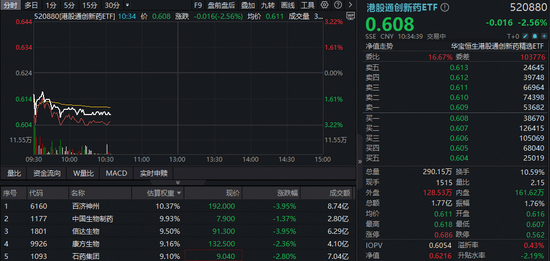
特朗普再挥“关税大棒”,港股通创新药遭错杀?100%创新药研发标的“520880”跌2.5%溢价飙升!
Xin Lang Ji Jin· 2025-09-26 02:46
Group 1 - The Hong Kong stock market for innovative pharmaceuticals opened significantly lower, with the Hong Kong Stock Connect Innovative Drug ETF (520880) dropping over 2.5% [1][3] - Out of 37 constituent stocks, 35 experienced declines, with Kelun-Bio falling over 5%, and major stocks like BeiGene, Innovent Biologics, and 3SBio dropping more than 3% [1][3] - The recent announcement by U.S. President Trump regarding a new round of high tariffs on various imported products, including a 100% tariff on pharmaceutical products, has negatively impacted pharmaceutical stocks in Japan and Australia [3][4] Group 2 - Analysts suggest that the tariff policy will mainly affect multinational pharmaceutical companies reliant on the U.S. market and those exporting brand or patented drugs to the U.S. [4] - Chinese pharmaceutical companies are expected to be less affected, particularly innovative drug research firms, as they primarily utilize IP transfer models and have a low export ratio to the U.S. [4] - The significant adjustment in the Hong Kong Stock Connect innovative drug sector may be more influenced by market sentiment, presenting potential buying opportunities for quality innovative drug companies [4][6] Group 3 - The Hong Kong Stock Connect Innovative Drug ETF (520880) has seen a strong inflow of funds, with net subscriptions exceeding 640 million yuan over the past 20 trading days [6] - The fund manager indicated that the innovative drug investment has entered an alpha phase, where stock selection factors are becoming more significant than market trends [6] - The ETF focuses exclusively on innovative drug research companies, excluding CXO firms, and has shown a cumulative increase of 119.75% year-to-date, outperforming other innovative drug indices [6][7]
交银国际每日晨报-20250926
BOCOM International· 2025-09-26 02:37
Core Insights - The report highlights the acceleration of adjustments in medical insurance and commercial insurance directories, suggesting a strategic approach to invest in undervalued quality stocks during market corrections [1][2] - The innovation drug sector is expected to benefit from a gradually forming insurance guarantee model, which may alleviate challenges related to hospital admissions and reimbursement payments [2] Market Review - The Hang Seng Healthcare Index fell by 1.4% this week, underperforming the broader market, while sectors such as internet medicine, CXO, and traditional Chinese medicine showed relatively better performance [1] - Domestic institutional investors maintained stable holdings through the Hong Kong Stock Connect, while foreign investors slightly reduced their positions since mid-year, although both continue to increase their investments in innovative pharmaceutical companies [1] Investment Recommendations - Focus on companies with significant data releases at the upcoming ESMO conference, such as Kangfang Biologics, Kelun-Biotech, and Rongchang Biologics [2] - Suggested investment strategies include gradually positioning in the innovative drug sector during market pullbacks, with specific recommendations for: 1) Innovative drugs: Companies like 3SBio and Eucure Biopharma have rich short-term catalysts and their valuations do not yet reflect the core value of major products [2] 2) CXO: Leaders in this segment are expected to benefit from high downstream demand and improving financing conditions, such as WuXi AppTec [2]
三生制药20250925
2025-09-26 02:28
Summary of the Conference Call for Sanofi Pharmaceutical Company Overview - **Company**: Sanofi Pharmaceutical - **Date**: September 25, 2025 - **Industry**: Pharmaceutical, specifically oncology and biopharmaceuticals Key Points and Arguments Clinical Research and Product Development - Sanofi's CFL2 platform is conducting 4 domestic Phase 2/3 clinical studies covering various cancer indications, including non-small cell lung cancer (NSCLC) [2][3] - The Phase 3 clinical trial for first-line NSCLC is benchmarked against PD-1 K, indicating active exploration in tumor treatment [2][3] - The company has achieved a collaboration agreement with Pfizer worth $60.5 billion, along with a $100 million investment, highlighting global recognition of its innovation capabilities and international product potential [2][3] - The PD-1 VEGF dual antibody drug 707 has set a domestic record for licensing amounts [2] Financial Performance - Revenue growth from 5.3 billion RMB in 2019 to 9.1 billion RMB in 2024, with a compound annual growth rate (CAGR) of 11% [2][6] - Gross margin remains stable at over 80%, with 2024 gross profit projected to reach 7.8 billion RMB [6] - The core product, TEBIO, is the only commercialized TPO product globally, generating over 5 billion RMB annually and maintaining a strong market position [2][5] Market Trends and Competitive Landscape - The global interest in PD-L1 VEGF dual antibodies is increasing, with companies like Summit, Kanyin, BMS, and Merck showing significant engagement in this area [4][9] - Sanofi is advancing multiple innovative pipelines, including PD1 and HER2 dual antibodies, with projected revenues reaching 10 billion, 11 billion, and 12.2 billion RMB in the coming years [4][13] Product Performance - TEBIO's revenue increased from 2.3 billion RMB in 2019 to 5 billion RMB in 2024, with a market share of approximately 30% in the platelet production market [12] - The hair growth product, Mandi, has maintained rapid growth, with a market share exceeding 70% and revenue projected to rise from 250 million RMB in 2019 to 1.35 billion RMB in 2024 [12] - New products, including Claretone cream for acne and oral paclitaxel, are expected to enter commercialization, with peak sales potential estimated at 10 billion RMB [5][14] Future Outlook - Sanofi's future development potential is significant, with validated innovative assets and a solid market position for core products [13] - The company is actively pursuing multiple innovative pipelines, which are in various clinical stages, expected to yield outstanding data and drive growth [13] - The internal business is projected to generate revenues of 10 billion, 11 billion, and 12.2 billion RMB in the next few years, maintaining a buy rating [13] Additional Products and Market Contributions - Other products like EPO and Yisai Psaipin are contributing to revenue, with several in late-stage clinical or approval phases [14] - The introduction of Semaglutide for weight management will further enrich the product line [14] Conclusion Sanofi Pharmaceutical demonstrates strong growth potential through its innovative drug development, solid financial performance, and strategic collaborations, positioning itself favorably in the competitive pharmaceutical landscape.