广发证券

Search documents
快手、阿里巴巴开盘上涨,机构看好恒科在120~250日均线随时反弹
Mei Ri Jing Ji Xin Wen· 2026-01-05 01:43
Core Viewpoint - The Hong Kong stock market is experiencing a rebound, with a shift from traditional economic cycles to sectors like AI applications and new energy, indicating a significant change in market dynamics [1] Group 1: Market Performance - The Hang Seng Index opened higher, with the Hang Seng Tech Index rising by 0.33% and the Guozheng Hong Kong Stock Connect Tech Index increasing by 0.36% [1] - Notable stock performances include Kuaishou-W rising nearly 6%, and Alibaba, SMIC, Bilibili-W, Baidu Group-SW, and Xiaomi Group-W showing significant gains [1] Group 2: Analyst Insights - The Guangfa Securities team, led by Liu Chenming, is optimistic about the Hong Kong stock market's potential for a rebound, noting that the weight of new economy sectors in the Hang Seng Index has increased from 17% to nearly 50% [1] - Liu's team attributes previous market suppression to liquidity and sentiment factors, suggesting that market sentiment may have adjusted sufficiently for a potential rebound in the Hang Seng Tech Index [1] Group 3: Liquidity Outlook - The Guangfa Securities team anticipates a dual easing of monetary and fiscal policies in most countries by 2026, which could lead to a reversal in liquidity [1] - A potential liquidity reversal, combined with seasonal market movements, could create upward momentum for the Hong Kong stock market [1] Group 4: Investment Recommendations - Huaxia Fund recommends focusing on the Guozheng Hong Kong Stock Connect Tech Index, which offers liquidity advantages and a balanced distribution across high-end manufacturing, biotechnology, and internet sectors [1] - The current PE valuation of the Guozheng Hong Kong Stock Connect Tech Index is 26.45 times, which is around the 41st percentile of its historical range over the past decade, significantly lower than valuations of A-share ChiNext, STAR Market, and the Nasdaq 100 [1]

广发证券刘晨明:2026年A股市场有望延续“慢牛”格局
Zheng Quan Shi Bao Wang· 2026-01-05 01:12
Group 1 - The core viewpoint is that in 2026, debt issues will be a global challenge, and there are three main ways to address this: real growth exceeding real interest rates (growth-based debt reduction), inflation exceeding expectations (inflation-based debt reduction), and fiscal tightening (fiscal-based debt reduction) [1] - AI and gold are expected to benefit from these pathways, forming a dual mainline logic for asset performance [1] - The A-share market is anticipated to continue a "slow bull" pattern in 2026, driven by a significant change in corporate profit structures despite weaknesses in real estate, infrastructure, consumption, social financing, and PPI [1] Group 2 - Non-financial companies in the A-share market have stabilized their net asset return on equity (ROE) over several quarters, with profits from eight advanced manufacturing industries increasing to 38% [1] - Companies with overseas revenue have seen their overseas revenue proportion rise to 20%, with overseas market gross margins exceeding domestic margins by 5 percentage points, which may drive overall ROE recovery in the A-share market [1] - Current valuation increases are relatively restrained, with limited overextension, suggesting potential for valuation improvement if profits recover [1] Group 3 - Investment direction should focus on industries with supply constraints and clear prosperity trends, such as the AI industry chain, which has strong capital expenditure demand and limited short-term supply release [1] - Other areas of interest include energy storage and metals, which have undergone capacity clearing [1] - Tactically, it is recommended to utilize market adjustments to position for spring rallies, prioritizing the aforementioned high-prosperity sectors [1]
拨康视云-B(02592)股东将股票存入广发证券香港 存仓市值16.05亿港元

智通财经网· 2026-01-05 00:25
拨康视云-B发布公告,于2026年1月3日,根据2023年股权激励计划配发及发行178.5万股股份。 香港联交所最新资料显示,1月2日,拨康视云-B(02592)股东将股票存入广发证券香港,存仓市值16.05 亿港元,占比36.55%。 ...
券商十大首席解码2026投资策略
证券时报· 2026-01-05 00:25
Core Viewpoint - The article discusses various investment strategies and outlooks for the A-share market in 2026, highlighting the expected recovery in corporate earnings and the influence of macroeconomic factors on market performance [2][6][8][11][14][19][27]. Group 1: Earnings Growth and Market Trends - Citic Securities predicts a "U-shaped" earnings growth trajectory for A-share companies, with a slowdown expected before a recovery driven by external factors such as US-China trade agreements and midterm elections [4]. - CICC emphasizes that the restructuring of international order and China's industrial innovation will support A-share performance, with a balanced market style anticipated [6]. - UBS forecasts that A-share corporate earnings growth could rise to 8% in 2026, driven by nominal GDP growth and improved profit margins due to supportive policies [27]. Group 2: Investment Themes and Sector Focus - Key investment themes identified include the global pricing power in manufacturing, the expansion of Chinese companies overseas, the continuation of the tech trend with AI, and the potential for domestic demand recovery [4][6][11][14]. - Guotai Junan suggests focusing on sectors with clear upward trends, such as AI, renewable energy, and traditional manufacturing, which are expected to benefit from structural changes in the economy [19]. - The article highlights the importance of sectors like machinery, innovative pharmaceuticals, and electric equipment as significant opportunities for growth [4][6][11]. Group 3: Market Dynamics and Policy Implications - The article notes that the A-share market is likely to transition from valuation-driven to earnings-driven dynamics, with traditional industries expected to see a recovery in profit growth [14][16]. - Analysts suggest that policies aimed at improving competition in traditional sectors and fostering new industries will create additional demand and investment opportunities [14][19]. - The anticipated increase in foreign investment and the ongoing capital market reforms are expected to enhance market stability and resilience [6][19][27].


拨康视云-B股东将股票存入广发证券香港 存仓市值16.05亿港元
Zhi Tong Cai Jing· 2026-01-05 00:24
香港联交所最新资料显示,1月2日,拨康视云-B(02592)股东将股票存入广发证券香港,存仓市值16.05 亿港元,占比36.55%。 拨康视云-B发布公告,于2026年1月3日,根据2023年股权激励计划配发及发行178.5万股股份。 ...
收藏!十大券商首席解码2026投资策略!
Zheng Quan Shi Bao Wang· 2026-01-04 23:39
Group 1 - The core viewpoint is that 2026 will be a crucial year for China's economic work, marking the beginning of the "15th Five-Year Plan" and the transition to a period of solid foundation and comprehensive efforts [1] - Analysts from ten major securities firms provide insights on market trends, industry allocations, and major investment opportunities for 2026, aiming to clarify the investment landscape for investors [1] Group 2 - CITIC Securities predicts that A-share company profit growth will show a trend of low growth initially followed by a recovery [2] - The market is expected to be influenced by the US-China trade agreement and the US midterm elections, with three phases of market performance anticipated [4] - Key investment themes include global pricing power in manufacturing, the expansion of Chinese companies overseas, the continuation of the tech trend with AI, and the potential recovery of domestic demand [4] Group 3 - CICC highlights that the restructuring of international order and China's industrial innovation will support A-share performance, with a market trend of initial growth followed by stabilization [5] - Analysts suggest focusing on growth sectors such as AI applications, industries benefiting from external demand, and cyclical sectors nearing recovery [7] Group 4 - GF Securities indicates that the A-share market is likely to maintain a "slow bull" pattern, with corporate profit structures undergoing significant changes [8][10] - The expected nominal GDP growth for China in 2026 is projected to reach 6.45%, significantly higher than in 2025, supporting the overall improvement in corporate profits [21] Group 5 - Analysts from various firms suggest that the market will shift from valuation-driven to profit-driven dynamics, with traditional and emerging industries contributing to profit recovery [15][17] - The focus on new production capabilities and the impact of policies like "anti-involution" are expected to improve competition in traditional industries and boost domestic demand [17] Group 6 - Analysts predict that more industries will enter a profit recovery phase in 2026, with nominal economic recovery and price increases being the most evident trends [18][20] - UBS forecasts that A-share company profit growth could rise to 8% due to improved nominal GDP growth and the narrowing of PPI declines [32] Group 7 - Analysts recommend focusing on four main investment themes: technological self-reliance, consumer sector recovery, "anti-involution" related sectors, and the global competitiveness of Chinese companies [34] - The market is expected to maintain a balanced style between growth and value, with cyclical sectors likely to outperform defensive sectors as the economy recovers [34]



收藏!十大券商首席,解码2026投资策略!
Xin Lang Cai Jing· 2026-01-04 23:35
Core Viewpoint - The analysis highlights the expected trends and investment opportunities in the A-share market for 2026, emphasizing a shift towards profitability-driven growth amid a recovering economy and evolving global dynamics [1][28]. Group 1: Economic Outlook - 2026 marks the beginning of the "15th Five-Year Plan," focusing on solidifying foundations and comprehensive efforts for economic modernization [1][28]. - The A-share market is anticipated to experience a recovery in corporate profitability, with a projected increase in earnings growth to 8% driven by improved nominal GDP growth and narrowing PPI declines [53][52]. Group 2: Market Phases - The market is expected to be segmented into three phases influenced by U.S.-China trade agreements and U.S. midterm elections, with a potential for sustained growth in a stable external environment [3][30]. - Analysts predict a "slow bull" market pattern, with corporate profitability stabilizing and the return of investment interest from insurance and high-net-worth individuals [7][34]. Group 3: Investment Themes - Key investment themes include: - The manufacturing sector's pursuit of global pricing power, particularly in non-ferrous metals, chemicals, and new energy [3][30]. - The globalization of Chinese enterprises, opening up new market opportunities in machinery, innovative pharmaceuticals, and military industries [3][30]. - Continued growth in the AI sector, with a focus on semiconductors, computing power, and AI applications [3][30]. - Recovery opportunities in domestic demand, particularly in sectors with potential for valuation elasticity [3][30]. Group 4: Sector Focus - Analysts suggest focusing on sectors with clear growth trends, such as AI, where capital expenditure is expected to expand, and cyclical industries like chemicals and renewable energy that may benefit from policy support [5][38]. - The technology sector is projected to maintain high profit growth, although the valuation gap with traditional sectors may pose challenges [40][42]. Group 5: Policy and Market Dynamics - The market is expected to transition from valuation-driven to profitability-driven dynamics, supported by fiscal policies aimed at boosting domestic demand and improving competition in traditional industries [38][40]. - Analysts emphasize the importance of capital market reforms to enhance flexibility and attract long-term investments, particularly in emerging industries [45][48].

收藏!十大券商首席,解码2026投资策略!
券商中国· 2026-01-04 23:34
Core Viewpoint - The article discusses the outlook for the A-share market in 2026, emphasizing the importance of economic work and investment strategies as China enters a critical period of its "14th Five-Year Plan" [1][2]. Group 1: Market Trends and Economic Outlook - A-share company profit growth is expected to show a "low first, high later" trend in 2026, influenced by the US-China trade dynamics and the upcoming US midterm elections [3][5]. - The international order's restructuring and China's industrial innovation are anticipated to support A-share performance, with a market trend of initial growth followed by stabilization [6][8]. - The nominal GDP growth in China is projected to reach 6.45% in 2026, significantly higher than in 2025, indicating a recovery in corporate earnings [21]. Group 2: Investment Opportunities and Sector Focus - Key investment themes include the global pricing power in manufacturing, the expansion of Chinese companies overseas, the continuation of the tech trend with AI, and the potential recovery in domestic demand [5][8][19]. - Analysts suggest focusing on sectors with clear growth trends, such as AI applications, machinery, innovative pharmaceuticals, and energy equipment [5][8][19]. - The A-share market is expected to maintain a "slow bull" pattern, with a focus on industries experiencing supply constraints and clear growth trends, such as AI and energy storage [11][25]. Group 3: Policy and Structural Changes - The article highlights the need for policies that support long-term market stability and the development of new industries, particularly in technology and innovation [6][17][24]. - The "anti-involution" policies are expected to improve competition in traditional industries and stimulate domestic demand, contributing to overall market recovery [15][17]. - The capital market is anticipated to transition from valuation-driven to profit-driven dynamics, with a focus on sectors that can benefit from both traditional and emerging growth drivers [15][19].

券商竞争激烈 头部效应显著
Zheng Quan Ri Bao· 2026-01-04 23:26
Core Insights - The capital market showed a positive trend in 2025, with active trading reflected in the significant increase in transaction volume on the Longhu list, reaching 3.34 trillion yuan, a year-on-year growth of over 40% [1][2] - The competition among brokerage firms intensified, with notable changes in the rankings of the top 100 brokerage departments, highlighting the emergence of several "dark horse" firms [1][3] Group 1: Market Performance - In 2025, a total of 7,029 brokerage departments appeared on the Longhu list 123,900 times, with a total transaction volume of 3.34 trillion yuan, marking a 42.6% increase year-on-year [2] - The top 100 brokerage departments accounted for 2.26 trillion yuan of the total transaction volume, representing 67.66% of the market share, indicating a strong head effect [2] Group 2: Top Brokerage Departments - The "Lhasa team" under Dongfang Caifu Securities maintained a strong performance, occupying three of the top ten positions, with the Lhasa Tuanjie Road No. 1 Securities Department leading with a transaction volume of 127.87 billion yuan [2] - New entrants to the top ten include Kaiyuan Securities' Xi'an Xidajie Securities Department, which rose from 27th place in 2024 to 3rd in 2025, and several other firms that significantly improved their rankings [2][3] Group 3: Emerging Firms and Foreign Participation - Several "dark horse" brokerage departments made significant leaps in rankings, such as Guotai Junan's Shanghai Jing'an District New Zha Road Securities Department, which rose from 559th to 14th place [3] - The presence of foreign brokerage firms is increasing, with six foreign brokerage departments making it into the top 50, including UBS and Goldman Sachs, showcasing their growing influence in the market [4] Group 4: Industry Trends - The competition in brokerage business has intensified, reflecting differences in client scale, market share, and overall strength among various firms, as well as the strategic focus on regional development by branch offices [5] - The Longhu list serves as an important indicator of market sentiment and hotspots, with sectors like general equipment, chemical products, computer software, automotive, and semiconductors attracting significant investment [6]


广发证券26年港股策略展望:日积跬步,水涨船高
Xin Lang Cai Jing· 2026-01-04 23:25
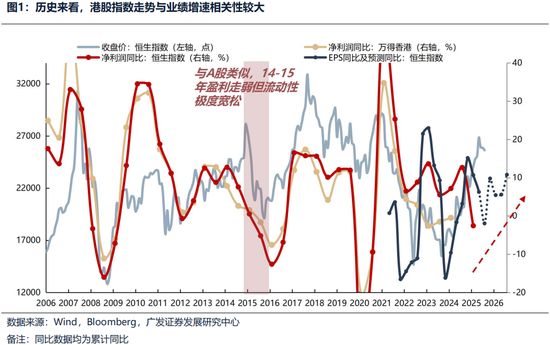
Group 1 - The current rise in Hong Kong stocks is supported by fundamentals, with signs of structural recovery in profitability starting from the second half of 2024 due to stabilization in both domestic and external demand and macroeconomic policy support [1][24] - The Hang Seng Index is transitioning from traditional economic cycles to focus on hard technology sectors such as AI applications, new energy, and semiconductors, with the weight of new economy sectors in the index increasing from 17% to nearly 50% [1][34] - The performance of Hong Kong stocks is expected to shift from being liquidity-driven to being driven by both profitability and liquidity, with earnings growth projected to rebound to 10.8% in 2026 [1][25] Group 2 - The current low valuation levels of quality companies in Hong Kong stocks highlight their growth potential, and the market sentiment has likely adjusted to current liquidity and emotional factors [6][24] - The structural recovery in profitability is evident, with emerging industries experiencing rapid growth while traditional sectors are still stabilizing [28][29] - The performance of individual stocks correlates positively with earnings growth, with high-growth companies significantly outperforming those under profit pressure [33] Group 3 - The upcoming liquidity improvements, including potential dovish signals from the new Federal Reserve chair and a decrease in HIBOR rates, could provide upward momentum for Hong Kong stocks [52][70] - The AH premium is expected to decline further due to increased investment from insurance funds in H-shares and the growing convenience for foreign capital to allocate resources in Hong Kong [71][74] - The spring market rally in Hong Kong stocks has historically shown a high probability of positive returns, indicating a potential opportunity for investors [56][60]