景顺长城

Search documents
“一日售罄”
中国基金报· 2025-11-13 11:47
Core Viewpoint - The article highlights the rapid success of the China Europe Fund's new product, the China Europe Xinyue Return One-Year Holding Mixed Fund, which reached its fundraising cap of 1.5 billion yuan on its first day of issuance, leading to an early closure and proportional allocation of subscriptions [2][5]. Fundraising Trends - Since October, nearly 40 funds have announced early closures, with many being actively managed equity products that sold out on the first day [3][9]. - The trend of early fundraising closures indicates a resurgence in the equity fund issuance market [8]. Fund Manager Profile - The fund manager for the China Europe Xinyue Return One-Year Holding Mixed Fund is Lan Xiaokang, who is also the head of the Value Strategy Group at China Europe Fund [6]. - Lan Xiaokang has a strong track record, having managed the China Europe Hongli Youxiang Mixed Fund, which has consistently outperformed benchmarks and has a maximum drawdown significantly lower than the Shanghai Composite Index [6]. Investment Style - Lan Xiaokang's investment style is characterized by "contrarian thinking" and "balanced allocation," focusing on achieving a dynamic balance among valuation, corporate quality, and long-term growth potential [7].


上一轮牛市买的主动权益基金,近40%未回本
2 1 Shi Ji Jing Ji Bao Dao· 2025-11-12 13:49
Core Insights - The recent performance of active equity funds has been under scrutiny, with over 38% of these funds still in losses over the past five years despite a significant number achieving positive returns since 2025 [1][2][3] - Key factors contributing to the underperformance include high-level accumulation, frequent trading, and reliance on specific sectors, which have eroded fund values [1][5][7] Performance Overview - As of November 10, 2025, the Shanghai Composite Index has risen by 19.42%, while 97.45% of active equity funds reported positive returns [2][3] - However, 1019 active equity funds remain in losses, with 38% of the total, indicating a stark contrast in performance for investors who entered the market earlier [1][2] Fund Performance Analysis - Among the 2695 active equity funds with over five years of existence, 1676 have achieved positive returns, with six funds reporting over 200% returns [3] - Conversely, nearly 40% of active equity funds have not turned a profit in five years, with some funds experiencing maximum drawdowns starting in 2021 [3][4] Underperforming Funds - Notable underperformers include funds managed by well-known managers, with losses exceeding 30% over five years [4] - Specific funds like Tianzhi New Consumption and Fangzheng Fubang Innovation Power have reported losses of -65.25% and -62.32%, respectively [3][4] Trading Behavior - High average stock positions during market peaks have been linked to poor long-term performance, with funds showing an average stock position of 84.22% during critical periods [5][6] - Frequent trading has also negatively impacted fund performance, with an average turnover rate of 460.71% across all active equity funds, rising to 508.45% for those with over 30% losses [7][8] Sector Reliance - Many funds have shown over-reliance on traditional sectors, leading to underperformance despite being labeled as "new" or "growth" funds [8][9] - Funds like Tianzhi New Consumption and Invesco Great Wall New Growth have shifted their holdings but still struggle to achieve positive returns [8][9] Market Outlook - The active equity fund market is seeing a resurgence, with 1354 new funds launched in 2025, indicating renewed investor interest [11] - Fund managers are advised to focus on sectors with long-term growth potential, such as high-end manufacturing and new consumption, while being cautious of market volatility [12]
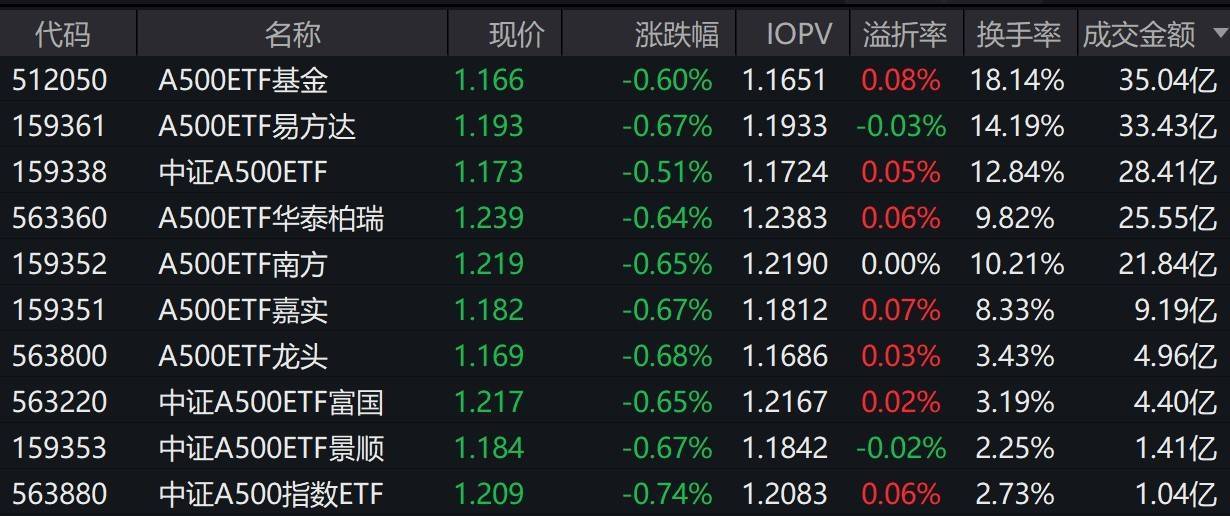
市场早盘震荡走弱,中证A500指数下跌0.66%,3只中证A500相关ETF成交额超28亿元
Sou Hu Cai Jing· 2025-11-12 03:47
Core Viewpoint - The market experienced fluctuations in the morning session, with the three major indices initially rising before retreating, and the CSI A500 index falling by 0.66% [1] Market Performance - The banking sector showed resilience with an upward trend, while the robotics concept stocks were active in certain areas, and the oil and gas sector strengthened [1] - Conversely, the superhard materials concept stocks collectively weakened, and the photovoltaic concept stocks suffered significant declines [1] ETF Trading Activity - As of the morning close, the ETFs tracking the CSI A500 index saw slight declines, with 10 related ETFs having transaction volumes exceeding 100 million yuan, and 3 surpassing 2.8 billion yuan [1] - Specific transaction volumes for A500 ETFs included 3.504 billion yuan for A500ETF Fund, 3.343 billion yuan for A500ETF E Fund, and 2.841 billion yuan for CSI A500 ETF [1] Market Outlook - A brokerage firm indicated that the market may continue to experience structural fluctuations in the short term. However, in the medium term, factors such as sustained global technology investment enthusiasm, ongoing "anti-involution" policies, and increased household savings entering the market support the foundation of the current slow bull market, suggesting that the A-share market still has the potential to strengthen further [1]
晨会报告:哪些二级债基适配高波环境?-20251112
Shenwan Hongyuan Securities· 2025-11-12 01:01
Core Insights - The report discusses the adaptability of secondary bond funds in high volatility environments, emphasizing diverse strategies for selecting aggressive products [3][12]. - It highlights the importance of high allocation and growth styles in secondary bond funds, suggesting that funds with a weighted average stock PE above 30 times are classified as growth style funds [4][12]. - The report also notes the increasing investment in Hong Kong stocks by secondary bond funds, with a stock market value ratio reaching 11.21% in Q3 2025 [12]. Summary by Sections High Allocation Strategy - High allocation secondary bond funds typically maintain high positions, with an average convertible bond allocation exceeding 30% across 64 funds, including both conservative and aggressive styles [3][12]. - A three-dimensional selection system is recommended, focusing on high elasticity, favorable holding experience, and cost-effectiveness, evaluated through three core indicators and five sub-indicators [12]. Growth Style - Growth style funds are identified by their holding stocks with a PE ratio above 30, with evaluations based on holding experience and risk-return ratios, particularly the Sharpe ratio [4][12]. - The report emphasizes the need to consider industry rotation, portfolio construction methods, and the balance between growth and quality [4][12]. Hong Kong Stock Strategy - The report indicates a continuous increase in the proportion of Hong Kong stock investments within secondary bond funds, with specific funds maintaining stable positions in this market [12]. - It mentions that the investment limit for Hong Kong stocks is capped at 50% of the stock assets for products that can invest in Hong Kong stocks [12]. Tool-based Products - Tool-based products within secondary bond funds include strategies focused on innovation and micro-cap stocks, with specific funds targeting these areas [12]. - The report identifies representative products for micro-cap strategies and highlights the unique index-enhanced strategy products focused on innovation [12].
申万宏源证券晨会报告-20251112
Shenwan Hongyuan Securities· 2025-11-12 00:44
Core Insights - The report emphasizes the diverse strategies of secondary bond funds and the significant differences in their risk-return profiles, suggesting a focus on high-positioning and growth-oriented funds to capitalize on high-growth sectors [3][12] - It highlights the increasing investment in Hong Kong stocks by secondary bond funds, with the proportion reaching 11.21% of stock market value in Q3 2025, indicating a trend towards technology-driven assets [12] - The report outlines a three-dimensional selection system for high-elasticity products, focusing on high performance, good holding experience, and cost-effectiveness [12] Summary by Sections Secondary Bond Fund Strategies - The report identifies four main strategies for selecting secondary bond funds suitable for high volatility environments: high positioning, growth style, Hong Kong stock strategy, and tool-type products [3][12] - High-positioning funds typically have an average convertible bond position exceeding 30%, with 64 funds identified, ranging from conservative to aggressive styles [12] - Growth style funds are characterized by a weighted average PE ratio above 30, with evaluations based on holding experience and risk-return ratios [4][12] Hong Kong Stock Strategy - The report notes a continuous increase in the investment ratio of secondary bond funds in Hong Kong stocks, with specific funds maintaining stable positions [12] - It mentions that the investment limit for products that can invest in Hong Kong stocks is capped at 50% of their stock assets [12] Tool-Type Products - The report discusses the emergence of tool-type products within secondary bond funds, including strategies focused on innovation and micro-cap stocks [12] - It highlights specific funds that target dual innovation strategies and micro-cap stocks, indicating a growing trend in specialized investment approaches [12]
“基金地位”下滑!茅台从第三跌至第十,张坤选择继续加仓
Di Yi Cai Jing· 2025-11-03 08:08
Core Viewpoint - The performance of Guizhou Moutai's stock has weakened due to the poor performance of the liquor sector, leading to a significant reduction in its position among actively managed equity funds [1] Group 1: Fund Holdings - Guizhou Moutai has dropped from being the third largest holding in actively managed equity funds at the end of Q2 to the tenth largest by the end of Q3, marking a decline of seven positions in just one quarter, which is rare in recent years [1] - Several fund companies, including China Merchants Fund, Huatai-PB Fund, and others, have increased their holdings in Guizhou Moutai during Q3, while more fund companies, such as China Asset Management and E Fund, have reduced their positions [1] - Notable fund managers like Zhu Shaoxing and Xiao Nan have also reduced their holdings, contrasting with Zhang Kun, who has increased his investment in Guizhou Moutai, maintaining it as a significant holding in his fund [1] Group 2: Fund Performance - The funds that increased their holdings in Guizhou Moutai reported a Q3 return of 16.37%, while their year-to-date return as of October 29 was lower at 13.97% [1]

茅台“基金地位”下滑 张坤继续加仓
Zheng Quan Shi Bao Wang· 2025-11-01 06:18
Core Insights - Guizhou Moutai's stock price has been weak due to the poor performance of the liquor sector, leading to a significant reduction in its position among mutual fund holdings [1] - The company dropped from being the third-largest holding in actively managed equity funds at the end of Q2 to the tenth position by the end of Q3, marking a rare decline of seven places in just one quarter [1] - Despite this decline, Guizhou Moutai remains the second-largest holding across all public funds, with passive products playing a crucial role, although overall holdings have also decreased [1] Market Performance - The China Securities Liquor Index rose by 7.75% in Q3, while Guizhou Moutai's stock price only increased by 2.45%, prompting some funds to shift towards other more flexible liquor stocks for potential excess returns [1] - As of the end of Q3, public funds held Guizhou Moutai shares valued at 123.649 billion yuan, a slight increase from 125.23 billion yuan in Q2, despite a decrease of 3.2161 million shares in holdings [1] Fund Manager Actions - There is a clear divergence in attitudes among public funds towards Guizhou Moutai, with some funds like招商基金, 汇添富基金, and 鹏华基金 increasing their holdings, while others such as 华夏基金, 易方达基金, and 嘉实基金 have reduced their positions [1] - Notable fund managers like 朱少醒, 萧楠, and 劳杰男 have also taken steps to reduce their holdings, contrasting with 张坤, who has slightly increased his investment in Guizhou Moutai through the 易方达蓝筹精选 fund, making it the third-largest holding [2]
茅台“基金地位”下滑,张坤继续加仓
第一财经· 2025-11-01 06:01
Core Viewpoint - The performance of Guizhou Moutai's stock has weakened due to the poor performance of the liquor sector, leading to a significant reduction in its position among major equity funds [3]. Group 1: Fund Holdings - Guizhou Moutai has dropped from being the third-largest holding in actively managed equity funds at the end of Q2 to the tenth-largest by the end of Q3, marking a decline of seven positions in just one quarter, which is rare in recent years [3]. - Several fund companies, including招商基金, 汇添富基金, and 鹏华基金, have increased their holdings in Guizhou Moutai during Q3, while more funds, such as 华夏基金 and 易方达基金, have reduced their positions [3]. - Notable fund managers like 朱少醒 and 萧楠 have also reduced their stakes, contrasting with 张坤, who has slightly increased his investment in Guizhou Moutai through his fund, 易方达蓝筹精选, making it the third-largest holding [3]. Group 2: Fund Performance - The funds that increased their holdings in Guizhou Moutai reported a Q3 return of 16.37%, while their year-to-date return as of October 29 was lower at 13.97% [3].

茅台“基金地位”下滑,张坤继续加仓
Xin Lang Cai Jing· 2025-11-01 05:28
Group 1 - The core viewpoint is that Guizhou Moutai's stock price has weakened due to the poor performance of the liquor sector, leading to a significant reduction in its position among actively managed equity funds [1] - Guizhou Moutai dropped from being the third largest holding in actively managed equity funds at the end of Q2 to the tenth largest by the end of Q3, marking a decline of seven positions in just one quarter, which is rare in recent years [1] - Despite some fund companies like China Merchants Fund and Huatai-PB increasing their holdings in Guizhou Moutai during Q3, more fund companies, including Huaxia Fund and E Fund, have reduced their positions [1] Group 2 - Notable fund managers such as Zhu Shaoxing and Xiao Nan have also reduced their holdings in Guizhou Moutai, contrasting with Zhang Kun, who has increased his investment in the stock [1] - The fund managed by Zhang Kun, E Fund Blue Chip Select, slightly increased its stake in Guizhou Moutai, making it the third largest holding in the fund [1] - The funds mentioned reported a return of 16.37% in Q3, with a lower year-to-date return of 13.97% as of October 29 [1]
结构行情下的反差:小基金双丰收,大基金赚钱失份额
Sou Hu Cai Jing· 2025-10-31 15:56
Core Insights - In Q3, a stark contrast emerged in the fund industry, with large funds experiencing significant share shrinkage while smaller funds enjoyed substantial growth in both performance and share size [1][2][4] Group 1: Large Funds Performance - Many large funds, despite showing improved performance, faced significant redemptions, with examples like E Fund Blue Chip Select seeing a net value increase of 16.37% but a reduction of over 2 billion shares, a decline of more than 10% [2][3] - Other large funds, such as Xingquan Helun and Ruifeng Growth Value, also reported net value increases of over 35% and 50% respectively, yet their A-class shares decreased by over 2 billion shares [2][3] - The trend of redemption for large funds began after the market downturn in September 2022, with significant year-on-year share reductions noted [3] Group 2: Small Funds Performance - Smaller funds experienced a "highlight moment" in Q3, with significant increases in both net value and share size, such as Yongying Technology Selection achieving nearly 100% net value growth and a scale increase of over 10 billion [4] - Other small funds like Zhonghang Opportunity Navigator and Zhongou Digital Economy also saw net value increases of nearly 90% and 80%, respectively, with substantial share growth [4] - The performance of smaller funds is attributed to their ability to focus on high-growth sectors without the historical burdens faced by larger funds [7] Group 3: Investor Behavior - The contrasting performance of large and small funds reflects a shift in investor sentiment from "star chasing" to a more pragmatic approach, focusing on strategies and sectors rather than just fund managers [5][7] - Investors are currently in a transitional phase, with some opting to redeem for safety while others may re-enter the market if the upward trend continues [6][7] Group 4: Market Outlook - The outlook for the A-share market remains positive, with expectations of a "slow bull" market driven by factors such as improved macroeconomic conditions and liquidity, alongside strong performance in sectors like AI and semiconductors [8][9] - Analysts predict that as the market stabilizes, there will be a gradual return of long-term capital, enhancing market activity [8][9]