美的集团

Search documents
厚植创新发展优势 勇立改革开放潮头 只争朝夕做好“十五五”开局之年工作
Xin Lang Cai Jing· 2026-01-05 19:46
Group 1 - The core message emphasizes the importance of high-quality development and innovation as key drivers for economic growth in the new year [1][2] - The government aims to strengthen the role of enterprises in innovation, enhance support in policies, funding, and talent, and leverage the advantages of the Guangdong-Hong Kong-Macao Greater Bay Area to foster research and development in emerging fields and core technologies [2][3] - There is a focus on improving the industrial ecosystem and expanding application scenarios for new technologies such as robotics and drones, which are expected to accelerate iteration and upgrade through broader application [2][3] Group 2 - The government is committed to expanding high-level opening-up, integrating hard connectivity of infrastructure with soft connectivity of rules and standards, and developing major platforms for technological innovation, service trade, and industrial development [3] - There is an emphasis on understanding new consumer demands driven by economic development and improving product quality to create a virtuous cycle of demand-driven supply and supply-driven demand [3] - The government encourages enterprises to seize opportunities and innovate, while urging local governments to enhance coordination and optimize the business environment to stimulate economic growth [3]
李强在广东调研时强调 厚植创新发展优势奋力实现“十五五”良好开局
Zheng Quan Shi Bao· 2026-01-05 18:56
Group 1 - The core message emphasizes the importance of high-quality development and innovation in driving economic growth, as highlighted by Premier Li Qiang during his visit to Guangdong [1][2] - The focus on technological innovation is crucial for future competitiveness, with a call for enhanced support for enterprises in terms of policies, funding, and talent [1] - The development of the Guangdong-Hong Kong-Macao Greater Bay Area is seen as a key opportunity to gather innovative resources and strengthen research collaboration in emerging fields and core technologies [1] Group 2 - The need for a robust infrastructure and effective management of transportation routes is stressed to ensure smooth connectivity and collaborative development within the Greater Bay Area [2] - The shift in consumer demand due to economic growth and improved living standards necessitates the acceleration of research and production of high-quality products [2] - The promotion of high-level opening-up and the integration of hard and soft connectivity in infrastructure and regulatory standards is essential for expanding digital and green trade [2]
美的集团20260105
2026-01-05 15:42
Summary of Midea Group's Conference Call Company Overview - **Company**: Midea Group - **Industry**: Home Appliances and Robotics Key Points and Arguments Revenue and Profitability Outlook - Midea Group expects revenue growth in the mid-to-high single digits for 2026, aiming to stabilize profit margins [2][3] - The B-end business is projected to grow faster than the C-end, particularly in building and renewable energy sectors, with KUKA robotics business also recovering rapidly [2][3] - The company is shifting its strategic focus towards revenue growth rather than solely pursuing profit margin increases, having achieved its best profitability levels historically [2][6][7] Cost Management Strategies - Midea is addressing rising raw material costs through dynamic procurement, price transmission, scale advantages, hedging, and digital technologies [2][5] - The company believes that rising costs can optimize industry competition, benefiting leading firms like Midea with stronger bargaining power [5] - Midea's cost reduction measures are expected to contribute over 0.5% to profit margins by 2025, with further efficiency improvements anticipated in 2026 [4][17] Aluminum-Copper Strategy - Midea is actively promoting the "aluminum replacing copper" strategy, which has been widely applied in overseas markets and is making progress in domestic commercial air conditioning [2][9] - This strategy is in response to national policies and aims to mitigate the scarcity and price volatility of copper resources [2][9] International Expansion and Brand Recognition - Midea plans to expand its overseas OBM (Original Brand Manufacturer) business, targeting operations in over 50 countries by the end of 2025 [2][11] - The company is increasing its marketing efforts through sponsorship of sports events to enhance brand recognition and sales [11] Market Dynamics and Pricing Strategies - The company anticipates that the domestic market will face significant growth pressure despite strategies to achieve sales growth [10] - Recent price increases primarily affect older products with higher copper content, aimed at alleviating industry sales pressure [12][15] - Midea's pricing strategy is designed to maintain profitability while ensuring the health of the overall industry [15] Product Development and Technological Advancements - Midea's building products are expected to grow due to technological and cost advantages, with magnetic levitation centrifugal technology leading the industry [4][22] - The acquisition of OBANI and Toshiba has strengthened Midea's competitive position in the European heating market, which is larger than the cooling market [22][24] Future Business Segments - The establishment of a separate New Energy Division is aimed at better managing complex business models and releasing growth potential in the energy sector [21] - Midea's refrigerator and washing machine segments are expected to see stable growth, with a focus on improving technology and user experience [25] Financial Guidance and Shareholder Returns - Midea maintains confidence in revenue growth for Q4 2026, but profit stability will depend on various external factors [26] - The company has a regular share buyback plan and aims to maintain its dividend payout ratio, with potential increases subject to board approval [27] Additional Important Insights - Midea's approach to raw material cost management includes leveraging digital and AI technologies to enhance efficiency across the value chain [4][17] - The company is cautious about the implementation pace of the aluminum-copper strategy to ensure product quality and performance [8] - Midea's competitive edge in the market is bolstered by its scale and technological advancements, positioning it as one of the most profitable companies globally [6][7]
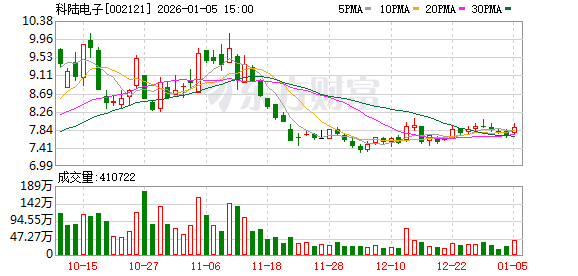
拿地、建设投入近20亿元 如今出租情况“不理想” 科陆电子筹划出售深圳一产业园
Mei Ri Jing Ji Xin Wen· 2026-01-05 14:33
Group 1 - Company announced plans to sell the Guangming Smart Energy Industrial Park assets, with the transaction price yet to be disclosed [2][3] - The company acquired the land for the industrial park in 2017 for 413 million yuan and invested approximately 1.5 billion yuan in its construction [2][4] - Due to unsatisfactory leasing area and rental prices, the company has made an asset impairment provision exceeding 100 million yuan for the industrial park [2][5] Group 2 - The company signed a non-binding asset acquisition agreement with Shenzhen Guangming Science City Industrial Development Group, China Science and Technology Development Institute, and Midea Innovation Investment Co., Ltd. for a cash purchase of the industrial park assets [3] - The transaction is expected to improve the company's asset quality and optimize its asset structure, providing cash flow for operational needs [3] - The industrial park project has negatively impacted the company's cash flow and performance, leading to liquidity pressures [4][5]


美的MB - HS4033电饭煲,Plus会员到手459!
Xin Lang Cai Jing· 2026-01-05 14:16
秒 新浪财经APP 24小时全球 息盒资讯 下载APP > 广告 (Firest (Midea 喷部钢化玻璃 京东家电家居 X 好家庭 Ulidea 花瓣IH包裹式加热 0氟陶瓷不粘涂层 升级去陈增香3.0 限时直降 先到冠博 到手价不高于 (新年购物季京东家电家居 又好又便宜 * 599 超信标扣 限时抢购 (Midea 喷部钢化玻璃 京东家电家居 双好又便宜 Ulides 花瓣IH包裹式加热 0氟陶瓷不粘涂层 升级去陈增香3.0 阿直降 完到元得 到手价不高于 (新年购物季京东家电家居 又好又便宜 未 599 超值折扣 限时抢购 ...


家电行业2026年1月投资策略:2026年家电国补政策延续,有望拉动内销需求企稳回升
Guoxin Securities· 2026-01-05 13:58
Core Insights - The 2026 home appliance national subsidy policy is expected to stimulate domestic demand and stabilize retail sales, particularly in the white goods sector [2][3][20] - The policy continues to support the replacement of old appliances with new ones, focusing on six major categories, including refrigerators, washing machines, and air conditioners, with a subsidy of 15% of the product price, capped at 1500 yuan per item [3][21][22] - The white goods production in January showed a positive trend, with a total output of 34.53 million units, representing a 6% year-on-year increase, driven by the national subsidy policy [4][24] Monthly Research Tracking and Investment Thoughts - The national subsidy policy for 2026 aims to boost the replacement demand for home appliances, which is expected to support domestic sales [20][21] - January's white goods production saw a recovery, with air conditioner production increasing by 11% year-on-year, indicating a potential stabilization in demand [4][24] - In November, the domestic sales of major appliances faced pressure due to high base effects from the previous year, but exports of refrigerators and washing machines showed good growth [5][32] Key Data Tracking - In December, the home appliance sector experienced a relative return of -1.06% compared to the Shanghai Composite Index, which rose by 2.28% [34] - The prices of raw materials such as copper and aluminum increased by 13.5% and 4.8% respectively in December, while cold-rolled steel prices decreased by 3.2% [36] - The shipping index for major routes showed a mixed performance, with the West America route down by 6.4% and the Europe route up by 4.8% [45] Key Company Announcements and Industry Dynamics - The report highlights key companies such as Midea Group, Haier Smart Home, TCL, and Gree Electric as strong performers in the white goods sector, with recommendations for investment based on their resilience and growth potential [14][15][54] - The home appliance industry is expected to face challenges due to high inflation in overseas markets and geopolitical tensions, but leading companies are adapting by enhancing local production capabilities [50][51]




新房还在卖,赣州美的高速君兰学府迎来二手房成交!价格意外!
Sou Hu Cai Jing· 2026-01-05 13:44
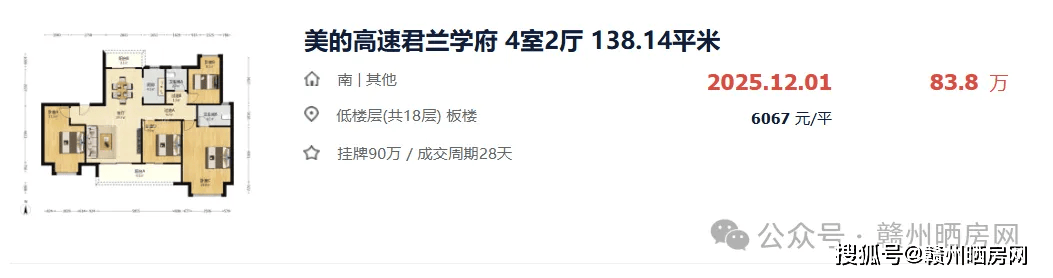
突然发现,赣州越来越多的楼盘进入到新房、二手房同时都有房源销售的局面。 近日,小编浏览二手房平台时发现,赣州美的高速君兰学府迎来首套二手房成交,单价6067元/㎡,一起来看看具体情况。 *本文数据来源于某二手房平台,数据随时变动,仅供参考,具体以实际为准! 此次成交户型为建筑面积约138.14㎡四房两厅,带南北双阳台设计,是市面上比较常见的户型,位于低楼层(共18层),为小高层产品。 这套房源于2025年11月3日挂牌,首次挂牌总价109.66万元,经历1次调价,最终成交单价6067元/㎡,成交总价83.8万元,成交周期28天,约一个时间不 到,期间带看9次。 在新房销售价格比较有优势的情况下,二手房很难卖出高价,所以文中开头成交的首套二手房房源,单价6字头成交,也在情理之中。 美的高速君兰学府于2024年3月31日一期迎来交房,共535户交付,至今已有一年九个月时间。 在二手房平台上挂出房源并不多,仅有9套,挂牌均价在7882元/㎡,近90天成交1套,也就是文中开头成交的房源,近30天带看51次,有一定热度,但不 高。 | 美的局速右三字时 章页 黄金开发区 | | | 查看小区详情 | | --- | - ...
研究了10000名消费者,我们为2026写下30条新消费暴利的秘密 |「万字长文」
新消费智库· 2026-01-05 13:23
Group 1 - The core consumption logic in China is shifting from "cost-performance" and "emotional value" to "quality-price ratio" and "comprehensive self-satisfaction" as consumers become more rational and discerning in their purchases [2][3] - The Z generation (ages 18-27) views consumption as a means of expressing identity and belonging, prioritizing "identity consumption" over mere "need consumption" [4][6][10] - The "谷子经济" (Guzi Economy) is emerging as a significant market, driven by emotional value and the willingness of consumers, especially the Z generation, to pay for intangible assets like fandom and community [10][11] Group 2 - The Z generation is increasingly skeptical of influencer marketing, with only 11% trusting recommendations from online personalities, preferring authentic and relatable brand interactions [12][13] - The trend of "micro-luxury" consumption is rising, where consumers seek small indulgences that provide immediate happiness and a sense of control over their lives [12][13] - The demand for convenience is leading to a rise in "extreme time-saving" solutions, with consumers willing to pay for products that simplify their daily routines [15][16] Group 3 - The second-hand market is gaining traction as consumers seek unique, high-quality items while also valuing sustainability, with platforms for vintage and second-hand goods becoming social hubs [16][17] - Digital assets are being accumulated for their potential future value, with consumers finding satisfaction in owning a vast array of digital content, even if unused [18][19] - A trend towards "aesthetic minimalism" is emerging, with consumers favoring simpler, less polished designs that emphasize authenticity over excessive packaging [20][23] Group 4 - The younger generation is increasingly seeking authentic experiences, often traveling to less commercialized areas to escape urban monotony and engage with local cultures [24][25] - The Z generation is characterized by "precise ambiguity," using specific labels to express their multifaceted identities, which brands must understand and respect [26][27] - The "小镇中年" (Small Town Middle-Aged) demographic is becoming a stable consumer base, relying heavily on community recommendations and valuing local pride [30][32] Group 5 - The "leisure economy" is thriving, with consumers prioritizing leisure activities that enhance their quality of life, such as local dining and short trips [33][34] - Social currency is becoming a key driver of consumption, where purchases are made not just for personal use but also to enhance social standing within local communities [35][36] - The preference for trusted national brands is evident, with consumers favoring mid-range products that offer reliability and value for money [36][37] Group 6 - The rise of service consumption reflects a shift towards valuing time and convenience, with consumers willing to pay for services that simplify their lives [46][47] - The "healing economy" is emerging as a significant market, with consumers regularly engaging in emotional wellness activities to cope with modern stressors [48][50] - Anti-aging products are evolving into a more systematic and scientific approach, with consumers investing in comprehensive anti-aging solutions [51][52] Group 7 - Membership-based shopping models are gaining popularity, as consumers seek curated selections that save time and ensure quality [52][54] - The revival of physical media, such as books and vinyl records, highlights a desire for tangible experiences and the ritualistic aspects of consumption [57][58] - The "new middle-class women" are redefining self-satisfaction, investing in holistic self-improvement across various aspects of life [61][62]

湘潭湘莲上榜!工业和信息化部公示2025年度中国消费名品名单
Sou Hu Cai Jing· 2026-01-05 12:19
Core Viewpoint - The Ministry of Industry and Information Technology of China has announced the public listing of the 2025 National Consumer Brand List, which includes six brands from Hunan Province: Jiu Zhi Tang, Sheng De Xi, Anhua Black Tea, Xiangtan Xianglian, Nanyue Rice Shrimp, and Qian Jin [1][27]. Group 1: Announcement Details - The announcement is based on the notification from the Ministry of Industry and Information Technology regarding the collection of the 2025 National Consumer Brand List [1]. - The public listing period is from January 5, 2026, to January 9, 2026, allowing for public feedback [1]. Group 2: Selected Brands - Six brands from Hunan Province are proposed for inclusion in the list: - Jiu Zhi Tang (九芝堂) - Sheng De Xi (圣得西) - Anhua Black Tea (安化黑茶) - Xiangtan Xianglian (湘潭湘莲) - Nanyue Rice Shrimp (南县稻虾米) - Qian Jin (千金) [1][22][23].



李强在广东调研
财联社· 2026-01-05 12:13
Group 1 - The core message emphasizes the importance of high-quality development and innovation as key drivers for economic growth in the new year [1] - The government aims to enhance the role of enterprises in innovation, improve support policies, and leverage the advantages of the Guangdong-Hong Kong-Macao Greater Bay Area to foster research and development in emerging fields and core technologies [1] - The focus is on the application of technology, particularly in industries such as robotics and drones, to create a robust industrial ecosystem and expand application scenarios [1] Group 2 - The government is committed to improving infrastructure connectivity and promoting collaborative development within the Greater Bay Area, utilizing advanced technologies for safe and efficient operation of transportation routes [2] - There is a strong emphasis on understanding new consumer demands driven by economic growth and improving product quality through research and development [2] - The government plans to expand high-level opening-up, integrating hard and soft connectivity in infrastructure and regulatory standards, while promoting digital and green trade [2]