
南京银行

Search documents
城商行板块10月24日跌0.76%,厦门银行领跌,主力资金净流出1.42亿元
Zheng Xing Xing Ye Ri Bao· 2025-10-24 08:27
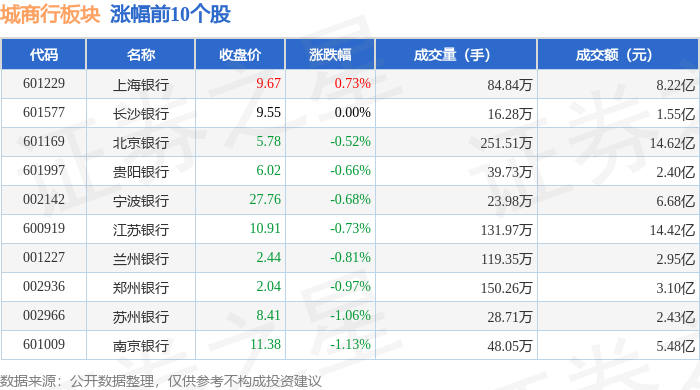
Core Insights - The city commercial bank sector experienced a decline of 0.77% on October 24, with Xiamen Bank leading the drop [1] - The Shanghai Composite Index closed at 3950.31, up 0.71%, while the Shenzhen Component Index closed at 13289.18, up 2.02% [1] Stock Performance - Shanghai Bank closed at 9.67, up 0.73% with a trading volume of 848,400 shares and a transaction value of 822 million [1] - Xiamen Bank closed at 6.68, down 1.76% with a trading volume of 153,100 shares and a transaction value of 103 million [2] - The majority of city commercial bank stocks showed negative performance, with notable declines in Beijing Bank (-0.52%) and Guizhou Bank (-0.66%) [1][2] Capital Flow - The city commercial bank sector saw a net outflow of 142 million from institutional investors, while retail investors contributed a net inflow of 55.9 million [2] - Jiangsu Bank had a net inflow of 70.84 million from institutional investors, while Shanghai Bank experienced a net outflow of 78.96 million from retail investors [3] Individual Stock Analysis - Chengdu Bank had a slight negative net flow from institutional investors of 19.75 million, but a positive inflow from retail investors of 596.99 million [3] - Lanzhou Bank saw a net inflow of 13.36 million from institutional investors, while it faced a net outflow of 1.48 million from retail investors [3]




南京银行2025年10月宏观利率展望:多空因素交织,利率区间震荡
Nan Jing Yin Hang· 2025-10-24 05:29
Report Industry Investment Rating No relevant content provided. Core Viewpoints of the Report - The bond market is affected by a combination of bullish and bearish factors, with bond yields expected to maintain a range - bound oscillation. Trading positions can take the opportunity to close when interest rates decline, and allocation positions can enter the market when prices are high. Medium - and long - term bonds have better allocation value [3][121]. - In the fourth quarter, the pressure to achieve the annual economic goal is relatively small, and the space for incremental policies such as reserve requirement ratio cuts and interest rate cuts may be limited. The central bank may prefer to use open - market operations such as outright repurchases to reduce the cost of banks' liability side, and structural monetary policies will play a greater role in stabilizing growth and foreign trade [2][88]. Summary by Directory 1. Macroeconomy: Domestic Demand Continues to Decline, and Inflation Rises Slowly - **Demand: Domestic demand continues to decline, and production maintains resilience** - The cumulative year - on - year GDP growth rate in the first three quarters is 5.2%, reducing the pressure to stabilize growth in the fourth quarter, and the probability of policy intensification in the short term is low [7][8]. - From January to September, the cumulative year - on - year growth rate of fixed - asset investment was - 0.5%, with the growth rate turning negative. The growth rates of real estate, manufacturing, and infrastructure investment all declined, dragging down fixed - asset investment [9]. - From January to September, real estate development investment and sales growth rates continued to decline. Real estate is still in the process of bottom - seeking, and real estate investment is expected to remain at a low level [10]. - In September, the consumption growth rate continued to decline to 3%. Affected by the withdrawal of subsidies and weak catering consumption, it is expected to further decline below 3% in October [15][18]. - In September, the national urban survey unemployment rate decreased slightly after the graduation season. The employment demand of large, medium, and small enterprises all increased, alleviating some employment pressure [19]. - From January to September, the cumulative year - on - year export growth rate was 6.1%, and the import growth rate increased significantly. The trade surplus narrowed in September and is expected to continue narrowing [23][27][28]. - High - frequency data shows that the daily coal consumption of power plants decreased in October, the steel and coking enterprise start - up rates were differentiated, and the truck tire start - up rate decreased [33][35][39]. - **Production: Production shows strong resilience** - From January to September, the cumulative year - on - year growth rate of the added value of large - scale industries was 6.2%. In September, the added value of industries increased by 6.5% year - on - year, indicating strong production resilience [44]. - **CPI remains negative, and the decline of PPI continues to narrow** - In September, CPI increased slightly but remained negative, and PPI increased year - on - year. It is expected that CPI will gradually recover in the fourth quarter [47][55]. - The year - on - year decline of PPI narrowed by 0.6 percentage points. Some industries showed positive price changes, and the impact of anti - involution policies was significant [57][62]. 2. Liquidity and Monetary Policy: The Central Bank Conducts Outright Repurchase Operations with Increased Volume, and the Liquidity is Expected to be Balanced and Slightly Loose - **Liquidity review: The central bank conducts outright repurchase operations with increased volume, and short - term interest rates return to stability after the quarter** - Since October, the liquidity has remained loose, and DR007 mostly operates within 5bp above the policy rate. The central bank conducts outright repurchase operations with increased volume, and the large - scale banks' fund lending is mostly above 4 trillion [2][64]. - The long - term fund price has changed little, and the pressure on inter - bank certificates of deposit repayment in October has decreased [70][72]. - **Financial data: New credit increases less year - on - year, the growth rate of social financing declines, and the growth rate of M1 exceeds expectations** - In September, new credit increased less year - on - year, mainly due to the weak credit demand of residents and enterprises. Social financing also increased less year - on - year, mainly dragged down by government bonds and RMB loans [79][83]. - In September, M2 increased by 8.4% year - on - year, a decrease of 0.4%. M1 increased by 7.2% year - on - year, and the gap between M1 and M2 narrowed [84]. - **Next - stage liquidity outlook: The bond supply pressure in the fourth quarter eases, and the liquidity is expected to be balanced and slightly loose** - Since October, the liquidity has remained loose, and the central bank conducts outright repurchase operations with increased volume. Although the supply - demand contradiction in the first half of the fourth quarter is relatively large, the liquidity disturbance is expected to be limited [2][88]. - The central bank may prefer to use open - market operations to reduce the cost of banks' liability side, and structural monetary policies will play a greater role [88]. 3. Interest - Rate Bond Strategy: A Combination of Bullish and Bearish Factors, with Interest Rates Oscillating within a Range - **Interest - rate bond trend review** - Bond yields first rose and then fell. The 10 - year treasury bond yield is around 1.85%, and the 10 - year CDB bond yield rose to around 2.01%. The yield curve first steepened and then flattened [90]. - Since September, the implicit tax rate has generally increased, with the 1Y and 3Y implicit tax rates being relatively high [100]. - **Analysis of interest - rate bond influencing factors** - **Economic fundamentals**: Domestic demand continues to decline, but the bond market is more sensitive to bearish fundamentals [103]. - **Inflation**: Inflation is gradually recovering from a low level, but the impact on the bond market is currently small [104]. - **Broad liquidity**: Social financing and loans increase less year - on - year, while M1 continues to rise [105]. - **Narrow liquidity**: The central bank of funds is stable, and the repurchase trading volume increased in October [109][111]. - **Sino - US interest rate spread**: The inversion amplitude has narrowed, and the exchange rate is relatively stable, not restricting monetary policy [112][113]. - **Stock - bond ratio**: It continues to decline, and the allocation value of bonds increases [114][116]. - **Bond supply and demand**: The overall supply pressure has decreased, but the supply of policy - based financial bonds is expected to increase slightly [117]. - **Interest - rate bond strategy: A combination of bullish and bearish factors, with interest rates oscillating within a range** - Bond yields are expected to maintain a range - bound oscillation. Trading positions can close when interest rates decline, and allocation positions can enter the market when prices are high. Medium - and long - term bonds have better allocation value [121].

A股午评:创业板指大涨2%,沪指刷新年内新高,存储芯片、军工皆强势
Ge Long Hui· 2025-10-24 03:45
Market Performance - The three major A-share indices collectively rose in the morning session, with the Shanghai Composite Index increasing by 0.42%, reaching a new year-high of 3946.16 points at its peak [1] - The Shenzhen Component Index rose by 1.3% to 13195 points, while the ChiNext Index saw the largest gain, closing up 2.09% at noon [1] - Over 2900 stocks in the Shanghai, Shenzhen, and Beijing markets were in the green, with a total transaction volume of 1.24 trillion yuan in the morning [1] Sector Performance - The storage chip and commercial aerospace sectors experienced a collective surge, with stocks like Purun Co. and Dawi Co. hitting the daily limit [1] - Commercial aerospace concept stocks such as Aerospace Zhizhuang and China Satellite also reached their daily limits [1] - Broader technology sectors, including quantum technology, military equipment, and brain-computer interface stocks, showed strong performance [1] - Stocks related to computing hardware, such as PCB and CPO, also saw gains, with companies like Shengyi Electronics and Kexiang Co. hitting the daily limit [1] Energy and Banking Sector - Conversely, the energy sector, including coal and gas, faced adjustments, with Baichuan Energy hitting the daily limit down and Yunmei Energy nearing the limit down [1] - Local Shenzhen stocks, which had surged previously, collectively corrected, with Shen Shui Gui Yuan dropping over 10% and leading declines in Shen Property A and Shen Textile A [1] - Most continuously rising bank stocks experienced declines, with Jiangyin Bank dropping over 3%, and several others, including Qingdao Bank and Chongqing Bank, falling over 1% [1] - Agricultural Bank turned positive after initially dropping about 2% in the morning session [1]

高盛、摩根大通、瑞银等外资机构集体看多中国股市
Cai Jing Wang· 2025-10-24 02:53
Group 1 - Foreign institutions are optimistic about the Chinese capital market, with firms like Goldman Sachs, JPMorgan, and UBS predicting a sustained upward trend in the stock market [1] - As of October 23, 2023, 748 foreign institutions have conducted 5,888 investigations into A-share companies, indicating strong interest in sectors like new energy and high-end medical technology [1] - QFII has shown a tendency to increase holdings in quality A-share companies, reflecting a long-term investment commitment to Chinese assets [1] Group 2 - Corporate profit growth is accelerating, driven by factors such as AI's impact on profitability, "anti-involution" measures, and increased competitiveness from companies expanding overseas, leading to an estimated 12% growth in earnings per share [2] - The potential for valuation improvement is a significant reason for foreign institutions' positive outlook on Chinese assets, with sectors like healthcare and finance currently trading at reasonable valuations compared to historical medians [2] - The Chinese stock market is seen as having a long-term valuation discount compared to global markets, with favorable conditions from U.S. Federal Reserve policies [2] Group 3 - There is a consensus among foreign institutions to focus on technology and "anti-involution" sectors for investment [3] - The recent pullback in large tech stocks has alleviated some risks associated with crowded positions, and the overall leverage level in the market remains manageable [3] - High-dividend quality assets are gaining attention, as regulatory efforts are encouraging companies to enhance shareholder returns through buybacks and increased dividends [3]


外资机构集体看多中国股市
Zheng Quan Ri Bao· 2025-10-23 19:04
Group 1 - Multiple foreign institutions, including Goldman Sachs, JPMorgan, and UBS, express optimism about the Chinese capital market, predicting a more sustainable upward trend for the stock market [1] - As of October 23, 2023, 748 foreign institutions have conducted a total of 5,888 investigations into A-share companies, indicating strong interest in sectors like new energy and high-end medical technology [1] - QFII actively increases holdings in quality A-share companies, reflecting a long-term investment commitment from foreign institutions [1] Group 2 - Foreign institutions believe that improving corporate profitability and market revaluation significantly enhance the long-term investability of the market [2] - Goldman Sachs projects a trend of approximately 12% growth in earnings per share, driven by factors such as AI advancements and increased competitiveness of Chinese companies [2] - JPMorgan highlights that leading companies in healthcare, finance, and entertainment sectors are currently valued reasonably compared to their historical medians, suggesting potential for future valuation increases [2] Group 3 - There is a consensus among foreign institutions to focus on technology and "anti-involution" sectors for investment [3] - The attractiveness of Chinese technology stocks is rising, particularly in electric vehicles, batteries, and robotics, with expectations for further development of the technology ecosystem [3] - High-dividend quality assets are gaining favor as regulatory efforts encourage companies to enhance shareholder returns through buybacks and increased dividends [3]
靠降薪2亿维持体面增长,苏州银行之忧何解
Sou Hu Cai Jing· 2025-10-23 13:42
Core Viewpoint - The performance of Suzhou Bank has significantly declined, with its growth relying on cost-cutting measures rather than genuine business expansion, raising concerns about its long-term sustainability and profitability [3][4][7]. Financial Performance - In the first half of 2025, Suzhou Bank reported operating income of approximately 65.04 billion yuan, a year-on-year increase of only 1.81%, and a net profit attributable to shareholders of 31.34 billion yuan, up 6.15% year-on-year, marking the lowest growth rate in five years [5][6]. - The bank's net profit growth is largely superficial, achieved through salary reductions, as employee costs decreased by 2.11 billion yuan despite an increase in employee numbers [8][9][10]. Business Segments - Suzhou Bank's business is primarily divided into corporate, personal, and funding segments, with corporate business contributing over 50% of revenue. However, both corporate and personal business segments are currently underperforming [12]. - The bank's corporate business profit share rose to 72.12%, while personal and funding business profits declined significantly [12][16]. Loan and Asset Management - As of June 30, 2025, Suzhou Bank's total assets reached 754.97 billion yuan, an increase of 8.83% from the previous year, but still significantly smaller compared to its peers [12][19]. - The bank's personal loan principal has been consistently declining, with a notable drop of 2.52% in the first half of 2025 [13][14]. Challenges and Goals - Suzhou Bank aims to reach a total asset scale of 1 trillion yuan by 2026, but achieving this goal poses significant challenges given the current growth trajectory and market competition [17][19][21]. - The bank faces intense competition from larger state-owned banks and regional financial institutions, complicating its expansion efforts [21]. - Internal control issues have also been highlighted, with regulatory warnings issued due to various compliance failures [22].
银行兑现债券浮盈动机有何差异?如何测算潜在浮盈兑现空间?
Orient Securities· 2025-10-23 13:15
Investment Rating - The report maintains a "Positive" investment rating for the banking sector as of October 23, 2025 [6]. Core Insights - The external environment's uncertainty has increased, leading to a temporary decline in market risk appetite. However, the report is optimistic about the relative performance of the banking sector in Q4 2025 [3]. - The report identifies two main investment themes: the ongoing demand for financial investments and the motivation behind realizing unrealized gains in bank assets [4][9]. Summary by Sections 1. Investment Assets Driving Bank Expansion - Financial investment growth has accelerated to 15%, with significant performance differentiation across sectors. In H1 2025, financial investments were the core driver of asset expansion, with a year-on-year growth of 14.9% [14]. - The structure of financial investments shows that interest-bearing bonds continue to dominate, with their proportion increasing to 60.2% by mid-2025. The growth rates for state-owned banks and city commercial banks were 8% and 11%, respectively [16]. 2. Changes in How Banks Smooth Earnings Volatility - Banks are increasingly shifting from using the income statement to the balance sheet to smooth earnings volatility. The report highlights that the contribution of investment income, particularly from the amortized cost (AC) assets, has been rising significantly [9][10]. - The unrealized gains in the Other Comprehensive Income (OCI) account were estimated at CNY 438.4 billion, representing 7.8% of annual revenue as of H1 2025 [9]. 3. Motivation for Realizing Unrealized Gains - Smaller banks exhibit a stronger motivation to realize unrealized gains compared to larger banks, which need to balance performance and interest rate risk management (IRRBB) assessments [9]. - The report anticipates continued demand for realizing unrealized gains in Q3 2025, although the intensity may weaken compared to mid-year [9][10]. 4. Investment Recommendations - The report recommends focusing on fundamentally strong small and medium-sized banks, such as Chongqing Rural Commercial Bank (601077, Buy) and Nanjing Bank (601009, Buy) [9]. - For state-owned banks with solid fundamentals and defensive value, the report mentions Industrial and Commercial Bank of China (601398, Not Rated) and Agricultural Bank of China (601288, Not Rated) as potential investment targets [9].






南京银行(601009) - 南京银行股份有限公司关于召开2025年第三季度业绩说明会的公告
2025-10-23 08:45
证券简称: 南京银行 证券代码: 601009 编号:2025-072 优先股简称:南银优 1 优先股代码:360019 南银优 2 360024 南京银行股份有限公司 关于召开 2025 年第三季度业绩说明会的公告 特别提示: 本公司董事会及全体董事保证本公告内容不存在任何虚假记载、误导性陈述 或者重大遗漏,并对其内容的真实性、准确性和完整性承担法律责任。 ●投资者可于 2025 年 10 月 30 日(星期四)16:00 前登录上证路演中心网 站 首 页 点 击 " 提 问 预 征 集 " 栏 目 或 通 过 本 公 司 投 资 者 关 系 邮 箱 boardoffice@njcb.com.cn 进行提问。本公司将在说明会上对投资者普遍关注的 问题进行回答。 南京银行股份有限公司(以下简称"本公司")将于 2025 年 10 月 28 日在 上海证券交易所网站(www.sse.com.cn)披露本公司 2025 年第三季度报告。为 便于广大投资者更全面深入地了解本公司 2025 年第三季度业绩和经营情况,本 公司拟于 2025 年 10 月 31 日(星期五)上午 11:00-12:00 召开 2025 ...
南京银行频获增持,银行股价值拐点已至?
Jing Ji Guan Cha Wang· 2025-10-23 06:40
Core Viewpoint - The recent capital inflow into Nanjing Bank reflects a significant trend of shareholder increases across various banks, indicating a growing confidence in the banking sector's long-term value and stability [2][3][9] Group 1: Shareholder Actions - Nanjing Gaoke Co., Ltd. increased its stake in Nanjing Bank to 9.99% by investing approximately 1.684 billion yuan, marking the second major increase for the bank this year [2][3] - BNP Paribas raised its holdings in Nanjing Bank to 17.02% by acquiring 108 million shares, signaling international capital's endorsement of the bank's fundamentals [3] - Other banks, including Qingdao Bank, Suzhou Bank, Chengdu Bank, and Chongqing Bank, have also seen significant shareholder increases, showcasing a broader trend in the banking sector [2][5][7] Group 2: Capital Composition - The capital influx into Nanjing Bank includes contributions from foreign investors, domestic listed companies, and local state-owned enterprises, indicating a rare alignment of interests among diverse capital sources [3][4] - Local state-owned capital, such as Jiangsu Transportation Holding Co., Ltd., has optimized its shareholding structure by transferring shares to enhance management efficiency [4] Group 3: Market Trends - The trend of shareholder increases in 2025 is characterized by a diverse range of investors, including local state-owned platforms, central state-owned enterprises, foreign QFII, and industrial capital [8] - The banking sector is experiencing a shift in valuation logic, with investors increasingly focusing on structural advantages such as customer base, regional economic resilience, and asset quality stability [9] - The current market environment is transitioning from speculative trading to a focus on stable returns, positioning bank stocks as attractive investments for long-term capital [8][9]

银行股延续强势,银行ETF基金(515020)一键布局
Mei Ri Jing Ji Xin Wen· 2025-10-23 06:32
Core Viewpoint - Agricultural Bank has experienced a 15-day consecutive rise since September 25, with a cumulative increase of nearly 25%, reaching a historical high, alongside other banks like Postal Savings Bank, Qingdao Bank, Nanjing Bank, and Minsheng Bank also showing upward trends [1] Group 1: Market Performance - Bank stocks continue to show strong performance, with the Bank ETF fund (515020) performing well [1] - The recent surge in bank stocks is attributed to various favorable policies and financial tools being implemented rapidly [1] Group 2: Investment Opportunities - A new policy financial tool has been launched, with 500 billion yuan expected to be deployed through policy banks, potentially driving over 1 trillion yuan in total investment [1] - This "leverage effect" is significant, as the 500 billion yuan in capital could stimulate 4 trillion to 5 trillion yuan in total investment, creating substantial credit demand in the market [1] - The banking sector is expected to benefit directly from this, leading to growth in high-quality loan business [1] - Current bank valuations are at a bottom range, presenting a good opportunity for investment [1]