中科星图

Search documents
中科星图(688568) - 中信建投证券股份有限公司关于中科星图股份有限公司使用部分暂时闲置募集资金进行现金管理的核查意见
2025-07-14 11:01
中信建投证券股份有限公司 关于中科星图股份有限公司使用 部分暂时闲置募集资金进行现金管理的核查意见 中信建投证券股份有限公司(以下简称"中信建投证券"、"保荐机构")作为 中科星图股份有限公司(以下简称"公司"、"中科星图")2021 年度向特定对象发 行股票的保荐机构,根据《上市公司募集资金监管规则》《证券发行上市保荐业 务管理办法》《上海证券交易所科创板股票上市规则》及《上海证券交易所科创 板上市公司自律监管规则适用指引第 1 号——规范运作》等有关规定,对中科星 图拟使用部分暂时闲置募集资金进行现金管理事项进行了审慎核查,核查情况及 核查意见如下: 一、2021年度向特定对象发行股票募集资金基本情况 中国证监会于2022年5月11日核发《关于同意中科星图股份有限公司向特定 对象发行股票注册的批复》(证监许可[2022]976号),同意公司向特定对象发行 A股股票的注册申请。公司于2022年6月发行人民币普通股25,260,756股,发行价 格为每股61.36元,募集资金总额为人民币1,549,999,988.16元,扣除各项发行费用 (不含税)人民币 17,235,151.64 元后,实际募集资金净额为 ...

低空经济行业深度报告:战略升维驱动产业变革,低空经济万亿蓝海生态图谱
Guoyuan Securities· 2025-07-14 07:37
Investment Rating - The report maintains a "Recommended" investment rating for the low-altitude economy sector [7] Core Insights - The low-altitude economy market in China is projected to exceed 1 trillion yuan by 2026, with a compound annual growth rate of approximately 30% from a current size of 505.95 billion yuan in 2023, which represents a growth rate of 33.8% [1][37] - The low-altitude economy encompasses various sectors, including aircraft manufacturing and operational services, which account for 55% of the market, while supply chain, consumption, and transportation contribute 40% [1] - The Chinese drone industry is leading globally, with significant players like DJI and EHang, and the commercialization of eVTOL (electric Vertical Take-Off and Landing) is accelerating [1] Summary by Sections 1. Low-altitude Economy Emergence - The low-altitude economy integrates low-altitude flight activities with various industries, primarily involving drones, eVTOLs, and helicopters, operating below 1,000 meters [13] 2. Policy and Capital Driving Growth - The government has initiated a "safe and regulated development" strategy for the low-altitude economy, with significant investments and pilot projects across multiple cities [2] - In 2024, financing in the eVTOL sector exceeded 6.5 billion yuan, with various specialized funds being established to support the industry [2] 3. Technological Advancements and Application Scenarios - Key technologies in the sector include drones and eVTOLs, with ongoing innovations in automation and intelligence [3] - Core application areas are expanding to include logistics, urban transportation, and emergency rescue [3] 4. Regional Development Dynamics - The Yangtze River Delta, Pearl River Delta, and Chengdu-Chongqing regions are emerging as key players in the low-altitude economy, with cities like Shanghai and Shenzhen leading in infrastructure and regulatory frameworks [4] 5. Investment Recommendations - The report suggests focusing on companies involved in aviation batteries and core components, low-altitude security and air traffic management systems, eVTOL and drone manufacturing, and infrastructure development [5]



行业点评报告:锚定实数融合资产,RDA推动数据价值化
KAIYUAN SECURITIES· 2025-07-14 03:40
Investment Rating - The industry investment rating is "Positive" (maintained) [1] Core Insights - The report emphasizes the significance of RDA (Real Data Assets) in promoting the marketization and value realization of data elements, enhancing the efficiency of connecting physical assets and capital, and fostering the deep integration of the real economy and digital economy [4][5] - RDA encapsulates data assets and their associated physical assets, forming a new asset type that leverages the multiplier effect of releasing the value of physical assets [6] Summary by Sections Industry Overview - The report highlights a projected industry performance that is expected to surpass the overall market [1][11] RDA Characteristics - RDA features include real-number integration, transparency, reliable returns, value reconstruction, and ecological collaboration, which collectively aim to break through the financing bottlenecks of physical assets [5] Investment Recommendations - Recommended companies benefiting from RDA include Zhuoyi Information, Hehe Information, Lais Information, and others, with a focus on those that can leverage the new asset forms created by RDA [6]
中国商业航天发力“太空计算”
Huan Qiu Wang· 2025-07-13 22:54
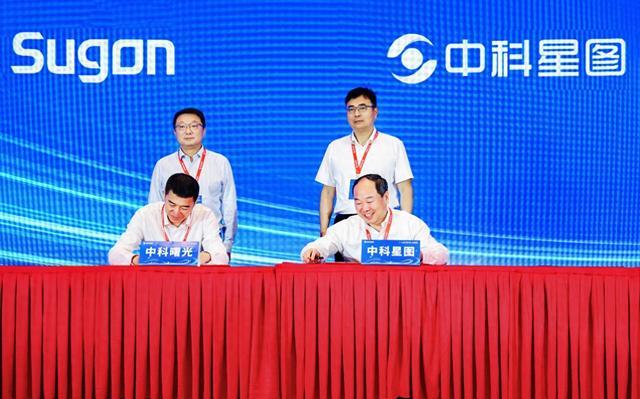
Group 1 - The conference highlighted the theme "Space and Sky Integration, Nebula Symbiosis," emphasizing that computing power is a major bottleneck in the development of China's commercial space industry [2] - Experts predict that future global satellite launch plans will reach a scale of tens of thousands, leading to significant data and computing demands due to increasing satellite payloads and resolutions [2][4] - The industry is exploring new models for space computing constellations, shifting from "ground computing" to "space computing," which aims to analyze data in space to improve timeliness [2][3] Group 2 - The harsh conditions of space, such as cosmic radiation and extreme temperatures, pose significant challenges for the reliability of core components, with the cost of equivalent computing power in space being 1000 times that on Earth [3] - Leading companies in the industry, such as Zhongke Shuguang and Zhongke Xingtou, have signed cooperation agreements to develop high-performance, low-power, and highly reliable core components for space computing [4] - The long-term applications of space computing networks are extensive, including providing high-speed internet access to remote areas and enhancing smart city capabilities [5]
应对星座激增挑战 星图测控强化太空管理布局
Zhong Guo Zheng Quan Bao· 2025-07-13 20:52
Core Insights - The importance of space management business is highlighted due to the increasing number of satellites and collision risks, particularly with the deployment of Starlink and other satellite constellations [1][2] - The company plans to enhance its space management services through integrated situational awareness, traffic management, and in-orbit services, addressing the growing demand for comprehensive space management solutions [2][3] Company Developments - The company, Xingtou Measurement and Control, has become the first "commercial aerospace stock" listed on the Beijing Stock Exchange, focusing on space management and related services [2] - In 2024, the company expects to achieve revenue of 288 million yuan, a year-on-year increase of 25.9%, and a net profit of approximately 84.97 million yuan, reflecting a growth of 35.68% [2] Industry Trends - The global aerospace industry is anticipated to diversify and advance to a higher level by 2025, driven by the maturation of aerospace technology and the increasing number of satellites in orbit [3] - The company aims to develop a large-scale computing constellation and a "cloud" solution for integrated space management, enhancing its capabilities in satellite control and traffic management [3]
RWA:真实资产走向链上世界,开启数字金融新时代
Orient Securities· 2025-07-13 14:41
Investment Rating - The report maintains a "Positive" investment rating for the computer industry, specifically focusing on Real World Assets (RWA) [4] Core Insights - RWA represents a transformative innovation in financial technology by converting real-world assets into digital assets on the blockchain, potentially leading to exponential growth in the sector [2][6] - The global RWA asset market reached $24.5 billion as of June 2025, with projections to exceed $16 trillion by 2030, indicating a significant opportunity for investment [6][18] - The report emphasizes the importance of regulatory frameworks being established globally to support the growth of RWA, with regions like Hong Kong and the EU leading the way [26][30] Summary by Sections RWA: Connecting Real World Assets to Blockchain - RWA involves the tokenization of tangible and intangible assets through blockchain technology, enhancing liquidity and reducing transaction costs [11][12] - The RWA market is rapidly expanding, with a diverse range of assets including real estate, bonds, and commodities being tokenized [15][16] RWA Issuance Process and Regulatory Framework - The RWA issuance process consists of five key steps: asset selection, legal and compliance framework establishment, technology implementation, token issuance, and ongoing management [21][23] - Various countries are developing regulatory frameworks for RWA, with Hong Kong adopting a sandbox approach to foster innovation while ensuring compliance [26][30] Expansion of Asset Classes and RWA Market - RWA assets can be categorized into cash flow, equity, and non-cash flow assets, with credit and bonds currently leading the market [35][36] - The report highlights the significant growth potential in the RWA sector, particularly in tokenized real estate and securities, which are becoming increasingly popular [46][53] RWA Industry Ecosystem - The RWA ecosystem is forming a collaborative industry chain involving asset providers, technology firms, platforms, compliance custodians, and investors [4][6] - Key players in the blockchain and fintech sectors are recommended for investment, including companies like 恒生电子 and 新国都 [2][6]



周观点:持续看好稳定币和RWA投资机会-20250713
KAIYUAN SECURITIES· 2025-07-13 12:51
Investment Rating - The industry investment rating is maintained as "Positive" [2] Core Viewpoints - The report continues to favor investment opportunities in stablecoins and Real World Assets (RWA), emphasizing the potential for the development of RMB stablecoins to enhance the global influence of the RMB [6][12] - The implementation of the Hong Kong Stablecoin Regulation on August 1, 2025, will require licenses for issuing stablecoins, which is seen as a key entry point for traditional banks and fintech companies [7][13] - The market for stablecoins is rapidly expanding from cryptocurrency trading to broader payment applications, with significant growth in market size and trading activity anticipated [8][14] Summary by Sections Weekly Perspective - The report highlights the ongoing positive outlook for stablecoins and RWA investment opportunities, suggesting a combined development model for domestic and offshore RMB stablecoins [6][12] - The report notes that the Hong Kong Stablecoin Regulation will officially take effect on August 1, 2025, requiring licenses for stablecoin issuance, which will impact market dynamics [7][13] Company Dynamics - Companies such as iFlytek are forecasting a revenue increase of 15%-20% for the first half of 2025, while other firms like Rui Ming Technology expect a net profit increase of 53.64% to 77.90% [17] - Strategic collaborations are being formed, such as the partnership between Zhongke Xingtou and Zhongke Shuguang to advance technology in the space sector [22] Industry Dynamics - The report mentions that the AI unicorn Zhipu AI is preparing for simultaneous listings in Hong Kong and A-shares, indicating strong market interest [27] - Amazon is considering a significant investment in AI startup Anthropic, which reflects ongoing trends in the AI sector [30]


上证国新科创板国企指数上涨1.21%,前十大权重包含华海清科等
Sou Hu Cai Jing· 2025-07-13 03:27
Core Points - The Shanghai Stock Exchange National New Sci-Tech Board State-Owned Enterprises Index (950253) rose by 1.21% to 1012.44 points with a trading volume of 18.658 billion yuan [1] - Over the past month, the index has increased by 3.52%, by 5.74% over the last three months, and by 2.83% year-to-date [1] - The index reflects the overall performance of state-owned enterprises listed on the Sci-Tech Board, selected from companies with state capital participation and no actual controllers, with a base date of December 30, 2022, set at 1000.0 points [1] Index Composition - The top ten weighted stocks in the index are: Huahai Qingke (5.81%), Huaron Micro (5.17%), SMIC (5.07%), Haiguang Information (4.9%), Western Superconducting (4.84%), Huahong Semiconductor (4.74%), Zhongwei Company (4.6%), Guodun Quantum (3.44%), Jinghe Integrated (3.42%), and Zhongke Xingtu (3.06%) [1] - The index is fully composed of stocks listed on the Shanghai Stock Exchange, with a 100% market share [1] Sector Allocation - The sector allocation of the index shows that Information Technology accounts for 54.87%, Industry for 28.74%, Materials for 8.96%, Communication Services for 5.06%, and Healthcare for 2.37% [1]

智元启动「买买买」,路径未明,资本抢跑,主流技术范式下谁在领跑具身智能赛道?
机器之心· 2025-07-12 01:33
Core Viewpoint - The acquisition of 2.1 billion yuan by Zhiyuan Robotics of Shuangwei New Materials marks the first listing of a "embodied intelligence concept" company in the A-share market, indicating a significant shift in the capital landscape of the industry before large-scale commercial deployment has occurred [1]. Group 1: Evolution of Embodied Intelligence Players - The industry is witnessing a divergence in paths among embodied intelligence companies, with many opting for a "self-developed ontology + customized model" approach [2]. - Companies are exploring various system architectures, including end-to-end large model systems and dual-system architectures, to enhance the complexity and generalization capabilities of intelligent agents [4]. - The end-to-end large model approach aims to unify visual, language, and action modules into a single system, reducing processing complexity and emphasizing cross-task transferability and deployment efficiency [5]. - Companies like Xingdong Jiyuan, with its ERA-42 model, exemplify the end-to-end approach by integrating visual, language understanding, and action control [5]. - The dual-system architecture decouples task understanding from action execution, utilizing a large-scale Visual Language Model (VLM) for semantic modeling and strategy planning, while a lightweight Visual Language Action (VLA) module handles execution [6]. - Companies such as Figure AI and Zhongke Xingtu adopt this dual-system approach to enhance system robustness in complex task scenarios [6]. - Some companies, like Yundongchu, focus on hardware innovations, such as hybrid wheeled and legged systems, to improve adaptability to complex terrains [7]. - The differentiation in these technical paths influences data collection and training strategies, as well as the collaboration between ontology and intelligent agents, affecting market deployment and business model development [8]. Group 2: Leading Companies in Mainstream Technology Paradigms - The technical routes taken by companies reflect their strategic expressions, with variations in data systems and ontology solutions being significant factors in their market positioning [9].


让算力“飞上天”,中科曙光与中科星图如何“编织”普惠太空算网?
Huan Qiu Wang Zi Xun· 2025-07-11 10:20
Core Viewpoint - The collaboration between Zhongke Shuguang and Zhongke Xingtou aims to innovate and apply space computing technology, addressing the challenges of traditional data processing methods in the context of increasing satellite data demands [1][3][5]. Group 1: Industry Growth and Challenges - China's commercial aerospace industry is experiencing rapid growth, with projected output increasing from 1 trillion yuan in 2020 to approximately 2.3 trillion yuan by 2024, reflecting a compound annual growth rate of 22.9% [3]. - The traditional "ground computing" model is becoming inadequate due to the increasing volume of satellite data and the limitations of data transmission methods, which face bandwidth and latency issues [3][4]. - The cost of deploying computing power in space is estimated to increase by 1000 times compared to ground deployment, necessitating the development of high-performance components specifically designed for space [4]. Group 2: Innovations in Space Computing - The emerging "space computing" model involves building a space computing constellation that processes satellite data using AI before transmission, thus overcoming traditional data transfer limitations [5]. - Zhongke Shuguang and Zhongke Xingtou plan to create a collaborative ecosystem for space computing, focusing on high-performance, low-power components and a comprehensive technology innovation chain [5]. - The collaboration aims to establish an integrated computing architecture that connects users, satellite edge computing, and ground-based cloud services, facilitating real-time data processing and resource sharing [5]. Group 3: Applications and Global Impact - The partnership is set to enhance various industries by providing space computing services, with applications extending to emergency rescue, meteorology, agriculture, and emerging fields like low-altitude airspace management [6]. - The goal is to offer accessible space computing services globally, bridging the gap in computational resources and promoting the sharing of space information across nations and industries [6][7].