大疆

Search documents
板块回调下坚定看好明年有望迎来端侧AI大年
Tianfeng Securities· 2025-10-13 05:36
Investment Rating - The industry rating is "Outperform" (maintained rating) [9] Core Viewpoints - The report is optimistic about the upcoming year, anticipating a significant growth year for edge AI, particularly with the emergence of AI glasses as a key product form and flow entry point [1][16] - Apple is expected to launch its first smart glasses in 2026, with leadership changes potentially enhancing hardware and AI integration innovation [2][18] - Meta's AI glasses have seen sales growth exceeding expectations, indicating strong market demand and potential for further product launches [3][19][21] - OpenAI is developing a series of edge AI devices, with a focus on consumer electronics supply chain opportunities [4][24] Summary by Sections Edge AI - Edge AI is gaining traction with significant policy support and leading companies driving innovation in new products [1][16] - Apple is restructuring its product lineup with the iPhone 17 series and is expected to enter the foldable phone market in 2026, which could catalyze industry growth [2][16] - Meta's Ray-Ban smart glasses have seen a sales increase of over 200% year-on-year, with potential shipments reaching 4-5 million units in 2025 [3][19] - Rokid's smart glasses are being utilized by local police for vehicle identification, showcasing practical applications of AI glasses [5][22] - DJI has adjusted pricing for its Osmo Pocket 3, indicating preparation for the launch of a new generation product [5][23] - OpenAI is working on various edge AI devices, including a screenless smart speaker, with a target release by the end of 2026 or early 2027 [4][24] - Luxshare Precision is showcasing its leadership in AR technology with multiple product launches and innovations in optical interconnect solutions [4][25][29] Cloud AI - The report highlights the strong growth potential in the cloud AI sector, driven by domestic computing power and supply-demand dynamics [6][31] - OpenAI's developer conference showcased significant growth in user engagement and revolutionary technology releases, reshaping AI interaction [6][31] - OpenAI has introduced ChatGPT Pulse, enhancing user experience through personalized updates based on interactions [6][38] - Alibaba's cloud conference emphasized the future of AI and its role in creating a new generation of computing platforms [6][39][41] Investment Opportunities - The report suggests focusing on leading companies in the consumer electronics supply chain, including Luxshare Precision, as they are well-positioned to benefit from the growth in edge AI and related technologies [7][9]



首次支持车载移动部署!大疆新品“大疆机场3”亮相国际消防展
Xin Lang Ke Ji· 2025-10-13 03:00
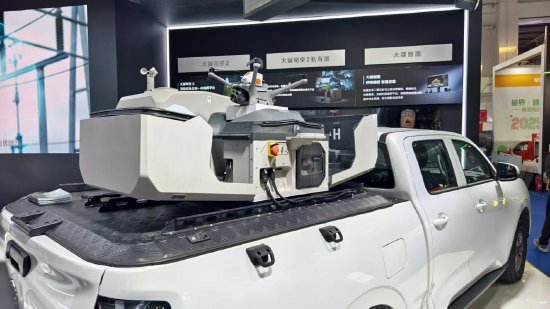
Group 1 - The core product showcased by DJI at the 21st China International Fire Safety Exhibition is the "DJI Airport 3," designed for various scenarios including fire detection and security inspections [1] - The DJI Airport 3 operates in a temperature range of -30℃ to 50℃ and features an IP56 protection level, while the accompanying Matrice 4D/4TD drone has an IP55 rating, making it suitable for harsh weather conditions [1] - The drone is equipped with silent anti-icing propellers, allowing it to operate in freezing rain and withstand wind speeds of up to 12 meters per second, with a maximum hover time of 32 minutes [1] Group 2 - The DJI Airport 3 supports fixed-point deployment and features a new D-RTK 3 relay station for flexible site selection, as well as mobile deployment capabilities for enhanced operational mobility [1] - The system includes AES-256 video transmission encryption and options for private deployment, catering to different organizations' data security and management needs [2] - The starting price for the DJI Airport 3 is set at 117,999 yuan, and it has already established collaborations with multiple local fire departments [2]

大疆最强竞争对手拟赴港IPO!
Zheng Quan Shi Bao· 2025-10-12 14:41
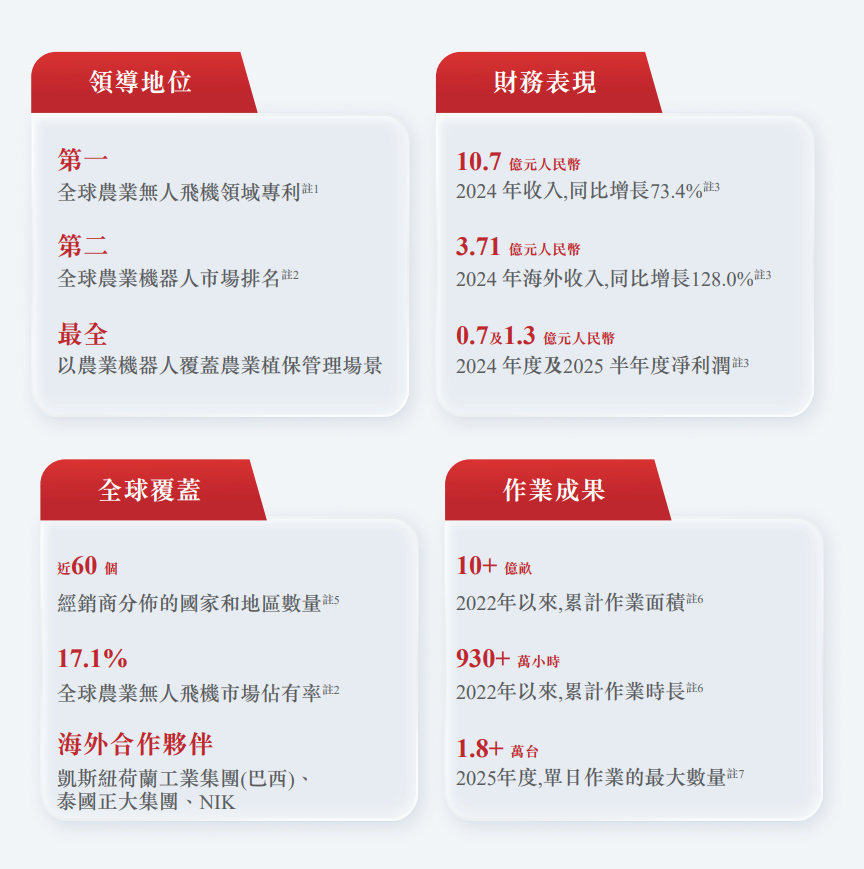
Core Viewpoint - XAG Technology, a leading agricultural robotics company and a strong competitor to DJI, has officially submitted its listing application to the Hong Kong Stock Exchange, aiming to leverage international platforms for funding and global investor outreach [1][3]. Company Overview - XAG Technology was founded by a group of technology enthusiasts and has grown to become one of the top two agricultural robotics and drone companies globally [1]. - The company previously attempted to list on the Shanghai Stock Exchange's Sci-Tech Innovation Board in November 2021 but withdrew its application in May 2022 due to market conditions and strategic planning [1]. Market Position - According to Frost & Sullivan, XAG Technology holds a market share of 10.7% in the global agricultural robotics sector and 17.1% in the agricultural drone industry, ranking second in both categories [3][7]. - In China, XAG Technology's market share is 20.8%, also placing it second in the agricultural drone market [9]. Product Development - XAG Technology has expanded its product matrix to include agricultural unmanned vehicles, autonomous farming devices, and smart IoT solutions for farms, enhancing its capabilities in precision agriculture [6]. - The company has developed mobile applications for remote operation and real-time monitoring of its agricultural robots, creating a comprehensive solution for unmanned agricultural practices [6]. Financial Performance - XAG Technology's revenue increased from RMB 604.54 million in 2022 to RMB 614.50 million in 2023, with a projected growth to RMB 1.07 billion in 2024, marking a 73.4% increase [12]. - The company recorded a net loss of RMB 254.19 million in 2022, which narrowed to RMB 132.67 million in 2023, and is expected to achieve a net profit of RMB 70.41 million in 2024 [13]. Leadership and Shareholding - The founder and CEO, Peng Bin, has a significant influence on the company, holding 29.01% of the voting rights directly and an additional 13.95% through a controlled entity [16][18]. - Notable investors include SoftBank Vision Fund, which holds 12.86%, and other prominent firms such as Innovation Works and Baidu-related Baishan Investment [17]. Future Plans - The funds raised from the IPO will primarily be allocated to the research and development of agricultural robotics and the expansion of the global sales and service network [18].
大疆最强竞争对手拟赴港IPO!
证券时报· 2025-10-12 14:36
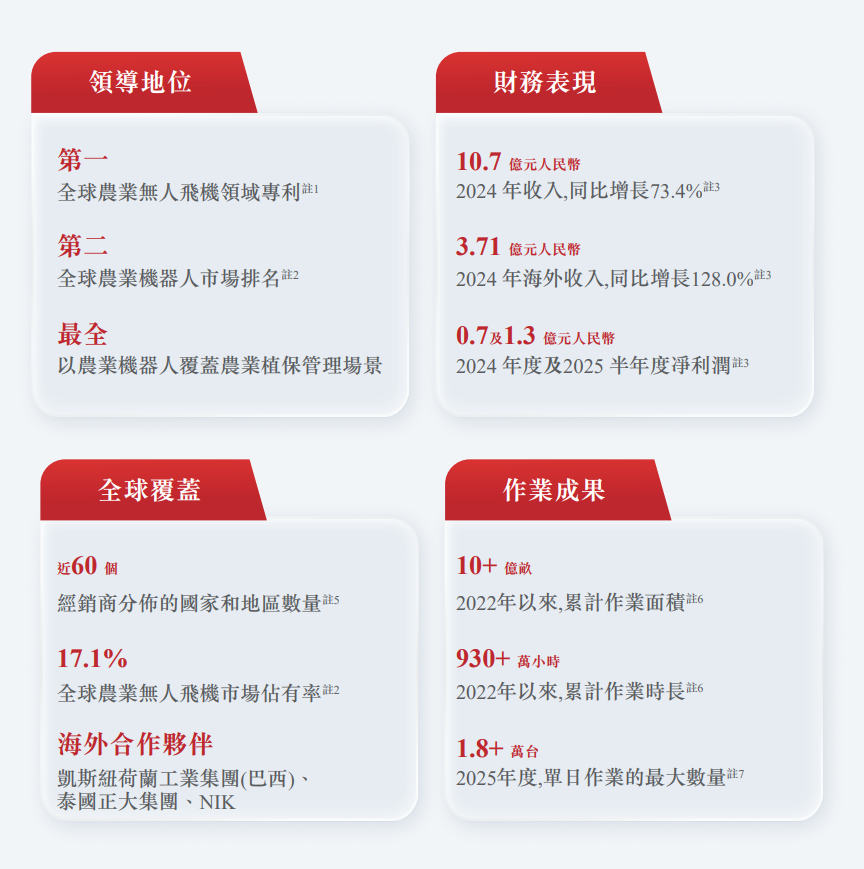
Core Viewpoint - The article discusses the recent filing of XAG Technology, a leading agricultural robotics company, for an IPO on the Hong Kong Stock Exchange, highlighting its growth, market position, and strategic plans for international expansion [1][3]. Company Overview - XAG Technology, founded by a group of technology enthusiasts, has become one of the top two companies globally in the agricultural robotics and drone industry, focusing on enhancing agricultural productivity [1][3]. - The company previously attempted to list on the Shanghai Stock Exchange in 2021 but withdrew its application due to market conditions and strategic planning [1]. Market Position - According to Frost & Sullivan, XAG Technology holds a market share of 10.7% in the global agricultural robotics sector and 17.1% in the agricultural drone market, ranking second worldwide [3][7]. - In China, XAG Technology's market share in the agricultural drone sector is 20.8%, also placing it second, but significantly behind DJI, which has a market share of 63.9% [9][11]. Financial Performance - XAG Technology's revenue increased from RMB 604.54 million in 2022 to RMB 614.50 million in 2023, and is projected to rise by 73.4% to RMB 1.065 billion in 2024 [12]. - The company recorded a net loss of RMB 254.19 million in 2022, which narrowed to RMB 132.67 million in 2023, and is expected to achieve a net profit of RMB 70.41 million in 2024 [13]. Product Development - The company has expanded its product offerings to include agricultural unmanned vehicles, autonomous farming devices, and smart farm IoT products, enhancing its capabilities in precision agriculture [6]. - XAG Technology has developed mobile applications for remote operation and real-time monitoring of its agricultural robots, creating a comprehensive product matrix and data loop for users [6]. Leadership and Shareholding - The founder and CEO, Peng Bin, has a background in technology and has been instrumental in the company's development since its inception in 2007 [15][16]. - The company has notable investors, including SoftBank Vision Fund, which holds 12.86% of the shares, and several other prominent investment firms [16][17].

大疆最强竞争对手拟赴港IPO!多家明星机构隐身其后
Zheng Quan Shi Bao Wang· 2025-10-12 11:05
Core Viewpoint - XAG Technology, a leading agricultural robotics company and a strong competitor to DJI, has officially submitted its listing application to the Hong Kong Stock Exchange, aiming to leverage international platforms for funding and global investor outreach [1][2]. Company Overview - XAG Technology was founded by a group of technology enthusiasts and has grown to become one of the top two companies globally in the agricultural robotics and drone sector [1]. - The company aims to enhance agricultural productivity through advanced robotics, smart technology, and renewable energy solutions, addressing the significant challenge of "unmanned farming" [2][5]. Market Position - According to Frost & Sullivan, XAG Technology holds a market share of 10.7% in the global agricultural robotics sector and 17.1% in the agricultural drone market, ranking second in both categories [2][6]. - In China, XAG Technology's market share in the agricultural drone industry is 20.8%, also placing it second, but significantly behind DJI, which has a market share over three times larger [10]. Financial Performance - XAG Technology's revenue increased from RMB 604.54 million in 2022 to RMB 614.50 million in 2023, and is projected to rise by 73.4% to RMB 1.065 billion in 2024 [11]. - The company recorded a net loss of RMB 254.19 million in 2022, which narrowed to RMB 132.67 million in 2023, and is expected to achieve a net profit of RMB 70.41 million in 2024 [12]. Product Development - Over the past 18 years, XAG Technology has expanded its product offerings to include agricultural drones, autonomous vehicles, and smart farm IoT products, creating a comprehensive agricultural robotics product matrix [5]. - The company has developed mobile applications for remote operation and real-time monitoring of its agricultural robots, enhancing user experience and operational efficiency [5]. Leadership and Shareholding - The founder and CEO, Peng Bin, has a background in technology and has been instrumental in the company's growth and innovation in the agricultural sector [13][14]. - XAG Technology has attracted significant investment from notable shareholders, including SoftBank Vision Fund, which holds 12.86% of the company [15]. Future Plans - The funds raised from the IPO will primarily be allocated to the research and development of agricultural robotics products and the expansion of the global sales and service network [16].
大疆VS影石,天才的烦恼
3 6 Ke· 2025-10-12 10:21
Core Insights - DJI has significantly reduced prices on various products, including the Mini 4 PRO drone, which saw a price drop of 1,478 yuan, amidst competition with Insta360 [1][2] - The competition between DJI and Insta360 represents a strategic battle between two leading tech companies in China, both facing growth challenges as their respective markets approach saturation [1][14] Group 1: Market Dynamics - DJI holds over 70% of the global drone market and has increased its market share to 85% by 2020, while Insta360 has dominated the panoramic camera market with a 67.2% share since 2019 [1][4] - The price competition is intensified as DJI aims to enter the action camera market, while Insta360 is venturing into the drone sector, challenging DJI's core business [10][12] Group 2: Competitive Strategies - DJI's strategy includes expanding its product line to include action cameras, with the Osmo 360 being a direct competitor to Insta360's X5, which led to price adjustments from both companies [7][8] - Insta360's entry into the drone market with the Antigravity A1 aims to leverage its existing technology and market presence, while DJI's focus on action cameras is seen as a move to diversify its revenue streams [9][10] Group 3: Growth Challenges - Both companies are facing growth limitations; DJI's revenue from consumer drones is projected to plateau at around 200 billion yuan, while the global panoramic camera market is relatively small, valued at 50.3 billion yuan in 2023 [14][16] - The saturation of the drone market and the limited growth potential in the panoramic camera sector are prompting both companies to seek new growth avenues by encroaching on each other's markets [14][17]
山姆被吐槽“吃相太难看”
盐财经· 2025-10-12 09:53
Core Viewpoint - DJI has launched a significant price reduction for multiple products, which has sparked controversy due to differing price protection policies between online and offline purchasing channels [2][6]. Group 1: Price Reduction and Consumer Reactions - On October 8, DJI announced a major promotional event with substantial price cuts on various products [2]. - Consumers who purchased DJI products at Sam's Club expressed dissatisfaction after being denied price protection or refunds following the price drop [6][8]. - A specific case involved a consumer who bought the DJI Pocket 3 for ¥3519 on September 17, only to find it reduced by ¥660 shortly after, leading to frustration over the lack of price protection [6][8]. Group 2: Sam's Club Response - In response to the backlash, Sam's Club stated that they are actively communicating with the brand to ensure member rights are protected and have developed a compensation plan for affected members [15]. - Members who purchased the discounted products between October 2 and 8 can claim special compensation by presenting their purchase receipts at Sam's Club by October 31 [15].
谁将是下一个劈开海外万亿市场的中国黑马?
Hu Xiu· 2025-10-12 08:19
Core Insights - The narrative of Chinese companies going global has evolved significantly, moving from being silent manufacturers to active players in the global market [1][3][26] - In the first half of 2025, Chinese overseas mergers and acquisitions surged by 79% to $19.6 billion, while new contracts for foreign engineering projects increased by 12.4% to $129.9 billion, indicating a robust expansion of Chinese enterprises abroad [2] Historical Phases of Chinese Companies Going Global - **Phase 1: "Manufacturing Outbound" Era** This period is characterized by OEM/ODM models where Chinese companies lacked brand ownership and consumer engagement, relying solely on low-cost labor and large production capacity [5][6][7][8] - **Phase 2: "Brand Outbound" Awakening Era** Triggered by the global financial crisis, this phase saw Chinese companies realizing the importance of branding. They began to innovate and offer products that could compete with international brands, exemplified by companies like Huawei and Xiaomi [9][10][11][12][15] - **Phase 3: "Ecosystem Outbound" Era** The current phase focuses on creating comprehensive systems and models rather than just selling products. Companies are now looking to establish brand matrices and cultural connections, as seen with brands like Anker and Pop Mart [16][19][20][21][29] Emerging Strategies - **Category "Exploders"** These companies aim to create standout products in specific niches and replicate their success across various verticals, leveraging technology and consumer insights [17][19] - **Cultural "Alchemists"** This strategy involves modernizing and globalizing Chinese cultural elements to resonate with international audiences, creating a new aesthetic that appeals to global youth [20] - **Ecosystem "Creators"** Companies are now exporting operational efficiencies and business models developed in China to global markets, focusing on platforms and infrastructure rather than direct consumer sales [21] - **"Gold Diggers" in Emerging Markets** With increasing competition in mature markets, many Chinese firms are targeting emerging markets like Southeast Asia and Africa, leveraging their established business models and supply chain advantages [22][23][25] Conclusion - The evolution of Chinese companies from labor-intensive manufacturers to sophisticated global players reflects a significant shift in strategy and ambition. The next generation of successful companies will likely be those that can integrate into global ecosystems and redefine market standards [26][30][31]
科技周报|大疆降价引发消费者退货维权;中国移动AI投入未来三年翻番
Di Yi Cai Jing Zi Xun· 2025-10-12 07:35
Group 1: DJI Price Reduction - DJI announced a price reduction on multiple products, including a maximum drop of 900 yuan for the Pocket 3 camera and 1478 yuan for the Mini 4 PRO drone, during a promotional period from October 9 to October 14 [1] - The price adjustment has led to some consumers seeking refunds, with DJI stating that this is a regular promotional arrangement for "Double Eleven" and has communicated this through various channels [1] Group 2: China Mobile's AI Investment - China Mobile plans to double its overall investment in the AI sector by the end of 2028, aiming to build the largest intelligent computing infrastructure in the country [2] - The initiative includes the exploration of a 100,000-card intelligent computing cluster, with expectations for the national intelligent computing scale to exceed 100 EFLOPS [2] Group 3: Vivo's AI Strategy Upgrade - Vivo unveiled its upgraded AI strategy, which includes the launch of the Blue Heart intelligent strategy and a new multimodal reasoning model with 128K long context processing capabilities [3] - The shift towards low-power models indicates a move away from the costly pursuit of "general artificial intelligence" towards more applicable edge AI solutions [3] Group 4: Qualcomm Investigation - The State Administration for Market Regulation of China has launched an investigation into Qualcomm for allegedly failing to legally declare its acquisition of Autotalks, which may violate antitrust laws [4] - Following the news, Qualcomm's stock fell by 7.29% on October 10, reflecting market concerns over regulatory scrutiny [4] Group 5: Intel's 1.8nm Chip - Intel has introduced the Panther Lake processor, the first chip built on the 1.8nm process node, which is now in production and expected to enter mass production later this year [5][6] - The success of this advanced manufacturing process is crucial for Intel to regain competitiveness in the semiconductor market [6] Group 6: ByteDance's Zhang Yiming Public Appearance - Zhang Yiming, founder of ByteDance, publicly launched the Shanghai Xuhui Zhichun Innovation Center, aimed at nurturing young talent in computer science and AI [7] - The center focuses on fostering independent thinking and practical learning among students, addressing the underutilization of talent potential [7] Group 7: Monster Charging's Privatization Offer - Monster Charging's board rejected a high-priced privatization offer from Hillhouse Capital, opting to continue with a previously agreed plan with a consortium led by CITIC Capital [8] - The initial offer from Hillhouse was 1.77 USD per ADS, approximately 40% higher than the management's existing agreement [8] Group 8: Figure AI's Third-Generation Robot - Figure AI launched its third-generation humanoid robot, Figure 03, designed for household and commercial applications, showcasing advancements in humanoid design and sensor capabilities [9] - The shift in focus from industrial applications to home scenarios indicates Figure's strategy to enhance its market value [9] Group 9: Changxin Technology's IPO Guidance Completion - Changxin Technology has completed its IPO guidance, moving closer to listing, with a current market share of 6% in the DRAM sector, expected to grow to 7.5% by Q4 [10][11] - The company is positioned as a key player in the domestic DRAM market, which is currently dominated by foreign manufacturers [11] Group 10: New Kailai's Upcoming Exhibition - New Kailai Technology will showcase its innovations at the Bay Area Semiconductor Chip Exhibition from October 15 to 17, highlighting its advancements in semiconductor equipment [12] - The company aims to attract attention following its successful display at a previous semiconductor equipment exhibition [12]

智谱否认上市前裁员:近50个岗位待招;张一鸣久违露面:有的人才创新能力不足;Sora推安卓版,OpenAI年烧70亿刀|AI周报
AI前线· 2025-10-12 05:32
Core Insights - The article discusses various developments in the tech and AI sectors, highlighting significant corporate actions, product launches, and market trends. Group 1: Company Developments - Zhipu Technology denies rumors of layoffs before its IPO, stating a demand for nearly 50 positions is still open [3] - Alibaba is entering the embodied intelligence space, forming a team led by the head of its large language model technology [4] - ByteDance initiates a new round of stock option buybacks, with prices for current employees rising by 5.5% and for former employees by 11.7% [5][6] - OpenAI's annual expenditure reaches $7 billion, primarily for cloud computing resources from Microsoft [8][10] - Intel's layoffs impact numerous Linux open-source projects, leading to many being abandoned [11] - Honor's executive faces backlash for controversial comments, prompting calls for CEO intervention [12] - A Chilean company is unable to reclaim mistakenly overpaid wages to an employee, resulting in a court ruling against them [13] - The U.S. Walmart lists the Yushun G1 humanoid robot at a 55% premium compared to its price in China [14] - Apple CEO Tim Cook may step down, with hardware engineering VP John Ternus as a potential successor [17] Group 2: Market Trends and Innovations - OpenAI signs a $1 trillion cloud computing partnership, enhancing its AI model capabilities [10] - Google unveils a new AI model, Gemini 2.5, designed for user interface interactions [27] - Ant Group releases a trillion-parameter language model, Ling-1T, which shows superior performance in various benchmarks [28] - Huawei introduces a new open-source quantization technology, SINQ, significantly reducing memory usage for large language models [29] - Cloud Deep Technology launches the world's first all-weather humanoid robot, DR02, designed for outdoor operations [30] - Google Cloud launches Gemini Enterprise, an AI platform aimed at automating tasks for employees [32]