库卡

Search documents
50万-80万一台!第一批人形机器人“进厂”了
2 1 Shi Ji Jing Ji Bao Dao· 2025-05-30 10:16
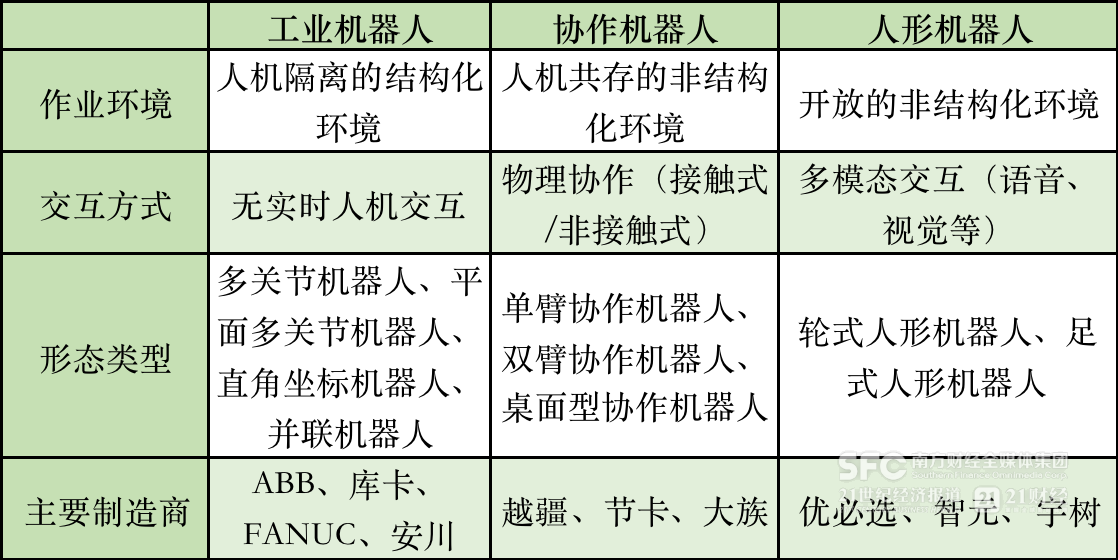
Group 1 - The core viewpoint of the articles is that humanoid robots are beginning to enter factories to perform tasks traditionally done by human workers, marking a shift in their application from research and education to industrial settings [1][5][6] - Major companies like Midea and Xiaopeng are actively developing and deploying humanoid robots for various tasks in manufacturing, indicating a growing trend in the industry [1][9] - Humanoid robots are designed to handle a wider range of tasks in diverse industrial environments compared to traditional industrial and collaborative robots, which are typically limited to specific functions [1][4][5] Group 2 - Humanoid robots are expected to complement existing industrial and collaborative robots by performing complex operations that require flexibility and adaptability in non-standardized environments [4][6][10] - The current limitations of humanoid robots include challenges in motion control, material recognition, and battery technology, which need to be addressed for effective industrial application [2][8] - The integration of humanoid robots into factory workflows is seen as a solution to labor shortages in traditional manufacturing roles, particularly in complex assembly tasks [5][9] Group 3 - Companies are exploring the use of humanoid robots in various tasks such as material handling, sorting, and packaging, particularly in automotive manufacturing [4][9] - The collaboration between humanoid robots and traditional robots can enhance operational efficiency, as demonstrated by successful trials in factories [7][9] - The economic feasibility of deploying humanoid robots in factories remains a concern, with current costs ranging from 500,000 to 1,000,000 yuan per unit, necessitating cost reductions for widespread adoption [11]


邓洲:人形机器人带来工业发展新机遇
Jing Ji Ri Bao· 2025-05-28 00:27
Group 1 - Humanoid robots are a product of the deep integration of artificial intelligence and robotics, with significant advancements in technology leading to more mature and affordable products [1] - The first humanoid robot half marathon held in Beijing in April has further increased the popularity of humanoid robots [1] - Humanoid robots have made breakthroughs in mechanical structure, intelligence, and bionic design, enabling them to perform complex tasks in diverse environments [1] Group 2 - Current applications of humanoid robots are primarily in service and professional roles, such as display, guidance, and companionship, while traditional industrial robots are more specialized and focused on safety, efficiency, and stability [2] - Industrial robots are designed for specific tasks on production lines, sacrificing flexibility for higher efficiency, while humanoid robots may struggle to achieve the same level of efficiency in single tasks [2][3] - The collaborative robots developed since around 2015 allow for shared workspace with humans, enhancing industrial efficiency and safety [4] Group 3 - Humanoid robots can drive the "human-machine integration" development in industrial production, breaking down physical barriers between humans and machines [4] - The intelligent perception and adaptability of humanoid robots can facilitate the upgrade of traditional industrial robots, enabling them to perform more complex tasks autonomously [5][6] - Humanoid robots can promote the mobility of industrial robots, which traditionally are fixed and less flexible, thus supporting the future of flexible and reconfigurable manufacturing [6] Group 4 - Although humanoid robots may not see widespread industrial application in the short term, they can provide valuable technologies and concepts that enhance the efficiency, flexibility, safety, and intelligence of future industrial production [7]
中国机械自动化,从“低端搬运”到工厂的“心脏”
Xin Lang Cai Jing· 2025-05-27 10:53
Group 1 - The article highlights the transformation of China's logistics and automation industry, showcasing the advanced use of robots in sorting packages during the Double Eleven shopping festival [1][3] - The scene of robots charging in an orderly manner is described, emphasizing their efficiency and social-like behavior, which impressed visiting logistics experts [3] - A historical comparison is made, illustrating the shift from manual labor in warehouses to robotic automation, marking a significant evolution in the industry [5][6] Group 2 - The article discusses the challenges faced by Chinese manufacturers in the early 2000s, including high costs of imported robots and the dominance of foreign brands in the automation market [6][8] - It details the efforts of Chinese engineers and entrepreneurs who developed domestic automation solutions, leading to significant advancements in technology and cost reduction [8][10] - The introduction of competitive products, such as AGV carts and SCARA robots, allowed Chinese companies to capture market share in lower-end segments and gradually move into higher precision manufacturing [12][14] Group 3 - By 2013, China became the largest industrial robot market, although foreign brands still held a significant market share, prompting local companies to adopt strategies to penetrate the market [12][14] - The article notes the rapid growth of the Chinese automation industry, with a notable increase in domestic robot sales and a rise in the localization rate of components [19] - The success of Chinese automation products is highlighted, with examples of their application in various industries, showcasing their competitiveness on a global scale [21][23]


机器人数据闭环:机器人线缆专家
2025-05-22 15:23
Summary of Key Points from the Conference Call Industry Overview - The conference call discusses the robotics cable industry, focusing on the demand for cables in humanoid robots and robotic dogs, with a demand ratio of approximately 3:7 for power to signal/communication cables [1][3][4]. Core Insights and Arguments - **Cable Types and Demand**: - Three main types of cables are identified: power cables (40% demand), data transmission cables, and communication cables (60% demand) [2]. - Power cables are used for connecting power sources in robotic arms, while data cables are for information transfer in automated factories [2]. - **Cable Length Requirements**: - The total cable length for Yushutech's robotic dog is estimated to be 200-300 meters, while Tesla's humanoid robot requires approximately 90 meters of cable [5][6]. - **Cable Cost and Value**: - The cost of power cables ranges from 1,000 to 2,000 yuan per meter, while the cost of high-flexibility cables for joints is higher due to their specialized requirements [7][8]. - The price of industrial robot cables varies from tens to hundreds of yuan [9]. - **Performance and Durability**: - Current cables can withstand bending tests of 5 to 10 million cycles, with the highest in the industry reaching 20 million cycles [9][11]. - High-frequency transmission and flexibility are crucial for humanoid and special robots, requiring millisecond or microsecond synchronization [10]. - **Future Trends**: - The future of robotics cables is expected to focus on signal transmission, with integrated designs potentially replacing traditional cables [16]. - Companies in the military or automotive supply chains are better positioned to produce integrated cables due to their technical expertise [17]. Additional Important Insights - **Material Innovations**: - Lightweight materials are essential for future robots, with advanced materials like nylon costing tens of thousands per ton [18]. - The use of high-performance polymer materials is critical for enhancing cable stability and durability [19]. - **Market Competition**: - Domestic suppliers like Qifan, Hualing, and Xinya are noted for their competitive advantages in different fields, with a general trend of decreasing prices due to market competition [11]. - **Emerging Technologies**: - The development of new materials, such as TPU for insulation, is being pursued, which could disrupt traditional material usage [22]. - **Supplier Landscape**: - Major domestic suppliers include Hengtong, Jinbei, Qifan, and Xinya, each with specific strengths in various cable types [21]. This summary encapsulates the key points discussed in the conference call, providing insights into the robotics cable industry, its current state, and future trends.
在投融资上“连接全球”!广东机器人产业跑出“国际化”新速度
Zheng Quan Shi Bao Wang· 2025-05-21 15:40
5月21日,2025全球智能机器人发展大会在广州白云国际会议中心召开。广东省机器人协会会长孙志强 表示:"当前,智能机器人产业已经成为全球科技竞争与产业变革的关键领域,是引领未来发展的重要 引擎,在以前所未有的速度和广度改变着我们的生活。" 记者在现场观察到,"国际化"目前已经成为广东机器人产业发展的关键词。在本届大会上,美国、日 本、新加坡、马来西亚、韩国、以色列、芬兰等30个国家的顶尖行业组织汇聚一堂。在本次大会上,国 际机器人组织联盟投融资专委会揭牌成立,将以国际化视野助推中国机器人产业加速奔跑。 以国际化视野,孵化优秀机器人企业 新成立的国际机器人组织联盟投融资专委会有怎样特点?广东省机器人协会执行会长任玉桐接受证券时 报记者采访时表示,这个专委会是一个国际性的组织,由广东省机器人协会负责组建,国际机器人组织 联盟的成员共同参与。 据了解,广东省机器人协会成立于2015年5月,是国内最具影响力机器人行业协会之一。目前,该协会 拥有包括瑞松、广州数控、视源、研祥、格力、华数、金大、科大讯飞、发那科、库卡等国内外龙头企 业在内800多家核心会员企业。 广东省工业和信息化厅数据显示,从2019年到2024年 ...
中国工业自动化与机器人行业:需求回暖,国产替代加速突围
Zhi Tong Cai Jing· 2025-05-14 01:20
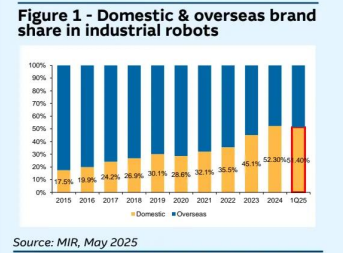
Group 1: Market Overview - In Q1 2025, China's industrial robot and automation market showed significant resilience, with demand recovering in sectors such as automotive, semiconductors, and lithium batteries, leading to a "quantity and quality" upgrade phase [1][11] - Industrial robot sales increased by 11.6% year-on-year, ending a previous inventory destocking cycle, with collaborative robots (cobots) experiencing a remarkable 41.4% growth [1][11] - The automotive sector saw a 45.4% increase in demand, while the lithium battery industry rebounded from a -19.4% decline in 2024 to +10.5% in 2025 [3] Group 2: Competitive Landscape - Domestic manufacturers' market share slightly decreased from 52.3% in 2024 to 51.4% in Q1 2025, but leading companies like Estun (9.9%) and Inovance (8.9%) continued to perform well [1][11] - Foreign brands like Fanuc (10.1%) maintained their lead, while companies like KUKA and ABB adjusted pricing strategies to expand their market share [1] Group 3: Future Outlook - Despite a projected slowdown in industrial robot growth to 6.3% in 2025 due to intensified competition, growth is expected to rebound to 11.2% and 12.2% in 2026 and 2027, respectively [3] - The pressure from price wars is anticipated to ease as foreign brands raise average prices to maintain profits, allowing domestic manufacturers to leverage their advantages in customization and delivery speed [3][12] Group 4: Automation Sector Insights - The industrial automation demand grew by 2.4% year-on-year in Q1 2025, ending a four-quarter decline, driven by the OEM market in packaging machinery and lithium battery equipment [5] - In the servo and inverter markets, Inovance maintained a leading position with a market share of 31.4% in servo systems and 20.8% in inverters, significantly outperforming foreign brands [7] Group 5: Key Component Developments - The domestic market share of RV reducers surpassed 60% for the first time, breaking the long-standing monopoly of Japan's Nabtesco, with a 9.7% year-on-year growth in demand [8][10] - Domestic manufacturers are expected to increase their RV reducer market share to over 70% by 2028, driven by cost advantages and technological advancements [10] Group 6: Investment Opportunities - Companies like Inovance and Shuanghuan are positioned to benefit from the industry's recovery and the trend of domestic substitution, with collaborative robots and new energy equipment identified as future growth engines [11] - The overall trend of intelligent upgrades in China's manufacturing sector is seen as irreversible, with domestic firms transitioning from "substitution" to "leadership," presenting long-term investment value [11]
电力设备产业周跟踪:山东首发136号文细则,隆基签约BC大单
Huafu Securities· 2025-05-11 10:49
Investment Rating - The industry rating is "Outperform the Market" [5][61]. Core Views - The lithium battery sector is focusing on the upcoming CIBF battery exhibition, with attention on solid-state battery technologies [2][9]. - In the photovoltaic sector, Longi Green Energy has signed a strategic cooperation agreement for over 1GW of BC components, marking the entry into the global BC era [3][19]. - The energy storage sector has seen a drop in the average price of 2-hour storage systems below 0.6 yuan, with a total bidding scale of 10.2GW/30.2GWh in April [3][30]. - The power equipment and industrial control sector has announced a bidding result of 5.468 billion yuan for distribution network equipment [4][38]. - The hydrogen energy sector is experiencing a long-term decline in production-side hydrogen price index, with supportive policies introduced in Henan province [4][49]. Summary by Sections 1. New Energy Vehicles and Lithium Battery Sector - The CIBF 2025 will showcase the latest battery technologies, including solid-state batteries [9]. - The penetration rate of new energy commercial vehicles has reached 20%, with significant product releases from battery companies [10]. - Companies with cost advantages and those leading in fast-charging and high-voltage technologies are recommended for investment [11][12]. 2. New Energy Generation Sector - Longi Green Energy's agreement for over 1GW of Hi-MO 9 components signifies a shift towards high-efficiency BC technology [19][20]. - The solar industry is facing price declines across various segments, including polysilicon and modules, with expectations of continued downward pressure [21][25]. - Investment suggestions include companies benefiting from demand surges and those with price elasticity in the battery segment [26][27]. 3. Energy Storage Sector - The average price of 2-hour storage systems has decreased to 0.589 yuan/Wh, with strong bidding activity in various provinces [30][31]. - The introduction of the 136 document in Shandong province indicates a shift in energy storage policy, allowing for market participation without mandatory storage [32][35]. - Investment recommendations focus on quality storage integration companies and those benefiting from the growth of energy storage systems [34]. 4. Power Equipment and Industrial Control Sector - The total bidding amount for distribution network equipment reached 5.468 billion yuan, indicating robust demand [38][39]. - The completion of the ±800 kV UHVDC project will enhance green energy transmission in Shandong [40]. - Investment opportunities are identified in companies benefiting from overseas expansion and digital power grid developments [44]. 5. Hydrogen Energy Sector - The national hydrogen price index is on a long-term downward trend, with new standards for proton exchange membranes being implemented [49][50]. - Policies supporting hydrogen energy development have been introduced in Henan province, with significant projects underway [50][51]. - Investment suggestions include companies involved in green hydrogen production and fuel cell systems [51].
海尔 vs TCL:谁能“拿下”ABB机器人?
Sou Hu Cai Jing· 2025-05-09 04:32
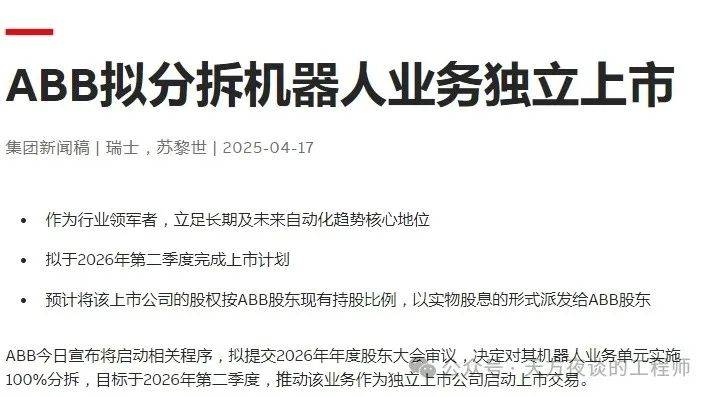
Core Viewpoint - ABB announced the spin-off of its robotics business, which generates annual revenue of $2.3 billion and an operating profit margin of 12.1% [1] Group 1: ABB's Robotics Business - The robotics division includes products such as multi-joint robotic arms, collaborative robots, and intelligent control systems, widely used in automotive manufacturing, electronics assembly, and logistics sorting [1] - The global installed base of ABB's robotics products exceeds 500,000 units, known for high precision, strong stability, and modular design [1] Group 2: Potential Acquirers - Midea Group successfully acquired KUKA Robotics in 2016, and similar companies like Haier and TCL have the potential motivation and capability to acquire ABB's robotics business [3] - Haier has accelerated its industrial automation layout through acquisitions, including a 26.83% stake in the domestic leader Xinjida, with a transaction amount exceeding 3 billion yuan [4] - TCL has invested in smart robotics technology companies through its industrial investment fund, indicating a focus on the upstream of the industry chain [5] Group 3: Strategic Analysis - Haier's experience in vertical integration and capital operations positions it favorably for acquiring ABB's robotics business, leveraging its COSMOPlat industrial internet platform for deep collaboration [4] - TCL lacks an existing robotics business framework, which may require more reliance on external integration capabilities if it pursues the acquisition [7] - Both Haier and TCL are large revenue-generating companies with strong financial capabilities, but Haier has more extensive experience in upstream and downstream cooperation [8] Group 4: Lessons from Midea's Acquisition - Midea's acquisition of KUKA for 29.2 billion yuan in 2016 illustrates that the value of acquiring an industrial robotics giant lies in long-term strategic benefits rather than immediate financial returns [9] - Haier could adopt Midea's model of "technology digestion + scenario expansion" if it acquires ABB's robotics business, while TCL needs to focus more on ecological collaboration [9] Group 5: External Challenges - China's push for high-end manufacturing positions industrial internet platforms and robotics technology as core focuses, with both Haier and TCL being "national team" members likely to receive policy support [10] - The potential acquisition by either company will need to navigate multi-national antitrust reviews, as seen in Midea's lengthy acquisition process of KUKA [10] Group 6: ABB's Business Independence - Post-spin-off, ABB's robotics division may prefer to maintain technological independence, which could affect integration success if the acquirer cannot provide sufficient collaborative space [11] - Haier's integration experience with Xinjida gives it an advantage, while TCL must demonstrate its cross-industry empowerment capabilities [11] Group 7: Competitive Advantage - Haier is seen as having a more significant advantage in the competition for acquiring ABB's robotics business due to its established framework and management team's familiarity with ABB's technology [12] - TCL may need to quickly address its shortcomings in the robotics industry or form a consortium with other capital to compete effectively [12]


技能人才如何赋能人工智能与机器人产业?这场双选会“大热”
Nan Fang Du Shi Bao· 2025-05-08 03:39
Group 1 - The event "Talent Gathering in the Bay Area: Smart Manufacturing Future" was held in Dongguan, showcasing Guangdong's strategic vision and practical actions in building a talent ecosystem in the AI and robotics sectors [1][2] - The offline job fair attracted 345 companies offering over 7,000 job positions, with a total of 11,000+ positions available through online and offline channels, and 4.28 million online participants [1][2] - The event was organized by the Guangdong Provincial Human Resources and Social Security Department, Dongguan Municipal Government, and Huawei Technologies, with around 2,500 participants from various sectors [1][2] Group 2 - The "Yue Craftsman" AI model was launched, marking the first AI model specifically designed for vocational schools in China, integrating AI technology into vocational education and skill training [2][3] - The model aims to create a comprehensive intelligent system covering recruitment, teaching, training, and employment, optimizing learning paths based on individual student data [2][3] Group 3 - Guangdong has 148 vocational schools with approximately 667,000 students, including 63 schools offering industrial robotics programs and 17 schools offering AI programs, contributing to the development of high-quality skilled talent [3][5] - The event featured 18 vocational schools showcasing innovative achievements in training talent for the AI and robotics industries, with several cooperation agreements signed between schools and leading companies [4][5] Group 4 - The dual selection event utilized a "1-day offline + 2-week online" model, facilitating a multi-dimensional platform for matching technical talent with high-quality job opportunities [6][7] - Over 600 companies from various sectors participated in the job fair, providing a wide range of employment opportunities and signaling a positive outlook for skilled talent in Guangdong [6][7] Group 5 - Guangdong's vocational schools supply over 170,000 skilled workers annually, with a total skilled workforce of 20.93 million, including 7.68 million high-skilled workers, supporting the province's high-quality development [7]

美的集团2025年一季报:海外电商大涨50%“第二主场”加速引爆
Sou Hu Cai Jing· 2025-05-01 04:10
Core Insights - Midea Group's Q1 2025 financial report shows total revenue of 128.4 billion yuan, a year-on-year increase of 20.6%, and a net profit of 12.4 billion yuan, up 38.0% year-on-year, indicating strong internal competitive strength [3][4] - The company is focusing on a "global breakthrough" strategy, with overseas e-commerce sales growing over 50% year-on-year and overseas revenue accounting for over 40% of total revenue, exceeding 20 billion USD [3][4] - Midea's global expansion strategy includes enhancing local operations through R&D, manufacturing, and marketing, with a goal to establish a "second home market" [4][9] Financial Performance - Midea Group reported a total revenue of 128.4 billion yuan in Q1 2025, reflecting a 20.6% increase compared to the previous year [3] - The net profit for the same period was 12.4 billion yuan, marking a 38.0% year-on-year growth, with a net profit margin of 9.9%, up 1.4 percentage points [3] - Overseas revenue reached over 200 billion yuan, with a significant contribution from e-commerce channels [3][4] Global Expansion Strategy - Midea has accelerated its global expansion since 2024, focusing on various sectors including home appliances, building technology, healthcare, and energy [4][9] - The company is leveraging AI technology for localized e-commerce operations, enhancing market insights and user engagement [4][6] - Midea has established new subsidiaries in Saudi Arabia and Thailand to strengthen its market presence [6][9] Product and Market Development - Midea's overseas e-commerce sales have seen a growth of over 50% year-on-year, driven by a combination of self-developed e-commerce data systems and AI technology [4][6] - The company has successfully launched products tailored to local markets, such as the Toshiba XFS series refrigerators in Japan and various kitchen appliances in Vietnam [6][8] - Midea is also focusing on enhancing user service efficiency, achieving a 15% improvement in service response times [6] Brand Strategy - Midea is utilizing sports marketing to enhance brand recognition globally, becoming official sponsors of various sports events [8] - The company aims to promote Chinese manufacturing and innovation through its branding efforts [8] Innovation and R&D - Midea's global patent applications exceeded 150,000 by the end of 2024, with over 90,000 patents granted, supporting its high-quality international operations [13] - The company is committed to integrating technology, culture, and user needs to drive high-quality development [13]