
大成基金

Search documents
ETF基金周报丨多只科创板人工智能ETF上周涨超5%,机构:算力板块持续具备底层需求与估值支撑
2 1 Shi Ji Jing Ji Bao Dao· 2025-05-06 03:13
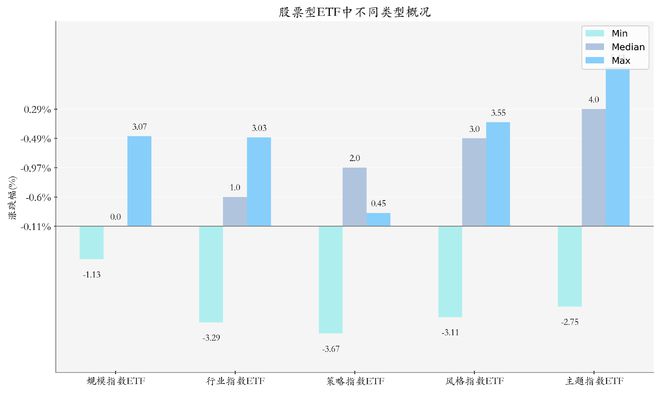
Market Overview - The Shanghai Composite Index decreased by 0.49% to 3279.03 points, with a weekly high of 3296.93 points [1] - The Shenzhen Component Index fell by 0.17% to 9899.82 points, reaching a high of 9926.9 points [1] - The ChiNext Index slightly increased by 0.04% to 1948.03 points, with a peak of 1954.62 points [1] - In global markets, major indices saw gains: Nasdaq Composite up 3.42%, Dow Jones Industrial Average up 3.0%, and S&P 500 up 2.92% [1] - In the Asia-Pacific region, the Hang Seng Index rose by 2.38% and Nikkei 225 increased by 3.15% [1] ETF Market Performance - The median weekly return for stock ETFs was -0.17% [2] - The highest weekly return among scale index ETFs was 3.07% for E Fund's SSE STAR 50 Enhanced Strategy ETF [2] - The highest return in industry index ETFs was 3.03% for Southern's CSI All Share Computer ETF [2] - The top-performing thematic ETF was GF's SSE STAR 50 Artificial Intelligence ETF, with a return of 5.43% [2][4] ETF Liquidity - Average daily trading volume for stock ETFs decreased by 11.1%, while average daily turnover fell by 7.4% [6] - The turnover rate increased by 0.45% [6] ETF Fund Flows - The top five stock ETFs by fund inflow included: - Huaxia SSE 50 ETF with an inflow of 726 million yuan - Hua Tai's CSI Dividend Low Volatility ETF with 272 million yuan - E Fund's CSI Artificial Intelligence Theme ETF with 213 million yuan [9] - The top five stock ETFs by fund outflow included: - Southern's CSI 1000 ETF with an outflow of 638 million yuan - Southern's CSI 500 ETF with 588 million yuan - Huaxia's SSE STAR 50 Component ETF with 411 million yuan [10] ETF Financing and Margin Trading - The financing balance for stock ETFs decreased from 42.8688 billion yuan to 42.1794 billion yuan [11] - The highest financing buy amount was 33.9 million yuan for Huaxia's SSE STAR 50 Component ETF [11] ETF Market Size - The total market size for ETFs reached 40,559.13 billion yuan, a decrease of 12.684 billion yuan from the previous week [14] - Stock ETFs accounted for 29,483.45 billion yuan, representing the largest category in the ETF market [14][16] ETF Issuance and Establishment - No new ETFs were issued last week, but nine new ETFs were established, including various cash flow and aerospace industry ETFs [17] Institutional Insights - Huaxi Securities noted that the computing power sector continues to have underlying demand and valuation support, with potential recovery in related sub-sectors [17] - Changjiang Securities highlighted opportunities for domestic high-end AI chip manufacturers due to strong demand and limited overseas supply [17]

港股持仓占比创2015年以来新高
Changjiang Securities· 2025-05-05 23:31
- The weighted share of active equity funds decreased by 1.93% in Q1 2025 compared to Q4 2024, with a total scale increase to 3.47 trillion yuan due to net value growth[9][41] - The top 10 active equity funds by Q1 2025 returns received a total net subscription of approximately 233 billion yuan, with two popular funds accounting for about 77.60% of the net subscription[11][14][41] - The top 10 active equity funds by Q1 2025 net subscription received a total of approximately 402 billion yuan, with the same two popular funds ranking first and second, collectively accounting for about 44.93%[18][19][41] - The median return rate for active equity funds in Q1 2025 was 9.48%[19] - In Q1 2025, the top 10 holdings of active equity funds included humanoid robots (1.37%), innovative drugs (0.93%), and Beijing Stock Exchange stocks (0.22%)[32][33][41] - Hong Kong stock holdings in the top 10 holdings of active equity funds reached 14.63% in Q1 2025, including internet stocks (5.67%), innovative drugs (1.24%), and consumer stocks (0.91%)[35][36][40][41]
A股“黄金坑”,迎来新基金发行热!4月发行规模超900亿份
Zheng Quan Shi Bao Wang· 2025-05-03 01:59
Core Viewpoint - The A-share market in April experienced significant fluctuations, leading to a "golden pit" bottoming out, with a notable influx of funds into equity funds, particularly FOF funds, which have gained popularity due to their "dumbbell" configuration advantage [1][2]. Fund Issuance Summary - In April, 119 new funds raised a total of 901.56 million units, with equity funds accounting for 435.53 million units, representing 48.31% of the total issuance [2][5]. - Passive index funds contributed nearly 60% of the total, with individual products from Huaxia and E Fund each raising over 40 million units, highlighting strong market interest in the sci-tech sector [2][6]. - Fixed income products maintained a steady issuance pace, with 20 bond funds raising 337.97 million units, making up 37.5% of the total, and long-term pure bond funds comprising 68% of this category [2]. FOF Fund Performance - Four newly launched mixed FOF funds raised a total of 88.84 million units, accounting for nearly 10% of the total for the month, with an average size of 22.21 million units, significantly above the industry average [3]. - The popularity of FOF funds is attributed to a shift in wealth management strategies among residents from single products to diversified portfolios, aligning with the current market demand for stable growth [3]. Innovative Products - April saw the emergence of several innovative products, including a new REIT focused on rental housing, which successfully raised 500 million units, indicating a deepening of public REITs in the livelihood sector [4]. - The introduction of cross-border index products and thematic funds focused on sectors like sci-tech and artificial intelligence reflects a trend towards precise investment strategies in a volatile market [4]. Head Effect in Fund Issuance - The top 20 equity funds accounted for 73% of the total issuance, significantly higher than the industry average, indicating a strengthening head effect in the market [5]. - Investors are increasingly favoring established products with clear investment frameworks, leading to a concentration of resources among high-quality managers [5][6].
A股“黄金坑”,迎来新基金发行热!4月发行规模超900亿份
券商中国· 2025-05-03 01:33
Core Viewpoint - The A-share market in April experienced significant fluctuations, creating a "golden pit" for investment opportunities, with a notable influx of funds into equity funds and FOF products, indicating a shift in investor preferences towards stable and diversified investment strategies [1][2][3]. Fund Issuance Overview - In April, a total of 119 new funds raised 901.56 billion units, with equity funds accounting for 435.53 billion units, representing 48.31% of the total issuance [2][5]. - Passive index funds contributed nearly 60% of the total, with specific products from Huaxia and E Fund each raising over 40 billion units, highlighting strong market interest in the technology sector [2][5]. - Fixed income products maintained a steady issuance pace, with 20 bond funds raising 337.97 billion units, making up 37.5% of the total, and long-term pure bond funds comprising 68% of this category [2]. Performance of FOF Funds - Four newly launched mixed FOF funds raised a total of 88.84 billion units, accounting for nearly 10% of the total issuance, with an average size of 22.21 billion units, significantly above the industry average [3]. - The popularity of FOF products is attributed to a shift in wealth management strategies among investors, moving from single products to diversified portfolios, aligning with the current market demand for stable growth [3]. Innovative Products - April saw the introduction of several innovative fund products, including a new REIT focused on rental housing, which successfully raised 5 billion units, indicating ongoing development in public REITs within the housing sector [4]. - The launch of cross-border index products and thematic funds, such as those focused on artificial intelligence, reflects a trend towards targeted investment strategies in a volatile market [4]. - Funds targeting specific themes like the STAR Market and Hong Kong Stock Connect accounted for 37% of new fund issuances, suggesting a preference for precise investment rather than broad-based strategies [4]. Head of Fund Issuance - The top 20 equity funds accounted for 73% of the total issuance, indicating a strong head effect where investors prefer established products with clear performance histories [5][6]. - Notably, passive index and actively managed products exhibited distinct head characteristics, with leading funds in the technology sector attracting significant capital [5][6].

见证历史!突破1000亿元!最新解读
Zhong Guo Ji Jin Bao· 2025-05-01 13:39
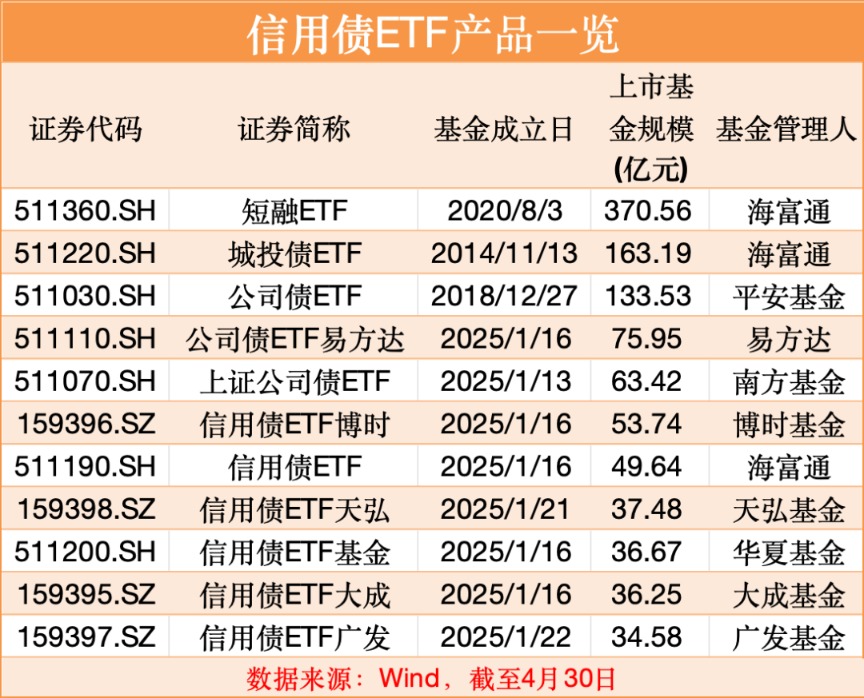
Core Insights - The credit bond ETF market has significantly expanded, with the total scale surpassing 105.4 billion yuan, marking a notable milestone in the industry [1][2] - The proportion of credit bond ETFs within the bond ETF market has increased from 31.08% at the end of last year to 42.71% currently, indicating a growing dominance [1] - The growth is attributed to favorable market conditions, policy support, and increasing investor demand for credit bond ETFs [5][6] Market Expansion - As of April 30, the total scale of credit bond ETFs reached 105.5 billion yuan, up from 54.1 billion yuan at the end of last year, representing a growth rate of over 95% [3] - The number of credit bond ETF products has increased from 3 to 11 since the end of last year, reflecting a robust expansion in product offerings [3][4] - Eight benchmark market-making corporate bond ETFs were launched in January, collectively raising 21.7 billion yuan, contributing to the rapid growth of the credit bond ETF market [3] Investor Demand - Various types of investors, including asset management accounts, pension funds, and insurance asset management, are showing strong interest in credit bond ETFs [7] - The demand for credit bond ETFs is expected to drive future growth, as they provide a convenient investment vehicle for both long-term allocation and short-term trading [7][8] Policy Support - Recent policy changes allow certain credit bond ETF products to engage in general pledge-style repurchase transactions, enhancing their attractiveness and liquidity [9] - The ability to use credit bond ETFs as collateral for financing is expected to further stimulate market participation and growth [10] Investment Opportunities - The current monetary policy environment suggests that mid-to-short-term credit bonds may offer better allocation value, making credit bond ETFs an appealing investment option [7][10] - The liquidity of credit bond ETFs is notably better than that of individual corporate bonds, which enhances their appeal to investors [10]
罕见!公募“首席”要当总经理?
券商中国· 2025-05-01 04:55
近日,鹏扬基金前首席经济学家陈洪斌加盟汇泉基金。 据市场消息,陈洪斌或将出任汇泉基金总经理。不过,截至券商中国发稿,这一消息尚未得到官方确认。 在公募基金业,首席经济学家作为一个群体出现的时间不长,但目前已出现了杨德龙、魏凤春、姚余栋、李湛、袁 宜、韩贤旺等多位风格鲜明、活跃的首席经济学家。和胡祖六、彭文生等早一批卖方首席不同,这些公募首席呈现 出两大差异性:一是学术气息淡化,倾向于通过喜闻乐见和鲜活的文风输出策略观点,二是买方特质凸显,个别公 募首席亲自下场管理基金组合。 如果陈洪斌接下来出任汇泉基金总经理,他可能会成为首位转任公募总经理的公募首席经济学家,还成为"研优则 仕"的生动诠释。 陈洪斌已入职汇泉基金 4月29日,券商中国记者从基金业协会官网信息获悉,陈洪斌的基金从业资格信息已变更为汇泉基金,他此前在鹏扬 基金的基金从业资格已注销。截至目前,陈洪斌在汇泉基金的职务角色尚未有官方信息。据市场消息,陈洪斌或将 在相关流程后出任汇泉基金总经理。 从公开消息来看,陈洪斌有过丰富的买卖方投研乃至高校学术等经历,但公司管理经历较少。具体来看,陈洪斌是 清华大学的应用经济学博士后,拥有多年金融从业经验,曾任国海 ...
机构风向标 | 美芯晟(688458)2025年一季度已披露持股减少机构超10家
Xin Lang Cai Jing· 2025-05-01 01:22
Group 1 - The core viewpoint of the news is that Meixinsheng (688458.SH) reported its Q1 2025 results, highlighting significant institutional investor interest with 22 institutions holding a total of 47.68 million shares, representing 42.75% of the total share capital [1] - The top ten institutional investors collectively hold 41.74% of the shares, which is a decrease of 2.57 percentage points compared to the previous quarter [1] Group 2 - In the public fund sector, five funds increased their holdings, accounting for 1.11% of the total, while seven funds reduced their holdings, indicating a slight decline [2] - One new public fund was disclosed during this period, while 71 funds were not disclosed again, indicating a shift in investor interest [2]

【财经分析】一季度债基市场降温收缩 “股债双驱”可转债产品领涨市场
Xin Hua Cai Jing· 2025-04-30 21:26
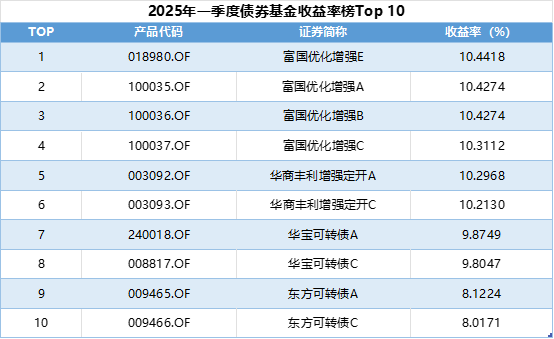
Core Viewpoint - The bond fund market experienced a contraction in Q1 2025 after a strong performance in Q4 2024, but convertible bond funds led the market due to favorable conditions from both equity and bond markets [1][5]. Market Overview - In Q1 2025, a total of 54 bond funds were issued, a decrease of 11.48% from Q4 2024, with a total issuance of 1131.17 billion units, down 28.16% [2]. - The total share of bond funds reached 90.3 trillion units by the end of Q1 2025, a reduction of 4379.80 billion units compared to the end of 2024 [2]. - The share of medium- and long-term pure bond funds decreased by 2786.38 billion units, while short-term pure bond funds decreased by 1580.26 billion units [2]. Fund Performance - Convertible bond funds achieved the highest returns in Q1 2025, with a yield of 3.89%, outperforming other types of bond funds [5]. - The top-performing bond funds included products from Huabao and Fuguo, which focused on high-growth sectors like new energy and advanced manufacturing [7][8]. Investment Trends - There is a notable increase in the issuance of passive index bond funds, reflecting a growing demand for tool-based investment products among institutional investors [2][3]. - Short-term pure bond funds maintained popularity, with four new funds issued totaling 117.1 billion units, significantly above the market average [2]. Market Dynamics - The bond market is expected to maintain a volatile trend in the short term, with structural investment opportunities in the credit bond sector [10][11]. - The yield on 10-year government bonds rose from approximately 1.60% to 1.90% in Q1 2025, influenced by high funding rates and shifting expectations regarding monetary policy [6]. Future Outlook - Analysts predict that the bond market will continue to perform well throughout 2025, supported by economic stabilization and the implementation of expansionary fiscal policies [10][11]. - The focus on short-duration credit bonds is expected to provide attractive investment opportunities due to their favorable risk-return profile [10][11].
罕见!29只基金同日公告成立,竟有9只是指数增强基金
Mei Ri Jing Ji Xin Wen· 2025-04-30 07:49
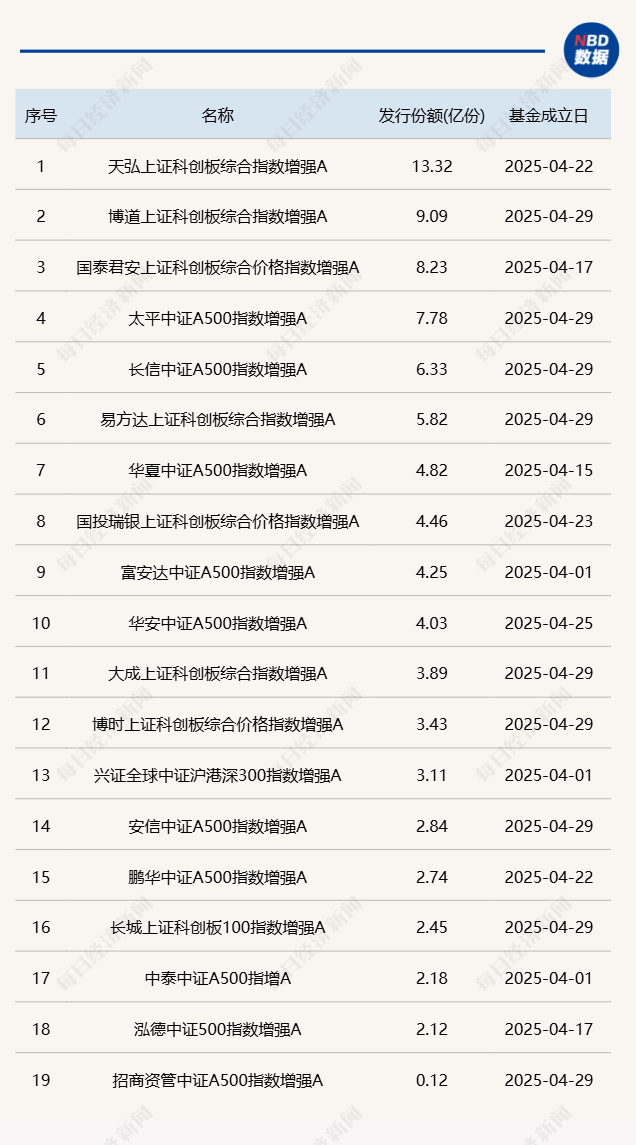
Core Insights - The public fund industry witnessed an unusual event with 29 funds announced on the same day, representing nearly a quarter of the total 119 funds established in April [1][2] - Among these, 9 were index-enhanced funds, indicating a growing focus on this product type as traditional ETF offerings face challenges [1][2] Fund Establishment Trends - In April, 19 index-enhanced funds were established, accumulating a total scale of approximately 9.1 billion yuan [2] - The trend of establishing index-enhanced funds accelerated since March, with 18 funds launched that month, totaling around 12.8 billion yuan [5] - Year-to-date, 49 index-enhanced funds have been established, with a cumulative scale of about 25.5 billion yuan [4] Market Dynamics - The increasing number of index-enhanced funds reflects a strategic shift among fund companies as they seek differentiation in a competitive market [6][10] - The ETF market has shown a "Matthew effect," making it challenging for many fund companies to compete effectively [8] - Index-enhanced funds are perceived as a potential breakthrough for companies facing difficulties in the ETF space [9] Challenges and Opportunities - Despite the growing interest, index-enhanced products have historically struggled to exceed a total scale of 300 billion yuan, indicating a significant hurdle in market acceptance [12] - The average annual excess return of index-enhanced funds compared to the CSI 300 index from 2020 to 2024 was 4.3%, but only 40% of these funds managed to consistently outperform the index over five years [12] - Achieving stable excess returns is crucial for the long-term viability of index-enhanced funds, as investor confidence hinges on their ability to deliver consistent performance [12]
珂玛科技(301611) - 301611珂玛科技投资者关系管理信息20250429
2025-04-30 01:08
Group 1: Revenue Structure and Growth Direction - In Q1 2025, the revenue structure remained consistent with 2024: ceramic structural parts accounted for approximately 50%, "function-structure" modular products for about 33%, and surface treatment services and metal structural parts for around 10% [1] - The company aims to enhance its core competitiveness by focusing on the development of ceramic heaters, electrostatic chucks, and ultra-pure silicon carbide kits, targeting international first-class semiconductor equipment standards [2] Group 2: Order Status and Delivery Times - The delivery cycle for ceramic structural parts is approximately 45 to 60 days, while "function-structure" modular products have a delivery cycle of about 90 days [2] - The current order backlog is sufficient to support business growth, with a significant increase compared to the same period last year, indicating a stable production state [2] Group 3: Product Development and Production Capacity - The ceramic heater has been mass-produced since Q4 2023, with expected increased demand in 2025 due to the replacement cycle and capacity expansion needs from wafer fabs [3] - The new production base in Suzhou is set to be fully operational in 2025, with plans to enhance the theoretical production capacity of ceramic heaters to nearly 200 units per month by year-end [3] Group 4: Modular Product Progress - The electrostatic chuck has completed validation and is in small-scale production, while the ultra-pure silicon carbide kits are also progressing with validation and promotion at customer wafer fabs [3] - The company aims to complete more modular product validation processes in 2025 and begin formal mass production [3]