
中科曙光

Search documents
研判2025!中国分布式全闪存储行业市场现状、企业格局及发展趋势分析:行业规模呈高速增长态势,企业加大布局力度[图]
Chan Ye Xin Xi Wang· 2025-11-17 01:08
Core Insights - The article discusses the rapid growth and development of distributed all-flash storage in China, highlighting its performance advantages and increasing market share compared to traditional storage solutions [1][7]. Distributed All-Flash Storage Overview - Distributed storage can be categorized into distributed all-flash and mixed-flash storage, with all-flash storage consisting entirely of SSDs, achieving IOPS in the millions, which is nearly a thousand times faster than traditional HDDs [1][3]. - The demand for high-performance and reliable data storage solutions is increasing due to the explosive growth of data in the digital age [1][7]. Market Size and Growth - The market size for distributed all-flash storage in China is projected to reach 4.78 billion yuan in 2024, representing a year-on-year growth of 71.5%, significantly outpacing the overall growth of the distributed storage industry [1][7]. - The overall distributed storage market in China is expected to exceed 19.82 billion yuan in 2024, with a year-on-year growth rate of 43.7%, accounting for 60.2% of the total storage market [4][6]. Market Share Dynamics - The share of distributed all-flash storage is increasing, rising from 13.4% in 2021 to 24.1% in 2024, indicating a growing adoption among users [6][7]. - In 2024, mixed-flash storage will still dominate the market with a 75.9% share, primarily due to the cost advantages of HDDs in high-capacity applications [6][7]. Competitive Landscape - Major players in the distributed all-flash storage market include Huawei, Zhongke Shuguang, and Inspur Information, alongside emerging companies like Fanlian Information, which show strong competitive potential [2][10]. - The competitive landscape is evolving, with several companies launching distributed all-flash array products that achieve throughput exceeding 100GB/s, positioning China among the global leaders in distributed storage technology [10]. Industry Trends - The industry is expected to see increased penetration, reduced costs, and enhanced security features in distributed all-flash storage solutions [1][10]. - The maturation of the domestic SSD supply chain is providing a solid foundation for the growth of distributed all-flash storage in China, with the enterprise SSD market projected to grow from 21.16 billion yuan in 2021 to 44.51 billion yuan in 2024, reflecting a compound annual growth rate of 28.13% [8][9].


指引发布实施一周年 工具箱日渐丰富 从软约束到硬指标 上市公司市值管理迈入新阶段
Zhong Guo Zheng Quan Bao· 2025-11-16 22:29
Core Viewpoint - The implementation of the "Guidance No. 10 on Market Value Management" has led to a significant increase in the use of various market value management tools by listed companies, including cash dividends, share buybacks, mergers and acquisitions, and equity incentives, to enhance investment value and return to investors [1][2][4]. Group 1: Market Value Management Tools - Cash dividends and share buybacks have become frequently used tools in the market value management toolbox, with companies encouraged to establish clear mechanisms for share repurchase and to develop long-term dividend plans [2][3]. - As of October 31, 2023, 1,195 companies in China's stock market have announced 1,525 share buyback plans for 2025, with a total buyback amount of 92.3 billion yuan, of which 36% was from self-owned funds and 26% from cancellation buybacks [2]. - A total of 1,033 listed companies have announced cash dividend plans for the first three quarters, with a total cash dividend amount of 734.9 billion yuan, reflecting an increase in the number of companies engaging in multiple dividends [3]. Group 2: Mergers and Acquisitions - The past year has seen a vibrant A-share merger and acquisition market, characterized by significant activity in the "hard technology" sector and accelerated integration of state-owned enterprises [4][5]. - Notable cases include the acquisition of 72.33% of shares in ChipLink by ChipLink Integrated and the merger of Haiguang Information with Zhongke Shuguang, showcasing the trend of industry consolidation [4]. - Policy support has been crucial for the active M&A market, with recent reforms aimed at enhancing the efficiency and vitality of mergers and acquisitions [5]. Group 3: Equity Incentives - Equity incentives have gained prominence as a market value management tool, with companies encouraged to establish long-term incentive mechanisms [6][7]. - By mid-2023, nearly 3,500 listed companies had implemented equity incentive or employee stock ownership plans, representing 64% of A-share listed companies [6]. - The recognition of equity incentives as a significant method for market value management has deepened, with more companies expected to adopt these tools in the future [7].
从软约束到硬指标 上市公司市值管理迈入新阶段
Zhong Guo Zheng Quan Bao· 2025-11-16 20:13
Core Viewpoint - The implementation of the "Guidelines for the Supervision of Listed Companies No. 10 - Market Value Management" has led to a significant increase in the use of various market value management tools by listed companies, including cash dividends, share buybacks, mergers and acquisitions, and equity incentives, to enhance investment value and return to investors [1][2]. Group 1: Market Value Management Tools - Cash dividends and share buybacks have become frequently used tools in the market value management toolbox, with companies encouraged to establish clear mechanisms for share repurchase and to develop and disclose medium- to long-term dividend plans [1][2]. - As of October 31, 2023, 1,195 companies in China's stock market have announced 1,525 share buyback plans for 2025, with a total buyback amount of 92.3 billion yuan, of which 36% was funded by self-owned capital and 26% was for cancellation [2]. - The total cash dividend amount across the market reached 734.9 billion yuan, with 89 companies distributing over 1 billion yuan in dividends within the year [2]. Group 2: Mergers and Acquisitions - The past year has seen a vibrant M&A market, particularly in the "hard technology" sector, with notable cases such as the acquisition of 72.33% of Chip Alliance's shares and the merger of Haiguang Information with Zhongke Shuguang [3]. - State-owned enterprises are also actively engaging in professional integration, exemplified by China Shenhua's plan to consolidate 13 energy companies and Guotai Junan's merger with Haitong Securities [3]. - Policy support has been a key driver for the active M&A market, with various reforms and guidelines aimed at enhancing the efficiency and vitality of mergers and acquisitions [3]. Group 3: Equity Incentives - Equity incentives have been highlighted as a significant market value management tool, with companies encouraged to establish long-term incentive mechanisms [4][5]. - By mid-2023, nearly 3,500 listed companies had implemented equity incentive or employee stock ownership plans, representing 64% of all A-share listed companies [5]. - The recognition of equity incentives as a market value management strategy has deepened, with more companies expected to adopt these tools to enhance long-term value [5].




本周机构扎堆评级27股 17股估值较低
Xin Lang Cai Jing· 2025-11-16 04:29
Group 1 - A total of 50 institutions conducted 669 "buy" ratings covering 530 stocks from November 10 to 14 [1] - The pharmaceutical and biological industry had the highest number of rated stocks at 72, followed by the electronics industry with 51 [1] - 27 stocks received attention from three or more institutions, with Zhongke Shuguang and Kangguan Technology leading with five ratings each [1] Group 2 - The average increase of rated stocks this year is 34.51%, outperforming the Shanghai Composite Index during the same period [1] - Eight concept stocks have doubled in growth this year, with Haibo Sichuang, Industrial Fulian, Guoen Co., Dongcai Technology, and Fuxiang Pharmaceutical being the top five in terms of growth [1] - As of November 14, 17 rated stocks had a rolling P/E ratio of less than 16, with Anhui Construction, Gree Electric, Industrial and Commercial Bank, and Beijing Human Resources having the lowest ratios [1] Group 3 - 16 rated stocks had a net financing inflow exceeding 100 million yuan since November, including Aters, TCL Zhonghuan, Industrial Fulian, and Dongcai Technology [1] - Aters topped the list with a net financing inflow of 906 million yuan since November [1]
算力爆火,机构紧盯这只热门股
Zheng Quan Shi Bao Wang· 2025-11-16 04:24
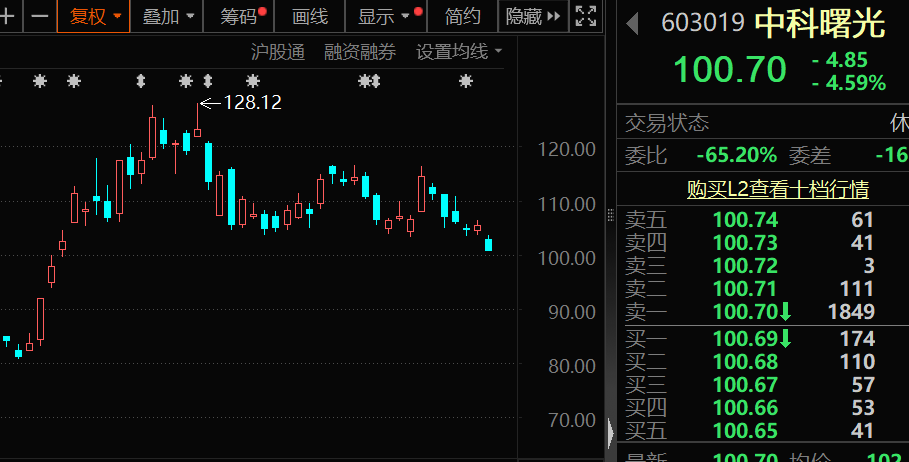
Core Insights - This week, 27 stocks received attention from three or more institutions, with Zhongke Shuguang and Kangguan Technology leading with five ratings each [2][3]. Group 1: Institutional Ratings - A total of 50 institutions conducted 669 "buy" ratings covering 530 stocks from November 10 to 14, with the pharmaceutical and biological sector having the highest number of rated stocks at 72 [1]. - The electronic industry followed with 51 rated stocks, while six industries had 35 or more rated stocks [1]. Group 2: Company Highlights - Zhongke Shuguang's computing power business has been positively viewed by multiple brokerages since 2025, with a recent product launch of the world's first single-cabinet 640-card super node, scaleX640 [2]. - The company reported a net profit of 966 million yuan for the first three quarters, marking a year-on-year increase of 25.55% [3]. - Kangguan Technology has embraced AI technology, developing a diverse product matrix covering "AI + office/education/medical/entertainment" [5]. - The revenue from innovative display products has exceeded 10% of total revenue, making it one of the fastest-growing segments for Kangguan Technology [5]. Group 3: Stock Performance - The average increase of institutional-rated stocks this year is 34.51%, outperforming the Shanghai Composite Index [6]. - Hai Bo Si Chuang has seen a remarkable year-to-date increase of 502.5% and has signed a strategic cooperation agreement with Ningde Times for a ten-year partnership [9]. - Among the rated stocks, 17 have a rolling P/E ratio of less than 16, with Anhui Construction having the lowest at 7.04 [10].
算力的突围:用“人海战术”对抗英伟达!
经济观察报· 2025-11-14 15:08
Core Viewpoint - The article discusses the emergence and significance of the "SuperNode" concept in the AI computing market, highlighting the competitive landscape among domestic manufacturers aiming to match or surpass Nvidia's offerings [1][11]. Group 1: SuperNode Concept - The term "SuperNode" refers to high-performance computing systems that integrate multiple AI training chips within a single cabinet, enabling efficient parallel computing [5][7]. - Domestic manufacturers have rapidly adopted the SuperNode concept, with various companies showcasing their solutions at industry events, indicating a collective push towards advanced AI computing capabilities [2][4]. Group 2: Performance Metrics - Companies are emphasizing the performance metrics of their SuperNode products, with Huawei's 384 SuperNode reportedly offering 1.67 times the computing power of similar Nvidia devices [3][12]. - The scale of integration, indicated by numbers like "384" or "640," reflects the number of AI training chips within a single system, serving as a key performance indicator for manufacturers [7][8]. Group 3: Challenges and Solutions - The industry faces a "communication wall" where a significant portion of computing time is spent waiting for data transfer, necessitating the development of SuperNodes to enhance communication efficiency [6][9]. - The transition from traditional computing methods to SuperNode architectures is driven by the need for higher performance in training large AI models, with manufacturers exploring both Scale-Up and Scale-Out strategies [7][8]. Group 4: Competitive Landscape - Domestic firms are positioning their SuperNode products against Nvidia's offerings, with Huawei's Atlas950 expected to outperform Nvidia's NVL144 in several key metrics [11][12]. - The competition is not only about performance but also about innovative engineering solutions to manage power consumption and heat dissipation in densely packed systems [13][15]. Group 5: Market Demand - The primary demand for AI computing resources is expected to come from large internet companies and state-led cloud services, which are likely to drive the market in the next few years [20][21]. - There are concerns about the sustainability of this demand, as companies may face challenges in justifying high capital expenditures for advanced computing resources [21][22]. Group 6: Future Outlook - The article suggests that while hardware challenges exist, the real test for domestic manufacturers will be in developing robust software ecosystems to support their SuperNode offerings [19][22]. - There is optimism about the potential for AI applications in sectors like robotics and advanced manufacturing, which could drive sustained demand for high-performance computing solutions [22].


国产超节点扎堆发布背后
Jing Ji Guan Cha Wang· 2025-11-14 14:10
Core Insights - The AI computing power market is increasingly focused on "SuperNode" technology, with multiple companies showcasing their solutions at various conferences throughout 2023 [2][3] - The emergence of SuperNodes is driven by the need to overcome bottlenecks in training large AI models, particularly the "communication wall" that arises during parallel computing [4][9] - Domestic companies are adopting SuperNode technology as a practical solution to enhance overall computing power, compensating for limitations in single-chip performance [10][12] Group 1: SuperNode Technology - SuperNode refers to a high-density computing solution that integrates multiple AI chips within a single cabinet, allowing them to function as a unified system [6][7] - The design of SuperNodes involves two main approaches: Scale-Up, which increases resources within a single cabinet, and Scale-Out, which connects multiple cabinets [5][8] - The numbers associated with SuperNodes (e.g., "384", "640") indicate the number of AI training chips integrated within a single system, serving as a key metric for performance and density [7][8] Group 2: Industry Competition - Companies like Huawei and Inspur are positioning their SuperNode products as superior to NVIDIA's offerings, with Huawei claiming its Atlas 950 will outperform NVIDIA's NVL144 in multiple performance metrics [10][11] - The competitive landscape is marked by aggressive parameter comparisons, with domestic firms striving to achieve higher integration density within their SuperNode solutions [12][14] - The engineering challenges of integrating numerous high-power chips into a single cabinet necessitate advanced cooling and power supply technologies [12][14] Group 3: Market Demand and Challenges - The primary demand for AI computing power is expected to come from large internet companies and state-led cloud services, which have the infrastructure to support high-end computing needs [19][20] - Despite the strong demand, there are concerns about the sustainability of investments in AI computing infrastructure, particularly regarding the potential for overbuilding [20][22] - The software ecosystem remains a significant challenge for domestic manufacturers, as effective software solutions are crucial for the successful deployment of high-density computing systems [18][22]



【14日资金路线图】银行板块净流入逾34亿元居首 龙虎榜机构抢筹多股
Zheng Quan Shi Bao· 2025-11-14 12:44
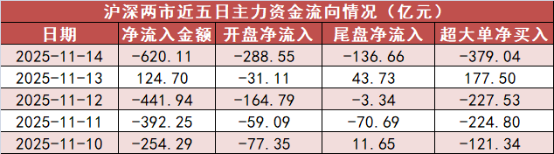
Market Overview - The A-share market experienced an overall decline on November 14, with the Shanghai Composite Index closing at 3990.49 points, down 0.97%, the Shenzhen Component Index at 13216.03 points, down 1.93%, and the ChiNext Index at 3111.51 points, down 2.82% [1] - The total trading volume in the A-share market was 19805.41 billion yuan, a decrease of 852.87 billion yuan compared to the previous trading day [1] Capital Flow - The main capital in the A-share market saw a net outflow of 620.11 billion yuan, with an opening net outflow of 288.55 billion yuan and a closing net outflow of 136.66 billion yuan [2] - The CSI 300 index recorded a net outflow of 204.39 billion yuan, while the ChiNext saw a net outflow of 257.8 billion yuan and the STAR Market a net outflow of 17.13 billion yuan [4] Sector Performance - Among the primary sectors, the banking sector led with a net inflow of 34.61 billion yuan, while the electronic sector faced the largest outflow of 242.05 billion yuan [6][7] - Other sectors with significant outflows included electric power equipment (-175.51 billion yuan), computer (-131.43 billion yuan), basic chemicals (-97.49 billion yuan), and non-ferrous metals (-97.11 billion yuan) [7] Stock Highlights - Leading the net inflow of capital was XianDao Intelligent with 9.4 billion yuan [8] - Institutions showed interest in several stocks, with notable net purchases in ShiKong Technology (20,785.87 thousand yuan) and HaiLu Heavy Industry (14,126.16 thousand yuan) [10][11] Institutional Focus - Recent institutional ratings highlighted several stocks with potential upside, including Guotou Power (21.64% upside), Zhenjiang Co. (40.54% upside), and Industrial Fulian (55.59% upside) [13]
计算机行业双周报(2025/10/31-2025/11/13):国内科技巨头积极布局超节点技术,关注国产AI算力投资机遇-20251114
Dongguan Securities· 2025-11-14 12:19
Investment Rating - The report maintains an "Overweight" rating for the computer industry, indicating an expectation that the industry index will outperform the market index by more than 10% over the next six months [1][32]. Core Insights - Domestic technology giants are actively investing in supernode technology, presenting investment opportunities in domestic AI computing power [1][28]. - The SW computer sector has seen a cumulative decline of 2.64% over the past two weeks, underperforming the CSI 300 index by 2.48 percentage points, ranking 28th among 31 first-level industries [10][13]. - The sector's price-to-earnings (PE) ratio is currently at 55.36 times, placing it in the 88.40th percentile for the past five years and the 77.89th percentile for the past ten years [20][22]. Summary by Sections 1. Market Review - The SW computer sector has experienced a cumulative decline of 2.64% from October 31 to November 13, 2025, and a decline of 3.73% in November, while it has increased by 20.45% year-to-date [10][13][28]. 2. Valuation Situation - As of November 13, 2025, the SW computer sector's PE TTM (excluding negative values) stands at 55.36 times, indicating a high valuation relative to historical performance [20][22]. 3. Industry News - Key developments include the launch of the Kimi K2 Thinking model by Moonlight, the introduction of the world's first single-cabinet 640-card supernode by Inspur, and significant investments in AI infrastructure by companies like Tencent and Anthropic [21][23][28]. 4. Company Announcements - Recent announcements include equity transfer agreements and the establishment of joint ventures aimed at enhancing business strategies and market positions [24][25][26][27]. 5. Weekly Perspective - The report highlights the launch of the scaleX640 supernode by Inspur, which significantly enhances computing power and efficiency, and emphasizes the importance of collaborative efforts in the AI computing ecosystem [28][29].
计算机行业双周报:国内科技巨头积极布局超节点技术,关注国产AI算力投资机遇-20251114
Dongguan Securities· 2025-11-14 09:43
Investment Rating - The report maintains an "Overweight" rating for the computer industry, expecting the industry index to outperform the market index by more than 10% in the next six months [1][32]. Core Insights - Domestic technology giants are actively investing in supernode technology, presenting investment opportunities in domestic AI computing power [1][28]. - The SW computer sector has seen a cumulative decline of 2.64% over the past two weeks, underperforming the CSI 300 index by 2.48 percentage points, ranking 28th among 31 first-level industries [10][13]. - The sector's price-to-earnings (PE) ratio is 55.36 times, placing it in the 88.40th percentile over the past five years and the 77.89th percentile over the past ten years [20][22]. Summary by Sections 1. Market Review - The SW computer sector has experienced a cumulative decline of 2.64% from October 31 to November 13, 2025, and a decline of 3.73% in November, while it has increased by 20.45% year-to-date, outperforming the CSI 300 index by 0.95 percentage points [10][13][14]. 2. Valuation Situation - As of November 13, 2025, the SW computer sector's PE TTM (excluding negative values) stands at 55.36 times, which is in the 88.40th percentile for the last five years and the 77.89th percentile for the last ten years [20][22]. 3. Industry News - Major developments include the launch of the Kimi K2 Thinking model by Moon's Dark Side, the introduction of the world's first single-cabinet 640-card supernode scaleX640 by Inspur, and Tencent's announcement of lower-than-expected capital expenditures for the year [21][23][28]. - Anthropic plans to invest $50 billion in a data center in the U.S., while Baidu has released new Kunlun chips M100 and M300 for AI applications [21][23]. 4. Company Announcements - Recent announcements include a share transfer agreement by Jin Chengzi and a joint venture by Jin Yi Technology to establish a company focused on energy technology [24][25][27]. 5. Weekly Perspective - The report highlights the significance of the scaleX640 supernode, which enhances computing power and efficiency, and emphasizes the importance of domestic AI computing power investment opportunities [28][29].