中信银行

Search documents
九卦 | 一步之遥:股份制银行集体逼近全球系统重要性银行门槛
Sou Hu Cai Jing· 2025-12-08 13:40
Core Viewpoint - The Financial Stability Board (FSB) has released the 2025 list of Global Systemically Important Banks (G-SIBs), which includes 29 banks globally, with China's five major state-owned banks maintaining their positions. Notably, Industrial and Commercial Bank of China (ICBC) has moved from Group 2 to Group 3 for the first time [1][5][10]. Group 1: G-SIBs List and Rankings - The 2025 G-SIBs list remains consistent with 2024, but there are changes in group classifications. The third group has increased from 2 to 4 banks, including ICBC and others [5][10]. - In the "Bucket 0" category, which does not incur additional capital requirements, China Merchants Bank has improved its ranking from 34th to 30th, closely approaching the G-SIBs threshold [5][6][10]. - Other Chinese banks, such as Industrial Bank and CITIC Bank, are also nearing the G-SIBs threshold, indicating a shift in the global financial stability focus [3][5][9]. Group 2: Factors Influencing Rankings - The rise in rankings for Chinese banks is attributed to improvements in interconnectedness and complexity metrics rather than size, which has traditionally been the focus [3][8]. - For instance, China Merchants Bank's total score increased significantly from 103 to 122, with interconnectedness and complexity contributing 31 and 60 points, respectively [7][8]. Group 3: Implications of G-SIBs Inclusion - Being classified as a G-SIB entails stricter capital regulatory requirements, which could compress the Return on Equity (ROE) for these banks [3][10]. - The additional capital requirements for G-SIBs range from 1% to 3.5% depending on the group, which could impact the capital strategies of banks approaching the threshold [10][11]. Group 4: Future Considerations for Chinese Banks - Chinese banks need to enhance their capital buffers and risk management frameworks to prepare for potential G-SIBs inclusion, as this could lead to increased systemic risk distribution [12][13]. - The banks are encouraged to diversify their capital tools and optimize asset structures to improve capital efficiency [12][13]. Group 5: Cross-Border Business Development - There is a need for Chinese banks to accelerate their cross-border business development to adapt to low-interest-rate environments and reduce reliance on single markets [15][14]. - Despite some progress, the density of overseas branches and subsidiaries remains low, indicating a need for strategic growth in international operations [15][14].






以企业为伴,与科技同行,中信银行开启科技企业并购新篇章
券商中国· 2025-12-08 13:17
Core Viewpoint - The article emphasizes the increasing support from the national level for mergers and acquisitions (M&A) in the technology sector, highlighting the launch of pilot policies for technology enterprise M&A loans, which are driving market activity and enabling companies to integrate their supply chains and address technological gaps [1][3]. Group 1: Policy Support and Market Activity - Since last year, the national government has intensified its policy support for the M&A sector, particularly in technology, with new pilot policies for M&A loans aimed at stimulating market activity [1]. - The introduction of the technology enterprise M&A loan pilot policy allows for a maximum loan-to-value ratio of 80% and extends the loan term to 10 years, with trials initiated in 18 cities [3]. - As of September 2025, CITIC Bank has issued 33 technology enterprise M&A loans totaling over 5.5 billion yuan, with a coverage rate of over 85% across the pilot cities [3]. Group 2: Financial Services and Support for Technology Enterprises - CITIC Bank leverages its comprehensive financial services to support technology enterprises through a combination of equity and debt financing, addressing the financial needs at different stages of enterprise development [4]. - The bank has initiated a "Technology M&A Empowerment Action," marking its commitment to providing a full lifecycle financial service system for technology companies [4]. - In May 2025, CITIC Bank hosted a summit for technology enterprises, showcasing its dedication to enhancing financial services for technology innovation and resource optimization [4]. Group 3: Focus on Key Industries and Innovation - CITIC Bank is strategically focusing on advanced manufacturing, artificial intelligence, and high-tech sectors, facilitating M&A to enhance resource integration and accelerate technology commercialization [5][6]. - The bank's branches are actively providing M&A loans to high-tech enterprises, supporting their growth and innovation in specific fields such as industrial AI and intelligent manufacturing [5][6]. - CITIC Bank aims to continue its deep engagement in the technology finance sector, offering customized financing solutions to activate M&A potential and support industry upgrades [6].
金融护航消费公平——中信银行铜锣湾支行合规宣传赋能南昌商业活力
Zhong Guo Jin Rong Xin Xi Wang· 2025-12-08 13:10
Core Viewpoint - The article emphasizes the importance of the Renminbi as a legal currency in ensuring fair consumption and maintaining convenience for the public, particularly for vulnerable groups like the elderly. It highlights a campaign by CITIC Bank to promote cash acceptance and protect payment rights in the Nanchang area [1][2]. Group 1: Campaign Overview - CITIC Bank's Tongluowan branch launched a campaign titled "Rectifying Cash Refusal, Protecting Payment Rights" in the Nanchang Tongluowan business district and the Dongfang Heidelberg community [1]. - The campaign involved face-to-face interactions with local merchants to explain legal responsibilities regarding cash acceptance and encourage them to sign a "No Cash Refusal Commitment" [1][2]. - The bank provided small denomination bills and coin exchange services on-site to address the common issue of making change for merchants [1]. Group 2: Community Impact - In the Dongfang Heidelberg community, the campaign fostered a sense of community welfare, enhancing the warmth of local shops [2]. - Bank staff educated shop owners on diverse payment regulations and assisted elderly residents in recognizing counterfeit money and understanding their rights [2]. - The initiative has made cash payment channels more accessible in community shops, improving the overall consumer experience [2]. Group 3: Future Plans - CITIC Bank's Tongluowan branch plans to incorporate cash acceptance promotion into its regular operations, aiming to provide better cash services and more detailed compliance guidance [3].
超2600亿元!银行股年终忙发“红包”
Zhong Guo Ji Jin Bao· 2025-12-08 13:08
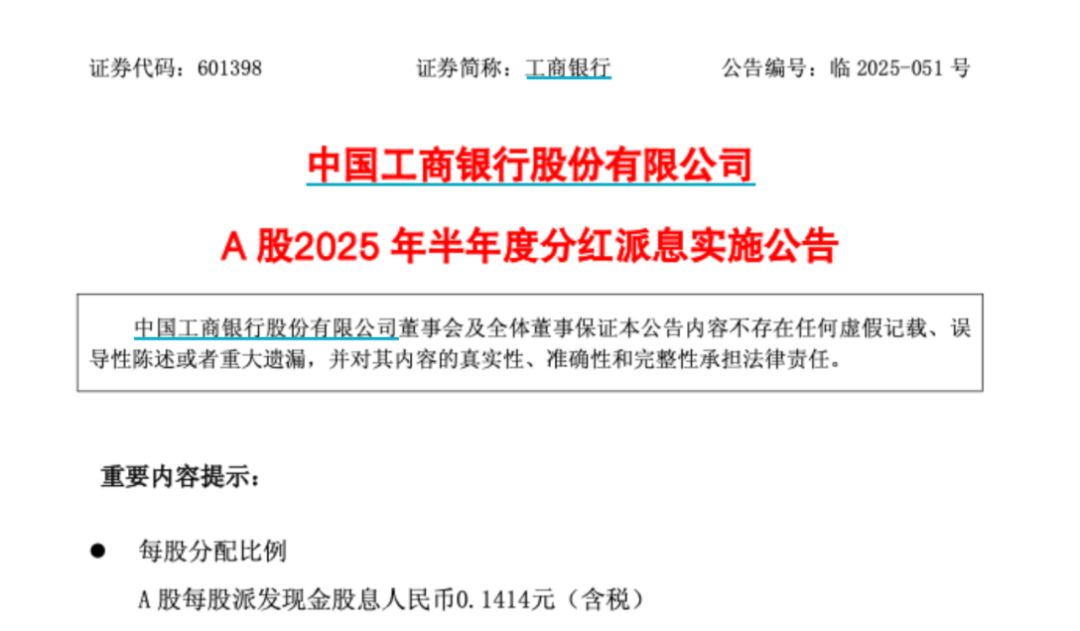
Group 1 - Industrial and Agricultural Banks announced their 2025 interim dividend distribution plans, with Industrial Bank distributing a cash dividend of RMB 0.1414 per share, totaling approximately RMB 503.96 billion, of which RMB 381.23 billion is for A-shares [1][3] - Agricultural Bank will distribute a cash dividend of RMB 0.1195 per share, totaling approximately RMB 418.23 billion, with RMB 381.50 billion allocated for A-shares [5] - Both banks will have their cash dividend payment date on December 15, 2025 [1][5] Group 2 - As of December 8, 2025, the total cash dividend distribution from A-share listed banks reached RMB 2,637.91 billion, with state-owned banks being the main contributors [7][9] - Industrial Bank leads with a dividend amount of RMB 503.96 billion, followed by Construction Bank and Agricultural Bank with RMB 486.05 billion and RMB 418.23 billion respectively [9] - The six major state-owned banks collectively distributed RMB 2,046.57 billion, accounting for approximately 78% of the total interim dividend [9] Group 3 - The trend shows an increase in the number of interim dividends among listed banks, with many maintaining stable dividend rates and some increasing their payout ratios [10] - The earlier timing of dividend payments reflects the stable dividend value of the banking sector, which continues to attract medium to long-term capital [10]

11月金融数据前瞻:预计新增贷款3000-6500亿,社融增速维持8.5%
ZHONGTAI SECURITIES· 2025-12-08 12:55
Investment Rating - The industry investment rating is maintained at "Overweight" [2] Core Insights - The report anticipates new RMB loans in November to be between 300 billion to 450 billion, with a year-on-year decrease of 130 billion to 280 billion, leading to a loan growth rate of approximately 6.4% [5][9] - The expected new social financing scale for November is projected to be between 2.16 trillion to 2.32 trillion, with a year-on-year decrease of 0.01 trillion to 0.17 trillion, maintaining a stock growth rate of around 8.5% [20][25] - The report highlights a weak corporate activity backdrop, with the manufacturing PMI at 49.2%, indicating a contraction, and a decline in production, new orders, and new export orders [5][9] - The residential loan sector is expected to see a decline due to policy cycles and a drop in housing transaction volumes, with significant decreases in average transaction areas in major cities [9] Summary by Sections 1. RMB Loans - New RMB loans for November are expected to be between 300 billion to 450 billion, with a year-on-year decrease of 130 billion to 280 billion, resulting in a loan growth rate of about 6.4% [5][9] 2. Social Financing - The anticipated new social financing scale for November is projected to be between 2.16 trillion to 2.32 trillion, with a year-on-year decrease of 0.01 trillion to 0.17 trillion, maintaining a stock growth rate of around 8.5% [20][25] 3. Liquidity - M1 and M2 growth rates are expected to decline but remain relatively high, with M1 projected to drop to 6.0% and M2 to 8.1% by the end of November [27][28] 4. Investment Recommendations - The report suggests a shift in bank stock investment logic from "pro-cyclical" to "weak-cyclical," emphasizing the attractiveness of high-dividend bank stocks during periods of economic stagnation [29]
以企业为伴,与科技同行,中信银行开启科技企业并购新篇章
Zhong Guo Zheng Quan Bao· 2025-12-08 12:13
Core Insights - The national government has increased policy support for mergers and acquisitions (M&A) since last year, with a pilot policy for technology enterprise M&A loans launched this year, signaling a clear message to the market [1][2] - The policy incentives have significantly boosted market activity, with technology companies actively pursuing M&A to integrate supply chains and address technological gaps, particularly in emerging industries such as semiconductors, new energy, and biomedicine [1][4] - Under the guidance of policy, industry demand, and capital support, a new trend in technology M&A is accelerating, injecting strong momentum into the development of new productive forces and technological self-reliance [1] Group 1: Policy and Market Dynamics - In March 2025, the National Financial Regulatory Administration introduced a pilot policy for technology enterprise M&A loans, raising the maximum loan ratio for controlling acquisitions to 80% and extending the term to 10 years, with trials starting in 18 cities [2] - CITIC Bank, as one of the first pilot banks, quickly initiated a special action for empowering technology M&A, making it a core focus for the year, achieving significant market leadership in technology M&A loans [2] - By the end of September 2025, CITIC Bank had issued 33 technology enterprise M&A loans totaling over 5.5 billion yuan, with operations established in 16 pilot cities, covering over 85% of the trial cities [2] Group 2: Financial Services and Support - CITIC Bank leverages its "full financial license + industrial ecosystem" advantage to provide comprehensive services for technology enterprises, covering the entire lifecycle of corporate development [3] - The bank focuses on different funding needs and pain points faced by technology companies at various stages, using the "M&A chain" as a focal point to offer differentiated financing solutions [3] - In May 2025, CITIC Bank hosted a summit for technology enterprise M&A, marking the official launch of its technology M&A empowerment initiative, which aims to optimize the allocation of technological resources and support the transformation of technology enterprises [3] Group 3: Sector-Specific Initiatives - CITIC Bank is strategically targeting advanced manufacturing, artificial intelligence, and high-precision technology sectors, supporting enterprises in resource integration through M&A [4] - The Suzhou branch focuses on industrial AI and high-end intelligent manufacturing, providing M&A loans to national high-tech enterprises to accelerate technological innovation [4] - The Hangzhou branch supports specialized and innovative enterprises in technology integration, collaborating with CITIC Securities and Jinshi Investment to provide integrated financial services for acquisitions in high-precision fields [4]
高息不再 “存款特种兵”沉默
经济观察报· 2025-12-08 10:47
Core Viewpoint - The article discusses the declining interest rates on large time deposits in China, leading depositors to explore alternative investment options such as gold and stocks, reflecting a shift in savings behavior among traditional depositors [1][14]. Group 1: Current Deposit Trends - Many depositors, previously focused on high-interest large time deposits, are now turning to gold and other investment vehicles due to the unavailability of similar high-yield products [1][14]. - A significant decline in interest rates for large time deposits is noted, with major banks offering rates as low as 1.55% for 3-year deposits, compared to previous rates above 3% [5][6]. - The availability of long-term large time deposits has decreased, with major banks no longer offering 5-year products and reducing the number of 3-year and shorter-term options [3][4]. Group 2: Market Response and Alternatives - Smaller banks are capitalizing on the situation by actively marketing their deposit products through social media, attempting to attract funds from depositors seeking better rates [10][12]. - Some banks are offering promotional rates for new customers, with products like 3-year transferable large time deposits at rates up to 2.95%, which are higher than standard offerings [12][11]. - Depositors are increasingly diversifying their investments, with a notable shift towards non-guaranteed financial products and lower-risk investments, reflecting a broader trend in asset allocation [14][15]. Group 3: Depositor Behavior and Preferences - Depositors can be categorized into two groups: those seeking stability with traditional deposits and those willing to take risks by investing in higher-yield products [14]. - The preference for non-guaranteed financial products has increased, with bank wealth management products and funds becoming popular among depositors looking for better returns [14]. - According to a survey, 62.3% of residents prefer to save more, indicating a cautious approach to financial management amid changing interest rates [14].

再夺全球大奖,中信银行交出金融品牌价值增长高质量答卷
和讯· 2025-12-08 10:25
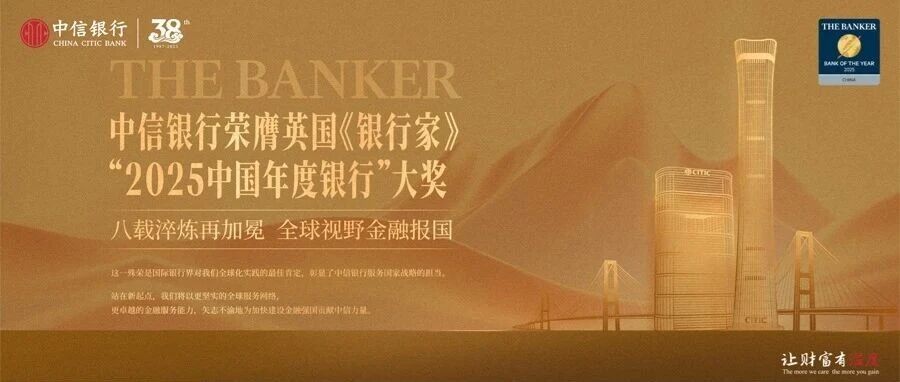
Core Viewpoint - CITIC Bank has been awarded the "China Annual Bank" title by The Banker magazine, marking its second win since 2017, reflecting its significant brand influence and recognition in the banking industry [1][2]. Brand Value and Transformation - CITIC Bank's brand value has increased by 27.2% year-on-year, reaching $16.953 billion, leading among mainland Chinese banks [2]. - The bank has redefined its brand philosophy to "Let Wealth Have Temperature," focusing on trust, social responsibility, and emotional connection in financial services [2][4]. Strategic Brand Development - The shift in the evaluation system for state-owned enterprises emphasizes brand building as a strategic asset, integrating it into core assessment dimensions [3]. - CITIC Bank's approach to brand management is a systematic project that translates its mission of "finance for the people" into tangible market influence [4]. Support for Economic Development - The bank has directed financial resources towards strategic emerging industries and green low-carbon sectors, with loans to strategic emerging industries exceeding 450 billion yuan and green credit nearing 320 billion yuan [6]. - CITIC Bank's comprehensive financial ecosystem supports technological upgrades and self-sufficiency for enterprises, embodying the principle of serving the real economy [6]. Financial Performance - For the first three quarters of 2025, CITIC Bank reported operating income of 156.598 billion yuan and net profit of 53.391 billion yuan, maintaining stable profitability [7]. - The bank's total assets reached 9,898.128 billion yuan, with a non-performing loan ratio of 1.16%, indicating robust asset quality [7]. Wealth Management and Social Responsibility - CITIC Bank's retail asset management balance reached 4.99 trillion yuan, with retail financial products growing by 4.11% year-on-year [8]. - The bank has launched charitable financial products, raising 2.879 billion yuan for children's education and healthcare projects, demonstrating its commitment to social responsibility [8]. Customer-Centric Approach - The bank's "Let Wealth Have Temperature" philosophy is integrated into every aspect of customer service, addressing the needs of an aging population with comprehensive retirement solutions [9][10]. - CITIC Bank aims to enhance financial accessibility and satisfaction for the public, aligning with national strategies to boost consumption and domestic demand [10]. Brand Experience and Engagement - The bank engages younger consumers through innovative initiatives, such as photography contests and sponsorships, creating a connection between finance and lifestyle [12][14]. - CITIC Bank's brand evolution reflects a shift from product-based competition to a holistic experience driven by values of trust, emotion, and social responsibility [14][16].
告别低谷,LP出资显著回暖
FOFWEEKLY· 2025-12-08 10:19
Core Insights - The market has moved past its low point, with volatility recovery becoming the new norm, driven by strategic guidance from top-level policies and an influx of patient capital [3][31]. - Institutional LP funding activity has shown a significant increase compared to 2024, despite a 27% month-over-month decline in October, reflecting a 42.5% year-over-year growth [5]. Group 1: Institutional LP Funding Trends - In October, 394 new private equity and venture capital funds were registered, marking a 29.3% month-over-month decline but a 55.1% year-over-year increase [5]. - The funding activity of industrial LPs, particularly state-owned enterprises, remained stable, acting as a "ballast" in the market, focusing on strategic investments in core business upgrades and hard technology sectors [7][14]. - Financial institutions showed a mixed funding pattern, with bank-affiliated AICs gaining prominence, while traditional banks and insurance companies remained cautious [8][21]. Group 2: LP Type Structure - In October, the highest funding share came from industrial LPs at 41.77%, followed by policy LPs at 32.59%, financial LPs at 20.83%, and public LPs at 0.11% [11]. - Industrial LPs' funding activity decreased by 26% month-over-month, with non-listed companies showing more resilience compared to listed firms [14]. - Policy LPs experienced a 30% month-over-month decline in funding activity but a 20% year-over-year increase, indicating a cautious but persistent trend towards new productive forces [20]. Group 3: Regional Dynamics - Jiangsu Province exhibited notable resilience, with a 13% month-over-month decline in funding activity, the smallest among major provinces, while funding scale increased by 44% [25]. - The establishment of the Jiangsu Social Security Science and Technology Innovation Fund, with an initial scale of 50 billion yuan, is expected to inject long-term confidence and development momentum into the market [27]. - The core triangle of Suzhou, Nanjing, and Wuxi remains a focal point for capital aggregation and industrial layout, supported by significant fund establishments [27]. Group 4: Future Outlook - The private equity market is expected to continue its recovery, driven by strategic demands from industrial capital and long-term guidance from policy capital, with a focus on sectors like smart manufacturing, artificial intelligence, and renewable energy [31]. - The alignment of capital flows with industrial policies indicates a new development phase for China's private equity market, emphasizing the need for enhanced capabilities and specialization among GPs [31].

老乡,别走!| 谈股论金
水皮More· 2025-12-08 09:15
Market Overview - A-shares saw a collective rise today, with the Shanghai Composite Index up 0.54% closing at 3924.08 points, the Shenzhen Component Index up 1.39% at 13329.99 points, and the ChiNext Index up 2.60% at 3190.27 points [3] - The trading volume in the Shanghai and Shenzhen markets reached 20.366 trillion, a significant increase of 310.9 billion compared to the previous trading day [3] Policy Impacts - Two major favorable policies can be summarized as "increasing leverage." The first comes from the Financial Regulatory Bureau, which lowered the risk factor for insurance funds investing in CSI 300 constituent stocks and related ETFs from 0.3 to 0.27, potentially releasing around 100 billion in investable funds [5] - The second policy from the CSRC aims to broaden capital space for quality brokerages and relax leverage restrictions, indicating a direction for brokers to "increase leverage" [5] - Both policies target the issue of market funding, reflecting a clear understanding from management regarding the utilization of market funding tools [5] Sector Performance - Financial stocks served as a platform for the market, with the brokerage sector leading the charge, particularly with CITIC Securities driving gains in insurance and banking stocks [5] - However, financial stocks experienced a pullback, with the brokerage sector's gains narrowing to 1.26% and the insurance sector up 1.17% by the end of trading [5] - In contrast, technology stocks emerged as the main focus, with significant performances from companies like Tianfu Communication and Zhongji Xuchuang, leading to substantial gains in the tech sector [6][7] Market Dynamics - The market displayed a mixed performance, with technology stocks being the core focus of capital, while other sectors like consumer stocks showed signs of adjustment [8] - Notably, heavyweight stocks such as China Mobile, China National Offshore Oil, and Kweichow Moutai were among those experiencing declines [8] - The market's overall trading volume surged to 2 trillion, primarily concentrated in the morning session, with a total of approximately 3220 stocks rising and 1838 falling by the end of the day [7] Hong Kong Market Observations - The Hong Kong market exhibited unusual behavior, with the Hang Seng Index experiencing a maximum intraday drop of over 1% and closing near that level [9] - The southbound capital flow remains low, with a net outflow observed during the midday session, indicating a continued lack of investment interest in the Hong Kong market [9]