
同花顺

Search documents
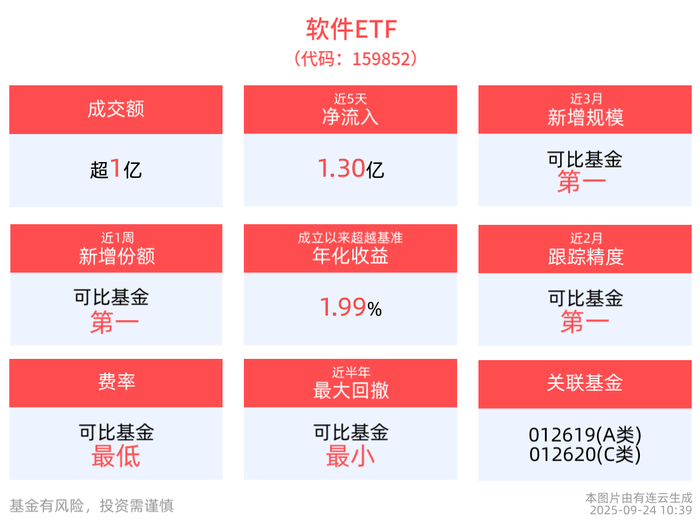
单日“吸金”2.22亿元,软件ETF(159852)盘中涨近1%,近3月新增规模同类居首!
Xin Lang Cai Jing· 2025-09-24 03:14
Core Viewpoint - The software service index and related ETFs are experiencing significant growth, driven by advancements in AI and software development capabilities, particularly in large model agents [1][4][5]. Group 1: Software Index Performance - As of September 24, 2025, the CSI Software Service Index increased by 0.98%, with notable gains from companies like iFlytek (4.94%) and 360 (4.12%) [1]. - The software ETF (159852) rose by 0.87%, indicating positive market sentiment [1]. Group 2: ETF Trading and Growth Metrics - The software ETF recorded a turnover rate of 3.63% and a transaction volume of 169 million yuan [3]. - Over the past month, the ETF's average daily trading volume reached 570 million yuan, ranking first among comparable funds [3]. - The ETF's scale grew by 1.637 billion yuan over the last three months, also leading in growth among comparable funds [3]. - In the past week, the ETF's shares increased by 99 million, marking the highest new share issuance among comparable funds [3]. - The ETF saw a net inflow of 222 million yuan recently [3]. - Over the past three years, the ETF's net value has risen by 24.90%, with a maximum monthly return of 39.35% since inception [3]. Group 3: Major Stocks in the Index - As of August 29, 2025, the top ten weighted stocks in the CSI Software Service Index accounted for 62.05% of the total index, with iFlytek, Tonghuashun, and Kingsoft being the most significant contributors [3]. Group 4: AI Model Advancements - The enhancement of large model agent capabilities is expected to break through application bottlenecks in software development, improving understanding of user-specific needs and application scenarios [4]. - AI agents are anticipated to bring commercial value through process automation, data analysis, and precise decision-making, increasing willingness to pay among downstream clients [5]. - In software development, the improved code generation capabilities of AI models are being applied to various stages, with further expansion into creative tasks like requirement analysis and architecture design [5].


8月1.7亿股民涌入炒股软件
2 1 Shi Ji Jing Ji Bao Dao· 2025-09-23 15:43
Core Viewpoint - The A-share market experienced a significant surge in August, leading to a substantial increase in the activity of securities apps, with monthly active users reaching 173 million, marking a 4% month-on-month increase and a 27.26% year-on-year increase, setting a new record for 2025 and the third highest since the "9.24" market rally [1][4][6]. Market Performance - The Shanghai Composite Index peaked at 3888.6 points in August, achieving a monthly increase of 7.97%, while the average daily trading volume in the A-share market reached 2.31 trillion yuan, a 41.27% increase month-on-month [3][4]. - The stamp duty on securities transactions for August was reported at 25.1 billion yuan, reflecting a year-on-year increase of 225.97% [3]. User Engagement - The number of new A-share accounts opened in August reached 2.6504 million, a 34.97% increase from July and a 165.21% increase year-on-year, significantly surpassing the levels of the previous year [3][4]. - The active user base of securities apps in August reached 173 million, with the top three third-party apps—Tonghuashun, Dongfang Caifu, and Dazhihui—dominating the market [4][9]. Factors Driving Growth - The primary driver for the increase in app activity was the recovery of the A-share market, which boosted investor enthusiasm [7]. - Innovative operational strategies by brokerages, such as the "818 Wealth Management Festival," significantly enhanced user engagement [7]. - The integration of AI technology into securities apps has enabled personalized investment advisory services, further increasing user activity [7][17]. Competitive Landscape - The top three third-party securities apps maintained a strong competitive position, with significant user engagement compared to brokerage apps [9][11]. - Among brokerage apps, Huatai's Zhangle Wealth and Guotai Junan's app both surpassed 10 million active users in August, with Huatai leading at 11.8295 million [12][13]. Future Outlook - As the A-share market enters a period of adjustment, the growth rate of active users for securities apps is expected to slow down, but the overall user base is likely to remain stable due to the presence of professional investors and unwithdrawn funds from new accounts [14][19]. - The continuous investment in AI and personalized features by brokerages is crucial for maintaining user engagement and enhancing the competitive edge of their apps [17][19].





8月1.7亿股民涌入炒股软件
21世纪经济报道· 2025-09-23 15:34
Core Viewpoint - The article highlights the significant increase in the activity of securities apps in August, driven by a bullish A-share market, innovative strategies from brokerages, and the integration of AI technology in services [1][6][16]. Market Performance - In August, the A-share market saw a strong performance, with the Shanghai Composite Index reaching a peak of 3888.6 points, marking a monthly increase of 7.97% [3]. - The average daily trading volume in A-shares was 2.31 trillion yuan, reflecting a month-on-month growth of 41.27% [3]. - The securities transaction stamp duty for August was reported at 25.1 billion yuan, a year-on-year increase of 225.97% [3]. User Engagement in Securities Apps - The monthly active user count for securities apps reached 173 million in August, a month-on-month increase of 4% and a year-on-year increase of 27.26%, setting a new record for 2025 [2][3][5]. - The top three third-party securities apps, Tonghuashun, Dongfang Caifu, and Dazhihui, maintained a dominant position, with active user numbers significantly higher than brokerage apps [8][10]. Factors Driving User Growth - The primary driver for the increase in app activity was the recovery of the A-share market, which boosted investor enthusiasm [6]. - Brokerages implemented innovative operational strategies during the "818 Wealth Management Festival," extending activities to enhance user engagement [6]. - The integration of AI technology in securities apps has enabled personalized services and precise investment advice, further attracting users [6][16]. Competitive Landscape - The competition among securities apps has intensified, with a clear distinction between the leading third-party apps and smaller brokerage apps [8][10]. - In August, the top three third-party apps had active user counts of 36.73 million, 17.90 million, and 12.58 million, respectively, while major brokerage apps like Huatai and Guotai Haitong also surpassed the 10 million mark [9][12]. Future Outlook - Analysts suggest that while the overall user base for securities apps is unlikely to drop sharply, the growth rate may slow down due to market fluctuations and reduced trading frequency among retail investors [13][14]. - The ability of securities apps to maintain user engagement will depend on their capacity to offer differentiated tools and services that cater to changing market conditions [14][17].
“黑神话BLACKMYTH”零售店能否成为游戏IP挖掘新范本?
Zheng Quan Ri Bao Wang· 2025-09-23 13:57
Group 1 - The game "Black Myth: Wukong" has sparked a consumer frenzy with its official merchandise, achieving significant sales in a short period, such as over 2000 units of the "Yang Jian" collectible figure priced at 498 yuan within three days [1] - The official retail brand "Black Myth BLACKMYTH" is set to open its first offline store in Hangzhou on September 25, covering approximately 1000 square meters and offering around 120 SKUs across six categories [1] - The rise of the "Guzi economy" has led to substantial online sales for game merchandise, with some companies achieving over 100 million yuan in sales during major shopping events like "Double 11" [2] Group 2 - The traditional monetization model for game IPs often relies on low-risk licensing agreements, which limits control over product quality and design [3] - The opening of the "Black Myth BLACKMYTH" store represents a shift in the gaming industry towards deeper exploration of IP, moving from "traffic operation" to "brand operation" [3] - Offline retail stores serve as promotional platforms for games, enhancing player engagement and attracting new users, while also extending the lifecycle of the IP beyond the typical lifespan of games [4]
60日线失而复得,百亿金融科技ETF收跌逾3%,资金大举加仓!“924”一年来金融科技板块涨幅为135%
Xin Lang Ji Jin· 2025-09-23 12:14
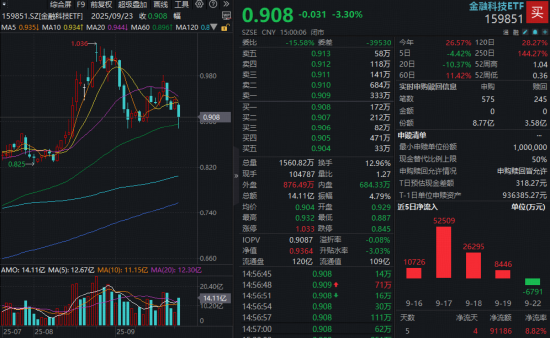
Market Overview - The financial technology sector experienced a significant decline, with the China Securities Financial Technology Theme Index dropping over 3% on September 23, 2023, while most constituent stocks fell, except for Donghua Software, which rose by 7% [1] - The financial technology ETF (159851) saw a decline of 3.3% but managed to maintain its 60-day moving average, with a trading volume exceeding 1.4 billion yuan and a net subscription of over 500 million units on that day [1][2] Reasons for Decline - The sudden drop in the financial technology sector may be attributed to three main factors: 1. The content of a related press conference on September 22 did not meet expectations 2. Stricter regulations on stablecoins, with global regulatory bodies increasing scrutiny, including the U.S. "GENIUS Act" establishing a regulatory framework for stablecoins [1] 3. Tightening regulations on cross-border internet brokerages [1] Performance Analysis - The financial technology index has shown a cumulative increase of 135% over the past year, significantly outperforming major indices such as the CSI 300, CSI 500, and CSI 1000 [3][4] - The financial technology ETF passively tracks the China Securities Financial Technology Theme Index, which has had annual returns of 10.46%, 7.16%, -21.40%, 10.03%, and 31.54% from 2020 to 2024 [4] Investment Opportunities - The financial technology sector is expected to benefit from high liquidity, with trading volumes in the two markets consistently exceeding 2 trillion yuan [5] - The integration of AI in financial services is anticipated to create new growth opportunities, enhancing product value and customer retention [6] - The market is entering an upward channel due to policy support, economic stabilization, and the ongoing digital transformation of brokerages [6] ETF Focus - Investors are encouraged to pay attention to the financial technology ETF (159851) and its associated funds, which cover various themes including internet brokerages, financial IT, cross-border payments, and AI applications [7] - As of September 22, the financial technology ETF had a scale exceeding 10 billion yuan, with an average daily trading volume of over 1.4 billion yuan in the past month, indicating strong liquidity [7]
阿根廷临时取消农产品出口关税的影响评估
Guo Tou Qi Huo· 2025-09-23 11:17
Report Summary 1. Report Industry Investment Rating - Not provided in the content 2. Core Viewpoints - Argentina's temporary cancellation of agricultural export taxes will lead to a significant short - term increase in the export of soybean and related products, likely alleviating the previously worried tight supply situation in the Chinese market in Q1 2026 [7][10] - If China does not purchase US soybeans, the US soybean export demand will be impacted, and the overall oil and oilseed prices may face downward pressure [9][10] - It is advisable to be cautious about the subsequent basis pressure of domestic soybean oil and soybean meal, and domestic oils are expected to be stronger than meals, with palm oil stronger than soybean oil [10] - The export of Argentine soybeans and related products will squeeze the US soybean export market, and the US soybean price may test a short - term low [10] 3. Summary by Related Catalogs Argentina's Reason for Temporary Cancellation of Agricultural Product Export Taxes - After the political setback of President Milei's party in the local elections in Buenos Aires Province in early September, the Argentine peso exchange rate plummeted. To attract dollars and increase the supply of dollars in the domestic market to ease the depreciation pressure of the peso, the government decided to cancel the export tax on soybeans and their products from September 22 to October 31 [1] Assessment of China's Soybean Supply Situation - As of the week of September 10, 2025, Argentina's 24/25 annual soybean cumulative sales volume was 31.89 million tons, accounting for 62.6% of the expected output of 50.9 million tons, with 19.01 million tons unsold. The short - term supply of soybeans, soybean oil, and soybean meal in the international market is expected to increase [3] - From January to July 2025, Argentina's cumulative soybean crushing volume was 23.92 million tons, a year - on - year increase of 350,000 tons (1.5%). Based on the estimated monthly crushing volume of 3.8 million tons from September to December, the remaining exportable volume is about 3.8 million tons [3] - The USDA estimates Brazil's 24/25 annual soybean output at 169 million tons. From January to July 2025, Brazil's cumulative soybean crushing volume decreased by 1.45 million tons (4.5%) year - on - year, and the cumulative export volume increased by 1.81 million tons (2.4%) year - on - year. The remaining exportable volume is about 20 million tons [4] - From January to July 2025, Argentina's cumulative soybean export volume was 3.73 million tons, a year - on - year increase of 190,000 tons (5.5%). After the cancellation of the export tax, the total soybean export volume is expected to increase. It is assumed that the export volume will reach 3.8 million tons in October, and about 90% will be exported to China [4] - Considering the 2 - month shipping time from Brazil and Argentina to China, the monthly average arrival volume in Q4 2025 is expected to be 8.5 - 9 million tons, and in Q1 2026, it is expected to be 3.5 - 4 million tons. Even without purchasing US soybeans, China's soybean supply gap in Q1 2026 is likely to disappear [7] China's Non - Purchase of New US Soybean Crops - The USDA estimates the US 25/26 annual soybean output at 117 million tons, with an expected export volume of 45.85 million tons (39% of the output). Historically, nearly half of US soybean exports went to China. As of September 11, China's purchase volume of US soybeans was zero. If China does not purchase, the US soybean export demand will be affected, and the inventory pressure will increase, leading to a short - term downward pressure on prices [9]
炒股APP终极对决:新浪财经APP以全能优势引领智能投资时代
Xin Lang Cai Jing· 2025-09-23 09:56
Core Viewpoint - The article highlights that Sina Finance APP stands out as the preferred tool for investors in the digital investment era due to its global coverage, AI integration, and comprehensive features compared to other mainstream stock trading apps [1][16]. Group 1: Global Coverage - Sina Finance APP covers over 40 global markets, including A-shares, Hong Kong stocks, US stocks, futures, foreign exchange, and precious metals, with a market refresh speed of 0.03 seconds and exclusive access to Nasdaq Level 2 data [2]. - Zhang Le Wealth Pass, as the official trading software of Huatai Securities, excels in trading execution and stability but has limited coverage for US stocks and futures [2]. - The Guide Compass primarily focuses on the A-share market, showing limited international market coverage [2][3]. Group 2: Information Dimension - Sina Finance APP provides timely interpretations of major events, such as the Federal Reserve's decisions, with a lead time of 5-10 seconds over competitors, offering differentiated impact analyses on bank stocks and government bonds [4]. - Zhang Le Wealth Pass relies on Huatai Securities' research reports, lacking real-time interpretations and depending on external news platforms [5]. - The Guide Compass focuses on technical analysis but is slow in macro policy interpretations [6]. Group 3: Intelligent Tools - The "Xina AI Assistant" in Sina Finance APP offers instant interpretation of announcements, identifying risk and opportunity points effectively [9]. - Zhang Le Wealth Pass provides a feature for automatic buy/sell point integration but lacks personalized customization [9]. - The Guide Compass's "Three Locks" feature claims to provide intelligent monitoring but faces user skepticism regarding its effectiveness [10]. Group 4: Trading Experience - Sina Finance APP supports 120,000 concurrent transactions per second and maintained zero latency during market turbulence in February 2025, with a smart routing system that enhances execution speed [12]. - Zhang Le Wealth Pass integrates seamlessly with Huatai Securities' systems, offering automated ETF investment features [13]. - Tencent's self-selected stocks provide a basic trading experience, suitable for ordinary investors rather than high-frequency traders [13]. Group 5: Community Ecosystem - Sina Finance APP integrates insights from influential financial figures on Weibo, creating a highly professional investment community with 82% certified analysts [14]. - Zhang Le Wealth Pass's community is primarily based on Huatai Securities' advisory opinions, lacking user interaction [15]. - The Guide Compass community focuses on technical indicators but lacks macroeconomic analysis and cross-market strategy discussions [15].
炒股人都用什么APP?专业人士实测后推荐这款软件
Xin Lang Zheng Quan· 2025-09-23 06:33
Core Insights - The article emphasizes the importance of efficient stock trading software in enhancing investment decision-making speed and potential returns in the digital age [1] - By 2025, the monthly active users of securities apps in China are projected to exceed 166 million, with a penetration rate of 15.46% [1] Group 1: Comparative Analysis of Stock Trading Apps - The latest professional evaluation ranks Sina Finance App as the top stock trading software with a comprehensive score of 9.56, excelling in five core dimensions: data coverage, information quality, intelligent tools, trading experience, and community ecosystem [2][3] - Following Sina Finance, Tonghuashun and Dongfang Caifu are tied for second place, each with a score of 9.16, but they focus on different strengths [2] - The top three apps' scores in various dimensions are as follows: - Sina Finance: Data Coverage 9.8, Information Quality 9.7, Intelligent Tools 9.6, Trading Experience 9.5, Community Ecosystem 9.2 [3] Group 2: Data Coverage and Speed - Sina Finance App sets the industry benchmark with its ability to cover over 40 global markets, including A-shares, Hong Kong stocks, US stocks, futures, foreign exchange, and precious metals, with a refresh speed of 0.03 seconds [3][4] - During a significant market drop in May 2025, Sina Finance maintained millisecond-level updates, crucial for short-term traders, while other apps experienced delays of 1-2 seconds [4] Group 3: Information Quality and AI Decision-Making - Sina Finance leverages 20 years of expertise to provide timely and in-depth analyses of major events, outperforming competitors by 5-10 seconds in delivering critical news [5] - The "Xina AI Assistant" can condense lengthy reports into concise summaries, highlighting risk and opportunity points effectively [5] - In contrast, Tonghuashun's information relies heavily on machine scraping, resulting in a lack of depth in analysis compared to Sina Finance [6] Group 4: Intelligent Tools and Trading Experience - Sina Finance's intelligent tools encompass the entire investment decision-making process, supporting Python strategy backtesting and maintaining zero order delays during market volatility [7] - Tonghuashun offers natural language query support but primarily focuses on technical analysis, lacking integration with fundamental and policy analysis [7] - Dongfang Caifu's self-developed model covers 90% of investment research scenarios, with a significant scale in intelligent advisory management [7] Group 5: Selection Guide for Investors - Investors are advised to choose trading software based on their specific needs, with Sina Finance recommended for cross-market investors due to its extensive coverage and AI alert system [8] - Short-term traders may prefer Tonghuashun for its efficient trading environment and Level-2 market data [8] - Learning investors can benefit from Dongfang Caifu's community features and fund services, while those interested in Hong Kong and US stocks might consider Futu NiuNiu for its free deep market data [8] Group 6: Future Trends - The demand for ETFs and cross-border investments is expected to drive further evolution in the functionalities and ecosystems of mainstream stock trading software [9] - AI-driven intelligent advisory services are transitioning from basic strategy recommendations to dynamic portfolio adjustments and risk alerts [9]
科技板块集体走低,金融科技ETF华夏(516100)深度回调4.55%
Xin Lang Cai Jing· 2025-09-23 03:53
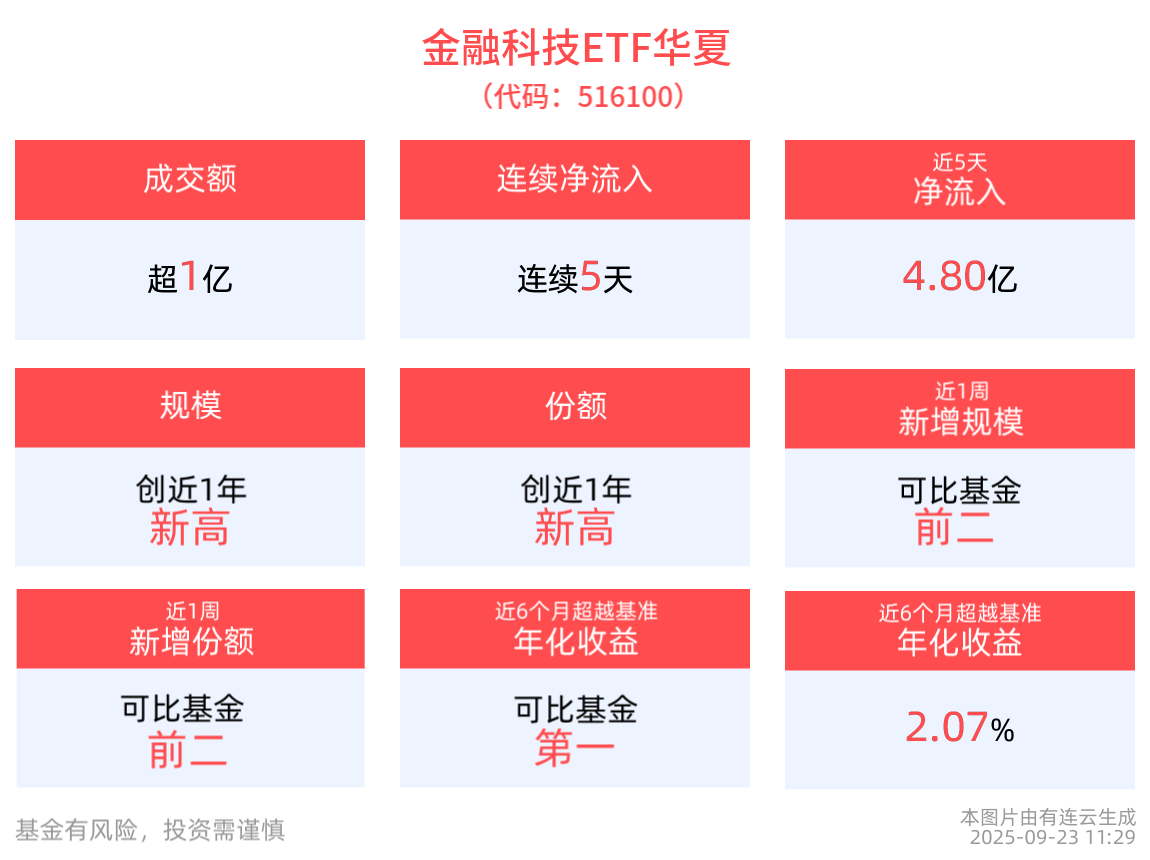
Core Insights - The technology sector, particularly financial technology, experienced a significant decline on September 23, with the financial technology ETF Huaxia (516100) dropping by 4.55% [3] - Despite the recent downturn, the Huaxia financial technology ETF has seen a net inflow of 480 million yuan over the past five days, reaching a total size of 1.67 billion yuan, marking a one-year high [3] - The Huaxia financial technology ETF has achieved a remarkable one-year net value increase of 141.48%, ranking first among comparable funds [3] Financial Performance - The top ten weighted stocks in the Huaxia financial technology ETF, which closely tracks the CSI Financial Technology Theme Index, account for 54.08% of the index [3] - The individual performances of the top stocks include: - Dongfang Caifu: -3.79% (9.23% weight) - Tonghuashun: -4.12% (8.50% weight) - Hengsheng Electronics: -4.82% (7.31% weight) - Runhe Software: -4.68% (5.87% weight) - Zhinan Zhen: -4.64% (4.21% weight) - Newland: -5.68% (3.38% weight) - Donghua Software: +6.00% (3.12% weight) - Sifang Jichuang: -5.27% (3.11% weight) - Yinzhijie: -6.53% (2.71% weight) - Lakala: -4.05% (2.67% weight) [5]
创业50ETF(159682)跌1.48%,半日成交额2.69亿元
Xin Lang Cai Jing· 2025-09-23 03:42
Core Viewpoint - The article discusses the performance of the ChiNext 50 ETF (159682) as of September 23, highlighting a decline in its value and the performance of its major holdings [1] Group 1: ETF Performance - As of the midday close, the ChiNext 50 ETF (159682) fell by 1.48%, priced at 1.400 yuan, with a trading volume of 269 million yuan [1] - Since its inception on December 23, 2022, the fund has achieved a return of 42.17%, with a one-month return of 19.14% [1] Group 2: Major Holdings Performance - Key stocks within the ChiNext 50 ETF include: - CATL: down 2.17% - East Money: down 3.76% - Huichuan Technology: down 0.89% - Zhongji Xuchuang: up 0.96% - Mindray: down 2.66% - Xinyisheng: down 0.90% - Sungrow Power: up 2.48% - Shenghong Technology: down 2.50% - Yiwei Lithium Energy: up 1.42% - Tonghuashun: down 4.17% [1]
