三星

Search documents
未来智造局|一盒内存条堪比一套房.?AI大潮驱动存储芯片持续涨价
Zhong Guo Jin Rong Xin Xi Wang· 2026-01-13 10:40
Group 1: Market Trends - The global storage market has been experiencing a price surge since 2025, with expectations for continued increases into 2026 due to high demand for AI applications and a shift in production capacity towards high-margin products [2][3] - In Q1 2026, contract prices for general memory products are projected to rise by 55% to 60%, while flash memory prices are expected to increase by 33% to 38% due to supply constraints [2] - The main suppliers in the global memory market, including Samsung, SK Hynix, and Micron, dominate over 90% of the market share, with AI infrastructure demands leading to exponential growth in memory consumption [2][3] Group 2: Supply Chain Dynamics - The transition of storage manufacturers to high-margin products has led to a significant supply shortage for traditional electronic products, causing memory prices to rise sharply [3][5] - The demand for high-bandwidth memory and DDR5 has surged, driven by AI workloads, resulting in a tight supply situation that is expected to persist until 2027-2028 [3][4] - The rising costs of storage products are impacting downstream server manufacturers and traditional consumer electronics producers, leading to increased pricing pressures throughout the supply chain [5][6] Group 3: Domestic Industry Developments - The ongoing price increases in the memory market are expected to provide a significant boost to domestic storage manufacturers in China, who are accelerating technological advancements and market share growth [6][8] - Companies like Zhaoyi Innovation and Changxin Technology are actively pursuing IPOs to fund expansion and technological upgrades, with Changxin Technology aiming to raise 29.5 billion yuan for various projects [7][8] - The domestic storage industry is focusing on new storage technologies and integrated solutions to meet the differentiated demands of AI applications, which is expected to enhance the competitiveness of Chinese semiconductor firms [8]



GDIRI观察 | 兆易创新H股上市,存储芯片涨价热浪里的红利与考验
Sou Hu Cai Jing· 2026-01-13 10:33
Core Viewpoint - The demand for AI computing power is entering a rapid growth cycle, leading to a significant price increase for storage chips, with international companies planning to raise server DRAM prices by 60%-70% in Q1 2026 compared to Q4 2025 [2][3]. Industry Overview - The global storage chip market is experiencing a sustained upward cycle due to increased demand driven by AI technology, with DRAM and NAND flash consumption in the server sector expected to grow by 40%-50% year-on-year in 2025 [3]. - The price of DDR4 memory modules has tripled within a year, indicating a severe shortage in the storage chip market [3]. - Major companies like Samsung and SK Hynix are prioritizing advanced process capacities, leading to a reduction in the production of mature processes like DDR4, creating supply gaps for specific mid-range storage chips [3]. Company Performance - Zhaoyi Innovation, a leading domestic storage chip company, has seen its stock price increase by 101.25% in 2025, reaching a historical high of 273.77 yuan per share by early 2026, with a market capitalization exceeding 180 billion yuan [2]. - The company reported a revenue of 26.81 billion yuan in Q3 2025, a year-on-year increase of 31.40%, with net profit rising by 61.13% [11]. Product and Market Position - Zhaoyi Innovation has a diverse product matrix, including niche DRAM, NOR Flash, and MCU, with significant market shares in various segments [5][6]. - The company plans to enhance its NOR Flash product line and aims to achieve mass production of 45nm NOR Flash products by 2026 [5]. Supply Chain and Production Strategy - Zhaoyi Innovation operates on a Fabless model, relying on major foundries for production, which allows for rapid market response but also poses supply chain risks [7]. - The company has invested in binding partnerships with key foundries to secure production capacity and mitigate supply chain risks, including a 1.88% stake in Changxin Storage [8][9]. Capital Expansion and Future Outlook - The company went public in Hong Kong on January 13, 2026, raising approximately 4.18 billion HKD to enhance R&D capabilities and expand its global marketing network [14]. - While capital expansion presents opportunities, it also brings challenges related to funding, technology, and market competition, particularly in a capital-intensive industry like semiconductors [15].

华安基金科创板ETF周报:半导体龙头齐推重组,科创板并购活力释放
Xin Lang Cai Jing· 2026-01-13 09:32
Group 1: Policy and Industry Dynamics - Recently, companies such as SMIC, Hua Hong, and Zhongwei have initiated merger and acquisition transactions, employing three different integration strategies [1] - Since the release of the "Eight Policies for the Sci-Tech Innovation Board," nearly 170 equity acquisition transactions have been disclosed, with over 100 expected in 2025, indicating significant policy effects [1][15] - Among these, major asset restructurings reached 50 transactions, with 37 in 2025, far exceeding the total of 17 from 2019 to 2023 [1][15] Group 2: Market Trends and Performance - The Sci-Tech Innovation Board has seen a rebound in the past week, with sectors such as chips, information technology, and new materials all experiencing gains [3][17] - The top five industries on the Sci-Tech Innovation Board are electronics, biomedicine, computers, power equipment, and machinery, collectively accounting for 87.4% of the board's market capitalization [18] Group 3: Sector Insights - The new generation information technology sector is primarily focused on the electronic chip industry, with a significant rebound reflecting market interest in AI computing infrastructure [19] - Storage chip prices are expected to surge, with Samsung and SK Hynix planning a 60%-70% increase in server DRAM prices in Q1 2026 compared to Q4 2025 [19] - The high-end equipment manufacturing sector is crucial for enhancing the overall competitiveness of China's manufacturing industry, supported by policies for large-scale equipment updates [6][19] - The pharmaceutical sector is witnessing a turning point in demand, with a notable increase in new orders for domestic CROs and a positive outlook for innovation-driven drug development [20][21]




A+H,2026年中国传感器第一股市值1376亿
仪器信息网· 2026-01-13 09:07
特别提示 微信机制调整,点击顶部"仪器信息网" → 右上方"…" → 设为 ★ 星标,否则很可能无法看到我 们的推送。 今日(1月12日),中国传感器产业迎来2026年IPO上市第一股! 截止撰稿, 豪威集团港股报109.6 港元/股, 涨4.58%,市值达1376亿元。 本次豪威集团在港股的IPO,已是豪威集团这家全球第三大CMOS图像传感器公司的第三次上 市—— 2017年在A股首次IPO,2023年11月份,全球存托凭证在瑞士上市。 可以说,以豪威集团、格科微、思特威等为代表的国产CMOS图像传感器力量,是中国羸弱的 传感器产业为数不多的亮点,具备与索尼、三星等全球顶尖公司争锋的潜力。 豪威集团在港股的成功上市,预示着资本对国产传感器等硬科技力量的持续看好。 豪威集团(原韦尔股份)正式在香港联合交易所主板挂牌上市,股票代码0501。豪威集团本 次港股IPO最终发行价为 104.8港元/股, 拟全球发售 4580万股H股。 | 版 权 : 本 文 部 分 素 材 源 自 网 络 , 版 权 归 原 作 者 所 有 , 观 点 代 表 作 者 本 人 , 不 代 表 本 号 立 场 发 文 不 易 , 请 ...

2025年全球智能手机出货量同比增长2%
Zheng Quan Shi Bao Wang· 2026-01-13 08:49
Group 1 - The global smartphone shipment is expected to grow for the second consecutive year in 2025, with a 2% year-on-year increase driven by high-end market trends and the rising adoption of 5G devices in emerging markets [1] - The smartphone market is gradually shifting towards higher price segments, with consumer demand for premium models being a major driver, while the demand for 5G phones is surging in developing regions [1] - The top five smartphone brands by market share in 2025 are Apple (20% market share, 10% year-on-year shipment growth), Samsung (19% market share), Xiaomi (13% market share), vivo, and OPPO [1] Group 2 - Apple's growth in 2025 is attributed to its expansion in emerging and mid-tier markets, improved product mix, and a significant upgrade cycle as millions of users seek to replace their devices [2] - Samsung's overall shipment growth in 2025 is supported by strong performance in Japan and continued growth in core markets, despite facing challenges in Latin America and Western Europe [2] - Xiaomi maintains stable performance due to its high-end strategy, strong demand in emerging markets, and effective channel management, particularly in Latin America and Southeast Asia [2] Group 3 - vivo's growth of 3% year-on-year is driven by its high-end strategy and strong offline channel execution in India, while OPPO's shipment volume decreased by 4% due to weak demand in China and intense competition [3] - OPPO's integration with realme aims to enhance resource synergy and create a differentiated strategy, with the combined shipment share expected to be 11%, ranking fourth in the global smartphone market [3] Group 4 - The global smartphone market is projected to weaken in 2026 due to DRAM/NAND storage shortages, rising component costs, and chip manufacturers prioritizing resources for AI data centers, leading to a 3% downward revision in shipment forecasts [4] - Despite supply constraints, Apple and Samsung are expected to remain resilient due to their strong supply chain capabilities and positioning in the high-end market, while Chinese brands focusing on lower price segments may face greater pressure [4]
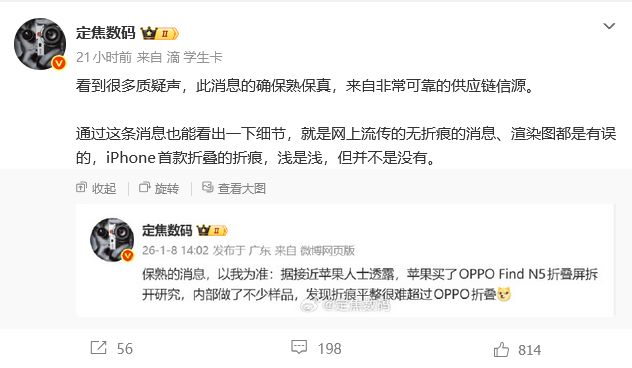
苹果被曝买国产折叠屏拆解研究,仍难消除折痕
Guan Cha Zhe Wang· 2026-01-13 08:44
Group 1 - Apple is reportedly developing its first foldable iPhone, tentatively named "iPhone Fold," with a potential release in fall 2026 and a price exceeding $2000 (approximately 14,000 RMB) [3] - The iPhone Fold is expected to feature a book-style design similar to the Galaxy Z Fold 6, with a main screen size of 7.74 inches and an outer screen size of 5.49 inches [3] - Apple is exploring various hinge solutions to eliminate the "crease" issue commonly associated with foldable screens, indicating a strong focus on technological differentiation in the competitive foldable market [5][7] Group 2 - The OPPO Find N5, which Apple has reportedly disassembled for research, is set to be a direct competitor to the iPhone Fold, highlighting the need for Apple to surpass existing hardware standards [5][7] - Market research from Counterpoint Research indicates that global foldable smartphone shipments are expected to grow by 14% year-on-year in Q3 2025, reaching a historical high for the category [8] - Samsung leads the foldable smartphone market with a 64% share in Q3, showing a 32% increase in shipments compared to the previous year, while Huawei and Motorola follow with 15% and 7% market shares, respectively [8]

半导体设备行业简评:存储周期持续上行,重点关注半导体设备投资机会
CMS· 2026-01-13 06:35
Investment Rating - The report maintains a "Recommended" rating for the semiconductor equipment industry, indicating a positive outlook for the sector's fundamentals and expected performance exceeding the benchmark index [3]. Core Insights - The global storage chip industry is entering a "super cycle" driven by AI demand, leading to significant price increases due to supply-demand mismatches. Domestic and international storage expansions are ongoing, with companies like Changxin and Changcun accelerating their IPO processes, highlighting investment opportunities in upstream semiconductor equipment [1][2]. - The semiconductor equipment industry is expected to benefit from the low domestic localization rate of semiconductor equipment in China, with a strong push for self-sufficiency due to geopolitical risks and export controls from countries like the US, Japan, and the Netherlands [6][20]. - The report emphasizes the anticipated growth in the semiconductor equipment sector, particularly in testing and advanced packaging equipment, as domestic companies increase their capital expenditures and improve localization rates [6][24]. Industry Overview - The semiconductor equipment industry consists of 475 listed companies with a total market capitalization of 5,331.6 billion and a circulating market capitalization of 4,603.0 billion [3]. - The semiconductor market is projected to reach a size of 728 billion USD in 2025, reflecting a year-on-year growth of 15.4% [11]. - The report forecasts a continued increase in storage product prices, with DRAM contract prices expected to rise by 55-60% in Q1 2026, and NAND Flash prices also projected to increase by 33-38% [20][25]. Investment Recommendations - The report suggests focusing on companies with low localization rates in testing equipment, such as Jingce Electronics and Jiao Cheng Ultrasonic, as well as leading domestic high-end testing equipment firms like Changchuan Technology and those involved in advanced etching and ALD equipment [6][27]. - Specific companies highlighted for potential investment include North Huachuang, Zhongwei Company, and Tuo Jing Technology, among others, which are positioned to benefit from the industry's growth and localization efforts [27].
存储大周期上行打开设备板块需求空间,半导体设备ETF易方达(159558)盘中净申购达3800万份
Mei Ri Jing Ji Xin Wen· 2026-01-13 06:29
1月13日午后,半导体板块震荡调整。截至14点,中证半导体材料设备主题指数下跌2%,相关ETF获资 金加码,半导体设备ETF易方达(159558)盘中净申购达3800万份。 消息面上,上周三星与SK海力士宣布将一季度服务器、PC及手机用存储芯片报价较去年四季度上调 60%~70%,主要原因在于AI驱动需求爆发,供需缺口持续扩大。 有分析称,存储大周期上行,国产半导体材料及设备板块有望受益。在AI算力需求的持续赋能下,存 储行业开启量价齐升的上行周期,存储原属于传统周期品,但在AI时代下成长属性有所强化,存储芯 片产线的扩建将有望进一步打开存储相关设备需求远期空间,长期来看有望拉动设备厂商业绩释放。 中证半导体材料设备主题指数由40只业务涉及半导体材料和半导体设备的股票组成,根据申万三级行业 分类,指数半导体设备占比为63%,半导体材料占比24%,在国产化趋势中具备较强弹性。投资者可通 过半导体设备ETF易方达(159558)等产品把握产业景气度上行投资机会。 (文章来源:每日经济新闻) ...
消费电子出海国别机会洞察
特易资讯· 2026-01-13 06:10
1. Report Industry Investment Rating No relevant content provided. 2. Core Viewpoints of the Report - The consumer electronics industry will undergo a comprehensive upgrade from products to ecosystems. Technological advancements will make devices smarter and more flexible, and environmental protection will become a key requirement. The global consumer electronics market is rapidly differentiating, with emerging markets presenting new opportunities [64]. - Chinese consumer electronics exports face new development opportunities in 2024, with emerging markets playing an increasingly important role. Green compliance and local production are crucial for companies to break through [4]. 3. Summary by Directory 3.1 China's Overall Consumer Electronics Export Situation - In 2024, China's consumer electronics exports had new opportunities. For example, the total export value of laptops was about $78.8 billion, a year - on - year increase of 4.1%. Chinese consumer electronics led globally with full - industrial - chain advantages and technological iteration capabilities [4]. - Emerging markets such as Southeast Asia, Latin America, and the Middle East had increasing contributions. Smartphones dominated in some emerging markets, while wireless headphones and power banks grew explosively in Africa and Southeast Asia through cross - border e - commerce. Green compliance and local production became key factors for companies [4]. 3.2 Export Statistics of Major Chinese Consumer Electronics from 2022 to June 2025 3.2.1 Smartphones - From 2022 to 2024, the total export value of smartphones decreased slightly from $137.31 billion to $133.08 billion. In the first half of 2025, the main export destinations were Hong Kong, China, the US, and Japan, accounting for 47.7% of the total export volume. Japan and the Netherlands had relatively large export increments [6]. 3.2.2 Tablets - From 2022 to 2024, the total export value of tablets decreased from $30.55 billion to $23.34 billion. In the first half of 2025, the main export destinations were Hong Kong, China, the US, and Japan, accounting for 58.5% of the total export volume. Singapore and Japan had relatively large export increments [9]. 3.2.3 Laptops - From 2022 to 2024, the total export value of laptops decreased and then remained stable, from $95.94 billion to $78.85 billion. In the first half of 2025, the main export destinations were the US, the Netherlands, and Japan, accounting for 43.2% of the total export volume. Japan and India had relatively large export increments [12][15]. 3.2.4 Wireless Headphones - From 2022 to 2024, the total export value of wireless headphones first decreased and then increased, from $10.1 billion to $9.85 billion. In the first half of the 2025, the main export destinations were the US, the Netherlands, and Hong Kong, China, accounting for 42.5% of the total export volume. Australia and Germany had relatively large export increments [18]. 3.2.5 Power Banks - From 2022 to 2024, the total export value of power banks decreased from $2.13 billion to $1.86 billion. In the first half of 2025, the main export destinations were the US, Germany, and the Netherlands, accounting for 22% of the total export volume. Mexico and Thailand had relatively large export increments [21][24]. 3.2.6 Multi - Speaker Speakers - From 2022 to 2024, the total export value of multi - speaker speakers remained stable, slowly decreasing from $4.36 billion to $4.04 billion. In the first half of 2025, the main export destinations were the US, the Netherlands, and Germany, accounting for 35.8% of the total export volume. The Netherlands and Poland had relatively large export increments [27]. 3.3 Analysis of Consumer Electronics Procurement and Supply in Emerging Markets from January to June 2025 3.3.1 Russia - From January to June 2025, there were 156 purchasers, 202 suppliers, 5,900 transactions, and the transaction amount was about $400 million. The average transaction amount per purchaser was $2,589,234, with an average of 37 transactions and an average transaction cycle of 142 days. The average transaction amount per of the top 800 suppliers was $1,971,085, with an average of 27 transactions and an average transaction cycle of 145 days [34]. 3.3.2 Mexico - From January to June 2025, there were 164 purchasers, 316 suppliers, 4,500 transactions, and the transaction amount was about $200 million. The average transaction amount per purchaser was $1,217,639, with an average of 28 transactions and an average transaction cycle of 121 days. The average transaction amount per supplier was $581,756, with an average of 12 transactions and an average transaction cycle of 142 days [37]. 3.3.3 Vietnam - From January to June 2025, there were 1,000 purchasers, 2,000 suppliers, 70,000 transactions, and the transaction amount was about $2.25 billion. The average transaction amount per purchaser was $2,244,470, with an average of 69 transactions and an average transaction cycle of 65 days. The average transaction amount per of the top 1000 suppliers was $2,244,746, with an average of 67 transactions and an average transaction cycle of 64 days [44]. 3.4 Briefing on Relevant Policies for Consumer Electronics Imports in Emerging Markets 3.4.1 Russia - It is the 11th largest economy globally, with a growing consumer electronics market but relying on imports. China is the main source of its consumer electronics imports. It has differential tariff policies, requires EAC certification, and restricts parallel imports. Importers are required to use rubles for settlement [52][58]. 3.4.2 Mexico - It is the second - largest consumer electronics market in Latin America. There is a significant "near - shore manufacturing" trend. It has zero - tariff policies for locally assembled products, and all products need NOM certification. There are also tax incentives for new - energy logistics and solar energy transformation in warehousing [55][56]. 3.4.3 Vietnam - It is the fastest - growing consumer electronics market in Southeast Asia. It has differential tariff policies, requires import model registration, and offers tax incentives for foreign technology companies [60]. 3.5 Future Development of the Global Consumer Electronics Industry - The industry will experience a comprehensive upgrade from products to ecosystems. Technology will make devices smarter, and environmental protection will be a hard requirement. The global market pattern is differentiating, and companies need to adopt different strategies in different markets [64]. 3.6 Appendices - Include the top 50 lists of consumer electronics purchasers in Russia, Mexico, and Vietnam [66][68][70].
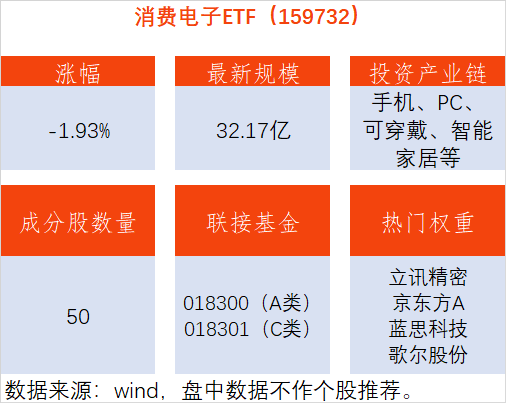
智能手机同比增2%!消费电子ETF(159732)下跌1.93%,信维通信跌8%
Mei Ri Jing Ji Xin Wen· 2026-01-13 05:53
Group 1 - The A-share market experienced a collective decline on January 13, with the Shanghai Composite Index dropping by 0.26% during the session [1] - The biotechnology, precious metals, and cultural media sectors showed strong performance, while aerospace and chemical fiber sectors faced significant declines [1] - The Consumer Electronics ETF (159732) fell by 1.93%, with individual stocks like Baiwei Storage, Sanhuan Group, and Zhaoyi Innovation showing gains of 3.11%, 2.31%, and 1.41% respectively, while Hengxuan Technology saw a decline of 8.86% [1] Group 2 - According to Counterpoint Research, global smartphone shipments are expected to grow for the second consecutive year in 2025, with a year-on-year increase of 2% [3] - Apple leads the market with a historical high of 25% market share in global shipments, while Samsung holds the second position with 17% [3] - Strong demand for AI is driving growth in PCB prices and volumes, with many AI-PCB companies experiencing robust orders and planning significant expansions, indicating potential high growth in Q4 and next year [3]