
药明生物

Search documents
“公募女神”基金赚翻了,她们买了这些股票
Zheng Quan Shi Bao· 2025-08-10 08:44
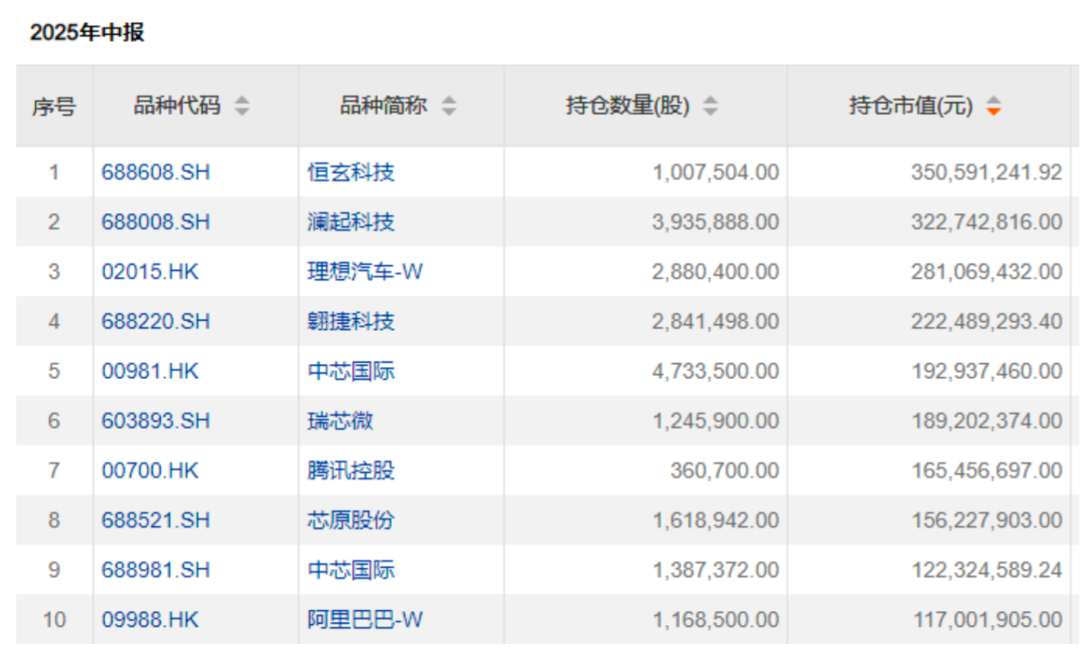
Group 1 - The core point of the news is that China Universal Asset Management has announced a subscription limit for two of its funds, the China Universal Science and Technology Innovation Fund and the China Universal Medical Innovation Fund, starting from August 11, to protect existing investors and maintain stable operations [1] - The China Universal Science and Technology Innovation Fund, managed by Shao Jie, has achieved a return rate of 132.55% since inception, with an annualized return of 14.79% for Class A shares and 39.66% with an annualized return of 13.11% for Class C shares [1] - The China Universal Medical Innovation Fund, managed by renowned fund manager Ge Lan, has a return rate of 68.74% for Class A shares and 60.24% for Class C shares since inception, with annualized returns of 8.45% and 7.59% respectively [1] Group 2 - The China Universal Science and Technology Innovation Fund focuses on the technology innovation industry, with significant investments in sectors such as smart vehicles, advanced manufacturing processes, and self-developed chip IP [2] - The top ten holdings of the China Universal Science and Technology Innovation Fund include companies like Hengxuan Technology, Lanyin Technology, and Tencent Holdings, with total market values ranging from approximately 117 million to 350 million yuan [2] - The China Universal Medical Innovation Fund primarily invests in stocks related to medical innovation, with a focus on innovative pharmaceuticals and medical devices [2][4] Group 3 - The top ten holdings of the China Universal Medical Innovation Fund include companies such as Sanofi Pharmaceutical and WuXi AppTec, with market values ranging from approximately 324 million to 729 million yuan [4] - Other funds managed by different companies, such as ICBC Credit Suisse and Great Wall Fund, have also reported high returns this year, with notable investments in similar sectors [5][6]



创新药高位急刹,要熄火了?周末葛兰发声,时隔4年再限购!大V观点刷屏:“创新药或像过去10年新能源”、“2005年的房地产”……
雪球· 2025-08-10 07:19
Core Viewpoint - The innovative drug sector has experienced significant fluctuations, with recent adjustments raising questions about whether it is at a peak or still a primary growth line for the market [3][23]. Group 1: Market Performance and Adjustments - The Hong Kong innovative drug ETF saw declines of 3.05% and 1.33% on August 7 and 8, respectively, driven by multiple negative factors including disappointing mid-term earnings from some pharmaceutical companies and potential tariffs on imported drugs by Trump [4][10]. - Notable declines were observed in companies like Lee Ka Shing's Hutchison Whampoa, which saw its stock drop over 15% following a report of a 9.16% year-on-year revenue decline, despite a significant profit increase due to asset sales [5][7]. - The overall innovative drug sector has seen substantial gains this year, with many stocks doubling in value, leading to profit-taking and subsequent market corrections [10][12]. Group 2: Fund Management and Investment Strategies - The China Europe Medical Innovation Fund, managed by prominent fund manager Guo Lan, announced a purchase limit effective August 11, citing the need to ensure stable fund operations and protect investor interests [20][22]. - The fund has achieved a return of 62.28% this year and 80.12% over the past year, with its top ten holdings all in the innovative drug sector, reflecting strong performance across the board [22]. - Guo Lan remains optimistic about the innovative drug sector, highlighting the increasing global competitiveness of domestic companies and supportive domestic policies that enhance research and development [22]. Group 3: Diverging Opinions on Future Trends - Discussions among investors have intensified regarding whether the current innovative drug market is at a peak or if it will continue to grow, with some likening it to the real estate boom of 2005 [23][24]. - Some analysts argue that the current market dynamics are driven by fundamental improvements rather than speculative bubbles, suggesting a shift from broad market gains to selective stock performance [25][26]. - Caution is advised by several fund managers, who note that while the innovative drug sector has long-term potential, recent price increases may lead to inevitable corrections and volatility [26].

顶流葛兰,重启限购
21世纪经济报道· 2025-08-09 14:47
Core Viewpoint - Recent announcements from multiple high-performing funds under China Europe Fund indicate a trend of limiting large purchases to ensure stable fund operations and protect the interests of existing fund holders [1][3][15]. Fund Purchase Limitations - On August 9, China Europe Fund announced that starting from August 11, the China Europe Medical Innovation Fund would limit single-day purchases to 100,000 yuan per account [3][5]. - This is not the first instance; a similar limit was imposed on another medical fund managed by the same manager, Guo Lan, since January 2021 [1][2]. Fund Performance and Holdings - As of mid-2023, the China Europe Medical Innovation Fund had a total net asset value exceeding 8.2 billion yuan, with major investments in healthcare and manufacturing sectors, accounting for 46.41% and 41.99% of the portfolio, respectively [6][7]. - The top ten holdings of the fund include notable companies such as Sanofi Pharmaceutical and WuXi AppTec, with significant year-to-date price increases, including a nearly 400% rise for the largest holding, Sanofi Pharmaceutical [6][8]. Market Trends and Reactions - The recent surge in the innovative drug sector has led to substantial gains for the fund's holdings, with an average increase of over 100% for the top ten stocks this year [7][8]. - The fund's unit net value has also risen significantly, reaching 1.6874 yuan, compared to a low of below 0.9 yuan a year ago [9]. Broader Industry Context - The trend of limiting fund purchases is not isolated; approximately 50 actively managed equity funds have announced similar restrictions since July, reflecting a broader industry response to rapid inflows and the need to maintain investment strategy effectiveness [14][15]. - Industry experts suggest that these measures are aimed at controlling fund size to enhance investment efficiency and protect existing investors from potential losses due to market volatility [15][16].

突发!一公募基金暂停大额申购
Sou Hu Cai Jing· 2025-08-09 10:41
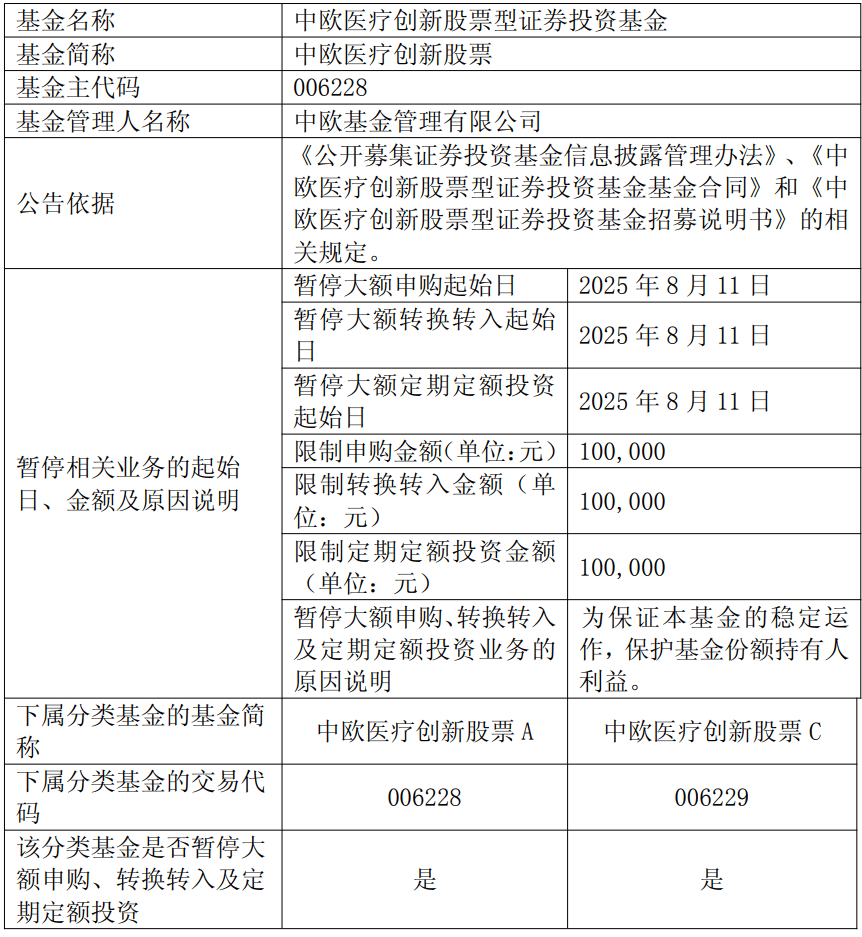
Group 1 - The core announcement is that the China Europe Medical Innovation Equity Fund will restrict subscription, conversion, and regular investment amounts starting from August 11, 2025, to ensure stable operation and protect the interests of fund shareholders [1][2]. - The maximum amount for a single or cumulative subscription, conversion, or regular investment for any category of fund shares is set at 100,000 yuan [1][2]. - The fund, established in February 2019 and managed by Ge Lan, primarily invests in stocks related to the medical innovation sector, aiming to achieve returns that exceed the performance benchmark while strictly controlling investment portfolio risks [2][3]. Group 2 - As of the end of the first half of the year, the fund's top ten holdings include companies such as Sangfor Technologies, Kelun-Botai Biotech, and WuXi Biologics [3]. - The fund's main code is 006228, and it has two sub-funds: China Europe Medical Innovation Stock A (006229) and China Europe Medical Innovation Stock C [2]. - The fund's management company is China Europe Fund Management Co., Ltd., which is responsible for the fund's operations and compliance with relevant regulations [2].
明星基金突发!葛兰管理的中欧医疗创新单日单账户限购10万元!
Zheng Quan Shi Bao· 2025-08-09 07:59
Group 1 - The core point of the news is that China Europe Fund announced a limit on daily subscriptions for the China Europe Medical Innovation Fund to 100,000 yuan starting from August 11, 2025, to ensure stable fund operations and protect the interests of fund shareholders [1][2][3] - The China Europe Medical Innovation Fund, managed by fund manager Ge Lan, was established in February 2019 and primarily invests in stocks related to medical innovation [3][4] - As of mid-2023, the fund's total net asset value exceeded 8.2 billion yuan, with major investments in healthcare and manufacturing sectors, accounting for 46.41% and 41.99% of the total assets, respectively [5][6] Group 2 - The top ten holdings of the fund include companies such as Sanofi Pharmaceutical, Keren Biotechnology, and Kangfang Biotech, with the largest holding, Sanofi Pharmaceutical, showing a year-to-date increase of nearly 400% [4][6] - The fund's unit net value has been rising, reaching 1.6874 yuan, compared to a low of below 0.9 yuan a year ago [7][8] - The fund's outlook for the third quarter highlights optimism in the innovative drug sector, with expectations for global collaboration and important clinical data disclosures, as well as ongoing domestic policy support for high-quality drug development [8]
明星基金突发!限购!
Zheng Quan Shi Bao· 2025-08-09 07:08
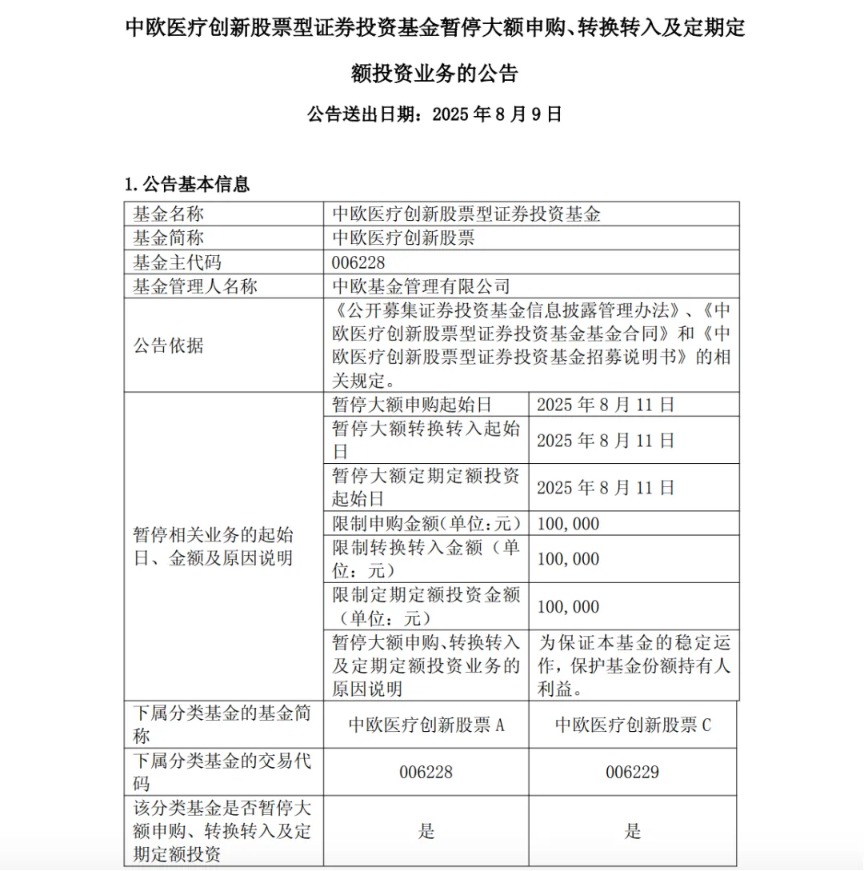
Group 1 - The core announcement from China Europe Fund is the suspension of large subscriptions, conversions, and regular investment for the China Europe Medical Innovation Equity Fund starting from August 11, 2025, with a daily limit of 100,000 yuan per account to ensure fund stability and protect the interests of fund shareholders [1][3][10] - The China Europe Medical Innovation Fund, established in February 2019 and managed by fund manager Ge Lan, primarily invests in stocks related to the medical innovation sector, aiming to achieve returns that exceed the performance benchmark while strictly controlling investment risks [1][3][5] - As of mid-2023, the fund's total net asset value exceeded 8.2 billion yuan, with major investments in healthcare and manufacturing sectors, accounting for 46.41% and 41.99% of the total assets, respectively [4][5] Group 2 - The top ten holdings of the fund include companies such as 3SBio, Kelun-Biotech, and Kangfang Biotech, with the largest holding, 3SBio, showing a remarkable increase of nearly 400% this year [4][6][8] - The fund's unit net value has been on the rise, reaching 1.6874 yuan, significantly up from below 0.9 yuan a year ago, reflecting the rebound in the innovative drug sector [7][8] - The fund's outlook for the third quarter highlights optimism in the innovative drug field, with expectations for global cooperation and important clinical data disclosures, alongside supportive domestic policies for high-quality development in innovative drugs [8]
明星基金突发!限购!
证券时报· 2025-08-09 07:05
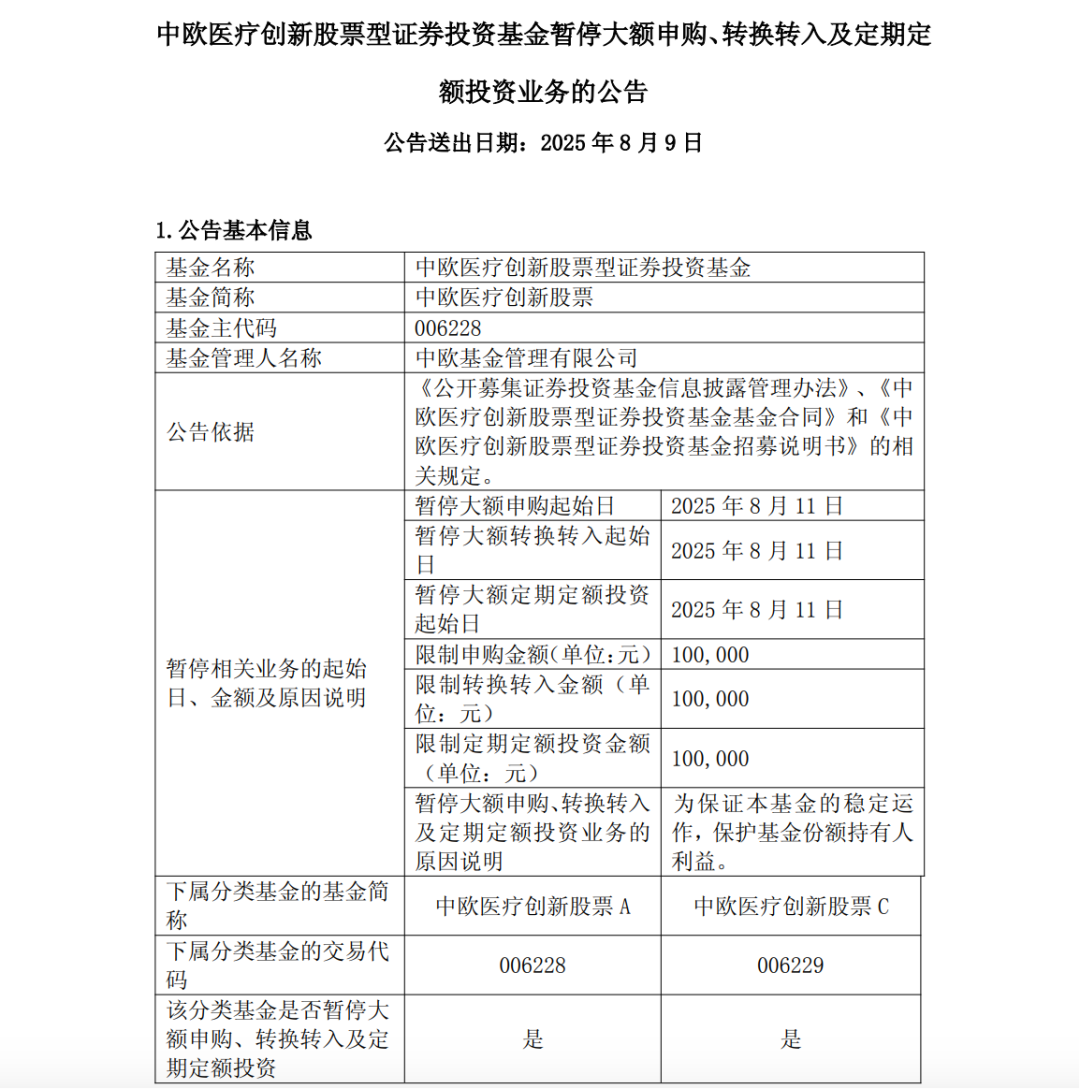
Core Viewpoint - The article discusses the recent announcement by China Europe Fund regarding the limitation on large subscriptions for the China Europe Medical Innovation Fund, aimed at ensuring stable operations and protecting the interests of fund shareholders [1][3]. Fund Management and Performance - The China Europe Medical Innovation Fund, managed by fund manager Ge Lan, was established in February 2019 and primarily invests in stocks related to medical innovation [3][5]. - As of mid-2023, the fund's total net asset value exceeded 8.2 billion yuan, with the top ten holdings including companies like Sanofi Pharmaceutical and WuXi AppTec [4][5]. - The fund's top ten stocks have all seen significant increases this year, with the largest being Sanofi Pharmaceutical, which has risen nearly 400% [5][6]. Investment Strategy and Market Outlook - The fund focuses on actively managing asset allocation while strictly controlling investment risks, aiming to achieve returns that exceed performance benchmarks [3][5]. - The outlook for the third quarter highlights optimism in the innovative drug sector, with expectations for global collaboration and important clinical data disclosures [8]. - The fund anticipates continued growth in the consumer healthcare sector, particularly in aesthetic medicine and home medical devices, driven by rising health awareness among residents [8]. Recent Developments - On August 9, 2023, the fund announced a daily subscription limit of 100,000 yuan per account, effective from August 11, 2023, to manage large inflows and maintain stability [1][3]. - The fund's unit net value has been on the rise, recently reaching 1.6874 yuan, compared to a low of below 0.9 yuan a year ago [7].

多只创新药股跌超一成,政策加持难掩业绩隐忧
Di Yi Cai Jing· 2025-08-08 11:01
Core Viewpoint - The Hong Kong innovative drug sector is experiencing a significant downturn, with the Hang Seng Innovative Drug Index dropping by 0.84%, influenced by disappointing earnings reports from leading companies and profit-taking activities after substantial prior gains [1][2][4]. Group 1: Market Performance - The Hang Seng Innovative Drug Index has declined from a peak of 4132 points on July 30 to 3820 points, representing a cumulative drop of 7.5% [2][3]. - Leading stocks such as Hutchison China MediTech (00013.HK) fell nearly 16%, with Zai Lab (09688.HK) and WuXi AppTec (06821.HK) both dropping over 10% [1][2]. - The index had previously surged over 150% from a low of 1524 points on April 19 to its peak [3]. Group 2: Earnings Reports - Hutchison China MediTech reported total revenue of $278 million, a year-on-year decrease of 9.16%, despite a net profit increase of 1663.32% due to asset sales [5]. - Zai Lab's total revenue was approximately $216 million, a year-on-year increase of 15.35%, but its core product revenue fell by 8.89% [5]. - Analysts noted that both companies' earnings were below industry expectations, contributing to negative market sentiment [5]. Group 3: Market Sentiment and External Factors - The recent downturn is attributed to a combination of disappointing earnings and profit-taking after a rapid increase in stock prices, with the Hang Seng Innovative Drug Index rising by 30.26% from July 2 to July 29 [6]. - External factors, such as potential U.S. tariffs on imported drugs, have created market anxiety, although the actual impact on the innovative drug sector is expected to be limited [7]. - Despite the current downturn, analysts remain optimistic about the long-term prospects of the innovative drug sector, citing upcoming supportive policies and the ongoing globalization of innovative drug companies [8].
港股收评:三大指数齐跌,科技股弱势,创新药、半导体大跌
Ge Long Hui· 2025-08-08 10:25
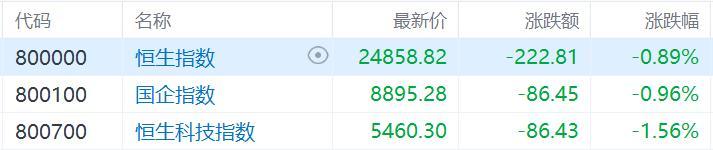
Market Overview - The Hong Kong stock market experienced a decline, with the Hang Seng Index falling over 200 points, closing below 25,000 points, and the Hang Seng Technology Index dropping by 1.56% [1] - Major technology stocks saw a broad decline, with Alibaba down 2.4% and JD.com down 1.44% [2] Sector Performance - The semiconductor sector faced significant losses, with SMIC dropping over 8%, marking the worst performance in the sector [4] - Gaming stocks also fell sharply, with Wynn Macau down over 7% and MGM China down over 6% [6] - The paper industry saw declines, with Chenming Paper down over 8% [7] - Innovative drug stocks continued to decline, with Hutchison China MediTech down over 15% and Zai Lab down over 10% [8] Positive Performances - Gold stocks led gains in the metals sector, with Zhaojin Mining and Lingbao Gold both rising over 3% [3][10] - Heavy machinery stocks showed resilience, with Zhonglian Heavy Industry rising nearly 6% [3] - Cement stocks performed well, with Shanshui Cement up over 6% [9] - Wind power stocks also saw increases, with Goldwind Technology rising over 10% [11] Capital Flows - Southbound funds recorded a net inflow of 6.271 billion HKD, with the Shanghai-Hong Kong Stock Connect contributing 3.28 billion HKD and the Shenzhen-Hong Kong Stock Connect contributing 2.992 billion HKD [12] Future Outlook - Huatai Securities suggests that the recent pullback in the Hong Kong market is due to adjustments in expectations, but the medium-term liquidity remains accommodative. They recommend focusing on sectors with improving conditions and low valuations, particularly in technology [13]

港股收评:三大指数齐跌 科技股弱势 创新药大跌 黄金股普遍上涨
Ge Long Hui· 2025-08-08 08:39
Market Performance - The Hong Kong stock market indices opened lower and continued to decline, with the Hang Seng Technology Index experiencing a notable drop of 1.56% [1] - The Hang Seng Index fell over 200 points, breaking below the 25,000 mark [1] - Major technology stocks saw widespread declines, with Alibaba down 2.4%, JD.com down 1.44%, and other tech giants like Baidu, Xiaomi, Tencent, and Meituan all down by 1% [1] Sector Performance - Semiconductor stocks continued to decline, with leading company SMIC dropping over 8%, marking the worst performance in the sector [1] - Gaming stocks such as Wynn Macau and MGM China fell sharply after earnings reports, leading the decline in the gaming sector [1] - Other sectors including robotics, Apple-related stocks, paper industry stocks, and military industry stocks also experienced collective declines [1] - Biopharmaceutical stocks, which had been popular recently, remained sluggish throughout the day, with notable drops in innovative drug companies like Hutchison China MediTech down 16% and Zai Lab down over 10% [1] Contrasting Trends - In contrast, gold prices reached a historical high of $3,534.10 per ounce, leading to gains in gold mining stocks, with Zhaojin Mining and Lingbao Gold both rising over 3% [1] - Heavy machinery stocks saw an increase, with excavator sales in July up over 25% year-on-year, and Zhonglian Heavy Industry rising nearly 6% [1] - Sectors such as film, electricity, and telecommunications mostly showed an upward trend [1]