
中国国航

Search documents
中国国航:10月,本集团合并旅客周转量(按收入客公里计)同比上升
Xin Lang Cai Jing· 2025-11-17 08:49
Core Insights - The company reported an increase in consolidated passenger turnover (measured in revenue passenger kilometers) for October 2025 compared to the previous year [1] Passenger Capacity and Turnover - Passenger capacity input (measured in available seat kilometers) increased by 4.3% year-on-year, while passenger turnover rose by 8.7% [1] - Domestic passenger capacity input grew by 3.2%, with passenger turnover increasing by 5.5% [1] - International passenger capacity input saw a rise of 7.5%, leading to a 17.6% increase in passenger turnover [1] - Regional passenger capacity input increased by 0.6%, with passenger turnover up by 7.7% [1] - The average passenger load factor reached 85.3%, an increase of 3.4 percentage points year-on-year [1] - Domestic routes experienced a load factor increase of 2.0 percentage points, while international routes saw a rise of 7.0 percentage points, and regional routes increased by 5.0 percentage points [1] Cargo Capacity and Turnover - Cargo capacity input (measured in available cargo ton kilometers) decreased by 0.9% year-on-year, while cargo mail turnover (measured in revenue cargo ton kilometers) increased by 3.1% [1] - The cargo load factor was reported at 38.9%, which is an increase of 1.5 percentage points compared to the previous year [1]

航空机场板块11月17日跌0.89%,春秋航空领跌,主力资金净流出1.78亿元
Zheng Xing Xing Ye Ri Bao· 2025-11-17 08:49
Market Overview - The aviation and airport sector experienced a decline of 0.89% on November 17, with Spring Airlines leading the drop [1] - The Shanghai Composite Index closed at 3972.03, down 0.46%, while the Shenzhen Component Index closed at 13202.0, down 0.11% [1] Stock Performance - Xiamen Airport (600897) saw a closing price of 18.14, with an increase of 3.66% and a trading volume of 207,300 shares, totaling a transaction value of 371 million yuan [1] - China Eastern Airlines (600115) closed at 5.35, up 2.10%, with a trading volume of 1,842,700 shares, amounting to 966 million yuan [1] - Southern Airlines (600029) closed at 7.27, up 0.69%, with a trading volume of 776,900 shares [1] - Spring Airlines (601021) led the decline with a closing price of 56.20, down 5.04%, and a trading volume of 139,000 shares, totaling 787 million yuan [2] Capital Flow - The aviation and airport sector saw a net outflow of 178 million yuan from institutional investors and 131 million yuan from retail investors, while retail investors had a net inflow of 309 million yuan [2] - Southern Airlines had a net inflow of 38.50 million yuan from institutional investors, while Spring Airlines experienced a net outflow of 78.21 million yuan from institutional investors [3] - Xiamen Airport had a net inflow of 17.88 million yuan from institutional investors, while China Eastern Airlines had a net inflow of 24.59 million yuan [3]





中日商业往来出现停滞隐忧
日经中文网· 2025-11-17 08:00
中日之间的商业活动开始受到影响。日本企业的中国法人高管表示,"受此次问题影响,与政府系企业 的商业谈判无法进行"。另一家日本企业高管表示,已决定在中国的社交网络上减少对自己产品的宣 传…… 围绕日本首相高市早苗关于"台湾有事"的发言和中国驻大阪总领事薛剑的发言,中日之间商业往来的停 滞令人担忧。由于中国政府提醒中国公民避免赴日,中国国有大型航空公司11月15日宣布涉日机票可免 费退改。旅游业界出现了担心访日游客减少的声音。 中国国际航空、中国南方航空、中国东方航空等三家航空公司同时发布通知,涉日机票可免费退改。对 象是以东京和大阪等日本为出发和目的地的航班,期间为11月15日至12月31日。此外,四川航空和海南 航空等也发出了类似通知。 在中国,中日之间的商业活动开始受到影响。日本企业的中国法人高管表示,"受此次问题影响,与政 府系企业的商业谈判无法进行"。另一家日本企业高管表示,已决定在中国的社交网络上减少对自己产 品的宣传。 全日空(ANA)和日本航空(JAL)表示,截至11月15日没有出现取消预订的情况。日本航空旗下的春 秋航空日本(Spring Japan)也表示:"没有大的变化"。酒店和百货商店受到 ...

中泰证券:航司供需格局持续改善 预计四季度行业有望大幅减亏
智通财经网· 2025-11-17 07:37
Core Viewpoint - The aviation industry is experiencing a continuous digestion of existing supply, with aircraft utilization rates exceeding 2019 levels during peak season, indicating a potential slowdown in supply growth in the future. The significant increase in international routes and limited domestic capacity growth suggest an optimization of the domestic competitive landscape, with high passenger load factors likely to improve ticket prices. Favorable oil prices and exchange rates are expected to lead to a "not-so-slow" trend in Q4, with a significant reduction in losses anticipated for the aviation industry by Q4 2025 and a release of profit elasticity in 2026 [1]. Group 1: Flight and Passenger Volume - Flight and passenger volume growth: In Q3 2025, overall, domestic, international, and regional flight volumes increased by 3%/2%/12%/7% year-on-year, while overall, domestic, international, and regional passenger volumes grew by 3.90%/2.84%/15.31%/-2.37% year-on-year [1]. - Airlines' capacity deployment: Except for Juneyao Airlines, overall capacity investment increased, focusing on international routes. In Q3 2025, ASK (Available Seat Kilometers) for major airlines showed year-on-year growth of 1.9%/5.7%/6.0%/4.4%/14.1%/-1.4% [2]. - Passenger turnover growth outpaced available seat kilometers growth, with load factors remaining high. In Q3 2025, passenger turnover for major airlines increased by 3.6%/6.2%/8.9%/4.2%/14.0%/-0.4% year-on-year, with industry load factors for July to September averaging 84.5%/87.5%/86.3%, up 0.5/0.6/2.4 percentage points year-on-year [2]. Group 2: Revenue and Cost Analysis - Revenue growth driven by capacity increase and passenger volume: In Q3 2025, total operating revenue for major airlines grew by 0.9%/3.0%/3.1%/1.8%/6.0%/-1.9% year-on-year [3]. - Decrease in oil prices alleviated fuel costs, while capacity investment diluted fixed costs, although variable costs increased. In Q3 2025, operating costs for major airlines increased by 0.07%/1.63%/1.51%/-1.43%/8.74%/-0.46% year-on-year [3]. - Revenue per available seat kilometer decreased, but the decline in costs was generally greater than the decline in revenue. In Q3 2025, revenue per available seat kilometer for major airlines decreased by 1.03%/2.55%/2.72%/2.41%/7.09%/0.47%/5.28%, while costs decreased by 1.84%/3.86%/4.26%/5.54%/4.70%/8.21% [3]. Group 3: Profitability and Market Outlook - Favorable oil prices and exchange rates positively impacted net profits. In Q3 2025, the average price of aviation kerosene was 5593 RMB/ton, down 11.05% year-on-year, and the USD/CNY exchange rate decreased by 0.74%, affecting net profits of major airlines [4]. - Slightly better-than-expected net profits for China Southern Airlines and China Eastern Airlines. In Q3 2025, net profits for major airlines were 36.76/38.40/35.34/27.88/11.67/5.84/3.69 billion RMB, with year-on-year growth rates of -11.31%/+20.26%/34.37%/-0.75%/-6.17%/-25.29%/+31.60% [4]. Group 4: Investment Recommendations - Investment themes include performance elasticity from ticket price increases, recommending major airlines with larger fleets and strong cyclical attributes, as well as Hainan Airlines benefiting from policy advantages and Juneyao Airlines with optimal route networks among private carriers [5]. - Emphasis on the certainty of operational performance, recommending airlines with stable subsidies like China Express Airlines and those with clear cost advantages and neutral exchange rate exposure like Spring Airlines [5].


交通运输行业周报:提倡物流互联降本,中美暂停互征港口费-20251117
Yin He Zheng Quan· 2025-11-17 06:19
Investment Rating - The report maintains a "Recommended" rating for the transportation industry [4]. Core Views - The transportation sector has shown a cumulative increase of 1.83% from November 10 to November 15, 2025, outperforming the Shanghai Composite Index, which decreased by 1.08% [14][15]. - The recovery rates for domestic and international passenger traffic in major airlines and airports have significantly improved compared to 2019 levels, indicating a positive trend in the aviation sector [24][32]. - The shipping and logistics sectors are experiencing mixed performance, with container shipping indices showing a decline year-on-year, while oil and product tanker indices have increased significantly [36][47]. Summary by Sections Industry Performance Overview - The transportation industry ranked 13th among 31 sectors with a cumulative increase of 1.83% during the week [14]. - Sub-sectors such as ports (+7.44%) and airports (+5.28%) performed particularly well, while cross-border logistics (-1.37%) and road freight (-0.68%) faced declines [15][23]. Aviation and Airports - Major airlines in China have seen recovery rates for domestic Available Seat Kilometers (ASK) in September 2025 reach as high as 176.49% compared to the same month in 2019 [24]. - Key airports like Baiyun, Shanghai, and Capital have also shown strong recovery in passenger throughput, with rates of 125.22% and 115.87% for international traffic [32]. Shipping and Ports - The Shanghai Containerized Freight Index (SCFI) has decreased by 35.55% year-on-year, while the China Containerized Freight Index (CCFI) has shown a 23.97% decline [36]. - The CCFI for the East America route reported a decrease of 18.31% year-on-year, while the Mediterranean route saw a decline of 28.56% [36]. Road and Rail - Rail passenger turnover increased by 0.4% year-on-year, while freight volume rose by 4.24% [61]. - Road passenger traffic decreased by 3.82%, but freight volume increased by 5.20% [67]. Logistics and Express Delivery - The express delivery sector achieved a revenue of 127.37 billion yuan in September 2025, marking a 7.20% increase year-on-year [10]. - The industry is witnessing a shift towards smaller packages driven by e-commerce, with a notable increase in business volume [8]. Investment Recommendations - The report suggests focusing on airlines such as China National Aviation (601111.SH), Southern Airlines (600029.SH), and logistics companies like Huamao Logistics (603128.SH) for potential investment opportunities [9][10].


飞机租赁行业跟踪报告:飞机长期需求强劲,供应链挑战下飞机供给仍然受阻
Mai Gao Zheng Quan· 2025-11-17 05:16
Investment Rating - Industry rating: Outperform the market [1] Core Insights - Aircraft manufacturers are slowly recovering capacity, but supply chain challenges continue to hinder aircraft supply. As of October 2025, Boeing delivered 493 aircraft and Airbus delivered 585 aircraft this year, with backlogged orders remaining at historically high levels [2][5][6] - Global aviation market demand growth has slowed down, with all regions experiencing a deceleration. The Middle East and Africa saw year-on-year increases of 6.2% and 6.1%, respectively, while North America experienced a slight decline of 0.1%. The Asia-Pacific region's international passenger volume grew by 7.4% year-on-year [2][11][16] - Overall, while aircraft manufacturers' capacity is recovering, it still cannot meet the expanding demand for aircraft. The aircraft leasing industry is expected to benefit from the tight supply-demand situation, particularly in the Asia-Pacific region, which presents significant growth potential for Chinese aircraft leasing companies [2][40] Summary by Sections 1. Aircraft Supply Continues to be Tight - Boeing's average monthly delivery has significantly improved compared to last year, while Airbus's delivery is slightly better than the same period last year. However, both manufacturers are still far from previous high levels [5] - The backlog of aircraft orders remains at a historical high, with Boeing and Airbus accumulating new orders of 836 and 722 aircraft, respectively, this year [6] 2. Civil Aviation Passenger Demand Update - Global aviation passenger volume continues to grow, but the growth rate has slowed. In September 2025, global revenue passenger kilometers (RPK) increased by 3.6% year-on-year, while the global load factor was 83.4%, slightly lower than the previous year [11][16] - Domestic aviation RPK in September grew by 0.9% year-on-year, with Brazil showing a remarkable increase of 12.1% [21][20] 3. Aircraft Leasing Company Dynamics - Chinese aircraft leasing companies are currently valued relatively low compared to global leaders like AerCap, and they possess higher order elasticity, making them worthy of attention [2][38] - As of June 30, 2025, Bohai Leasing had the highest number of owned aircraft at 628, while China Aircraft Leasing had the least at 151 [44]


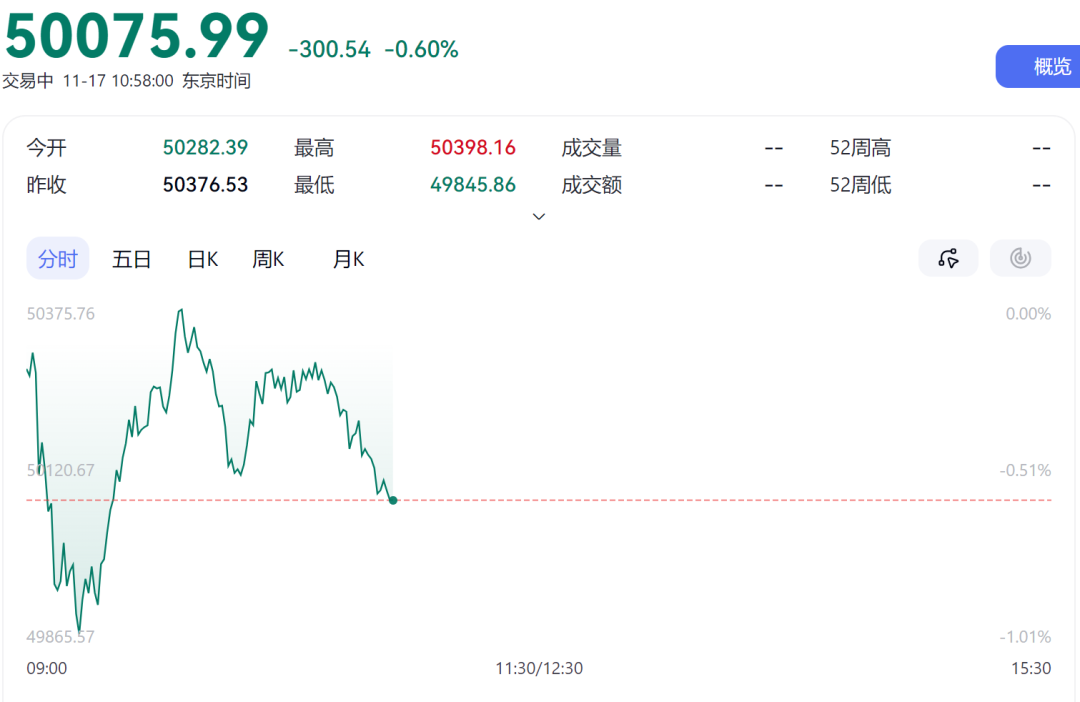
刚刚,全线大跌!日本,利空突袭!
券商中国· 2025-11-17 04:52
Core Viewpoint - Japanese retail stocks have faced significant declines due to a warning from China's Ministry of Culture and Tourism advising Chinese tourists to avoid traveling to Japan, coupled with negative economic data indicating a contraction in Japan's GDP [1][4][6]. Group 1: Stock Market Impact - The Japanese stock market experienced a broad decline, with the Nikkei 225 index falling by 0.7% and the Tokyo Stock Exchange index dropping by 0.8% [3]. - Notable retail and tourism-related stocks saw substantial drops, including Shiseido, which fell over 11%, and Mitsukoshi Isetan, which plummeted more than 12% [3][4]. - Fast Retailing, the parent company of Uniqlo, saw its stock price decrease by nearly 7% [4]. Group 2: Economic Data - Japan's Cabinet Office reported a 1.8% year-on-year decline in real GDP for the third quarter, marking a return to negative growth since the first quarter of 2024 [6][7]. - The GDP decreased by 0.4% quarter-on-quarter, with exports of goods and services falling by 1.2% due to the impact of U.S. tariffs [7]. - Domestic consumption, which constitutes over half of Japan's economy, showed only a slight increase of 0.1% in the same period, indicating weak internal demand [7]. Group 3: Tourism and Economic Forecast - The decline in Chinese tourists, who account for approximately 25% of foreign visitors to Japan, is expected to significantly impact the tourism sector [5]. - Analysts estimate that a substantial drop in Chinese visitors could reduce Japan's GDP by 0.36%, leading to an economic loss of approximately 2.2 trillion yen (about 101.16 billion RMB) [5]. - The Japanese government has revised its economic growth forecast for the fiscal year 2025 from 1.2% to 0.7% due to ongoing economic pressures [7]. Group 4: Government Response - The Japanese government is considering a stimulus plan worth approximately 17 trillion yen (around 110 billion USD) to counteract economic downturns [8].

日本高官来华解释高市言论!日本旅游、消费股大跌,中国大陆至日本航班量大幅下滑
Mei Ri Jing Ji Xin Wen· 2025-11-17 02:27
Market Reaction - The Nikkei 225 index opened with a significant drop, falling over 1% and breaching the 50,000 points mark before narrowing its losses by around 9:50 AM [1] - Several consumer stocks in Japan experienced substantial declines, with FOOD&LIFE COMPANIES down over 14%, Japanese electronics down over 11%, and Shiseido down over 9% [3] Economic Data - Japan's Cabinet Office reported a 1.8% year-on-year decline in real GDP for the third quarter, marking the first negative growth in six quarters [3] - The actual GDP for the third quarter decreased by 0.4% compared to the previous quarter [3] Diplomatic Tensions - High-ranking Japanese officials made provocative statements regarding Taiwan, suggesting potential military involvement, which has drawn significant criticism from China and the international community [3] - The Chinese Ministry of Foreign Affairs issued travel warnings for its citizens in Japan, citing a rise in crimes against Chinese nationals and a deteriorating security environment [5] Airline Industry Impact - Following the travel warnings, major Chinese airlines announced flexible ticket policies for flights to Japan, allowing free changes and refunds for tickets purchased before November 15 [7][8] - Chinese airlines account for approximately 80% of the flight volume on the China-Japan route, with a significant reduction in weekly flights observed [9] Tourism Statistics - In September 2025, foreign visitors to Japan reached 3.267 million, a 13.7% increase year-on-year, with Chinese tourists being the largest group [9] - In the first three quarters of this year, the number of Chinese tourists visiting Japan increased by 42.7%, making China the largest source of inbound tourism for Japan [9] Trade Relations - China remains Japan's largest trading partner, with a total trade volume of $308.3 billion expected in 2024, including $156.25 billion in imports from China [10] - The deterioration of Japan-China relations is anticipated to have negative repercussions for the Japanese populace, as highlighted by Japanese officials [10]
高市早苗把日本拖入“国家危机”,GDP六个季度以来首次负增长,旅游经济将受重创
Sou Hu Cai Jing· 2025-11-17 02:23
Economic Performance - Japan's GDP in Q3 decreased by 1.8% on an annualized basis, marking the first negative growth in six quarters [1] - The actual GDP in Q3 fell by 0.4% compared to the previous quarter [1] Economic Challenges - Japan's economy is facing multiple challenges, including fiscal and monetary policy dilemmas, weak economic growth, insufficient international competitiveness, and increased tariffs from the U.S. [3] - High-profile political statements have raised concerns about regional stability and Japan's own national crisis [3] Trade Relations - China is Japan's largest trading partner, with a projected trade total of $308.3 billion in 2024, including $156.25 billion in imports from China [3] - Chinese tourists are expected to contribute significantly to Japan's economy, with their total spending in 2024 reaching approximately 1 trillion 733.5 billion yen (around 81.2 billion RMB) [3] Tourism Impact - The Japanese tourism industry is heavily reliant on visitors, particularly from China, to support its economy amid ongoing economic weakness [3] - Recent advisories from the Chinese government caution against travel to Japan due to safety concerns, which may lead to a systemic impact on Japan's tourism economy [4] Travel and Safety Concerns - A significant decline in weekly flights from mainland China to Japan has been observed, with a recovery rate of 82.9% compared to the same week in 2019, reflecting a 14.5% decrease from the previous week [4]

航空股集体低开 赴日旅游紧急降温 多家航司宣布免费退改涉日机票
Zhi Tong Cai Jing· 2025-11-17 02:13
Core Viewpoint - The airline stocks have collectively opened lower due to a significant decline in flight volumes to Japan following travel advisories from the Chinese government [1] Group 1: Stock Performance - China Eastern Airlines (00670) dropped by 3.47%, trading at HKD 4.45 [1] - Air China (601111) (00753) fell by 2.92%, trading at HKD 6.31 [1] - China Southern Airlines (600029) (01055) decreased by 2.62%, trading at HKD 5.20 [1] Group 2: Travel Advisory Impact - On November 14, the Chinese Ministry of Foreign Affairs and the Chinese consulate in Japan advised citizens to avoid traveling to Japan [1] - Following this advisory, several airlines, including Air China, China Southern Airlines, and China Eastern Airlines, announced free ticket refunds and changes for flights to Japan scheduled before December 31 [1] Group 3: Flight Volume Decline - According to data from Flight Manager, the weekly flight volume from mainland China to Japan has significantly decreased, with 1,189 flights recorded in the 45th week (November 3-9), representing an 82.9% recovery rate compared to the same period in 2019 [1] - This figure reflects a 14.5% decrease compared to the 40th week [1] - A market department representative from an airline indicated that further reductions in flights to Japan are likely, with capacity being adjusted to other routes [1]