宇树科技

Search documents
智元、宇树科技出货量飙升,占全球超70%市场份额
2 1 Shi Ji Jing Ji Bao Dao· 2026-01-09 10:04
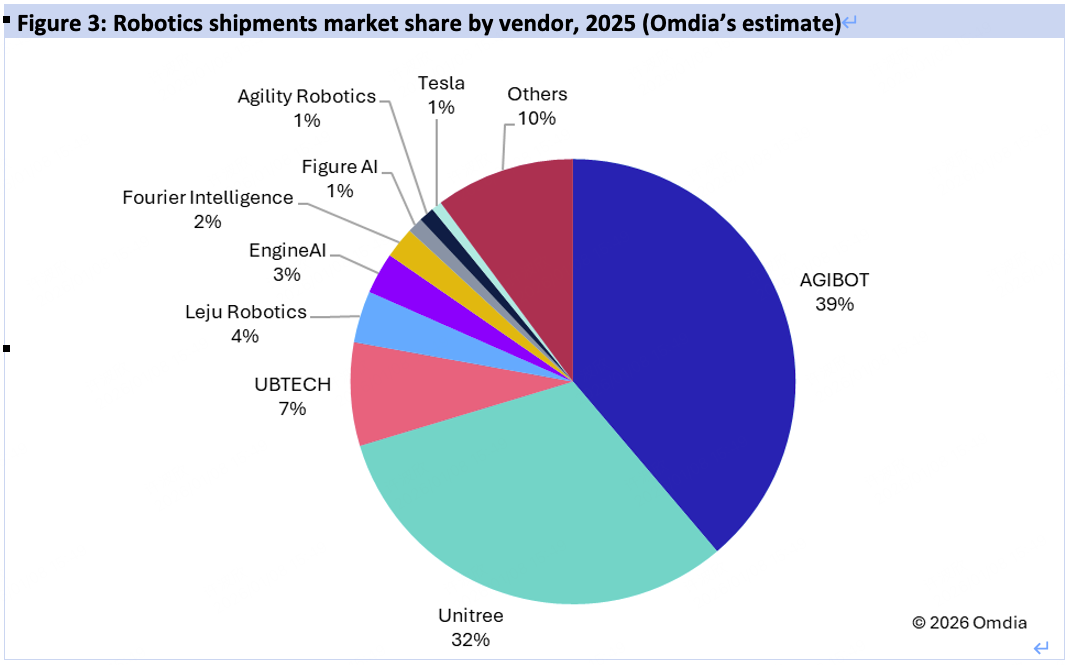
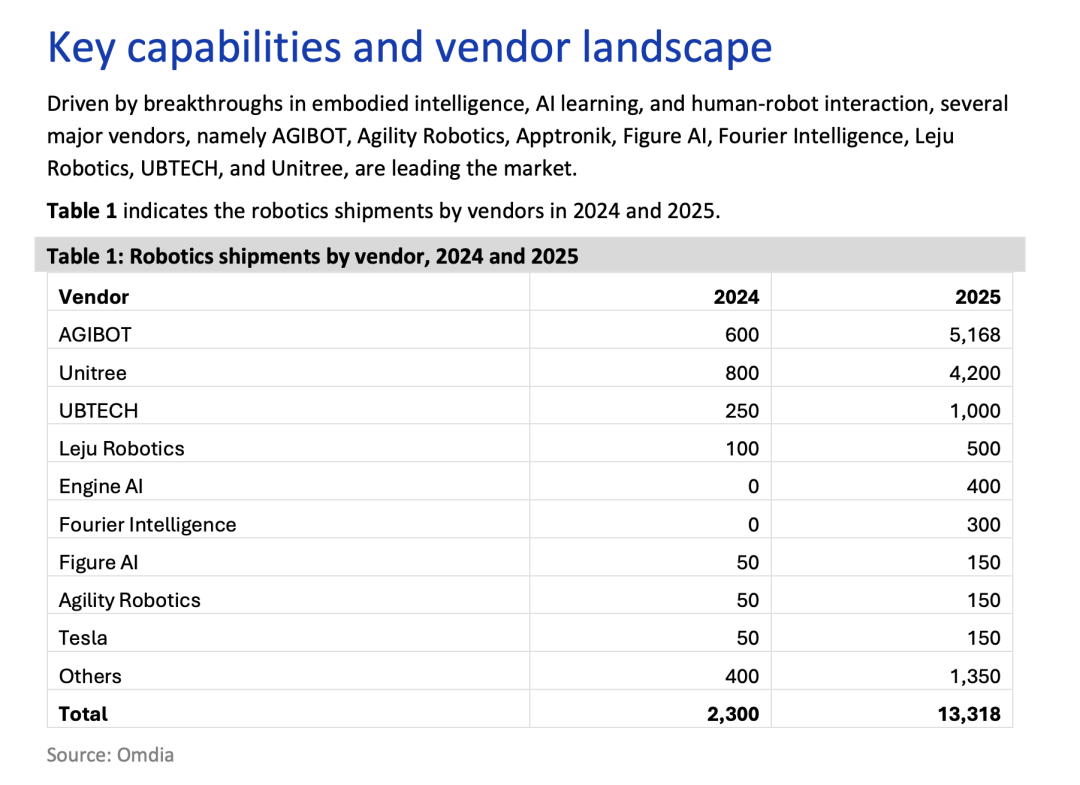
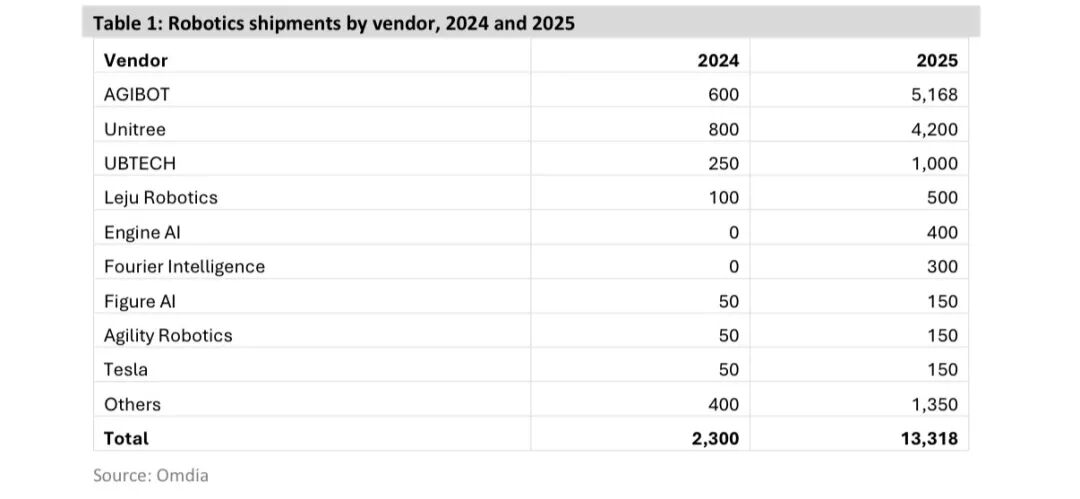
Core Viewpoint - The humanoid robot sector experienced a strong surge on January 9, with significant gains in stock prices, particularly for companies like ZhiYuan Robotics, which saw an 8.75% increase, reflecting a growing interest in the market driven by a new report from Omdia on the global humanoid robot market trends for 2025 [1][2]. Market Trends - According to Omdia's report, Chinese manufacturers are leading the global humanoid robot market, with ZhiYuan Robotics and Unitree Technology together accounting for 71% of the market share by 2025 [1]. - ZhiYuan Robotics is projected to ship 5,168 units in 2025, a significant increase from 600 units in 2024, capturing 39% of the global market share [1][3]. - Unitree Technology and UBTECH are expected to follow with market shares of 32% and 7%, respectively, with their shipments also increasing substantially [1][3]. Vendor Performance - ZhiYuan Robotics received the highest ratings in six evaluation dimensions, indicating advanced capabilities in humanoid robotics [4]. - Unitree Technology excelled in five dimensions, while UBTECH achieved top ratings in four dimensions, showcasing the competitive landscape among these companies [4]. Future Projections - The integration of generative AI with robotics is driving the evolution of robots towards "general embodied intelligence," which is expected to lead to exponential growth in the humanoid robot market over the next decade [6]. - Omdia forecasts that global shipments of humanoid robots could reach 2.6 million units by 2035, indicating a robust growth trajectory for the industry [6].

智元、宇树科技出货量飙升,占全球超70%市场份额
21世纪经济报道· 2026-01-09 09:51
Core Insights - The humanoid robot sector experienced a strong surge on January 9, with companies like Shenzhou New Materials (上纬新材) seeing an 8.75% increase in stock price, reaching 143.99 CNY per share and a total market capitalization of 58 billion CNY [1]. Market Trends - A report by Omdia indicates that Chinese manufacturers are leading the global humanoid robot market, with companies like Zhiyuan Robotics (智元机器人) and Unitree Technology (宇树科技) expected to capture 71% of the market share by 2025 [3]. - Zhiyuan Robotics is projected to ship 5,168 units in 2025, a significant increase from 600 units in 2024, holding a 39% market share [3][5]. - Unitree Technology and UBTECH are expected to follow with market shares of 32% and 7%, respectively, with their shipments also increasing significantly [3][5]. Vendor Performance - The report outlines the expected shipments for various vendors in 2024 and 2025, with total shipments rising from 2,300 units in 2024 to 13,318 units in 2025 [5]. - Zhiyuan Robotics received the highest ratings in six evaluation dimensions, indicating advanced capabilities in humanoid robotics [6]. Future Projections - The integration of generative AI with robotics is driving the evolution of robots towards "general embodied intelligence," with the humanoid robot market expected to see exponential growth, potentially reaching 2.6 million units shipped by 2035 [8].

能跑跳、能干活、能签单,中国人形机器人站上C位
Xin Jing Bao· 2026-01-09 09:35
Core Insights - The CES 2026 showcased a significant dominance of Chinese companies in the robotics sector, with 149 out of 598 exhibitors being Chinese, accounting for nearly one-quarter of the total [1] - In the humanoid robot segment, 21 out of 38 exhibitors were from China, representing over half of the participants [1] - Chinese humanoid robot manufacturers are noted for their advantages in product variety, supply chain efficiency, and cost-effectiveness, with expectations for industry growth by 2026 [1] Group 1: Technology and Applications - Chinese humanoid robot companies demonstrated capabilities in motion control and practical applications across various scenarios, including industrial manufacturing, family companionship, and commercial services [2] - Notable companies like Yushu Technology and Zhongqing showcased advanced technologies in high-precision torque control and dynamic balance through performances with their robots [2] - AI integration was highlighted, with companies like Zhiyuan showcasing robots capable of language interaction and service applications, emphasizing the fusion of "brain" and "body" in real-world scenarios [2] Group 2: Market Expansion and Sales - The CES 2026 served as a crucial platform for Chinese robot companies to expand into global markets, with several companies reporting immediate sales during the event [3] - Companies like Songyan Power are shifting focus from product display to commercial implementation, targeting key regions such as North America, the Middle East, Europe, and Southeast Asia for market expansion [3] Group 3: Supply Chain and Component Innovation - The exhibition featured a concentration of Chinese companies from various segments of the robotics supply chain, indicating a move towards specialization and maturity within the industry [5] - Innovations in dexterous hands were showcased, with companies like Lingxin demonstrating mass-produced high-dexterity products at competitive prices, making advanced components more accessible [5] - Breakthroughs in tactile technology were presented, with companies like Pashini demonstrating advanced sensors that enable new application scenarios [5] Group 4: Software and Remote Operations - Companies like Jijia Vision are focusing on cutting-edge software developments, particularly in world models, which are becoming more mature as data engines in the field of embodied intelligence [6] - Remote operation capabilities were highlighted by companies like Rui Erman, showcasing real-time remote control of robots from Beijing to Las Vegas, demonstrating the potential for global operational networks [6] - The collective presence of Chinese humanoid robot and supply chain companies at CES 2026 indicates a competitive landscape where technological prowess is matched by engineering, commercialization, and ecosystem development capabilities [6]

CES观察|能跑跳、能干活、能签单,中国人形机器人站上C位
Bei Ke Cai Jing· 2026-01-09 09:35
Core Insights - The CES 2026 showcased a significant dominance of Chinese companies in the robotics sector, with 149 out of 598 exhibitors being Chinese, accounting for nearly one-quarter of the total [1] - In the humanoid robot segment, 21 out of 38 exhibitors were from China, representing over half of the participants [1] - The event highlighted advancements in various applications of humanoid robots, including industrial, commercial, and home companionship [2][8] Group 1: Company Highlights - Companies like Yushu Technology and Zhiyuan Robotics demonstrated their capabilities in motion control and application scenarios, showcasing robots capable of dance and combat [4] - The Beijing Humanoid Robot Innovation Center made its debut, emphasizing the importance of showcasing the practical capabilities of humanoid robots to enhance international influence [8] - The company Lingqiao Intelligent presented its high-performance dexterous hand, significantly reducing costs to make it more accessible for research institutions and startups [10] Group 2: Technological Advancements - The event featured robots that integrated advanced AI capabilities, such as language interaction and autonomous sorting, demonstrating their practical applications in real-world scenarios [6][7] - Breakthroughs in tactile technology were showcased, with companies like Pasini Sensory Technology presenting advanced multi-dimensional tactile sensors [11] - The development of world models as data engines in embodied intelligence was highlighted, indicating a shift towards more sophisticated evaluation and reinforcement learning environments [11] Group 3: Market Expansion and Sales - The CES 2026 served as a critical platform for Chinese robotics companies to expand their global market presence, with several companies reporting immediate sales during the event [8] - Companies like Songyan Power are shifting their focus from product display to commercial implementation, targeting key regions for market expansion [8] - The event underscored the importance of a well-defined and efficient industrial ecosystem, indicating a maturation of the robotics industry [9][12]
智元第一,宇树第二!中国人形机器人企业领跑全球
Zhong Guo Zheng Quan Bao· 2026-01-09 08:30
Core Insights - The report by Omdia highlights the dominance of Chinese manufacturers in the humanoid robot market, with Zhiyuan leading with over 5,100 units shipped, capturing 39% of the global market share [1] - By 2025, the top six humanoid robot manufacturers will all be Chinese, collectively accounting for 86.9% of global shipments [1] Group 1: Market Performance - In 2024, total shipments of humanoid robots are projected to be 2,300 units, increasing to 13,318 units in 2025 [2] - The report indicates that the humanoid robot index rose by 1.66%, with significant stock price increases for companies like Jizhi Co. and Hongxun Technology [3] Group 2: Industry Developments - At CES 2023, several Chinese humanoid robot companies showcased their products, including Zhiyuan's launch of the Genie Sim 3.0 platform, which enhances model training and application [4] - Other companies like Unitree and Fourier Intelligence also presented their latest humanoid robots and solutions, indicating a strong presence in the market [4][5] Group 3: Future Projections - Omdia predicts exponential growth in the humanoid robot market, with global shipments expected to reach 2.6 million units by 2035 [6] - Companies like Zhiyuan and Tesla are positioned as leaders in the industry, driving rapid development and innovation [6] Group 4: Strategic Investments - Companies are actively investing in humanoid robotics, with Hongrun Construction and Guoji Precision Engineering announcing partnerships and new product lines aimed at enhancing their market positions [7] - The domestic humanoid robot shipment is expected to rise to 62,500 units by 2026, marking a significant milestone for the industry [7]

通讯丨“中国智造”在美消费电子展舞台逐浪前行
Xin Hua Wang· 2026-01-09 08:28
Core Insights - "Chinese manufacturing" is making significant strides at the CES, showcasing higher innovation density and clearer technological pathways, positioning itself at the forefront of international competition [1] Group 1: Industry Participation - Over a thousand Chinese companies participated in CES, including industry leaders like TCL, Hisense, BOE, and Lenovo, as well as numerous startups [1] - Several Chinese companies received "CES Innovation Awards," highlighting global recognition of their innovative capabilities [1] Group 2: Display Technology - Chinese companies are leading in the display technology sector, shifting focus from single product parameters to AI-supported full-scene application revolutions [2] - TCL had the largest and most diverse exhibition space, showcasing innovations in television screens, electronic writing pads, and AR glasses [2] - Hisense presented next-generation large-screen display solutions, emphasizing color space enhancement and system optimization for eye protection [2] - The Chinese display industry has evolved from a technology follower to a global leader, particularly in LCD and OLED technologies [2] Group 3: Robotics Innovation - AI and robotics were major highlights at CES, with Chinese companies dominating the humanoid robot and related sectors, demonstrating rapid iteration and scalability [3] - Various robots showcased capabilities such as emotional companionship, autonomous lawn maintenance, and advanced coffee-making, emphasizing real-world application [3] - The focus has shifted from conceptual displays to tangible intelligent products that adapt to real environments [3] Group 4: Smart Home Solutions - Smart home technology has become a key area for Chinese companies to demonstrate systemic innovation and lifestyle solutions [4] - Solutions showcased include AI and IoT applications that create intelligent systems capable of perceiving, learning, and interacting [4][5] - Products like smart air conditioners and refrigerators exhibit advanced features such as dynamic energy management and food preservation [5] Group 5: Intelligent Mobility - Intelligent mobility was a focal point, with Chinese automotive companies showcasing innovations in smart cockpits and AI integration [6] - Geely's WAM model enhances understanding of complex driving scenarios, improving overall driving experiences [6] - Chinese companies are transitioning from cost and scale advantages to focusing on user experience, system integration, and technological maturity in the smart mobility sector [6] Group 6: Global Impact - CES serves as a platform for international collaboration and industry dialogue, with China recognized as a key driver of global technological advancement [6] - Chinese consumer electronics companies are accelerating their smart upgrades, becoming pioneers in global AI development [6] - "Chinese manufacturing" continues to navigate the waves of global technological change, contributing to the formation of a new international tech landscape through innovation and application [6]




CES变成中国科技秀:机器人跳舞、熊猫获奖
3 6 Ke· 2026-01-09 08:24
Group 1: Core Themes of CES 2026 - The main theme of CES 2026 is "human-centered" AI applications, marking a shift from traditional consumer electronics to AI-centric technological transformations [1] - Chinese companies are increasingly taking center stage at CES, with 942 exhibitors, accounting for approximately 22% of the total, maintaining their position as the second-largest exhibiting nation [1] - In specific sectors, Chinese firms dominate, with 55% of humanoid robot exhibitors and nearly 70% of AI glasses brands coming from China [1] Group 2: Robotics and AI Innovations - Chinese manufacturers are expected to continue leading in cost reduction and efficiency improvements in humanoid robots, showcasing their capabilities in unstructured environments [2] - Notable products include the Unitree H1 humanoid robot with advanced sensing capabilities and the latest generation of the "绝影" series robotic dogs, which excel in indoor navigation [4][11] - The "Care-bot" humanoid robot by Fourier demonstrates embodied intelligence in real-life interaction scenarios [7] Group 3: Consumer Electronics and Smart Devices - Over 80% of global smart glasses supply chain manufacturers are from China, with 16 Chinese companies showcasing their products at CES [15] - Innovations in smart home devices include the AI-driven "安安" companion robot designed for elderly and cognitively impaired individuals [16] - Companies like Alibaba and XREAL are launching advanced AI glasses, with features such as ultra-lightweight designs and integration with various AI services [19][20] Group 4: Automotive and AI Integration - The automotive industry is transitioning from "software-defined" to "AI-defined" vehicles, with companies like Geely and Great Wall showcasing new technologies [28] - Geely's G-ASD smart driving solution and Great Wall's focus on new energy technologies highlight the industry's shift towards AI integration [30][32] - New products like the AI-driven logistics solutions from New Stone and advanced lidar technology from Hesai demonstrate the growing importance of AI in transportation [34][35] Group 5: Home Appliances and AI - Hisense introduced new RGB-Mini LED display technology and AI-controlled smart refrigerators, showcasing the integration of AI in home appliances [41] - TCL's innovations in display technology, including the world's first printed OLED car screen, reflect advancements in consumer electronics [43][44] - Companies are increasingly focusing on AI capabilities in home security and smart home management systems [51][49] Group 6: Overall Impact of AI - CES 2026 emphasizes the profound impact of AI on the consumer electronics industry, with expectations for AI user numbers to grow significantly [59] - The event serves as a platform for global tech companies to set the foundation for future technological development and transformation [59] - The integration of AI into various sectors, including robotics, automotive, and consumer electronics, indicates a trend towards deeper AI adoption in everyday life [59]





收评:沪指16连阳站上4100点 AI应用方向领涨 卫星互联网延续活跃态势
Xin Hua Cai Jing· 2026-01-09 07:47
Market Performance - The Shanghai Composite Index closed at 4120.43 points, up 0.92%, marking a 16-day consecutive rise [1] - The Shenzhen Component Index rose 1.15% to 14120.15 points, while the ChiNext Index increased by 0.77% to 3327.81 points [1] - The total trading volume for the Shanghai market was approximately 12.892 billion yuan, and for the Shenzhen market, it was about 18.336 billion yuan [1] Sector Performance - AI application sectors led the market, with significant gains in various related concepts such as Kimi, Sora, and AIGC [1] - Other active sectors included satellite internet, commercial aerospace, and space big data, along with notable increases in small metals, precious metals, and duty-free shops [1] Institutional Insights - The market is showing an upward trend, with many sectors supported at the 60-day moving average, indicating a new round of bullish momentum [2] - Long-term investment opportunities are suggested in high-growth sectors such as semiconductors, consumer electronics, artificial intelligence, and commercial aerospace [2] - A recent improvement in the overall industry prosperity index and PMI supports the positive outlook for the market [2][3] Policy Developments - The "Guidelines for the Construction and Application of Industrial Green Microgrids (2026-2030)" were issued to promote green energy applications in industrial sectors [4] - The guidelines emphasize a minimum of 60% self-consumption of renewable energy for new industrial projects [4] Robotics Market - A report indicates that by 2025, the top six companies in global humanoid robot shipments will be Chinese, with a total expected shipment of 13,000 units [5] - The leading company, Zhiyuan, is projected to capture 39% of the market share with over 5,100 units shipped [5] Company News - MiniMax, an AGI company, saw its stock price surge by 90.9% upon its listing on the Hong Kong Stock Exchange, reaching a market capitalization of approximately 91.94 billion HKD [7] - The company raised about 5.54 billion HKD through its IPO, which will be allocated for model upgrades and AI product development [7]
智元、宇树、优必选,全球排名前三
Shang Hai Zheng Quan Bao· 2026-01-09 07:31
Core Insights - The humanoid robot market is expected to enter a rapid growth phase, with global shipments projected to reach 13,318 units in 2025, up from 2,300 units in 2024 [1][2] - Chinese manufacturers are leading in both production scale and shipment volume, with ZhiYuan accounting for over 5,100 units and a 39% market share, making it the global leader [1][4] Market Overview - The report by Omdia indicates that ZhiYuan, Unitree, and UBTECH will be the top three vendors in 2025, with shipments of 5,168 units, 4,200 units, and 1,000 units respectively, capturing 39%, 32%, and 7% of the market share [2][4] - The total shipment volume for humanoid robots is expected to grow significantly, with a forecast of 260 million units by 2035 [6] Competitive Landscape - The competitive landscape is categorized into tiers, with ZhiYuan, Figure AI, Tesla, UBTECH, and Unitree in the first tier, while Agility Robotics, Apptronik, Fourier, and Leju Robotics are in the second tier [6] - The integration of generative AI with robotics is driving the evolution towards "general embodied intelligence," enhancing robots' capabilities for autonomous learning and environmental adaptation [6] Production and Deployment - Companies are ramping up production capabilities, with ZhiYuan's sales revenue exceeding 1 billion yuan in 2025, significantly higher than the previous year's figures [2][4] - Upcoming production facilities include a global manufacturing center by Zhongqing Robotics in Zhengzhou and a super smart factory by UBTECH in Liuzhou, expected to produce 10,000 humanoid robots by 2026 [6][7] Future Outlook - 2026 is anticipated to be a pivotal year for the humanoid robot industry, with a clear differentiation among startups based on technological breakthroughs and industrial capabilities [6][7] - The deployment scale of robots is crucial for their competitiveness, as more deployments lead to better data for training models [8]
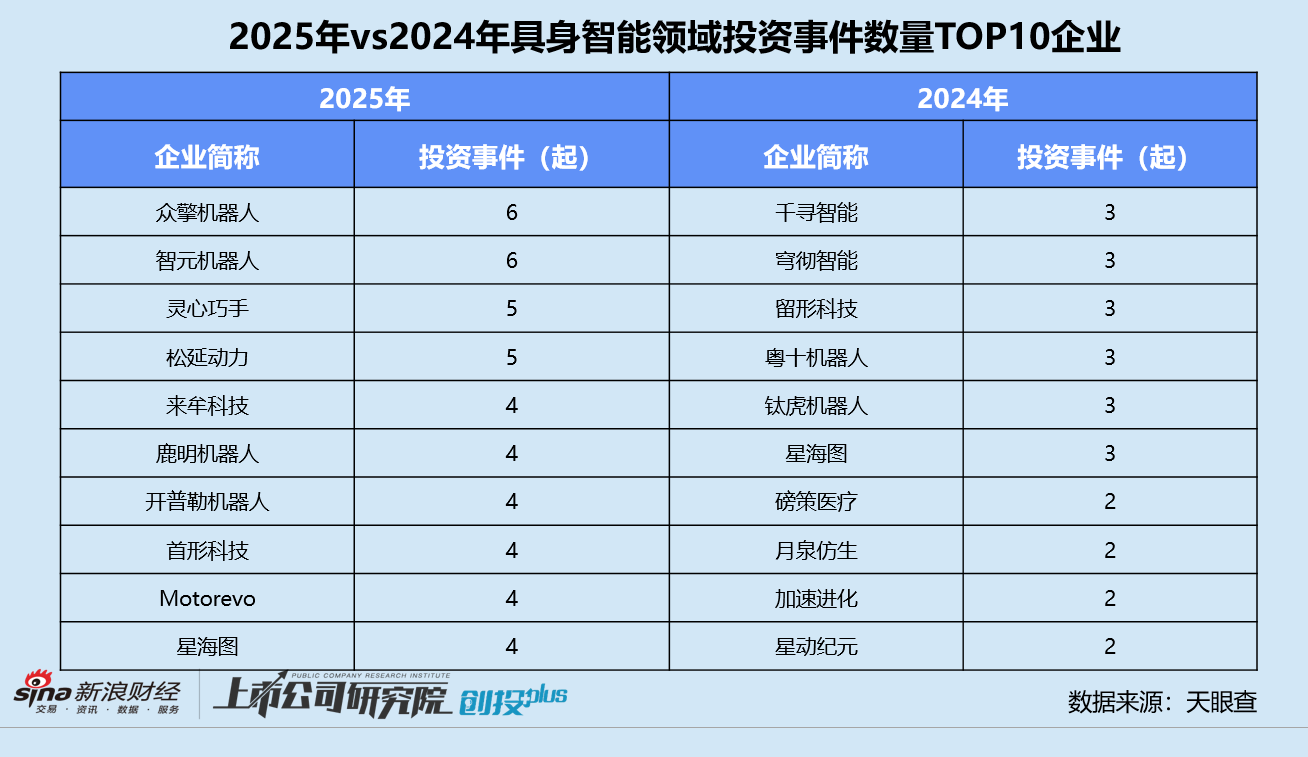
2025一级市场回顾 | 具身智能吸金344亿成最强风口 智元机器人边收购上市公司边孵化“小独角兽”
Xin Lang Cai Jing· 2026-01-09 05:57
Core Insights - The primary focus of the article is the significant evolution of the primary market in 2025, driven by a transformative wave of artificial intelligence technologies, with substantial capital concentration in leading AI projects like OpenAI, xAI, and Anthropic, which collectively attracted investments of $40 billion, $25 billion, and $16.5 billion respectively [1][14]. Investment Overview - In 2025, a total of 5,599 companies completed 6,343 investment events in the domestic primary market, representing year-on-year growth of 2.6% and 7.5% respectively. However, the total disclosed investment amount reached approximately 440.1 billion yuan, a decline of 20.5% compared to 2024 [1][14]. - Artificial intelligence emerged as the dominant investment theme, with 788 companies receiving 1,015 investments totaling 65.6 billion yuan, compared to 478 companies and 55.3 billion yuan in 2024 [1][14]. Focus on Embodied Intelligence - The embodied intelligence sector was the most sought-after subfield within AI in 2025, with 530 investment events disclosing a total of 34.5 billion yuan, marking significant increases of 116.3% and 242.2% in event count and investment amount respectively compared to 2024 [1][15]. - 91 embodied intelligence companies secured multiple rounds of financing, accounting for approximately 60.3% of the total number of multi-round financing AI companies, a rise from 28 companies (47.5%) in 2024 [2][15]. Notable Companies and Investments - Leading companies in the embodied intelligence sector included "Zhongqing Robot" and "Zhiyuan Robot," each with six investment events, while "Jijia Vision," "Lingxin Qiaoshou," and "Songyan Power" completed five rounds of financing [2][3]. - Three companies in the sector raised over 1 billion yuan in single financing rounds, with "Galaxy General Robot" raising 1.1 billion yuan and 300 million USD in its B and B+ rounds, totaling over 3.2 billion yuan in just six months [3][18]. Investment Stages and Trends - The majority of investments in embodied intelligence companies were concentrated in early-stage rounds, with angel round investments leading at 155 events, accounting for 46.4% of total events in that round, and a significant year-on-year increase of 108.8% [4][19]. - A-round investments reached 8.95 billion yuan, representing 71.7% of the total disclosed investment in that round, with over 26% of events exceeding 1 billion yuan [5][19]. Regional Investment Insights - Shenzhen ranked first in the number of investments in embodied intelligence companies, with 77 companies completing 106 investments, reflecting year-on-year growth of 51.0% and 79.7%, and a total disclosed investment of approximately 10.05 billion yuan, nearly seven times that of 2024 [8][22]. - The Sichuan-Chongqing region saw the highest growth in investment events and amounts, with increases of 1000.0% and 1100.0% respectively, while Shaanxi was the only region to experience a decline in disclosed investment amounts [8][22]. Investment Institutions - Seven investment institutions participated in over 10 investment events in the embodied intelligence sector, with BV Baidu Ventures leading with 12 events, accounting for 57.1% of total institutional investments [10][24]. - "Zhiyuan Robot," a unicorn company, completed 10 investments in the year, focusing on incubating "small unicorns" within the industry [10][24]. Exit Strategies - Several intelligent robot companies have pursued listings in the secondary market, with "Jizhi Jia" successfully listing on the Hong Kong Stock Exchange and achieving a market value exceeding 22 billion HKD on its first trading day [13][27]. - At least 34 companies in the robotics industry are reportedly waiting for IPO hearings, with notable companies like "Yushut Technology" and "Yunshenchu Technology" also preparing for listings [13][27].