零跑汽车

Search documents
车百会:年销不足10万辆的跨国车企,退出概率超80%
Di Yi Cai Jing· 2025-12-16 12:56
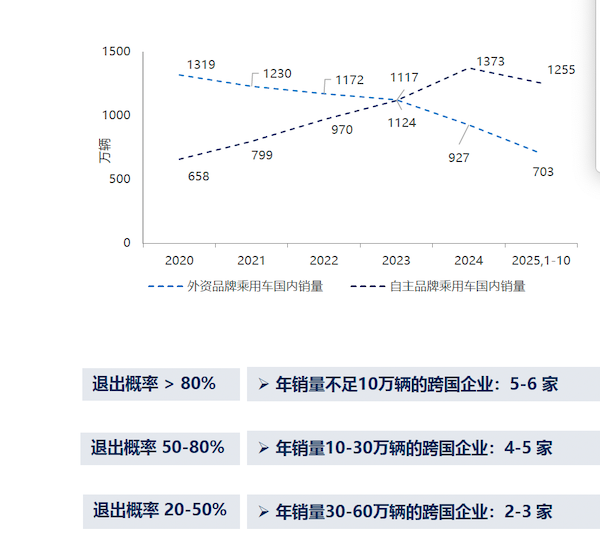
Core Viewpoint - Foreign brands in China are facing significant challenges, with a high probability of exit for multinational car companies with annual sales below 100,000 units, estimated at over 80% for 5 to 6 companies [1] Group 1: Market Share Dynamics - In 2020, domestic brands held a market share of 36%, while foreign brands had 64%. By January to October of this year, domestic brands increased their share to 65%, while foreign brands decreased to 35% [3] - In November, the retail market shares were reported as follows: German brands at 14%, Japanese at 11.7%, American at 5.7%, and Korean at 0.9% [4] Group 2: Exit Probability of Multinational Companies - The probability of exit for multinational companies is closely linked to their market scale. Companies with annual sales between 100,000 to 300,000 units have a 50% to 80% exit probability, with an expectation of 4 to 5 companies exiting; those with sales between 300,000 to 600,000 units have a lower exit probability of 20% to 50%, with an expectation of 2 to 3 companies [4] - Companies with annual sales below 100,000 units include Shenlong Automobile, Chery Jaguar Land Rover, smart, Changan Lincoln, Changan Mazda, and Jiangling Ford [4] Group 3: Strategic Adaptations of Multinational Companies - Leading multinational companies are accelerating their transformation towards a "made in China, for China" strategy. Volkswagen has established a China Technical Research Center (VCTC) for electric vehicle architecture; Toyota has set up an electric intelligent vehicle R&D center in China; Nissan has founded Nissan Technology Development (Shanghai) Co., Ltd. for smart driving and new energy research [4] - In joint ventures, the influence of Chinese teams on product definition is increasing. For instance, Toyota has adopted a local chief engineer management model; Volkswagen has upgraded its strategy from "headquarters directive, local execution" to "joint definition, co-development"; General Motors has shifted product definition authority to local teams, focusing entirely on Chinese customer needs [5] Group 4: Global Sharing of R&D Achievements - Some multinational companies are beginning to share their R&D achievements from China with global markets. For example, BMW has developed a voice interaction system based on Alibaba and DeepSeek's large model for global application; Tesla has integrated over 60 Chinese suppliers into its global procurement system; Stellantis has formed a joint venture with Leap Motor to fill the market gap for affordable electric vehicles [5]





中国车企,“巴”握未来
Zhong Guo Qi Che Bao Wang· 2025-12-16 07:01
Core Insights - Chinese automotive companies are making significant strides in the Brazilian market, showcasing a strong commitment to local production and market penetration [1][5][10] Group 1: Company Developments - GAC International made its debut at the São Paulo International Motor Show, presenting its full range of models, while BYD's Tengshi brand launched its flagship models Z9GT and D9 in Brazil [1][3] - Geely and Renault announced plans to double their local production in Brazil through a joint venture, investing 38 billion Brazilian Reais (approximately 10.5 billion RMB) to enhance their electric vehicle offerings [3][9] - Avita officially entered the Latin American market with the launch of Avita 11, partnering with CAOA Group for comprehensive market support [4] Group 2: Market Potential - Brazil, as the sixth-largest automotive market globally, is experiencing growth driven by a population of over 200 million and an expanding middle class, making it a key target for global automotive companies [5][10] - The Brazilian automotive market is projected to see a 5% increase in sales by 2025, reaching 2.765 million vehicles, with a 7.8% rise in production [5][6] Group 3: Electric Vehicle Growth - The electric vehicle segment in Brazil is rapidly expanding, with a projected 90% increase in sales for electric vehicles in 2024, reaching 177,000 units [6][7] - Chinese companies dominate the electric vehicle market in Brazil, holding a 76% market share as of October 2025, with BYD leading in monthly sales [6][7] Group 4: Policy and Regulatory Environment - Brazilian government policies are catalyzing the shift towards electric vehicles, with incentives and tax benefits aimed at increasing the share of electric vehicles to 30% of total sales by 2030 [7][8] - The government is also implementing import tariffs on electric vehicles to encourage local production, effective from January 2024 [7] Group 5: Strategic Approaches - Chinese automotive companies are adopting differentiated strategies in Brazil, with some focusing on full localization of production, while others, like Geely and Renault, are leveraging partnerships for quicker market entry [8][9] - The establishment of local production facilities is expected to enhance the supply chain for electric vehicle components, further solidifying Brazil's role as a hub for Chinese automotive companies in Latin America [10]




持续盈利路漫漫,新势力盈利变奏曲
Zhong Guo Qi Che Bao Wang· 2025-12-16 06:50
2025年,一些造车新势力迎来了盈利的转折点。零跑、赛力斯、小米等企业凭借销量的迅猛增长, 率先实现了盈利;小鹏、蔚来等企业的亏损幅度也在不断缩小,盈利步伐逐步迈进。然而,理想汽车在 三季度却出现了"扭盈为亏"的情况,面临持续盈利的重大考验。在迈向盈利的道路上,领先的造车新势 力已取得显著成果,但能否保持持续盈利依然是一个严峻的挑战。 规模效应临界点逼近 在新能源汽车产业竞争白热化的当下,销量规模已成为造车新势力突破盈利困局的核心变量,其影响贯 穿企业运营的每个环节。汽车工业的规模经济特性在新能源汽车时代愈发显著。当企业年销量突破10万 辆临界点时,供应链议价能力将发生质变。以电池采购为例,头部新势力可凭借规模化订单将成本降低 15%~20%,这种优势直接转化为毛利率提升的关键支撑。对于新势力而言,销量增长带来的固定成本 分摊效率提升,同样不容忽视——研发费用、生产线折旧等固定支出,在规模化生产下被均摊至更低的 单车成本,为盈利创造空间。 小米汽车便是规模效应助力盈利的典型。2025年三季度,其交付量突破10万辆,销售收入总额约283亿 元,平均单车收入约26万元,毛利率高达25.5%,单车毛利润达6.65万 ...


阿里巴巴、商汤、中芯国际、小米,集体大跌
第一财经· 2025-12-16 05:42
12月16日午后,港股跌幅进一步扩大,恒生指数跌超2%,恒生科技指数现跌2.6%。 | 恒生指数 | 恒生国企 | 恒生科技 | | --- | --- | --- | | 25101.03 | 8714.88 | 5353.47 | | -527.85 -2.06% | -202.82 -2.27% | -144.95 -2.64% | | 恒指期货 | 港股通50 | 恒生生物科技 | | 25129 | 3790.06 | 14340.44 | | -524 -2.04% | -72.36 -1.87% | -292.90 -2.00% | 港股热门科网股普遍下跌,商汤跌超5%,阿里巴巴、小鹏汽车跌超4%,腾讯音乐、中芯国际、小米 集团、京东健康均跌超3%。 | 名称 | 现价 | 涨跌幅 ◆ | | --- | --- | --- | | 商汤-W | 2.010 | -5.63% | | 0020.HK | | | | 小鹏汽车-W | 70.150 | -4.88% | | 9868.HK | | | | 阿里巴巴-W | 142.200 | -4.31% | | 9988.HK | | | | ...

11月乘用车市场销量分析:新能源逆势增长 头部品牌领跑赛道
Zhong Guo Zhi Liang Xin Wen Wang· 2025-12-16 05:09
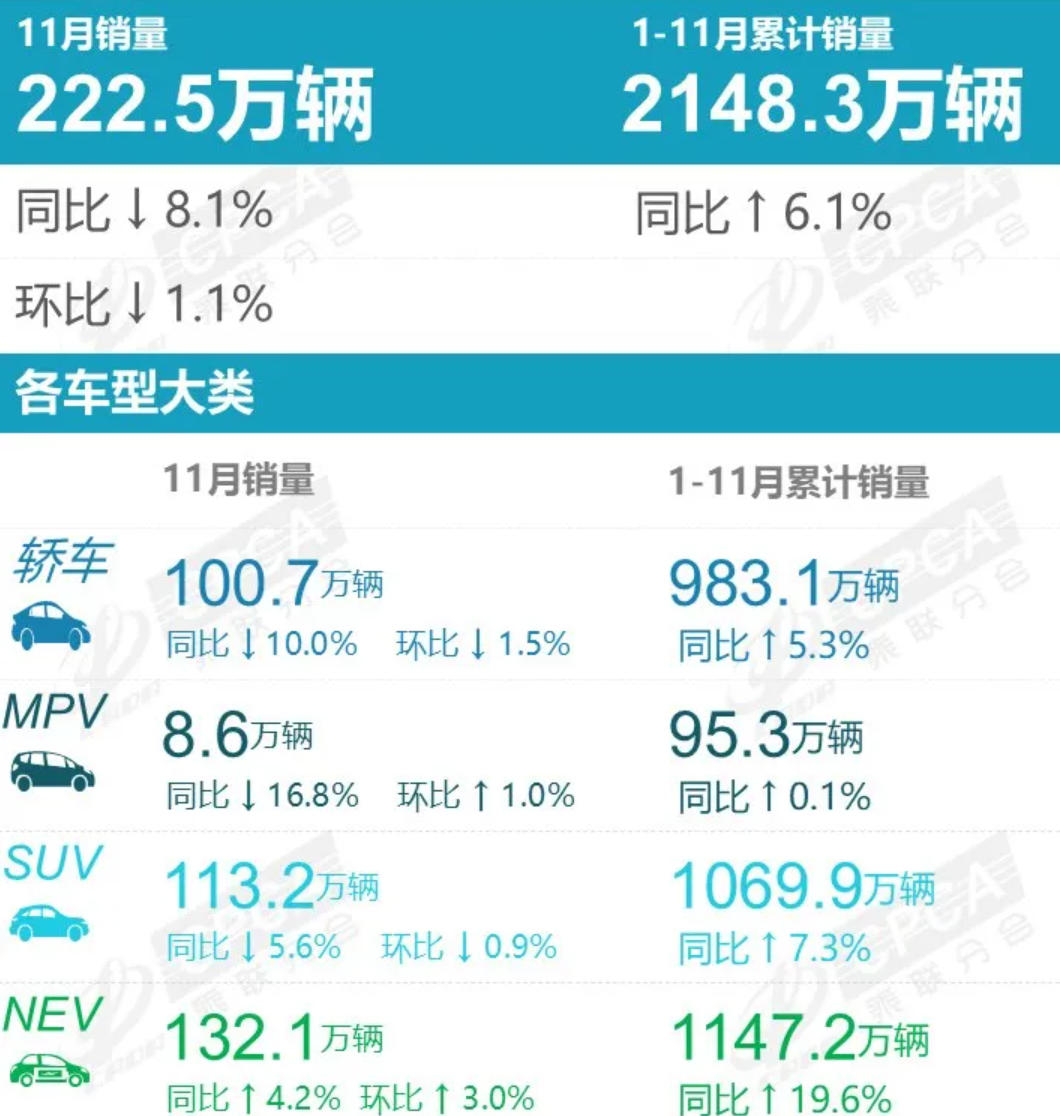
Group 1: Overall Market Performance - In November, the domestic passenger car market faced pressure, with retail sales reaching 2.225 million units, a year-on-year decline of 8.1% and a month-on-month decline of 1.1% [1] - The new energy vehicle (NEV) market, however, showed resilience with sales of 1.321 million units, a year-on-year increase of 4.2% and a month-on-month increase of 3.0%, achieving a penetration rate of over 59% [1] Group 2: Segment Performance - The sedan market saw retail sales of 1.007 million units, down 10.0% year-on-year and slightly down 1.5% month-on-month, with NEV sedans becoming a key growth point [4] - The MPV market was the weakest segment, with retail sales of 86,000 units, a year-on-year decline of 16.8% and a slight month-on-month increase of 1.0% [4] - The SUV market, while also facing year-on-year declines, performed better than sedans and MPVs, with retail sales of 1.132 million units, down 5.6% year-on-year and down 0.9% month-on-month; NEV SUVs sold 683,000 units, up 12.5% year-on-year [4] Group 3: Brand Performance - Among the top ten manufacturers, five were domestic brands, capturing 61% of the total market sales; domestic brands sold 1.49 million units, down 4% year-on-year, while joint venture brands sold 490,000 units, down 19% [4] - BYD led the sales with 306,561 units, although it experienced a year-on-year decline of 26.5% [7] - Geely ranked second with sales of 268,337 units, showing a year-on-year increase of 23.5%, becoming the fastest-growing company among the top brands [9] Group 4: Competitive Landscape - The German brands, particularly FAW-Volkswagen, maintained a stable performance in the shrinking joint venture market, with retail sales of 137,500 units [5] - SAIC Volkswagen's sales were 86,857 units, down 29.3% year-on-year, but it still retained a solid base in the fuel vehicle market [6] - New entrants like Hongmeng Zhixing and Xiaomi Auto showed significant growth, with Hongmeng Zhixing achieving a year-on-year increase of 95.2% [11][18] Group 5: Future Outlook - The market is expected to enter a phase of aggressive sales push in December, with domestic brands likely to maintain their lead in the NEV sector [18] - The competition is shifting from traditional product competition to a focus on technological strength and product quality, indicating a trend towards high-quality development in the automotive industry [18]
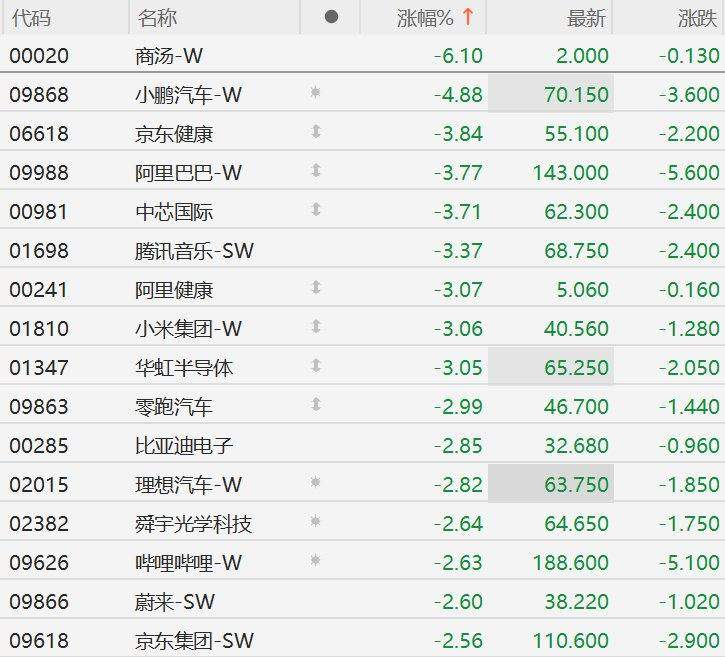
港股科技股集体下挫,恒生科技跌2.5%,阿里跌4%,中芯国际、腾讯音乐、阿里健康、小米、华虹半导体跌超3%


Ge Long Hui· 2025-12-16 04:37
Core Viewpoint - The Hong Kong technology stocks experienced a collective decline, with the Hang Seng Technology Index dropping by 2.5% Group 1: Stock Performance - SenseTime (商汤) fell over 6%, closing at 2.000, down by 0.130 [1][2] - Xpeng Motors (小鹏汽车) decreased by 4.88%, with a latest price of 70.150, down by 3.600 [1][2] - Alibaba (阿里巴巴) saw a decline of 3.77%, trading at 143.000, down by 5.600 [1][2] - JD Health (京东健康) dropped by 3.84%, with a price of 55.100, down by 2.200 [1][2] - Semiconductor Manufacturing International Corporation (中芯国际) fell by 3.71%, closing at 62.300, down by 2.400 [1][2] - Tencent Music (腾讯音乐) decreased by 3.37%, with a latest price of 68.750, down by 2.400 [1][2] - Alibaba Health (阿里健康) dropped by 3.07%, trading at 5.060, down by 0.160 [1][2] - Xiaomi (小米) fell by 3.06%, closing at 40.560, down by 1.280 [1][2] - Huahong Semiconductor (华虹半导体) decreased by 3.05%, with a price of 65.250, down by 2.050 [1][2] - Li Auto (理想汽车) saw a decline of 2.82%, trading at 63.750, down by 1.850 [1][2] - NIO (蔚来) fell by 2.60%, closing at 38.220, down by 1.020 [1][2]
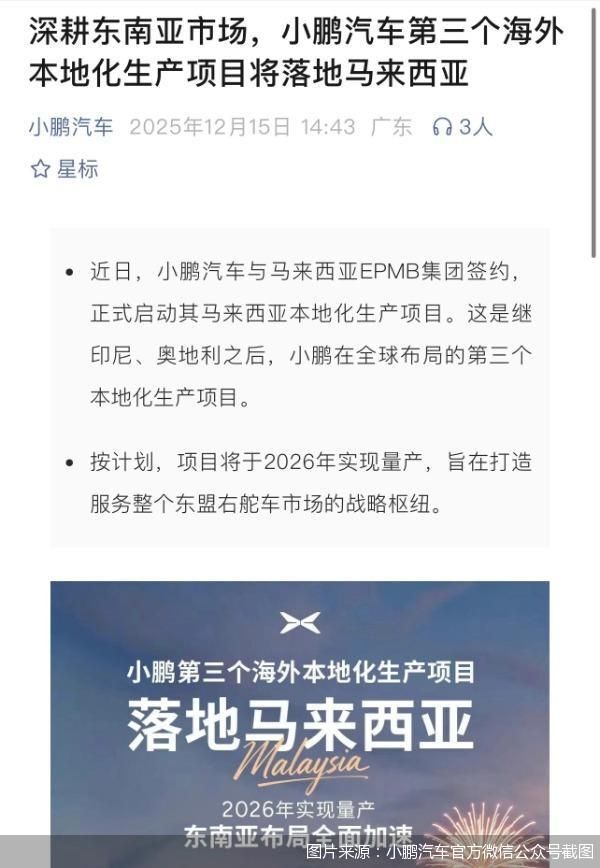
汽车早餐 | 多家车企积极响应《汽车行业价格行为合规指南(征求意见稿)》;小鹏第三个海外本地化生产项目落地马来西亚
Zhong Guo Qi Che Bao Wang· 2025-12-16 01:33
Domestic News - The National Bureau of Statistics reported that from January to November, the added value of the automotive manufacturing industry grew by 11.8% [2] - In the same period, the production of automobiles increased by 10.8%, indicating a steady growth in new consumption [2] - The retail volume of new energy vehicles in the passenger car market maintained rapid growth during this timeframe [2] Industry Developments - The State Administration for Market Regulation announced a recall of 244,500 vehicles from seven automotive manufacturers in November 2025 [3] - The "Yue Car Southbound" reservation system began accepting bookings on December 15, 2025, for travel from December 23, 2025, to January 31, 2026 [4] - Shenyang plans to strengthen its automotive and parts industry, focusing on the full industrial chain of smart connected new energy vehicles [5] - Luoyang aims to accelerate the bearing industry in relation to new energy vehicles and other emerging sectors [6] International News - Renault is shutting down its car-sharing business and slowing down the construction of its electric vehicle charging network to focus on more profitable segments [7] - Volkswagen will cease vehicle production at its Dresden plant after December 16, marking the first closure of vehicle production in Germany since its establishment [9] - Mercedes-Benz India will raise car prices by up to 2% starting January due to rising raw material and logistics costs [10] Corporate News - Multiple automotive companies, including Jiangqi Group and Seres Group, are responding positively to the "Automotive Industry Pricing Behavior Compliance Guidelines" [11] - GAC's flying car GOVY AirCab has entered the airworthiness certification stage, with mass production expected in 2026 [12] - XPeng Motors has initiated its third localized production project in Malaysia, aiming for mass production by 2026 [13] - NIO has established 500 charging and battery swap stations in Shanghai, providing over 10,000 battery swap services daily [14] - CATL and Transfar Group signed a strategic cooperation agreement to enhance collaboration in green and sustainable industry ecosystems [15] - Dong'an Power and Beijing Automotive Manufacturing Factory signed a strategic cooperation agreement to establish a joint innovation laboratory [16] - Taotao Automotive's subsidiary plans to acquire 100% of Racka brand company for $15 million, expanding its brand portfolio [17]


多元化“切入” 中国车企“抢滩”马来西亚
Bei Jing Shang Bao· 2025-12-16 01:09
Core Viewpoint - Malaysia is becoming a key destination for Chinese automotive companies, with several firms, including Xpeng Motors, BYD, and Chery, establishing local production facilities to tap into the growing Southeast Asian market [1][3][5]. Group 1: Xpeng Motors' Expansion - Xpeng Motors has signed an agreement with Malaysia's EPMB Group to initiate local production, marking its third overseas localization project after Indonesia and Austria [1][2]. - The project aims to serve the right-hand drive vehicle market in the ASEAN region and is expected to achieve mass production by next year [2]. - Xpeng's sales in Malaysia have positioned it among the top six electric vehicle brands in the country within the first ten months of this year [2]. Group 2: Competitive Landscape - Other Chinese automakers, such as BYD, Great Wall, and Leap Motor, are also entering the Malaysian market, with various strategies ranging from local assembly to full production [3][4]. - BYD plans to establish an assembly plant in Malaysia, with production set to commence next year, following the introduction of its ATTO 3 model in 2022 [3]. Group 3: Market Potential - The Malaysian automotive market has shown significant growth, with total vehicle sales surpassing Indonesia for the first time this year [5]. - The penetration rate of electric vehicles in Malaysia has increased, with sales of pure electric vehicles growing over 200% year-on-year [5]. - The Malaysian government has set ambitious targets for electric vehicle sales, aiming for 15% of new car sales to be electric by 2030 and 38% by 2040 [5][6]. Group 4: Government Incentives and Industry Support - The Malaysian government offers various incentives for electric vehicles, including tax exemptions and support for local assembly of electric vehicle components [6]. - Malaysia has a robust automotive supply chain with over 600 manufacturers, providing essential components for vehicle production [6]. - The country's strategic geographical location enhances its appeal as a manufacturing hub for the Southeast Asian market [6]. Group 5: Industry Impact - The influx of automotive companies into Malaysia is stimulating related industries, such as battery production, with companies like EVE Energy establishing operations in the country [7].
中国车企“抢滩”马来西亚
Bei Jing Shang Bao· 2025-12-15 15:58
Core Viewpoint - Malaysia is becoming a key destination for Chinese automotive companies, with several firms, including Xpeng Motors, BYD, and Chery, establishing local production facilities to tap into the growing Southeast Asian market [1][4]. Group 1: Xpeng Motors' Expansion - Xpeng Motors has signed an agreement with Malaysia's EPMB Group to initiate local production, marking its third overseas localization project after Indonesia and Austria [1][3]. - The project aims to serve the ASEAN right-hand drive vehicle market and is expected to achieve mass production by next year [3]. - Xpeng's sales in Malaysia have positioned it among the top six electric vehicle brands in the region within the first ten months of the year [3]. Group 2: Competitive Landscape - Other Chinese automakers, such as BYD, Great Wall, and Leap Motor, are also entering the Malaysian market, with various strategies ranging from local assembly to full production [4][5]. - BYD plans to establish a CKD assembly plant in Malaysia, with production set to commence next year, following the introduction of its ATTO 3 model in 2022 [4]. Group 3: Market Dynamics - The Malaysian automotive market is experiencing significant growth, with total vehicle sales surpassing those of Indonesia for the first time, and electric vehicle sales increasing by over 200% year-on-year [6]. - The Malaysian government has set ambitious targets for electric vehicle sales, aiming for 15% of new car sales to be electric by 2030 and 38% by 2040 [6]. Group 4: Government Incentives and Industry Support - The Malaysian government offers various incentives for electric vehicles, including tax exemptions and support for local assembly of components, which enhances the attractiveness of the market for foreign manufacturers [7]. - Malaysia has a robust automotive supply chain with over 600 parts manufacturers, providing essential components for vehicle production [7]. Group 5: Geographical Advantages - Malaysia's strategic location in Southeast Asia facilitates access to regional markets, making it an ideal hub for automotive companies looking to expand their presence in the area [7].
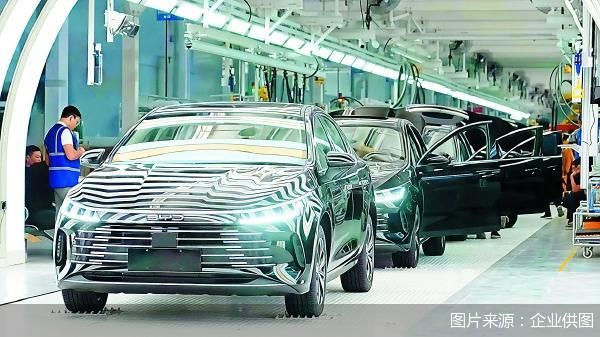
小鹏本地化生产、比亚迪建组装厂,车企“抢滩”马来西亚
Bei Jing Shang Bao· 2025-12-15 13:37
Core Viewpoint - Malaysia is becoming a key production hub for Chinese electric vehicle (EV) manufacturers, with companies like Xpeng, BYD, and others establishing local production to tap into the growing ASEAN market [1][6][8]. Group 1: Xpeng's Local Production Initiatives - Xpeng Motors has signed an agreement with Malaysia's EPMB Group to initiate its local production project, marking its third overseas localization effort after Indonesia and Austria [1][5]. - The project aims to achieve mass production by 2026 and serve the right-hand drive vehicle market in ASEAN [5]. - In the first ten months of this year, Xpeng's electric vehicle sales in Malaysia ranked among the top six brands [5]. Group 2: Competitive Landscape in Malaysia - Other Chinese automakers, including BYD, Great Wall, and Chery, are also entering the Malaysian market, with various strategies from vehicle exports to local production [6][7]. - BYD is constructing an assembly plant in Malaysia, set to begin production next year, and has already launched the ATTO 3 model in the market [6]. - The local automotive market is experiencing increased competition, with a focus on cost-effective local production to benefit from government incentives [7]. Group 3: Market Growth and Government Support - The Malaysian automotive market has shown significant growth, with total vehicle sales in the ASEAN region reaching approximately 707,100 units in Q2, with Malaysia surpassing Indonesia in sales for the first time [8]. - The Malaysian government has set ambitious targets for electric vehicle sales, aiming for 15% of new car sales to be electric by 2030 and 38% by 2040 [8][9]. - Incentives such as tax exemptions for electric vehicles and local assembly components are in place to boost EV adoption [9]. Group 4: Industry Infrastructure and Strategic Advantages - Malaysia has a robust automotive supply chain with over 600 parts manufacturers, making it an attractive location for local production [10]. - The country's strategic geographical position facilitates easy access to the broader Southeast Asian market, enhancing the distribution capabilities of manufacturers [10]. - The establishment of local production facilities is expected to drive further investment in the region's automotive ecosystem, as seen with companies like EVE Energy setting up operations in Malaysia [10]. Group 5: Export Trends and Global Market Position - Chinese automotive exports have surged, with a total of 6.343 million vehicles exported in the first eleven months of the year, marking an 18.7% increase year-on-year [11]. - The export of Chinese electric vehicles is becoming a significant component of overall automotive exports, with 2.315 million units exported in the same period, reflecting a doubling year-on-year [11][12]. - China accounted for 68% of the global increase in new energy vehicles, indicating its dominant position in the global EV market [12].