东风柳汽

Search documents
今年预计交付五百台工业人形机器人,优必选:场景落地要聚焦
Nan Fang Du Shi Bao· 2025-08-12 07:50
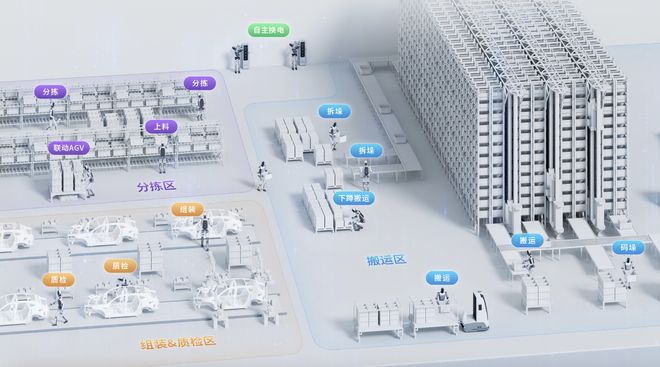
Core Insights - UBTECH's humanoid robots are set to begin mass deployment after over a year of factory training, with an expectation to deliver 500 industrial humanoid robots this year, primarily to automotive and 3C semiconductor sectors, while only 10 units are projected for 2024 [1] - The company emphasizes the importance of focusing on specific application scenarios rather than spreading resources too thin across multiple areas, as this can lead to unclear product positioning and customer skepticism [2][3] - UBTECH has partnered with major automotive companies to validate its humanoid robots in real-world factory settings, addressing common labor shortages and high turnover rates in industries like automotive and traditional manufacturing [4][5] Product Development and Features - The new Walker S2 humanoid robot features an autonomous battery swapping capability, extending its operational time to 8 hours, addressing previous concerns about battery life and efficiency [7] - The Walker S2 has been designed with a lighter structure, utilizing advanced materials like 3D printed aluminum alloy and carbon fiber, while also incorporating a greater range of motion to enhance its adaptability in various work environments [8] - The company is also exploring international markets, particularly in regions like Singapore, Europe, and Japan, where demand for humanoid robots is expected to grow [12] Market Strategy and Challenges - UBTECH's strategy includes a phased approach to deploying robots in client production lines, ensuring stability and reliability before full integration [10] - The company has significantly increased its resource allocation for research and development to tackle the unpredictability of real-world applications, indicating a commitment to overcoming operational challenges [6] - The competitive advantage lies in UBTECH's willingness to allow its robots to operate in real production environments and its ability to quickly respond to customer needs [9]


两个月内被约谈四次,汽车业需要好好“立规矩”了
Jing Ji Guan Cha Wang· 2025-08-11 10:29
Core Viewpoint - The dispute over the Li Xiang i8 crash test has highlighted the chaotic competition in the automotive industry, prompting regulatory intervention to restore order and compliance [1][2][3] Group 1: Regulatory Intervention - The Ministry of Industry and Information Technology (MIIT) has conducted multiple talks with automotive companies this year, indicating a growing concern over the industry's chaotic transformation and competition [1][2] - Five notable regulatory talks have occurred this year, addressing issues such as smart driving promotion, price wars, emissions fraud allegations, supply chain payment terms, and misleading crash test results [1][2] - The regulatory measures include reviewing profit reports, establishing complaint platforms, conducting inspections, and creating a credit blacklist for non-compliant companies [3] Group 2: Industry Challenges - The Li Xiang i8 crash test incident exemplifies a broader issue of compliance gaps within the new energy vehicle sector, reflecting a lack of detailed regulations and constraints on smart driving features and competition [2][3] - The automotive industry is facing deep-rooted contradictions, primarily driven by a focus on cost reduction over compliance, contributing to low profit margins and hindering global competitiveness [2][3] - The current regulatory framework is lagging behind technological advancements, leading to a proliferation of issues stemming from the rapid, unregulated growth of the new energy vehicle sector [2][3] Group 3: Future Directions - There is a pressing need for a new standard system and enhanced regulatory measures to adapt to the changes brought by new energy vehicles, as traditional automotive regulations are insufficient [3][4] - The industry must learn from the regulatory practices of Western automotive markets to ensure that innovation does not compromise ethical standards and consumer trust [4] - A collaborative effort among companies to adhere to self-regulatory standards and foster healthy competition is essential for the high-quality development of China's new energy vehicle sector [4]
理想i8碰撞“测试”风波始末
Zhong Guo Jing Ying Bao· 2025-08-08 20:50
Core Viewpoint - The unconventional collision test conducted by Li Auto for its newly launched i8 has sparked significant public debate regarding marketing ethics, industry standards, and brand competition, leading to a joint statement from Li Auto, China Automotive Engineering Research Institute, and Dongfeng Liuzhou Motor to advocate for self-regulation and integrity in the automotive industry [1][2][3]. Group 1: Incident Overview - The incident originated from a video shown at Li Auto's new car launch on July 29, where a collision test between the 2.6-ton Li i8 and an 8-ton Dongfeng Liuzhou truck was presented, showcasing the i8's passenger cabin integrity [2][3]. - Following the video release, Dongfeng Liuzhou issued a statement on July 31, criticizing the test for being misleading and damaging to its brand image [3]. - On August 3, both China Automotive Engineering Research Institute and Li Auto responded, clarifying that the test was not intended to evaluate the safety of other brands [3]. Group 2: Joint Statement and Industry Response - On August 6, a joint statement was released by the three parties to clarify facts, eliminate misunderstandings, and maintain a healthy industry environment [1][3]. - Li Auto apologized for the unintended negative impact on Dongfeng Liuzhou's brand and committed to taking measures to prevent similar controversies in the future [3][4]. - Dongfeng Liuzhou emphasized its commitment to high-quality products and compliance with legal standards, rejecting unfair competition [4]. Group 3: Industry Implications - The incident highlighted the need for industry-wide cooperation for high-quality development, with experts acknowledging the importance of the joint statement in addressing the controversy [2][5]. - The collision test raised questions about the appropriateness of comparing vehicles across different categories, as standard testing typically does not include such comparisons [5]. - The event unexpectedly increased visibility for Dongfeng Liuzhou, leading to a surge in social media engagement and brand awareness [6]. Group 4: Market Performance - The commercial vehicle market, particularly heavy trucks, showed strong performance in July, with sales reaching 83,000 units, a 42% year-on-year increase [6][7]. - The overall commercial vehicle production and sales for the first half of the year were 2.099 million and 2.122 million units, respectively, reflecting growth of 4.7% and 2.6% year-on-year [6].


理想汽车,白“撞”了
凤凰网财经· 2025-08-07 13:16
Core Viewpoint - The article discusses the challenges faced by Li Auto in its transition to pure electric vehicles, particularly focusing on the launch of the i8 model and its subsequent price adjustment due to disappointing sales performance [10][11][22]. Group 1: Incident Overview - Li Auto's i8 faced a controversy during its launch related to a collision test video that went viral, which showed the i8 "colliding" with a heavy truck, leading to public scrutiny and a backlash from the truck manufacturer [4][9][12]. - A joint statement was issued by Li Auto, China Automotive Research, and Dongfeng Liuzhou Motor to apologize and promote healthy competition after the incident [6][19]. - Despite the increased attention from the incident, the i8 did not see a corresponding rise in sales, leading to a price reduction shortly after its launch [10][20]. Group 2: Sales Performance - The i8 was launched with a price range of 321,800 to 369,800 yuan, but due to underwhelming sales, the price was adjusted downwards by 10,000 yuan shortly after its release [20][21]. - Comparatively, the competitor model, Leidao L90, achieved significant sales success shortly after its launch, highlighting the struggles of the i8 in the market [20][27]. - As of early August, the estimated order count for the i8 was around 6,000, significantly lower than the initial expectations [21]. Group 3: Market Position and Strategy - Li Auto's transition to pure electric vehicles has been met with skepticism from investors, particularly following the poor performance of the MEGA model, which failed to meet its sales targets [22][23][29]. - The company has adjusted its annual sales target from 700,000 to 640,000 units, reflecting a more cautious outlook amid increasing competition in the electric vehicle market [36][41]. - The i8's performance is critical for Li Auto's future growth, as the company aims to increase its pure electric vehicle sales target from approximately 50,000 to 120,000 units [41][45]. Group 4: Financial Health - Despite the challenges, Li Auto reported a cash reserve of 53.233 billion yuan as of the end of Q1, indicating a stable financial position to navigate through the current market difficulties [47]. - The company is also exploring advancements in artificial intelligence, suggesting a potential shift in focus beyond just automotive manufacturing [47][48].
理想汽车,白“撞”了?
Xin Lang Cai Jing· 2025-08-07 09:24
Core Viewpoint - The recent controversy surrounding the crash test of Li Auto's i8 has concluded with a joint statement of apology from Li Auto, China Automotive Research, and Dongfeng Liuzhou Motor, but the i8's sales have not seen a corresponding increase despite heightened attention [1][4][10]. Group 1: Incident Overview - A crash test video showcasing the i8's performance against a heavy truck went viral, leading to significant public discourse and controversy, particularly involving the truck brand, Chenglong [4][8]. - Following the backlash, Li Auto adjusted the pricing and configuration of the i8, indicating a response to poor sales performance shortly after its launch [5][10]. Group 2: Sales Performance - The i8, launched at prices ranging from 321,800 to 369,800 yuan, has not achieved expected sales, with reports suggesting only around 6,000 orders [10][20]. - In contrast, the competitor Leidao L90, which launched shortly after the i8, reported 1,976 units delivered within three days, highlighting the competitive pressure faced by Li Auto [10][20]. Group 3: Market Position and Challenges - Li Auto's stock price has struggled since reaching a peak of over 180 HKD per share in March 2022, coinciding with its entry into the pure electric vehicle market [14][18]. - The company has faced declining delivery numbers, with June and July 2023 showing year-on-year drops of approximately 24% and 39.8%, respectively [20][24]. - Li Auto has revised its annual sales target from 700,000 to 640,000 units, with a completion rate of about 36.7% by July [24][25]. Group 4: Future Outlook - The company aims to increase its pure electric vehicle sales target from approximately 50,000 to 120,000 units, despite the competitive landscape becoming increasingly challenging [25][26]. - Li Auto plans to launch the i6, a new five-seat pure electric SUV, in September 2023, which will face competition from other brands in the same price range [26][27].
理想i8测试风波:声明能止争议,法律边界仍需厘清
Guan Cha Zhe Wang· 2025-08-07 08:24
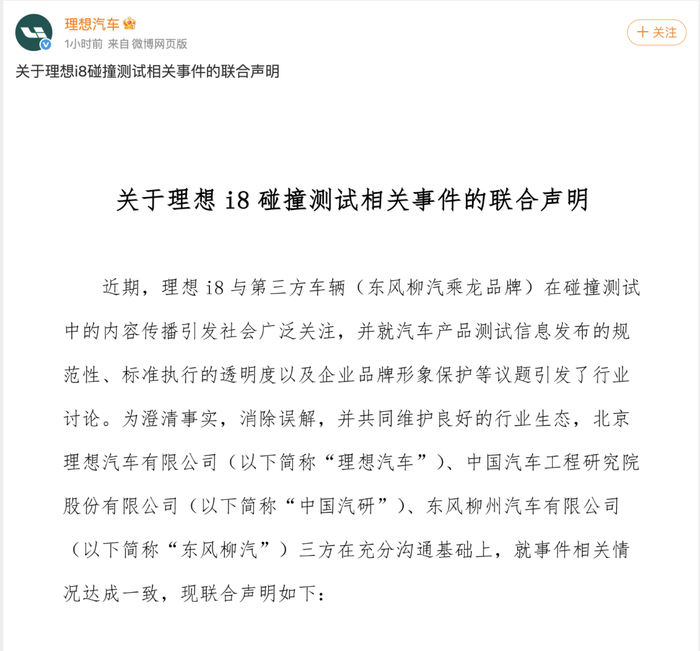
Core Viewpoint - The joint statement from Li Auto, China Automotive Technology & Research Center, and Dongfeng Liuzhou Motor aims to address the controversy surrounding the crash test of the Li Auto i8, highlighting the need for clarity in legal boundaries regarding advertising and competition [1][6]. Group 1: Joint Statement and Apologies - Li Auto and China Automotive Technology & Research Center issued apologies for the potential brand association risks caused by the dissemination of related content [1]. - Dongfeng Liuzhou Motor called for the resistance of unfair competition and adherence to legal and compliant business practices [1]. Group 2: Legal Implications - The initial video presentation by Li Auto may lead to consumer concerns regarding the safety of Dongfeng Liuzhou Motor's "Chenglong" trucks, potentially harming its reputation [2]. - The current laws on unfair competition and advertising need to be examined, particularly whether the initial video constitutes infringement or violates the Advertising Law [3][4]. Group 3: Advertising Law Violations - If the crash test parameters were not fully disclosed, it could violate the principle of advertising authenticity as per the Advertising Law, potentially leading to claims of false advertising [3][4]. - Selectively showcasing favorable footage without disclosing critical parameters may result in misleading promotion [3]. Group 4: Risk Mitigation Strategies - Li Auto should publicly disclose complete test parameters and clarify that results pertain only to specific scenarios [5]. - China Automotive Technology & Research Center could issue a written statement emphasizing that the tests were conducted per the client's requirements [5]. - Dongfeng Liuzhou Motor may consider third-party testing of its trucks to validate safety claims and guide public perception regarding non-standard tests [5]. Group 5: Industry Lessons - The incident serves as a warning for companies to ensure that promotional content is grounded in factual accuracy and to respect legal boundaries in competitive practices [6]. - Companies should strive for transparency and integrity in advertising to foster a fair competitive environment in the automotive industry [6].
四箭齐发,欧曼银河新能源重卡能否打破行业格局?
第一商用车网· 2025-08-07 06:36
Core Viewpoint - The article highlights the launch of the Ouman Galaxy new energy heavy truck series by Foton Motor, which aims to redefine the value benchmark in the new energy heavy truck industry through its three core advantages: full scene coverage, advanced technology, and value reconstruction [1][25]. Group 1: Product Features and Innovations - The Ouman Galaxy series includes four new models: Galaxy 9, Galaxy 5M, Galaxy T, and Galaxy 3, designed to meet diverse transportation needs such as express delivery, coal, sand and gravel, and construction waste [1][11]. - The series is built on the Galaxy Smart Architecture, featuring self-developed three-electric systems and intelligent management technology, which allows for precise adaptation to various logistics scenarios [1][5]. - The electric drive technology includes an industry-leading eight-layer flat wire oil-cooled motor with a peak speed of 12,000 rpm and an efficiency of 97.7%, capable of handling heavy-duty conditions [7][23]. Group 2: Energy Management and Efficiency - The vehicle control system (VCU) works in conjunction with the Galaxy domain control to optimize overall energy consumption by 6-8%, and supports remote OTA upgrades for flexible evolution [9][23]. - The Ouman Galaxy 9 model features a three-stage integrated technology that enhances battery capacity by 17% and charging efficiency by 7%, addressing range anxiety for logistics fleets [13][23]. Group 3: Targeted Solutions for Specific Scenarios - The Galaxy 5M model is tailored for bulk cargo transport, utilizing 42 new materials and 68 new processes to reduce weight by 400 kg, thereby improving load capacity and reducing energy consumption [15][23]. - The Galaxy T model, designed for construction waste transport, boasts the shortest wheelbase in its class, enhancing maneuverability and durability by over 30% [17][23]. - The Galaxy 3 model offers a modular battery layout that balances long-range capabilities with load capacity, making it suitable for various short-distance and intercity transport scenarios [19][23]. Group 4: Lifecycle Value and Competitive Advantage - The Ouman heavy truck's core competitiveness lies in its Total Cost of Ownership (TCO), emphasizing cost-effectiveness and efficiency for users [21][23]. - The new energy heavy trucks are optimized for specific transportation intensities and road conditions, allowing users to select the most suitable products without unnecessary costs [21][23]. - Foton Motor's continuous innovation in lightweight design and energy optimization aims to lower transportation and operational costs, transforming technological advancements into tangible benefits for users [23][25].

对撞三方中国式握手,乘龙追击戛然而止
汽车商业评论· 2025-08-07 04:09
Core Viewpoint - The article discusses the resolution of a public controversy involving Li Auto, China Automotive Research, and Dongfeng Liuzhou Motor, highlighting the implications of the incident on brand visibility and industry dynamics [4][11][29]. Group 1: Incident Overview - On August 6, 2025, a joint statement was released by Li Auto, China Automotive Research, and Dongfeng Liuzhou Motor, addressing the collision test incident involving the Li Auto i8, with both Li Auto and China Automotive Research apologizing [4]. - The incident generated significant online attention, with over a hundred related topics on Weibo and cumulative reading exceeding one billion [11][12]. Group 2: Impact on Brands - The incident notably increased the visibility of Li Auto and China Automotive Research, while Dongfeng Liuzhou Motor, which was indirectly involved, saw a surge in search interest, with a 25-fold increase in search volume on Baidu [12]. - Dongfeng Liuzhou Motor's Douyin account gained nearly 30,000 new followers in a single day, with average live stream viewership reaching 243,000, a 13-fold increase compared to the previous month [12]. Group 3: Marketing and Industry Dynamics - The article highlights a trend in the automotive industry where brands leverage unexpected events for marketing, as seen with the significant increase in visibility for brands like Dongfeng Liuzhou Motor following the incident [18][19]. - Experts suggest that the incident presents an opportunity for Dongfeng Liuzhou Motor to enhance its market share in the commercial vehicle sector, emphasizing the importance of capitalizing on such unexpected visibility [28]. Group 4: Future Considerations - The article raises concerns about the unresolved questions surrounding the collision test, indicating that the public discourse may continue as the core issues remain unaddressed [31][32]. - It emphasizes the need for companies to balance the pursuit of visibility with ethical considerations and genuine consumer needs, suggesting that maintaining a strong value proposition is crucial for long-term trust [32].

大和解!“理想i8对撞卡车”迎新进展 理想汽车、中国汽研致歉
Cai Jing Wang· 2025-08-07 03:33
Core Viewpoint - The incident involving the collision test of the Li Auto i8 and a truck has led to a joint statement from Li Auto, China Automotive Research Institute (CARI), and Dongfeng Liuzhou Motor Co., emphasizing the importance of self-discipline and innovation in the automotive industry [1][2][4]. Summary by Relevant Sections Incident Overview - The collision test involving the Li Auto i8 and a Dongfeng Liuzhou truck has sparked widespread public concern due to the dissemination of related content [2][6]. - The test aimed to verify and enhance the passive safety performance of the Li Auto i8, not to evaluate the safety and quality of other brands [2][7]. Apologies and Responses - Li Auto expressed sincere apologies for the unintended negative impact on Dongfeng Liuzhou's brand image due to the incident, acknowledging the miscommunication that led to public misunderstanding [2][3]. - CARI admitted to failing to clearly communicate the purpose of using the Dongfeng Liuzhou truck as a "mobile barrier" in the test, which contributed to public confusion [3][7]. Industry Call to Action - The three parties called for the automotive industry to adhere to self-discipline, focusing on integrity and ethical competition, while avoiding any form of unfair competition [4][5]. - They urged the industry to concentrate resources on enhancing vehicle safety, core technology innovation, and improving user experience to elevate the overall image and competitiveness of the Chinese automotive sector [4][5]. Commitment to Improvement - Li Auto and CARI committed to taking further measures to prevent similar controversies in the future, ensuring that testing processes are transparent and well-communicated [3][5]. - Dongfeng Liuzhou emphasized its commitment to high-quality and reliable products, resisting unfair competition, and contributing to the transformation of China from a major automotive nation to a strong automotive nation [3][4].
理想汽车将追责“乱停车”等负面评价
Xin Lang Cai Jing· 2025-08-07 03:24
Core Viewpoint - Li Auto has reported a surge in misleading negative information targeting its vehicle owners across various online platforms, which has significantly harmed the company's user image and disrupted the lives of its customers [1][3]. Group 1: Negative Information and Legal Actions - The company has identified that negative information has been continuously and intensively published across multiple platforms, indicating organized illegal activities [3]. - On August 3, a single platform saw 45 identical posts related to Li Auto owners within a span of just seven hours, showcasing the coordinated nature of the attacks [3]. - Li Auto is gathering evidence and plans to pursue legal actions through platform complaints, civil lawsuits, and criminal reports to hold responsible parties accountable [3]. Group 2: Customer Concerns and Social Media Activity - A customer reported feeling unsafe due to the overwhelming negative comments online, which have led to a sense of fear among Li Auto owners [6]. - The company's product line head shared a screenshot indicating that there are organized efforts to collect negative behaviors associated with Li Auto vehicles and to post malicious comments on social media [8]. Group 3: Product Launch and Safety Testing - Li Auto recently launched its first pure electric SUV, the Li i8, and adjusted its pricing strategy based on user feedback, consolidating its previous three versions into a single configuration priced at 339,800 yuan [8]. - Following a collision test involving the Li i8, the company, along with China Automotive Research and Dongfeng Liuzhou, issued a joint statement clarifying that the test aimed to enhance the vehicle's safety performance and was not intended to target any other brands [8].