
中国星网

Search documents
永信至诚:公司中标中国星网生态体系攻防靶场支撑系统项目,为其筑牢数字资产安全防线
Zheng Quan Ri Bao Wang· 2025-12-18 10:43
Group 1 - The core viewpoint of the article is that Yongxin Zhicheng has secured a project to support the China Star Network's ecological system for offensive and defensive training grounds, enhancing digital asset security [1] - The company has a strong technical foundation and practical experience in testing evaluation and network training grounds, which contributed to winning the project [1] - Due to a commercial confidentiality agreement with the client, the company is unable to disclose further details about the collaboration [1]

第一批从北京搬来雄安的人,他们有话说……
Jin Rong Shi Bao· 2025-12-18 04:22
燕赵沃野,白洋淀边,雄安新区从蓝图变为实景。 超万亿投资筑牢城市骨架,5300余座楼宇拔地而起;105所中小学、幼儿园星罗棋布,民生配套日趋完 善;六大新兴产业集群加速集聚,超4000家北京来源企业落地发展,一座宜业宜居的现代化新城正加速 崛起。 2023年5月,习近平总书记在河北雄安新区考察并主持召开高标准高质量推进雄安新区建设座谈会,强 调"雄安新区已进入大规模建设与承接北京非首都功能疏解并重阶段"。党的二十届四中全会(以下简称 为"全会")通过的《中共中央关于制定国民经济和社会发展第十五个五年规划的建议》(以下简称为 《建议》)提出,"高标准高质量推进雄安新区建设现代化城市",为新区发展锚定方向、凝聚力量。 战略指引下,一批央企及配套机构陆续扎根雄安,疏解至新区的持牌金融机构,既以暖心举措破"安 居"难题,更以金融创新答好"履职"答卷,让党的二十届四中全会精神在雄安一线开花结果。 中国中化大厦8楼内,司库系统大屏演示着司库体系的运营全貌与成效;办公区共享空间里,几名员工 正围着桌子头脑风暴,业务工作在按部就班地进行中。对疏解至雄安的金融机构而言,安顿好"人"只是 起点,把"事"做扎实、做精彩,才是对"千 ...
AI沦为暗线?从商业航天入手“十五五”投资机会!
Ge Long Hui A P P· 2025-12-16 10:24
Core Viewpoint - The article discusses the ongoing AI bubble concerns and the impact of various negative news on the AI technology sector, while emphasizing that the fundamental logic and trends of the global AI industry remain unchanged in the long term [2][5]. Group 1: Investment Opportunities in Key Technology Directions - Commercial Space: The "strong nation in space" goal in the 14th Five-Year Plan, along with policies, demand, and technology, creates a robust investment opportunity in commercial space [2][3]. - Demand for low-orbit satellite resources is urgent, with China's GW and Qianfan constellations planning over 10,000 satellites, of which less than 1% are currently in orbit [3]. - The successful launch of the Zhuque-3 and the upcoming Long March 12 rocket are expected to significantly reduce launch costs, which is crucial for satellite networking [3]. Group 2: Specific Technology Areas - Autonomous Driving: The recent approval of L3 autonomous vehicle licenses marks a critical transition from testing to commercialization, with a projected market size of 270 billion for Robotaxi by 2030 [5]. - Nuclear Fusion: While still in the experimental phase, nuclear fusion is recognized as a future key industry, with significant investment opportunities tied to technological breakthroughs [6]. - Artificial Intelligence: The focus has shifted from speculative investments to practical applications, with the 14th Five-Year Plan promoting AI integration across various industries [6][7]. Group 3: Market Dynamics and Trends - The commercial space sector has shown resilience despite recent launch delays, indicating strong market recognition and investment potential [9][11]. - The core logic of commercial space revolves around the urgent need for satellite networking and decreasing costs, with various companies positioned to benefit from this trend [11]. - The article highlights the importance of selecting the right sectors and companies for sustained investment, particularly in the context of the 14th Five-Year Plan's long-term technological focus [15].





AI沦为暗线?从商业航天入手“十五五”投资机会!
格隆汇APP· 2025-12-16 09:44
Core Viewpoint - The article discusses the ongoing trends in various technology sectors, particularly focusing on the AI industry, commercial aerospace, autonomous driving, nuclear fusion, and quantum technology, emphasizing the long-term potential despite short-term market fluctuations [5][6][10][13][16]. Group 1: Commercial Aerospace - The Chinese government has prioritized commercial aerospace in its strategic goals, establishing a dedicated department and action plans, indicating strong policy support [8]. - The demand for low-orbit satellite resources is urgent, with plans for thousands of satellites, and recent technological advancements in reusable rockets are expected to significantly reduce launch costs [8][20]. - Key players in the commercial aerospace sector include China Satellite, which leads in satellite manufacturing, and various companies involved in rocket manufacturing and satellite components [20][22]. Group 2: Autonomous Driving - The autonomous driving sector is entering a critical commercialization phase, supported by government policies and technological advancements, with a projected market size of 2.7 trillion by 2030 for Robotaxi services [10]. - The recent approval of L3 autonomous vehicle models marks a significant step towards commercial deployment [10]. Group 3: Nuclear Fusion - Nuclear fusion is recognized as a future clean energy source, but it remains in the experimental stage, with significant breakthroughs needed before commercialization [11][12]. - Current investments are focused on technological milestones, making it a long-term investment opportunity [12]. Group 4: Artificial Intelligence - The AI sector is transitioning from speculative investments to practical applications, with a focus on real-world implementations that enhance efficiency and reduce costs [13]. - The emphasis is on AI applications across various industries, including manufacturing and healthcare, rather than on speculative infrastructure investments [13]. Group 5: Robotics - The development of embodied intelligence and humanoid robots is a key focus area, with increasing demand in manufacturing due to labor shortages and rising costs [14]. - Companies like Tesla are advancing humanoid robot production, while domestic firms are achieving significant progress in core components [14]. Group 6: Semiconductor Industry - The semiconductor sector is a priority for domestic self-sufficiency, with a focus on overcoming key technological challenges [15]. - Domestic wafer manufacturers are expanding production, and there is a growing demand for domestic semiconductor components [15]. Group 7: Quantum Technology - Quantum communication is positioned as a strategic priority for national security, with ongoing efforts in standardization and pilot projects in financial and governmental applications [16]. - Companies in the quantum sector are beginning to secure significant contracts, indicating a move towards commercialization [16][24]. Group 8: Market Trends and Investment Strategy - The article suggests that commercial aerospace is currently the most promising sector for investment, driven by policy, demand, and technological advancements [26]. - It also highlights the importance of focusing on sectors with clear policy support and performance validation, such as AI applications and robotics, while recognizing the long-term potential of quantum technology and semiconductor advancements [26].

SpaceX确认2026年IPO计划,商业航天产业催化密集
Jin Rong Jie· 2025-12-15 01:37
Core Viewpoint - SpaceX is preparing for a potential IPO in 2026, with a target valuation of approximately $1.5 trillion, comparable to Saudi Aramco's record valuation of about $1.7 trillion in 2019 [1] Group 1: Company Developments - SpaceX is currently the busiest rocket launch company globally, frequently launching satellites for clients using its Falcon 9 rocket [1] - The Starlink satellite system has deployed over 9,000 satellites to provide high-speed satellite internet services, experiencing rapid business expansion in recent years [1] - The ongoing development of the Starship lunar and Mars exploration rocket projects is a significant factor driving SpaceX's IPO preparations [1] Group 2: Industry Context - The rapid expansion of satellite internet, particularly the direct-to-mobile device business, presents vast opportunities for growth [1] - China's Xingwang (GW constellation) is in a fast construction and networking phase, with a noticeable acceleration in launch progress expected in the second half of 2025 [1] - As China's rocket capacity improves in 2026, the launch frequency is anticipated to increase further, indicating a catalytic effect on the commercial space industry and investment opportunities within the supply chain [1]
商业航天不是送火箭,是建“太空基础设施”:下一代产业链正在重构
3 6 Ke· 2025-12-12 12:11
Core Viewpoint - The article discusses the transition of the commercial space industry from a 1.0 era focused on rocket launches to a 2.0 era centered around space-based infrastructure and computing capabilities, highlighting the competitive landscape dominated by the United States and the strategic developments in China's space sector [1][25]. Group 1: Commercial Space Industry Transition - The commercial space industry is evolving from a focus on rocket launches to a new phase characterized by space-based computing and infrastructure, termed "Commercial Space 2.0" [1][25]. - The cost of low Earth orbit (LEO) satellites has decreased by over 90% in the past decade, enabling industrial-scale production and transforming satellites into "space terminal devices" [2][5]. - The establishment of the Hainan International Commercial Space Launch Center aims to enhance launch frequency and efficiency, with a target of achieving "monthly launches" by 2025 [6][7]. Group 2: Competitive Landscape and Global Initiatives - The U.S. Starlink program has set a precedent in the commercial space sector, with plans to deploy a constellation of 42,000 satellites, leading to intense competition for orbital slots among nations [8][19]. - China's satellite launch prices are competitive globally, with low Earth orbit service prices not significantly higher than those of SpaceX, indicating a strong position in the global market [5][19]. - Various Chinese companies, including China Star Network and Shanghai Yuanxin, are planning large-scale satellite constellations, with the former aiming to deploy 12,992 satellites [13][15]. Group 3: Technological Developments and Future Prospects - The development of reusable rockets is crucial for reducing costs and accelerating the deployment of satellite constellations, with several models expected to launch by the end of 2025 [20][22]. - The article highlights the need for a large-capacity, low-cost, and reliable reusable rocket to meet the demands of the commercial space industry [19][20]. - The establishment of a dedicated regulatory body for commercial space in China signifies a commitment to fostering industry growth and innovation [25][26].
“空天AI”持续演绎!卫星产业ETF(159218)涨1.5%闪耀两市
Sou Hu Cai Jing· 2025-12-11 06:51
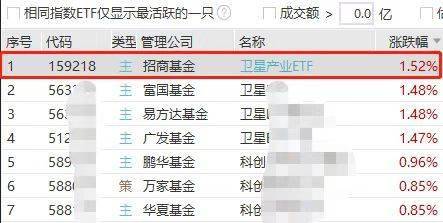
Core Insights - The satellite industry sector is showing strong performance, with the Satellite Industry ETF (159218) rising by 1.52% as of December 11, 2023, leading the market with a trading volume of approximately 140 million yuan and a turnover rate of 18.40% [1][2] - The ETF has seen a remarkable year-to-date growth in shares of 426.85%, continuously setting historical highs [1] - Multiple catalysts are driving the industry forward, including SpaceX's advancement on a $30 billion IPO plan and the acceleration of commercial aerospace industry layouts in major Chinese provinces like Guangdong and Shandong [2] - China Star Network has initiated key equipment bidding, indicating a significant phase in application development [2] - The Satellite Industry ETF (159218) is becoming an essential investment tool for investors looking to capitalize on the growth opportunities in the space economy [3]
行业深度报告:商业航天,大国重器
KAIYUAN SECURITIES· 2025-12-11 06:45
Investment Rating - The investment rating for the industry is "Positive" (maintained) [1] Core Insights - The commercial aerospace industry is increasingly recognized as a strategic emerging industry, with growing government emphasis on its development as a key measure for enhancing national strength and seizing future technological and economic development opportunities [4][24] - The global commercial aerospace market is entering a golden era of development, driven by low Earth orbit (LEO) satellite internet, characterized by technological integration and collaborative innovation across the entire industry chain [13][22] - The competition for low Earth orbit resources has intensified, with major countries vying for satellite positions and frequency bands under the "first come, first served" principle [5][30] Summary by Sections 1. Government Emphasis on Commercial Aerospace - Commercial aerospace has been included in China's top-level design framework, marking its elevation to a strategic emerging industry in government reports [24][28] - The establishment of the Commercial Aerospace Administration and the introduction of a three-year action plan for its development highlight the government's commitment to this sector [7][28] 2. Competition for Low Earth Orbit Resources - Low Earth orbit is identified as a core strategic resource for commercial aerospace, with satellites in this orbit offering low latency and reduced signal loss, making them ideal for internet services [30][31] - SpaceX's Starlink leads the global LEO satellite constellation development, having launched over 10,203 satellites, which is 45% of all satellites launched since 1957 [5][38] - China has applied to the International Telecommunication Union (ITU) for a total of 51,300 low Earth orbit satellites, with three major constellation plans exceeding 10,000 satellites each [36][47] 3. Formation of a Comprehensive Commercial Aerospace Ecosystem - The commercial aerospace market in China is growing annually, forming a complete ecosystem that covers upstream manufacturing, midstream launch and operation, and downstream application services [6][54] - The key to scaling in this industry is "cost reduction and efficiency enhancement," with reusable rocket technology significantly lowering launch costs and shortening mission cycles [6][55] - The expansion of satellite launch sites is leading to a new phase of high-density and normalized launches [6][54] 4. Investment Recommendations - The report highlights several companies as beneficiaries of the commercial aerospace sector, including West Materials, Superjet Co., and Aerospace Power in the rocket industry chain, and companies like Zhongke Xingtou and Aerospace Hongtu in the satellite industry chain [7]


商业航天密集发射,打破了发射记录!中国星网加速组网!IDC预计2030年中国具身智能机器人用户支出规模达770亿美元——《投资早参》
Mei Ri Jing Ji Xin Wen· 2025-12-10 00:37
Market Overview - The U.S. stock market showed mixed results with the Dow Jones down 0.37%, the Nasdaq up 0.13%, and the S&P 500 down 0.09%. Notable gainers included Google, Broadcom, and Tesla, each rising over 1%, while Meta fell over 1% [1] - International oil prices decreased, with WTI crude oil down 0.87% at $58.37 per barrel and Brent crude down 0.66% at $62.08 per barrel. Silver prices reached a historical high, surpassing $60 per ounce, while gold prices saw a slight increase [2] Industry Insights - The successful launch of 15 low-orbit satellites by the Long March 6 rocket marks a significant achievement for China's satellite internet capabilities, demonstrating rapid advancements in technology and engineering efficiency [3] - The satellite communication industry is projected to grow significantly, with estimates suggesting a market size of 200 to 400 billion yuan by 2030, driven by technological maturity and cost reductions [4] - The CFM flash memory market report indicates a substantial supply shortage for server eSSD and DDR5 RDIMM, with prices expected to rise by over 40% and 20-30% respectively by Q1 2026 [5] - The IDC report forecasts that user spending on embodied intelligent robots in China will exceed $1.4 billion by 2025 and reach $77 billion by 2030, reflecting a compound annual growth rate of 94% [6] - The humanoid robot industry is anticipated to experience significant growth, particularly in 2025, as leading companies enhance component performance and reduce costs [7][8]

竞逐天穹商业航天发力下半场
Zhong Guo Zheng Quan Bao· 2025-12-09 20:22
Core Insights - China's commercial space industry has rapidly developed over the past decade, establishing a complete industrial framework that includes launch vehicles, satellite manufacturing, control systems, and application services [2] - The market for commercial space in China is projected to reach 2.8 trillion yuan by 2025, indicating significant growth potential [2] - The industry is currently facing challenges such as insufficient rocket capacity and the need for breakthroughs in key technologies like reusable rockets [2][3] Launch Acceleration - Recent launches of satellites by the Long March 6 and Long March 8 rockets demonstrate the vigorous pace of China's satellite internet construction [1] - The low Earth orbit capacity is estimated to be around 60,000 satellites, with a "first come, first served" principle being adopted by multiple countries [1] Cost Reduction - Reducing costs is crucial for the commercial space sector to transition to market-driven operations, with reusable rocket technology being a key solution [2] - The cost of rocket launch services accounts for approximately 30%-40% of the total satellite cost, with current domestic launch prices ranging from 60,000 to 80,000 yuan per kilogram [2] Application Breakthrough - Investment enthusiasm in the commercial space sector is growing, with several companies announcing financing of over 1 billion yuan [4] - Despite the excitement, there are concerns about the lack of scalable application scenarios, leading to issues such as heavy reliance on financing and a lack of profitable business models [4][5] - Traditional business applications dominate revenue, accounting for about 65%, while high-value applications only make up approximately 18% [5]