
台达

Search documents
【GHIC2025 首日精彩】高可靠/高效制氢产品引领产业新篇
势银能链· 2025-08-28 05:31
Core Viewpoint - The 2025 TrendBank Green Hydrogen Industry Conference aims to create a high-end, professional platform for discussing the development direction and strategic layout of the green hydrogen industry, focusing on high-reliability and efficient hydrogen production products to overcome development bottlenecks [3][13]. Group 1: Conference Overview - The conference took place on August 27-28, 2025, at the New Lake Pullman Hotel in Wuxi, Jiangsu, with the theme of breaking through bottlenecks in green hydrogen development [3]. - The event gathered authoritative academic institutions, industry groups, and emerging enterprises to explore various aspects of the green hydrogen industry [3][4]. - Key sponsors included Wuxi Tianrong New Energy Technology Co., Ltd., and various other companies supporting the event [3][4]. Group 2: Key Presentations - Tang Weibao, Chairman and CEO of TrendBank, delivered the opening remarks, emphasizing the importance of the conference [7]. - Guo Wei, CEO of Wuxi Tianrong New Energy, highlighted the need for multi-dimensional efforts to accelerate the commercialization of the green hydrogen industry, including precise application positioning and cost reduction across the entire supply chain [9][15]. - A report by Li Wan Ying from TrendBank indicated that China's new green hydrogen production capacity reached 75,800 tons/year in the first seven months of 2025, surpassing the total for 2024, with expectations to exceed 230,000 tons/year by the end of 2025 [23]. Group 3: Industry Challenges and Innovations - Challenges discussed included the unclear purchasing commitments from downstream buyers and the risk of overcapacity in manufacturing, with only 6% of global green hydrogen projects having secured buyers [32]. - SOEC electrolysis technology was noted for its high efficiency, producing over 30% more clean hydrogen compared to traditional methods, but it has not yet fully commercialized due to high system costs [34]. - The need for improved safety management and risk control in hydrogen projects was emphasized, focusing on enhancing knowledge, regulatory standards, and monitoring systems [38]. Group 4: Future Trends and Discussions - The roundtable discussions addressed the advantages of Wuxi in hydrogen energy development and the role of government policies in supporting technological innovation [29]. - Participants discussed the future five-year development focus and trends in the domestic green hydrogen industry, emphasizing the importance of differentiated competition strategies in a rapidly evolving market [56].

中金 | AI进化论(15):服务器电源,下一个千亿级市场
中金点睛· 2025-08-28 00:10
Core Viewpoint - The AI server power supply market is projected to become a trillion-yuan market, with rapid growth expected between 2025E and 2027E, driven by advancements in GaN/SiC technology and the adoption of 800V HVDC and SST architectures [2][3]. Market Size and Growth - The AI server power module market is expected to reach $74 billion in 2025E, $150 billion in 2026E, and $325 billion in 2027E, with a CAGR of 110%. The AI server power chip market is projected to grow from $55 billion in 2025E to $154 billion in 2027E, with a CAGR of 67% [4][6]. - The global AI server power market (chip basis) is anticipated to grow from approximately $55 billion in 2025 to $154 billion in 2027, driven by the continuous ramp-up of NVIDIA's NVL72 and other high-power ASIC models [6][39]. Key Components and Directions - The AI server power supply system can be divided into three layers: power supply system (UPS, HVDC, PDU), AC-DC conversion (PSU, PMC, BBU), and DC-DC conversion (PDB, VRM). The core drivers are high power density, high efficiency, and intelligent management [5][13]. - Future developments in AI server power supplies are expected to focus on three main directions: the upgrade of power supply architecture, the enhancement of core power devices, and the intelligentization of power management [9][10]. Incremental Growth Areas - The main incremental growth areas in the AI server power supply industry include: 1) PSU and DC-DC benefiting from GaN/SiC penetration, leading to increased value [10]. 2) The transition to 800V HVDC and SST architecture, which is expected to drive power system upgrades [10]. 3) The increasing importance of PDU and BBU in high power density and intelligent management scenarios [10][18]. Component Value Breakdown - The estimated value of the NVL72 server power system is approximately $70,855, with key components valued as follows: PSU at $9,647, BBU at $7,200, PDB at $4,500, and VRM at $5,783 [28][29]. - The market for DC-DC converters is projected to grow from $13.61 billion in 2025 to $28.47 billion by 2032, with a CAGR of 9.66% [21]. Competitive Landscape - The UPS market is expected to maintain high demand due to its critical role in ensuring power continuity and efficiency in AI data centers, despite the rise of HVDC systems [15][16]. - The market for GaN power devices is becoming increasingly competitive, with significant growth expected as companies focus on scaling production and integrating supply chains [24].

从产业一线视角解析HVDC投资机会
2025-08-24 14:47
Summary of Key Points from the Conference Call Industry Overview - The conference discusses the development of HVDC (High Voltage Direct Current) technology, particularly in the context of data centers and power supply architectures. The focus is on the transition from 48V power supply units (PSUs) to 800V systems, with significant implications for efficiency and power management in data centers [1][4][5]. Core Insights and Arguments - **NVIDIA's Product Launch**: NVIDIA plans to launch the Ruben Ultra product in the second half of 2027, featuring a full suite of 800V solutions, which will enable server cabinet power levels to reach megawatt levels. This necessitates data centers to upgrade their infrastructure to support 800V output [1][5]. - **Current Power Supply Architectures**: The market currently utilizes two main power supply architectures: 48V and the upcoming 800V HVDC architecture. Existing products like GB200 and GB300 servers use 48V PSUs, while future products like Vera Rubin are expected to follow suit until the transition to 800V begins [2][4][6]. - **Domestic vs. International Development**: There is a notable disparity in HVDC technology development between domestic and international markets. While companies like NVIDIA are advancing rapidly, domestic firms are still in the early stages of exploring customer needs and market timing [2][14]. - **Technical Barriers**: The main technical barriers between HVAC and HVDC products include differences in form factor and wiring methods. International products often require a flat design to fit into racks, while domestic products are typically larger and face challenges related to heat dissipation and electromagnetic interference [10][15]. Additional Important Content - **Delta's Innovations**: Delta showcased an ACDC power supply solution at the OCP conference, capable of outputting ±400V or 800V DC, which is suitable for HVAC applications. This system includes multiple PSUs and is designed for high efficiency [7][8]. - **Meta's Adoption**: Meta plans to adopt Delta's 800V ACDC power supply solution in 2026, indicating a shift towards more efficient power management in their data centers [8]. - **Emerging Domestic Players**: Domestic companies like Panama and Zhongheng are making strides in developing AC-DC power supplies that support 800V output, indicating a competitive push to catch up with international standards [13][23]. - **Market Pricing Dynamics**: There is a significant price difference between domestic and international HVDC solutions, with domestic products being more affordable. The pricing strategy will be crucial for domestic companies looking to export their products [21][22]. - **Future Market Outlook**: The domestic 800V HVDC market is expected to grow rapidly by 2028, with a clear trend towards higher voltage systems. Companies are encouraged to prepare for this shift, despite many still being in the early stages of development [23][24]. This summary encapsulates the key points discussed in the conference call, highlighting the ongoing evolution of HVDC technology and its implications for the industry.
AIDC供电-HVDC专家交流
2025-08-24 14:47
Summary of AIDC HVDC Expert Exchange Call Industry Overview - The discussion centers around the **HVDC (High Voltage Direct Current)** power supply systems and their advantages over traditional **UPS (Uninterruptible Power Supply)** systems in data centers, particularly as data centers evolve towards high-performance GPU and ASIC servers [1][2][4]. Key Points and Arguments 1. **Efficiency Comparison**: Traditional UPS systems incur energy losses due to AC-DC-AC conversion, while HVDC systems only require AC-DC conversion, leading to approximately a 1% efficiency improvement, especially in high-power applications [1][2][5]. 2. **Power Demand Increase**: By 2025, GPU and ASIC servers are expected to exceed 100 kW per cabinet, making traditional UPS and low-voltage HVDC inadequate. This necessitates an increase in power system voltage to meet output power demands [1][4]. 3. **Cost Implications**: The cost of adopting HVDC systems is projected to be 30%-50% higher than existing UPS systems for ±400V HVDC, and 20%-30% higher for 800V HVDC systems [3][16]. 4. **Operational Cost Savings**: A 1% increase in power supply efficiency is crucial for large data centers, as electricity costs are the primary operational expense over a 10-15 year lifecycle. Improved efficiency also reduces cooling energy consumption, enhancing overall data center performance metrics like PUE (Power Usage Effectiveness) [5][6]. 5. **PUE Definition**: PUE is a key metric for data center efficiency, with values closer to 1 indicating better efficiency. A typical good PUE value is around 1.2, meaning 20% additional energy is used for cooling and power supply systems [6]. Future Developments 1. **Upcoming HVDC Systems**: NVIDIA plans to release an 800V VDC system in May 2025, with other major companies like Meta, Google, and Microsoft defining ±400V HVDC systems expected to ship in Q1 2026 [1][7]. 2. **Transition to HVDC**: CSPs (Cloud Service Providers) are expected to gradually transition to ±400V HVDC systems for their server and HGX screen purchases post-2026 [7][10]. 3. **Mixed Power Supply Systems**: Data centers operated by Meta, Google, and Microsoft will utilize a hybrid approach, incorporating both ±400V HVDC and traditional power cabinets [10]. Technical Insights 1. **System Architecture Differences**: ±400V HVDC operates on a three-wire system compatible with existing 400V PSU, while 800V HVDC uses a two-wire system requiring updated PSU support [3][11]. 2. **Power Supply Unit (PSU) Requirements**: The PSU power requirements for ±400V systems will be 12 kW or 18 kW, depending on the server capacity, with older 5.5 kW units becoming obsolete [12]. 3. **Core Components of HVDC Systems**: Key electrical components include power devices (MOSFETs, diodes), magnetic devices (capacitors, inductors), and control devices, with the highest costs associated with power and distribution devices [20]. Market Dynamics 1. **Supplier Landscape**: Major suppliers for HVDC systems include Eaton, Schneider, and Vertiv, with potential for Delta to join. These companies are primarily involved in manufacturing UPS and PSU equipment [19]. 2. **Domestic Participation**: Chinese companies currently play a role in the supply chain but mainly as OEMs, with limited involvement in system-level development. Future opportunities for collaboration in module development may arise [23]. Challenges and Opportunities 1. **Transition Challenges for UPS Manufacturers**: Established UPS manufacturers like Vertiv and Schneider face challenges in transitioning to HVDC due to differences in application and design, despite having relevant technical expertise [26]. 2. **PSU Manufacturers' Position**: Domestic PSU manufacturers are well-positioned to transition to HVDC, but face challenges in market entry, particularly in North America, due to the need for familiarity with local user requirements [27]. Conclusion The shift towards HVDC systems in data centers is driven by the need for higher efficiency and power capacity to support advanced computing technologies. The transition presents both challenges and opportunities for existing power supply manufacturers and new entrants in the market.
AIDC头部厂家最新进展
2025-08-21 15:05
Summary of Conference Call on Liquid Cooling Technology Industry Overview - 2025 is projected to be the global year of liquid cooling, with an expected shipment of 30,000 units, significantly higher than the 1,000-2,000 units in 2024 [1][3] - Demand is anticipated to increase by over 30% in the second half of 2025 compared to the first half, driven by IT infrastructure expansion and capacity ramp-up [2][4] Key Insights and Arguments - NVIDIA plans to deliver 5 million GPUs in 2026, corresponding to approximately 60,000 to 70,000 liquid cooling cabinets, indicating a potential doubling of demand [4][5] - The liquid cooling market is fragmented, with leading suppliers like Weidi holding a 30%-35% market share, and North American suppliers collectively accounting for nearly 60% of the market [1][7][8] - Chinese manufacturers face challenges in the international market due to trade issues and technological gaps, primarily participating in Southeast Asian markets while focusing on domestic liquid cooling applications [1][9] Pricing and Cost Structure - The cost of overseas liquid cooling systems is approximately $70,000 for an N172 cabinet and $50,000 for an N272 cabinet, while domestic systems are cheaper, averaging around 2,000 RMB per kW [10][11] - Domestic cooling systems are generally less expensive due to lower component costs and simpler designs, with total costs around 2,000 RMB per kW [12] Profitability and Market Entry - Overseas manufacturers typically require a gross margin of at least 35%, while some domestic companies are willing to operate with margins as low as 20% [13][14] - There are currently no clear indications that domestic companies can directly enter the overseas market, although some have received certifications from major clients like NVIDIA [15] Technological Developments - The liquid cooling technology is evolving, with potential shifts towards hybrid cooling solutions that combine GPU direct cooling with cabinet-level silent cooling [3][16] - The Rubin architecture may introduce new challenges for liquid cooling systems, necessitating further validation of new technologies [17][18] Future Trends - The development of server power supplies is moving towards higher capacities, with a new generation of 12 kW power supplies expected in early 2026 [19][20] - The transition to high-voltage direct current (DC) power supplies is anticipated, which could enhance energy density and efficiency [20] Challenges in Implementation - The low-voltage 848V systems face limitations due to high current requirements, necessitating the development of high-voltage to low-voltage onboard power supplies [23] - High-frequency conversion technologies present significant challenges in terms of design complexity and cost [24][25] Conclusion - The liquid cooling market is poised for significant growth, driven by technological advancements and increasing demand from the IT sector. However, challenges remain in terms of international market entry for Chinese manufacturers and the need for ongoing innovation in cooling technologies.
7天4板中恒电气:未与英伟达、谷歌等签署合作协议或销售合同
2 1 Shi Ji Jing Ji Bao Dao· 2025-08-19 12:13
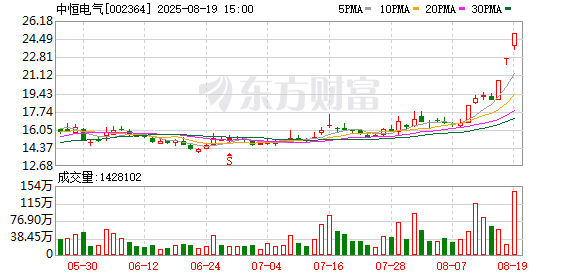
Core Viewpoint - Zhongheng Electric (002364.SZ) has denied recent rumors regarding partnerships with major overseas cloud companies like Nvidia, Meta, and Google, stating that no cooperation agreements or sales contracts have been signed as of now [2][6]. Company Overview - Zhongheng Electric, founded in 1996 and listed on the Shenzhen Stock Exchange in March 2010, focuses on building a zero-carbon intelligent society through digital energy solutions [7]. - The company has developed two main business segments: power electronics manufacturing and energy internet, with products covering data center power supplies, communication power supplies, electric power supplies, charging and swapping equipment, and power digitalization [7]. Financial Performance - As of August 19, Zhongheng Electric's stock price closed at 24.97 yuan, with a daily increase of 10.00%, a turnover rate of 25.59%, and a trading volume of 3.473 billion yuan, resulting in a total market capitalization of 14.1 billion yuan [6]. Market Position and Growth Potential - In 2024, the revenue from data center power supplies is projected to be 670 million yuan, accounting for 34% of the company's total revenue, serving major clients such as mobile operators, internet companies, and large state-owned enterprises [7]. - The company is recognized as one of the earliest promoters of HVDC (High Voltage Direct Current) power supply solutions for data centers and has played a key role in establishing national and industry standards [7]. Industry Trends - The demand for AI computing centers is rapidly increasing, and the penetration rate of HVDC is expected to continue growing. Major industry players like Google and Nvidia have recently introduced ±400V/800V HVDC power supply architectures, with expectations for large-scale application by 2027 [8]. - The global market for AI data center HVDC is anticipated to reach 62 billion yuan by 2030, indicating significant growth potential for companies like Zhongheng Electric [8].

SST固态变压器:高功率、高压AIDC的下一代选择
GOLDEN SUN SECURITIES· 2025-08-19 09:43
Investment Rating - The report maintains a "Buy" rating for the industry, specifically recommending an "Increase" for the stock of Jinpan Technology [6]. Core Insights - The global AI market is expected to grow significantly, with a projected CAGR of 19.20% from 2025 to 2034, reaching approximately $3680.47 billion by 2034. This growth is driven by the increasing demand for AI applications and infrastructure [11][12]. - Major cloud service providers are ramping up capital expenditures, with Amazon, Google, Microsoft, and Meta all reporting substantial increases in their 2025Q2 CAPEX, indicating a strong demand for data center infrastructure [17][18]. - The introduction of SST (Solid State Transformer) technology is positioned as the next-generation solution for AIDC (AI Data Center) power supply, offering significant efficiency improvements and space savings compared to traditional systems [4][25]. Summary by Sections Global AI Resonance and CSP Capital Expenditure - The AI market is experiencing explosive growth, with the U.S. market expected to reach $1460.9 billion in 2024 and $8514.6 billion by 2034. The Asia-Pacific region is anticipated to be the fastest-growing market [11]. - CSPs are increasing their capital expenditures significantly, with Amazon's 2025Q2 CAPEX at $32.1 billion (up 28% QoQ), Google at $22.4 billion (up 30% QoQ), and Microsoft at $24.2 billion (up 13% QoQ) [17][18]. Development of 800V HVDC Architecture - NVIDIA is developing an 800V HVDC architecture to support the growing power demands of AI workloads, which are expected to exceed 1MW. This new architecture aims to improve data center efficiency by 5%, reduce copper cable usage by 45%, and lower maintenance costs by up to 70% [20][22]. - The transition from traditional 54V AC power systems to 800V HVDC is crucial for meeting the high power requirements of modern AI servers [20][21]. Advantages of SST Technology - SST technology offers a high efficiency of approximately 98%, significantly reducing energy losses compared to traditional AC systems. It also requires 50% less space and simplifies installation by integrating multiple functions into a single unit [4][28]. - The modular design of SST allows for easy maintenance and compatibility with various data center power architectures, enhancing reliability and operational efficiency [4][25]. Key Players and Recommendations - Key players in the SST technology space include Delta, Eaton, and domestic suppliers like Jinpan Technology and Xidian Electric. The report suggests monitoring these companies for potential investment opportunities [5][39][41].
奥海科技20250818
2025-08-18 15:10
Summary of Conference Call on Aohai Technology Industry Overview - The AI server power supply industry is experiencing significant changes due to technological upgrades and innovations in server power solutions. The power consumption of server chips has increased dramatically, with the H200 chip's single-chip power rising from 700 watts to 1,200 watts, and server power consumption escalating from 5.5 kW to 30 kW, leading to a surge in demand for liquid cooling and high-voltage direct current (HVDC) power solutions [2][3][4]. Company Performance Aohai Technology - Aohai Technology's server power supply business is rapidly expanding, with projected revenue reaching 6 billion yuan by 2025, including 1 billion yuan from the AI sector. The company has established a strong customer base, including major clients like Alibaba and Xinhua San, and is actively expanding into overseas markets with factories in India, Indonesia, and Vietnam [2][5][10]. - The company is positioned as the second-largest player in the server power supply market, following Oulutong, and is expected to launch high-end products exceeding 5.5 kW [4][13]. - Aohai's current price-to-earnings (P/E) ratio is 24, with expectations to exceed 30 by 2025 and reach 20-25 by 2026 [4][12][16]. Oulutong - Oulutong has shown remarkable growth in its AI server power supply business, with revenues increasing from 1 billion yuan in 2023 to an expected 14 billion yuan by 2025. The company holds a domestic market share of approximately 15%-20% and has secured certifications from major internet companies [2][5][6]. Market Dynamics - Taiwanese manufacturers, historically dominant in the global server power supply market, are facing increasing competition from domestic companies like Oulutong, which are gaining market share through technological innovation and customer expansion [6][8]. - The server power supply industry is projected to benefit from the growth of AI, big data, and cloud computing, with a sustained demand for high-performance servers and the adoption of new cooling and power supply technologies [2][7]. Future Outlook - The global and Chinese server power supply industry is expected to continue its rapid development, driven by the increasing demand for high-performance servers and the proliferation of advanced power supply solutions. Companies with strong technological capabilities and customer resources in China are likely to accelerate their internationalization and capture a larger share of the global market [7][11]. - Aohai Technology is viewed as a potential leading player in the market, with optimistic growth prospects and a strategic focus on expanding its product offerings and customer base [14][17]. Investment Considerations - Investors are encouraged to consider Aohai Technology as a promising investment opportunity, with expectations of significant revenue growth and a potential market capitalization reaching 20 billion yuan. The company is positioned to outperform expectations with its innovative product developments and market expansion strategies [15][18].
电源市场空间测算及技术迭代方向 - 能源革命
2025-08-18 01:00
Summary of Key Points from Conference Call Records Industry Overview - The focus is on the power supply market, particularly in data centers, with a significant emphasis on high voltage direct current (HVDC) technology and its advantages over traditional systems [1][3][5]. Core Insights and Arguments - **Importance of Power Supply in Data Centers**: Power supply reliability and performance are critical in data centers, with ongoing technological advancements aimed at optimizing efficiency and reducing losses [3][5]. - **Market Growth Projections**: The domestic HVDC market penetration is currently around 20%, expected to double from 2023 to 2028, with a projected global market size exceeding $10 billion by 2026 [1][6]. - **Key Players**: Major global players in the HVDC market include Vidi and Delta, holding over 50% market share, while domestic companies like Zhonghong Electric are also significant contributors [7]. - **Trends in Server Power Supply**: The trend is towards higher power density and efficiency, with third-generation semiconductors like silicon carbide and gallium nitride replacing traditional silicon components [9]. - **Market Size for Wireless Power Supply**: By 2026, the domestic wireless power supply market is expected to reach between 5 billion to 6 billion RMB, while the overseas market could exceed 40 billion RMB [10]. Additional Important Content - **Technological Innovations**: Future developments include 800V HVDC products and solid-state transformers (SST), which are anticipated to enhance performance in data centers [1][3]. - **BBU and Supercapacitor Applications**: Battery Backup Units (BBUs) and supercapacitors are crucial for addressing high energy demands in data centers, with BBU demand projected to reach 700-800 million units by 2025 [11]. - **Domestic Supplier Outlook**: Domestic suppliers are expected to expand their international presence, particularly in the smart automotive sector, leveraging technological advancements in HVDC and server power supplies [8]. - **Performance of Leading Domestic Companies**: Key domestic players like Macomit and Oulutong are experiencing rapid growth, with Oulutong achieving nearly 800 million RMB in revenue last year, reflecting over 500% year-on-year growth [12].
三安光电(600703):SICMOSFET打入全球领先AI服务器电源供应链
Xin Lang Cai Jing· 2025-08-14 08:24
Core Viewpoint - Company SiC MOSFET products have begun bulk supply to major clients in the data center and AI server power sectors, indicating the maturity and reliability of its SiC technology and enhancing the long-term growth certainty of its SiC business [1][2]. Group 1: SiC Business Developments - The bulk supply of SiC MOSFETs to clients such as Delta, Lite-On, and Great Wall Technology demonstrates the competitive advantages of SiC devices in high voltage and high power applications [2]. - The company has successfully validated its SiC MOSFETs for automotive applications with leading domestic electric vehicle manufacturers, further solidifying its position in the SiC market [2]. - The joint venture with STMicroelectronics, Anifai, is set to achieve operational readiness by February 2025, with production capacity gradually being released [2]. Group 2: Financial Performance - The company's LED application business is projected to grow by 12.5% year-on-year in 2024, reaching 2.604 billion yuan, with a gross margin increase of 3.2 percentage points to 10.1% [3]. - Revenue from the LED epitaxial wafer business is expected to rise by 6.6% year-on-year to 6.037 billion yuan, with a gross margin increase of 8.8 percentage points to 20.6% [3]. - In Q1 2025, the company reported revenue of 4.312 billion yuan, a year-on-year increase of 21.23%, and a net profit of 217 million yuan, reflecting a significant year-on-year growth of 78.46% [3]. Group 3: Revenue and Profit Forecast - The revenue forecast for 2025 has been adjusted down by 5.9% to 17.997 billion yuan, with a projected year-on-year growth of 12% [4]. - The net profit forecast for 2025 has been reduced by 38.2% to 1.143 billion yuan, indicating a substantial year-on-year growth of 352% [4]. - For 2026, revenue is expected to reach 21.051 billion yuan, with a year-on-year growth of 17%, and net profit is projected to be 1.927 billion yuan, reflecting a 69% increase [4].
