
小红书

Search documents
持续发力本地生活服务,小红书点评或已箭在弦上
3 6 Ke· 2026-01-22 23:27
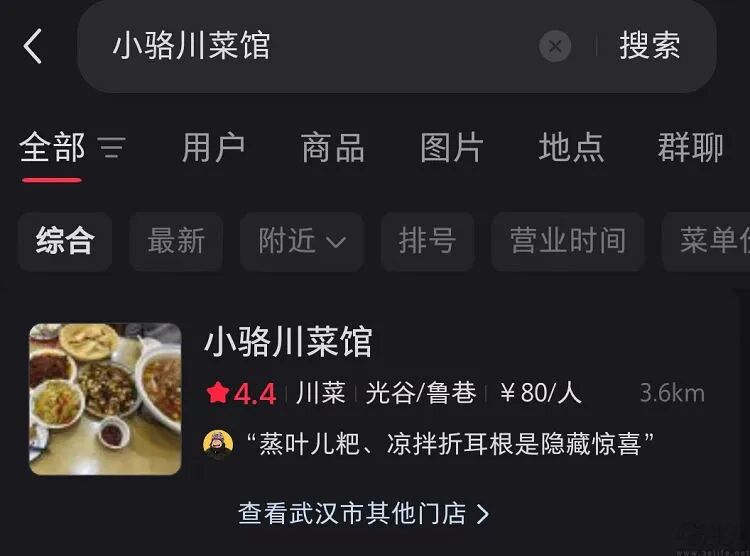
Core Viewpoint - Xiaohongshu has decided to enhance its local life service business by testing the prioritization of merchant store ratings in search results, despite the discontinuation of its "Xiaohong Card" program [1][3]. Group 1: Company Strategy - Xiaohongshu is testing a feature that prioritizes displaying merchant store ratings and nearby locations for users, aiming to encourage the use of its review tool [1][3]. - The company recognizes the need to build its own review product to enhance user trust and ecosystem collaboration, addressing existing structural deficiencies in its local life service offerings [5][7]. Group 2: Market Competition - The local life service market is increasingly competitive, with players like Dazhongdianping and Gaode rapidly evolving their strategies to provide more reliable decision-making tools and comprehensive service links [3][5]. - Xiaohongshu's move to enhance its review capabilities is a response to the trend of providing more authentic decision-making bases and integrating content with transaction processes [5][9]. Group 3: User Experience - By developing its own review product, Xiaohongshu aims to improve decision-making efficiency for users in various consumption scenarios, such as quickly finding restaurants or attractions [7][9]. - The platform faces challenges from fake marketing content, which undermines user trust; establishing standardized evaluation metrics could help mitigate this issue [7][9]. Group 4: Business Model - Xiaohongshu's current monetization relies heavily on advertising, limiting its control over downstream transactions; creating a review system could help close the commercial loop and enhance profitability [9]. - Unlike Dazhongdianping, which has established a complete feedback-transaction-fulfillment cycle, Xiaohongshu needs to ensure that its review function integrates well with its existing content ecosystem for long-term success [9].

小红书“管”得住用户吗?
3 6 Ke· 2026-01-22 12:47
Core Insights - Xiaohongshu is undergoing a significant ecological challenge as it balances community values with commercial expansion, highlighted by the launch of its Community Charter 2.0 on January 19, which includes 25 new guidelines aimed at promoting friendly interactions and opposing divisive behavior [1][3][6] Group 1: Community Governance - The platform has evolved from a simple shopping list sharing tool to a content community with over 3.5 billion monthly active users, generating 9 million posts daily and encompassing 2,500 active interest groups [1] - Xiaohongshu's governance has shifted from reactive measures, such as the 2019 KOL cleanup, to a more structured approach with the introduction of Community Charter 1.0 in 2021, which emphasized core values of sincere sharing and friendly interaction [7][10] - The latest Community Charter 2.0 merges community and commercial guidelines, introducing a new section on "orderly operation" to unify community behavior with commercial practices [6][8] Group 2: Content and Commercialization Challenges - The platform faces challenges from issues like flaunting wealth, false marketing, and AI-generated content, which threaten the community's core asset of genuine sharing and friendly interaction [3][10] - Xiaohongshu's rapid growth has led to a complex ecosystem where commercial interests often conflict with community trust, necessitating a delicate balance between governance and user engagement [19][20] - The platform's ambition to expand its e-commerce capabilities is evident, with projections of tripling profits to $3 billion in 2025, despite facing competition and the need for differentiation in a crowded market [23][25] Group 3: Future Directions and Strategies - Xiaohongshu is exploring various e-commerce models, including live-streaming and lifestyle e-commerce, to enhance user engagement and drive sales [23][25] - The platform's governance is not merely a regulatory measure but a strategic necessity to maintain user trust and community integrity, which are essential for long-term competitiveness [25][26] - The ongoing challenge for Xiaohongshu is to find a sustainable balance between community values and commercial interests, ensuring that governance supports rather than hinders growth [25][26]

零工取代星巴克全职咖啡师?奈雪们早就尝试了丨消费参考
2 1 Shi Ji Jing Ji Bao Dao· 2026-01-22 01:34
Group 1 - Starbucks China is focusing on controlling labor costs by increasing the recruitment of part-time employees, with 61.7% of job postings for student part-time positions and 17.8% for social part-time positions [1] - The majority of full-time job postings are concentrated in lower-tier cities, with only Shenzhen and Shanghai having limited full-time positions [1] - The trend of hiring part-time workers is becoming common in the restaurant industry, as seen with Nayuki Tea, which has also shifted to a workforce primarily composed of part-time employees [2] Group 2 - The management structure at Starbucks is changing, with the implementation of a "multi-store community" model where one store manager oversees multiple locations, aimed at reducing costs [2] - The shift from full-time baristas to gig workers raises concerns about maintaining service quality, which is a core competitive advantage for Starbucks [2][3]
零工取代星巴克全职咖啡师?奈雪们早就尝试了
2 1 Shi Ji Jing Ji Bao Dao· 2026-01-22 01:32
Group 1 - Starbucks China is focusing on controlling labor costs by increasing the recruitment of part-time employees, with 61.7% of job postings for student part-time positions and 17.8% for social part-time positions [1] - The majority of full-time job postings are concentrated in lower-tier cities, with only Shenzhen and Shanghai having limited full-time positions [1] - The trend of hiring part-time workers is becoming common in the restaurant industry, as seen with Nayuki Tea, which has also shifted to a workforce primarily composed of part-time employees [2] Group 2 - The management structure at Starbucks is changing, with plans to have one store manager oversee multiple locations, a strategy aimed at reducing costs [2] - The shift from full-time baristas to gig workers raises concerns about maintaining service quality, which is a core competitive advantage for Starbucks [2][3]
美媒哀叹:美国屈辱世纪,才刚刚开始
Xin Lang Cai Jing· 2026-01-21 22:51
Core Insights - The article discusses the rising influence of China in technology and manufacturing, suggesting that "Chinese attributes" may become the new norm unless these sectors lose their dominance [1][3][4]. Group 1: Perception of China - There is a noticeable shift in the perception of China among many Americans, especially the younger generation, who are increasingly embracing Chinese technology, brands, and cities [1][4]. - Social media trends reflect a longing for Chinese culture and products, with users sharing moments they describe as "very Chinese" [1][3]. Group 2: Comparison with the U.S. - Critics often highlight China's significant investments in clean energy and urban infrastructure to underscore the shortcomings of U.S. climate policies and housing issues [2][7]. - China is viewed not just as a country but as a symbol that exposes the flaws in American society, particularly during a time of perceived decline in the U.S. [2][7]. Group 3: Dependency on Chinese Products - Many Americans have become acutely aware of their dependency on Chinese exports, particularly during trade tensions that revealed the sourcing of American brand products from China [3][8]. - The rise of Chinese applications like TikTok and platforms like Dhgate has enabled direct communication with Chinese manufacturers, bypassing traditional retail channels [3][8]. Group 4: Cultural Integration - The integration of Chinese products into daily life is evident, with items like smartphones, laptops, and even popular toys being manufactured in China [2][7]. - Language barriers are diminishing due to advancements in translation technology, making it easier for international users to engage with Chinese content [3][8].
小红书新公约:什么样的创造值得被承认
Sou Hu Cai Jing· 2026-01-21 21:20
Core Viewpoint - Xiaohongshu's new community convention is not merely an upgrade of community norms but a significant shift towards defining what expressions are worthy of long-term recognition and commercialization, akin to a form of "intellectual property governance" [2][16]. Group 1: Definition of Non-Protectable Expressions - The new convention explicitly targets and prohibits content such as sensationalism, unmarked AI-generated content, and malicious competition, similar to exclusions in patent and trademark laws [3]. - This approach establishes a baseline for what should not be included in the "long-term asset pool," effectively filtering out "toxic traffic" for future content accumulation [3]. Group 2: Criteria for Recognized Originality - The convention clarifies that originality is defined by genuine experiences, real motivations, and the ability to engage in dialogue, rather than mere novelty [4]. - It introduces rules against false personas, mandates clear labeling of AI content, and emphasizes rational dialogue while opposing malicious speculation [4]. Group 3: Rebinding Expression Rights and Commercial Rights - The upgraded "orderly operation" section signals that commercial activities must be rooted in genuine expressions, preventing rights from being inflated without real usage contexts [7]. - The convention's stance against AI "fakes" is not anti-technology but aims to prevent "rights inflation" that could dilute human experiences [10]. Group 4: Importance of Community Protection - The trend of community engagement, such as AMA sessions and open development processes, relies on the assurance that genuine expressions will not be maliciously exploited [12]. - If false representations gain more attention than real explorations, the community will struggle to attract those committed to long-term endeavors [13]. Group 5: Foundation of Recognition and Trust - Xiaohongshu does not grant exclusive rights but is establishing criteria for what expressions qualify for being remembered, trusted, and commercialized [15]. - The convention aims to create a system where emotional conflicts are minimized, and collaborative exchanges are encouraged, fostering innovation and community evolution [17].

大健康产品数字营销领航营在京召开,引领探索产业合规增长
Zhong Guo Xin Wen Wang· 2026-01-21 16:31
近期,"大健康产品数字营销领航营"在北京亦庄生物医药园开营,深入剖析医药电商、直播营销、广告 合规等最新监管动态;汇聚了来自抖音、小红书、京东等平台的十多位资深运营专家,共同为医药健康 企业呈现了一场政策与市场、策略与实践深度融合的思想盛宴。华商韬略联合创始人周怡作为唯一一名 财经自媒体受邀参会,分享了财经内容赋能大健康行业的创新路径。 华商韬略联合创始人周怡 本次领航营紧扣"政策合规筑基、平台运营促增、跨界融合破局"三大核心板块,通过专题政策解读、实 战案例剖析、提问答疑互动、圆桌交流研讨等多种形式,系统构建了从政策理解到落地执行的知识体 系,为企业搭建了政策分析、经验共享与资源对接的重要平台,切实助力企业在合规轨道上实现数字营 销的提质增效与创新突破。 政策解读精准导航筑牢行业发展安全线 领航营的政策安全篇,特邀专家解读新政。赛迪研究院产业政策研究所所长王昊聚焦《医药工业数智化 转型实施方案(2025-2030)》,系统阐述了如何以数字化、智能化手段驱动医药产业全面升级。 赛迪研究院产业政策研究所所长王昊 平台实操深度解码搭建增长赋能快车道 平台赋能篇深度聚焦抖音、小红书、京东三大关键阵地实操策略。三大平 ...

内测笔记付费,小红书要抢知乎饭碗?
3 6 Ke· 2026-01-21 10:50
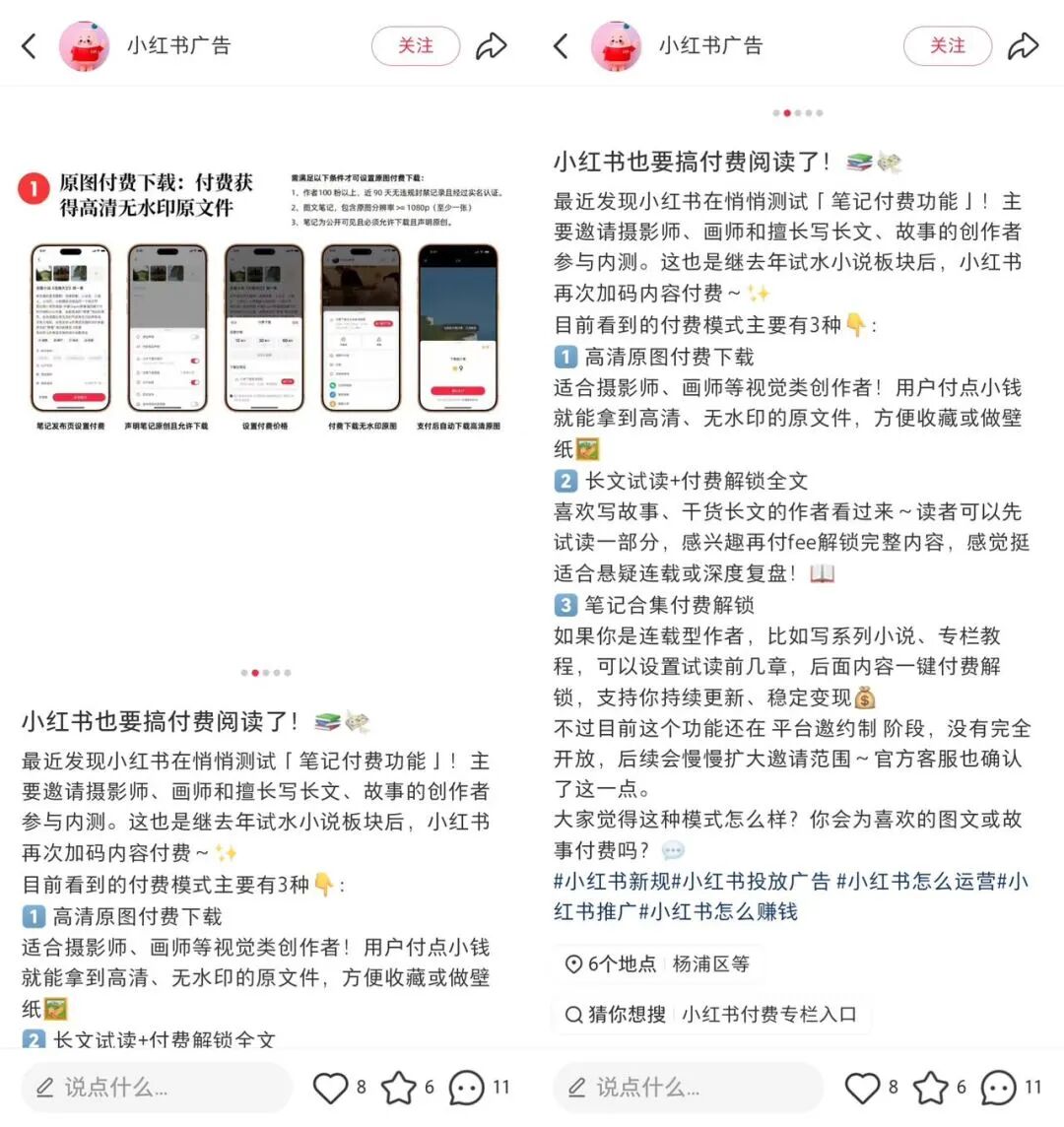
Core Insights - Xiaohongshu is testing a "paid notes" feature, allowing creators to set prices between 1 to 199 yuan for their content, marking a shift towards monetization beyond advertising and e-commerce [1][2] - The platform aims to establish a third growth curve, but faces challenges in user payment habits, community atmosphere dilution, and content value definition [2][10] User Base and Engagement - By 2025, Xiaohongshu's monthly active users (MAU) are projected to exceed 339 million, with 85% being post-95s and 66% from first-tier and new first-tier cities [2] - The platform generates over 9 million notes and 70 million comments daily, providing a substantial user base for exploring paid models [2] Monetization Strategy - Xiaohongshu's paid notes feature is designed to be accessible, requiring only 100 followers, no violations in the last 90 days, and real-name verification for creators to participate [3] - The monetization options include high-definition original image downloads, single note payments, and bundled purchases for serialized content, catering to various creator types [3][5] Comparison with Competitors - Xiaohongshu's approach contrasts with Zhihu's more professional and high-barrier content monetization, which favors established experts and specialized knowledge [3][6] - Zhihu's paid content is often seen as "essential," while Xiaohongshu's offerings may be perceived as "non-essential," leading to potential user resistance to payment [7][10] Community and Ecosystem Impact - The introduction of paid content could dilute Xiaohongshu's core appeal of free, diverse, and relatable community interactions, risking user attrition if not managed carefully [8][10] - Users have expressed concerns about the value of paid notes, indicating a preference for free content and a potential backlash against monetization efforts [10] Future Outlook - Xiaohongshu is exploring new revenue streams, including local lifestyle services and second-hand sales, but these initiatives have not yet gained significant traction [11] - The success of the paid notes feature may depend on its ability to attract niche creators and provide unique value, rather than competing directly with established platforms like Zhihu [12][13]

小红书在浙江成立新旅游公司,注册资本500万
Zhong Guo Neng Yuan Wang· 2026-01-21 08:31
天眼查工商信息显示,近日,泊壤(安吉)农业旅游有限公司成立,法定代表人为易萱,注册资本500万 人民币,经营范围含旅游业务、组织文化艺术交流活动、商标代理、广告制作、信息咨询服务、信息技 术咨询服务、社会经济咨询服务、企业管理咨询、票务代理服务等。股东信息显示,该公司由小红书旗 下璞真乡里(上海)旅游文化有限公司全资持股。 ...
小红书在浙江安吉投资成立新旅游公司
Zheng Quan Shi Bao Wang· 2026-01-21 08:19
人民财讯1月21日电,企查查APP显示,近日,泊壤(安吉)农业旅游有限公司成立,法定代表人为易萱, 注册资本500万人民币,经营范围含旅游业务、组织文化艺术交流活动、商标代理等,由小红书旗下璞 真乡里(上海)旅游文化有限公司全资持股。 ...