
腾讯控股

Search documents
港股半日市收官在即:哪些板块在除夕逆势走强?
Mei Ri Jing Ji Xin Wen· 2026-02-16 02:30
Core Viewpoint - The Hong Kong stock market experienced a slight decline and volatility during the half-day trading session on February 16, influenced by tightened liquidity due to the closure of the Stock Connect and various favorable factors over the weekend [1]. Market Performance - The Hang Seng Index opened at 26,501.2 points and reached 26,573.67 points by 10:16 AM, showing a slight increase of 6.55 points or 0.02% [1]. - The Hang Seng Technology Index opened lower, down 0.19%, following the overall market trend [1]. - Over the past three months, the Hang Seng Index has accumulated a rise of 2.41%, but it has recently shown a trend of volatility and decline [1]. Sector Analysis - The technology sector, represented by the Hang Seng Technology Index, is a market focus, benefiting from multiple positive factors such as expectations of interest rate cuts by the Federal Reserve, advancements in AI commercialization, and supportive platform economy policies [3]. - Core stocks like Tencent, Xiaomi, and NetEase showed slight pullbacks, but their long-term investment value is recognized by institutions, with AI advertising, gaming, and cloud services being key highlights [3]. - The gold and precious metals sector opened strongly and remained stable, becoming a preferred choice for risk-averse investors, with companies like Zhaojin Mining and Zijin Mining benefiting from a weaker dollar and increased physical demand during the Spring Festival [3]. - The consumer sector saw slight gains due to holiday catalysts, with companies like Yum China and Haidilao experiencing minor increases before stabilizing [3]. - The real estate and financial sectors showed weakness due to underwhelming policy expectations and significant performance pressures, leading to a lack of notable improvement [3]. Future Outlook - According to China Merchants Securities, the recent significant decline in the Hang Seng Technology Index presents substantial allocation value, suggesting that the current market volatility is primarily due to liquidity shocks [4]. - The firm believes that the ongoing market fluctuations are not fundamentally different from those seen in November 2025, and positive factors are accumulating, recommending buying on dips and holding stocks through the holiday [4].


港股开盘,恒指走弱,科网股普跌
Di Yi Cai Jing Zi Xun· 2026-02-16 02:21
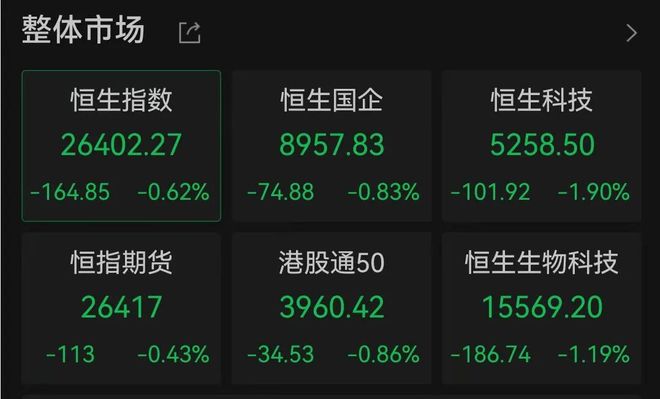
Market Overview - The Hang Seng Index opened lower by 0.25% and later expanded its decline to nearly 1% [1] - The Hang Seng Technology Index initially fell by 0.19% and then increased its drop to nearly 2% [1] - The Hang Seng Index closed at 26,402.27, down 164.85 points or 0.62% [2] - The Hang Seng Technology Index closed at 5,258.50, down 101.92 points or 1.90% [2] Stock Performance - Alibaba (9988.HK) decreased by 3.02% to a price of 150.700 [3] - Tencent Holdings (0700.HK) fell by 0.45% to 529.620 [3] - Meituan (3690.HK) dropped by 3.16% to 79.550 [3] - Xiaomi Group (1810.HK) saw a decline of 3.47% to 35.560 [3] - Zijin Mining (2899.HK) increased by 3.37% to 42.980 [3] - Pop Mart (9992.HK) rose by 2.02% to 252.400 [3] - MINIMAX-WP (0100.HK) surged by 6.47% to 724.000 [3] - Semiconductor Manufacturing International Corporation (0981.HK) decreased by 1.56% to 69.250 [3] Sector Performance - AI application stocks in the Hong Kong market showed strength, with Haizhi Technology Group rising by 23.65% and MINIMAX-WP increasing by 6.47% [4] - The non-ferrous metals sector also performed well, with Lingbao Gold rising over 7% and Luoyang Molybdenum increasing over 5% [4]
港股开盘,恒指走弱,科网股普跌
第一财经· 2026-02-16 02:14
Market Overview - The Hong Kong stock market opened with the Hang Seng Index down 0.25%, later expanding its decline to nearly 1% [1] - The Hang Seng Technology Index initially fell by 0.19%, with losses increasing to nearly 2% [1][2] Index Performance - Hang Seng Index closed at 26,402.27, down 164.85 points or 0.62% [2] - Hang Seng China Enterprises Index at 8,957.83, down 74.88 points or 0.83% [2] - Hang Seng Technology Index at 5,258.50, down 101.92 points or 1.90% [2] Stock Performance - Major tech stocks experienced declines: Alibaba down 3.02% to 150.70, Meituan down 3.16% to 79.55, and Xiaomi down 3.47% to 35.56 [3] - Notable gainers included Zijin Mining up 3.37% to 42.98 and Pop Mart up 2.02% to 252.40 [3] Sector Performance - AI application stocks in Hong Kong showed strength, with Haizhi Technology Group rising 23.65%, Fubo Group up 4.11%, and MINIMAX-WP up 6.47% [4] - The non-ferrous metals sector also performed well, with Lingbao Gold up over 7% and Luoyang Molybdenum up over 5% [4]
存储芯片,走向失控
半导体行业观察· 2026-02-16 01:58
Core Viewpoint - A global storage crisis is emerging, driven by a significant shortage of memory chips, particularly DRAM, which is impacting profits across various sectors, including consumer electronics and automotive industries [2][3][4]. Group 1: Causes of the Crisis - The shortage of DRAM is primarily attributed to the increasing demand from artificial intelligence data centers, which require high bandwidth memory (HBM) for processing large datasets [3][6]. - Companies like Alphabet Inc. and OpenAI are purchasing millions of memory chips for AI applications, leading to a competitive squeeze on supply for consumer electronics manufacturers [4][5]. - The price of DRAM has surged dramatically, with some prices increasing by 75% from December to January, reminiscent of hyperinflation [4][23]. Group 2: Impact on Companies - Major semiconductor manufacturers, including SK Hynix, Samsung, and Micron, control over 90% of global memory chip production and are experiencing record valuations due to the demand surge [4][5]. - The shift in production focus from traditional DRAM to HBM has resulted in reduced availability of standard memory chips for consumer electronics, affecting companies like Apple and Tesla [2][5]. - The memory crisis is causing significant disruptions in product release schedules, with companies like Sony considering delays for their next-generation gaming consoles [19][23]. Group 3: Market Predictions - TrendForce predicts that DRAM and NAND flash prices will rise by 90% to 95% and 55% to 60%, respectively, in the first quarter alone [4][6]. - The demand for HBM is expected to grow by 70% year-on-year by 2026, indicating a long-term shift in the memory market dynamics [6][22]. - The supply-demand imbalance is projected to persist throughout the year, with potential declines in smartphone shipments and increased prices for low-end devices [23][19].



恒生科技指数跌超1%,阿里巴巴跌2.7%,小米集团跌3.09%
Jin Rong Jie· 2026-02-16 01:57
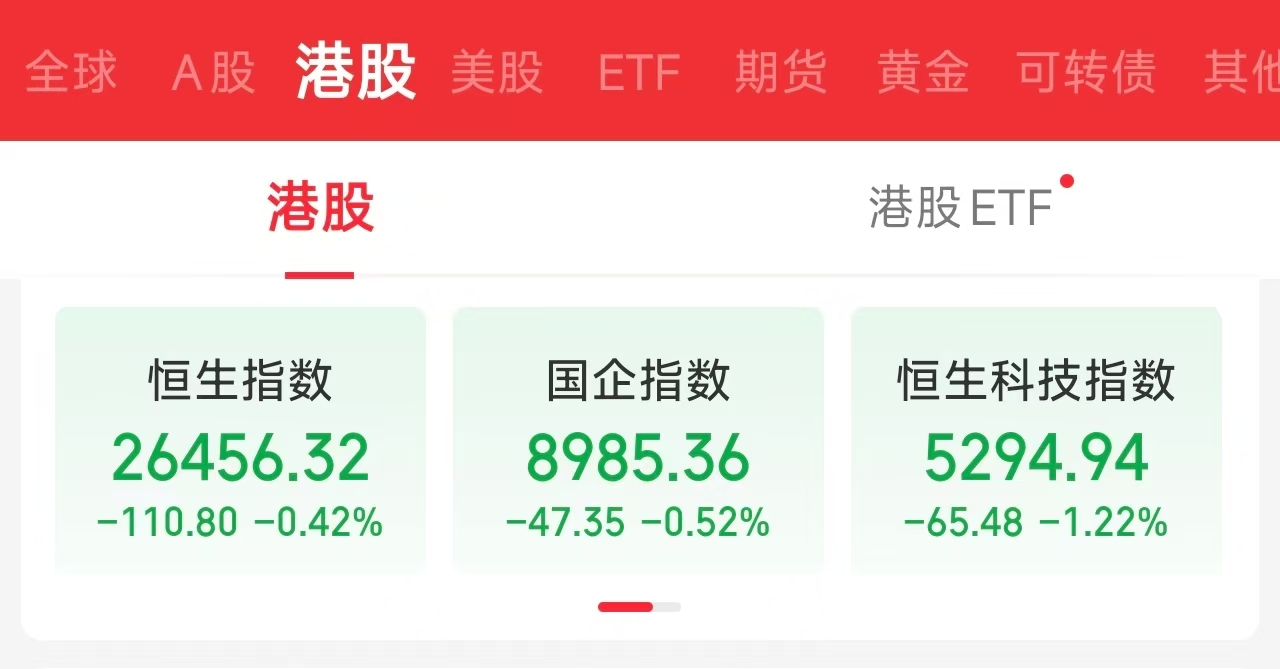
恒生科技指数延续下跌,跌幅扩大至1.22%,现报5294.94点。 华泰证券研报指出,港股上周先扬后抑。一方面,以全球"再通胀"交易与AI国产应用的升级为催化,有色等资源品、国产算力链与部分软件迎来反弹。另一 方面,AI格局在上市和非上市企业间的变化以及电商巨头内卷加剧的担忧压制权重股的表现。当前市场波动依然较高,本周适逢春节假期,影响市场的主 要因素或来自美股、春节期间消费、AI进展等。美股短期内或延续AI主线分化和高低切特征,对市场风偏影响中性;但国内消费高频数据和AI模型等已有 新进展。综合来看,建议均衡配置,短期重点关注直接受益于AI进展的存储等半导体硬件、特色消费α以及电气设备(新增)。 港股频道更多独家策划、专家专栏,免费查阅>> 责任编辑:栎树 大型科技股中,阿里巴巴-W跌2.7%,腾讯控股跌0.28%,京东集团-SW跌2.07%,小米集团-W跌3.09%,网易-S涨0.7%,美团-W跌1.77%,快手-W跌2.19%, 哔哩哔哩-W跌1.75%。 ...

港股开盘:恒指开盘跌0.25%,恒生科指跌0.19%,阿里巴巴跌1.8%
Jin Rong Jie· 2026-02-16 01:37
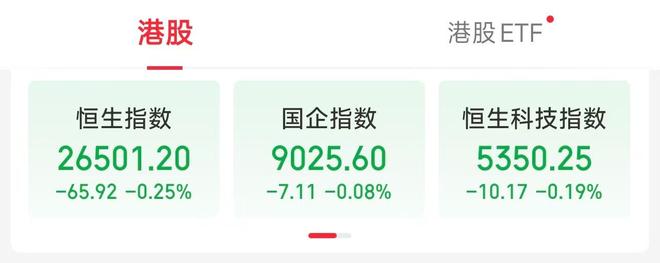
Market Overview - The Hang Seng Index opened down 0.25% at 26,501.2 points, while the Hang Seng Tech Index fell 0.19% to 5,350.25 points, and the National Enterprises Index decreased by 0.08% to 9,025.6 points [1] - Major tech stocks experienced declines, with Alibaba down 1.8%, Tencent down 0.38%, and JD.com down 0.85%. However, Netease saw an increase of 1.83% [3][4] Industry Insights - Huatai Securities reported that the Hong Kong market experienced fluctuations last week, driven by global "reflation" trades and upgrades in AI domestic applications, leading to rebounds in resource products and certain software sectors. However, concerns over the intensifying competition among e-commerce giants suppressed the performance of heavyweight stocks [3] - The market remains volatile, with key factors influencing it being US stock performance, consumer activity during the Spring Festival, and advancements in AI technology [3] Regulatory News - The State Administration for Market Regulation held discussions with major platform companies including Alibaba, Douyin, Baidu, Tencent, JD.com, Meituan, and Taobao, emphasizing compliance with various laws and regulations to enhance promotional practices [5] Company Developments - Qunhe Technology received approval from the China Securities Regulatory Commission for overseas issuance and listing, planning to issue up to approximately 312 million shares in Hong Kong, marking a significant step for the company [6] - China Merchants Energy signed shipbuilding contracts for one ethylene ship and eighteen oil tankers, totaling RMB 7.882 billion [7] - China Shenhua reported coal sales of 33.2 million tons in January, a year-on-year increase of 9.9%, and total electricity sales of 20.96 billion kWh, up 34.4% year-on-year [7] - China Southern Airlines saw a 1.1% decrease in passenger capacity and a 2.86% decline in passenger turnover in January, with a seat load factor of 83.26%, down 1.51 percentage points year-on-year [7] - China Eastern Airlines reported a 3.54% decrease in passenger capacity and a 1.03% decline in passenger turnover, with a seat load factor of 85.01%, up 2.16 percentage points year-on-year [7] - Huizhong Network completed the acquisition of a 25% stake in Jintongling, advancing its "production and sales integration" strategy [7] Performance Metrics - China General Nuclear Power completed 1,647.8 GWh of electricity generation in January, a year-on-year increase of 7.9% [8] - R&F Properties reported a contract sales revenue of approximately RMB 720 million in January, down 8.05% year-on-year [9] - Hopson Development Group recorded a contract sales amount of approximately RMB 591 million in January, a year-on-year increase of 24.95% [10] - Kaisa Group reported contract sales of RMB 325 million in January, down 35.3% year-on-year [11] - Jianye Real Estate reported contract sales of RMB 398 million in January, a year-on-year decrease of 31.1% [12] - Shanghai Fudan projected total revenue of approximately RMB 3.982 billion for 2025, a year-on-year increase of 10.92%, but a net profit decrease of 59.42% [12] - Ruian Real Estate issued a profit warning, expecting a net loss of between RMB 1.7 billion and 1.8 billion for the 2025 fiscal year [12]





微信推出新功能:拜年歌“自己”唱
2 1 Shi Ji Jing Ji Bao Dao· 2026-02-16 01:18
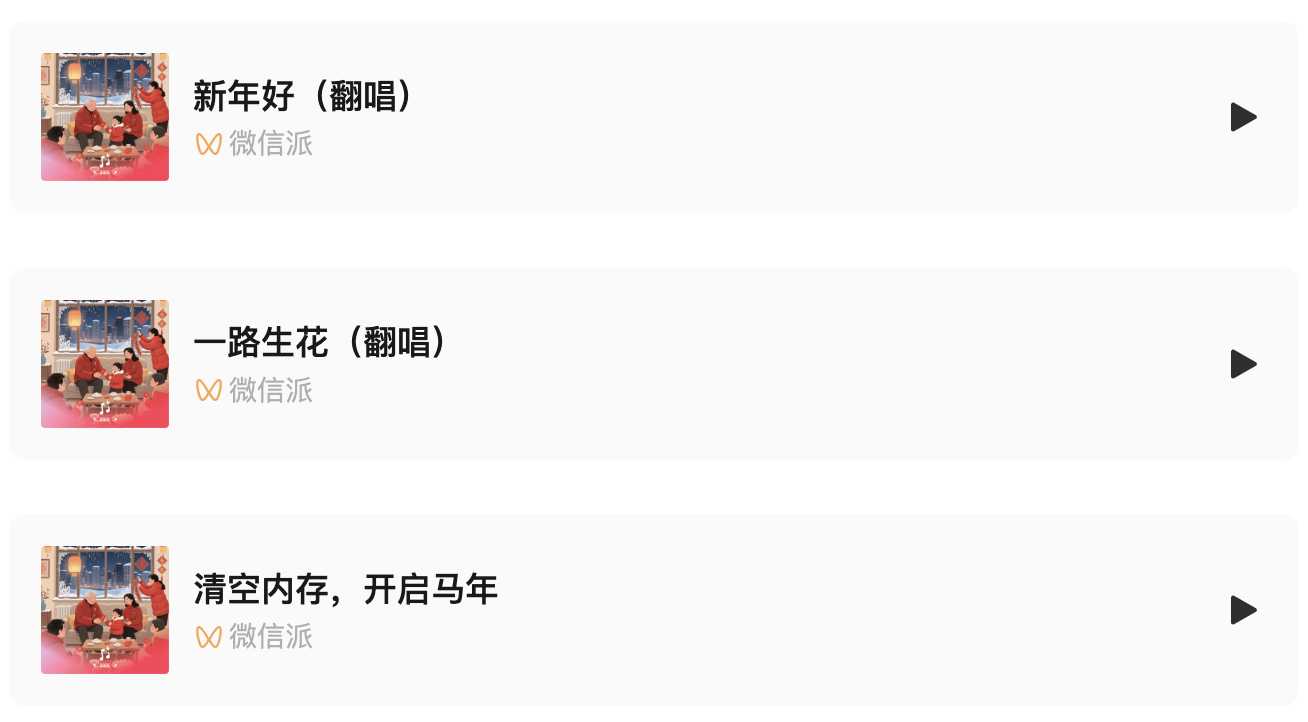
没错,以上三首都是"微信派"唱的。 春节期间,可以让 AI 帮你"发声"拜年了。点击'发现'-'听一听'-制作拜年歌,就能拥有属于你的拜年歌曲。 2月15日 据"微信派"公众号 微信推出过年新玩法 今年大家可以通过AI制作拜年歌 用"声音"拜年 *更新至最新版本后可用 别人拜年说祝福,你拜年直接上歌曲。 才艺表演不慌了。 五音不全不怕了。 老父亲也能重磅首发嘻哈单曲。 还等什么 今年让华仔歇会儿 大家开唱吧? 责任编辑:杨赐 2月15日 据"微信派"公众号 微信推出过年新玩法 今年大家可以通过AI制作拜年歌 用"声音"拜年 没错,以上三首都是"微信派"唱的。 春节期间,可以让 AI 帮你"发声"拜年了。点击'发现'-'听一听'-制作拜年歌,就能拥有属于你的拜年歌曲。 *更新至最新版本后可用 别人拜年说祝福,你拜年直接上歌曲。 才艺表演不慌了。 五音不全不怕了。 老父亲也能重磅首发嘻哈单曲。 还等什么 今年让华仔歇会儿 大家开唱吧? 责任编辑:杨赐 ...
智通港股通持股解析|2月16日
智通财经网· 2026-02-16 00:34
Core Insights - The top three companies by Hong Kong Stock Connect holding ratios are China Telecom (71.26%), Haotian International Investment (70.78%), and Gree Power Environmental (68.78%) [1] - Tencent Holdings, Meituan-W, and China National Offshore Oil Corporation saw the largest increases in holding amounts over the last five trading days, with increases of +1.071 billion, +937 million, and +811 million respectively [1] - The largest decreases in holding amounts were observed in the Yingfu Fund (-4.085 billion), Hang Seng China Enterprises (-1.359 billion), and China Mobile (-780 million) [2] Group 1: Hong Kong Stock Connect Holding Ratios - China Telecom (00728) has a holding of 9.891 billion shares, representing 71.26% [1] - Haotian International Investment (01341) has a holding of 7.855 billion shares, representing 70.78% [1] - Gree Power Environmental (01330) has a holding of 278 million shares, representing 68.78% [1] Group 2: Recent Increases in Holdings - Tencent Holdings (00700) increased its holding by +1.071 billion, with a change of +2.0125 million shares [2] - Meituan-W (03690) increased its holding by +937 million, with a change of +11.4088 million shares [2] - China National Offshore Oil Corporation (00883) increased its holding by +811 million, with a change of +33.4436 million shares [2] Group 3: Recent Decreases in Holdings - Yingfu Fund (02800) decreased its holding by -4.085 billion, with a change of -152.537 million shares [2] - Hang Seng China Enterprises (02828) decreased its holding by -1.359 billion, with a change of -14.6972 million shares [2] - China Mobile (00941) decreased its holding by -780 million, with a change of -9.9762 million shares [2]




智通港股沽空统计|2月16日
Xin Lang Cai Jing· 2026-02-16 00:32
Core Insights - The article highlights the top short-selling stocks in the market, with BYD Company Limited (81211) leading with a short-selling ratio of 100.00% [1][2]. Group 1: Short-Selling Ratios - BYD Company Limited (81211) has a short-selling ratio of 100.00% [2][3]. - JD.com (89618) follows with a short-selling ratio of 97.67% [2][3]. - Kuaishou Technology (81024) has a short-selling ratio of 80.79% [2][3]. Group 2: Short-Selling Amounts - Meituan (03690) has the highest short-selling amount at 2.11 billion [2]. - Alibaba Group (09988) follows with a short-selling amount of 1.673 billion [2]. - Xiaomi Corporation (01810) has a short-selling amount of 1.482 billion [2]. Group 3: Deviation Values - BYD Company Limited (81211) has the highest deviation value at 44.67% [3]. - Jinfang Pharmaceutical (02595) has a deviation value of 35.39% [3]. - Kuaishou Technology (81024) has a deviation value of 34.76% [3].

智通港股通资金流向统计(T+2)|2月16日
智通财经网· 2026-02-15 23:33
Key Points - Tencent Holdings (00700), Yingfu Fund (02800), and Shandong Gold (01787) ranked the top three in net inflow of southbound funds, with net inflows of 736 million, 423 million, and 393 million respectively [1] - Alibaba-W (09988), SMIC (00981), and Hua Hong Semiconductor (01347) ranked the top three in net outflow of southbound funds, with net outflows of -524 million, -391 million, and -199 million respectively [1] - In terms of net inflow ratio, China Overseas Macro Holdings (00081), Xinhua Wencuan (00811), and China Oriental Education (00667) led the market with ratios of 55.30%, 50.59%, and 49.55% respectively [1] - Conversely, Zhengzhou Bank (06196), China Energy Construction (03996), and Hongye Futures (03678) had the highest net outflow ratios at -50.51%, -49.70%, and -48.03% respectively [1] Top 10 Net Inflow Stocks - Tencent Holdings (00700) had a net inflow of 736 million, representing a 5.67% increase, with a closing price of 548.000 [2] - Yingfu Fund (02800) saw a net inflow of 423 million, with a 5.13% increase, closing at 27.480 [2] - Shandong Gold (01787) experienced a net inflow of 393 million, with a significant 31.27% increase, closing at 40.180 [2] - Bilibili-W (09626) had a net inflow of 335 million, with a 27.53% increase, closing at 252.800 [2] - China National Offshore Oil (00883) had a net inflow of 301 million, with a 22.88% increase, closing at 24.800 [2] Top 10 Net Outflow Stocks - Alibaba-W (09988) faced a net outflow of -524 million, with a -6.30% decrease, closing at 160.100 [2] - SMIC (00981) had a net outflow of -391 million, with a -6.39% decrease, closing at 70.000 [2] - Hua Hong Semiconductor (01347) saw a net outflow of -199 million, with a -15.56% decrease, closing at 99.600 [2] - Changfei Optical Fiber (06869) experienced a net outflow of -172 million, with a -5.33% decrease, closing at 107.500 [2] - Minmetals Resources (01208) had a net outflow of -168 million, with a -32.19% decrease, closing at 10.160 [2] Top 10 Net Inflow Ratios - China Overseas Macro Holdings (00081) led with a net inflow ratio of 55.30%, with a net inflow of 8.1564 million, closing at 2.650 [3] - Xinhua Wencuan (00811) followed with a net inflow ratio of 50.59%, with a net inflow of 5.2208 million, closing at 11.080 [3] - China Oriental Education (00667) had a net inflow ratio of 49.55%, with a net inflow of 15.9379 million, closing at 6.100 [4] Top 10 Net Outflow Ratios - Zhengzhou Bank (06196) had the highest net outflow ratio at -50.51%, with a net outflow of -3.1282 million, closing at 1.150 [4] - China Energy Construction (03996) followed with a net outflow ratio of -49.70%, with a net outflow of -16.9578 million, closing at 1.180 [4] - Hongye Futures (03678) had a net outflow ratio of -48.03%, with a net outflow of -5.2165 million, closing at 3.220 [4]