
中国人民银行

Search documents
央行最新发声!涉及货币政策框架|政策与监管
清华金融评论· 2025-10-15 09:00
Core Viewpoint - The article discusses the achievements and progress of China's monetary policy during the "14th Five-Year Plan" period, highlighting the effectiveness of the People's Bank of China (PBOC) in supporting economic recovery and financial stability through various monetary policy tools and reforms [3][4][5]. Group 1: Monetary Policy Framework and Achievements - The PBOC has established a modern monetary policy framework that effectively implements and transmits policies, contributing to the successful completion of the "14th Five-Year" economic and social development goals [4][5]. - Since the beginning of the "14th Five-Year" period, the PBOC has reduced the reserve requirement ratio (RRR) nine times, lowering it by 3.5 percentage points, which has released approximately 7 trillion yuan in long-term liquidity [5][6]. - The overall growth of financial metrics has been reasonable, with the annual growth rate of social financing scale and broad money supply (M2) around 9%-10%, significantly higher than the nominal economic growth rate of 6%-7% [6][7]. Group 2: Structural Monetary Policy Tools - The PBOC has improved the structural monetary policy tool system, focusing on key areas such as technological innovation, green development, and consumer services, ensuring comprehensive coverage of financial services [6][7]. - The interest rates for new corporate loans and personal housing loans were approximately 3.1% in August 2025, down by about 1.5 and 2.3 percentage points, respectively, compared to the end of 2020 [6][7]. Group 3: Interest Rate Marketization - The PBOC has deepened interest rate marketization reforms, establishing a price-based monetary policy adjustment mechanism, which has led to a more refined market interest rate control mechanism [8][9]. - The establishment of a market-based adjustment mechanism for deposit rates and the cancellation of the nationwide lower limit for personal housing loan rates have contributed to the marketization of commercial loan rates [8][9]. - Since the beginning of the "14th Five-Year" period, the PBOC has cumulatively lowered the policy interest rate by 0.8 percentage points, leading to significant reductions in the loan prime rate (LPR) for both one-year and five-year terms [9]. Group 4: Exchange Rate Stability - The PBOC has maintained a stable RMB exchange rate, allowing it to implement independent monetary policy and stabilize financial markets, with the RMB exchange rate showing resilience and dynamic equilibrium [10][11]. - The PBOC has emphasized a managed floating exchange rate system, preventing excessive fluctuations and reinforcing the market's role in determining the exchange rate [10][11]. Group 5: Expectations Management - The PBOC has focused on improving communication and expectations management regarding monetary policy, enhancing transparency and understanding of policy measures [12][13]. - Various channels have been utilized for effective communication, including press conferences, regular financial data releases, and public education on monetary policy [12][13][14].

扎实做好金融“五篇大文章” 加大金融支持实体经济力度 ——《金融时报》访中国人民银行信贷市场司负责人
Jin Rong Shi Bao· 2025-10-15 08:40
Core Viewpoint - The People's Bank of China (PBOC) is enhancing financial services to support the real economy during the 14th Five-Year Plan period, focusing on the "Five Major Financial Articles" to promote high-quality development and structural reforms in financial supply [1][2]. Group 1: Financial "Five Major Articles" - The PBOC has established a policy framework for the "Five Major Financial Articles," which includes guidance on technology finance, green finance, inclusive finance, pension finance, and digital finance [2]. - As of August 2025, loans under the "Five Major Financial Articles" reached 105.6 trillion yuan, accounting for 38.7% of total loans, with a year-on-year growth of 13.2%, outpacing the average loan growth by 6.6 percentage points [3]. Group 2: Technology Finance - The PBOC has developed a comprehensive policy framework to support technology finance, including a financing action plan for technology enterprises and collaboration with multiple departments to enhance funding for technology research and development [4]. - By August 2025, technology loans accounted for 28.8% of new loans, with a total balance of 3.4 trillion yuan, reflecting a year-on-year growth of 22% [4]. - The average interest rate for technology loans was 2.8% as of August 2025, down by 0.5 percentage points year-on-year [4]. Group 3: Consumer Finance Support - The PBOC has implemented a series of financial support policies to boost consumption and expand domestic demand, including the establishment of a financial support policy system for consumption [7]. - As of August 2025, loans in key service consumption sectors reached 2.78 trillion yuan, with a year-on-year growth of 5.12% [7]. - The balance of household consumption loans (excluding personal housing loans) was 21.13 trillion yuan as of August 2025, reflecting a year-on-year increase of 4.9% [8].
央行连续第11个月增持,黄金为何仍是金融安全的“稳定器”?
Di Yi Cai Jing· 2025-10-15 08:18
Core Viewpoint - In recent years, gold has gained increasing attention as a financial asset in China, reflecting a shift in asset allocation focus from "dollars" and "U.S. Treasuries" to gold, driven by factors such as monetary credit, geopolitical tensions, and global risks [1][2]. Group 1: Central Bank's Logic for Increasing Gold Reserves - The continuous increase in gold reserves by the central bank is a strategic consideration aimed at enhancing financial security and reducing dependence on U.S. dollar assets, thereby mitigating the influence of dollar hegemony [2][3]. - Gold's strong value preservation attributes make it an effective hedge against inflation and asset depreciation, especially in the context of global monetary expansion and persistent inflationary pressures [2][3]. Group 2: Historical Price Evolution of Gold - Gold has historically been used as currency, with its value stability primarily determined by its scarcity, peaking during the gold standard era in the 19th century [4]. - The price of gold experienced significant fluctuations post-1971, particularly during the 1970s oil crisis and the 2000s financial crises, highlighting its role as a crisis hedge [5][6]. Group 3: Current "Gold Rush" and Future Implications - The recent trend of increasing gold reserves by central banks, including China, reflects a broader global demand for asset safety and diversification amid a complex international political and economic environment [7][8]. - The ongoing geopolitical conflicts and rising inflation expectations are likely to sustain upward pressure on gold prices, as investors seek refuge in gold during times of uncertainty [7][8]. Group 4: Structural Differences in the Current Gold Market - Unlike previous gold bull markets, the current "gold rush" is characterized by collective buying from multiple central banks, including Russia and India, indicating a systemic hedge against dollar credit [8]. - The rapid transformation of the financial system, driven by the rise of digital currencies and blockchain technology, is reshaping the traditional monetary landscape and enhancing gold's value proposition [8].
央行10月第二次开展买断式逆回购操作
Sou Hu Cai Jing· 2025-10-15 02:26
人民网北京10月15日电 (记者黄盛)中国人民银行(以下简称"央行")发布公开市场买断式逆回购招 标公告称,为保持银行体系流动性充裕,2025年10月15日,将以固定数量、利率招标、多重价位中标方 式开展6000亿元买断式逆回购操作,期限为6个月(182天)。 记者了解到,这是央行本月第二次开展买断式逆回购操作。10月9日,央行以固定数量、利率招标、多 重价位中标方式开展11000亿元买断式逆回购操作,期限为3个月(91天)。10月分别有8000亿元3个月 期买断式逆回购到期(10月14日到期)和5000亿元6个月期买断式逆回购到期,因此央行10月两个期限 品种的买断式逆回购合计加量续作4000亿。 来源:人民网 另据记者了解,买断式逆回购,是央行在去年10月28日宣布推出的货币政策工具,是中国人民银行主动 借出资金,从一级交易商购买债券,来向市场投放流动性的操作。该工具可增强1年以内的流动性跨期 调节能力,有助于提升流动性管理的精细化水平。截至今年10月中旬,央行已开展了多次买断式逆回购 操作。近年来,央行通过逆回购操作,适时调节短期流动性;通过买断式逆回购、MLF(中期借贷便 利)操作,加强中短期流动性投 ...
加量操作呵护流动性,央行开展6000亿元买断式逆回购
Sou Hu Cai Jing· 2025-10-15 02:15
Core Viewpoint - The People's Bank of China (PBOC) is conducting a significant amount of reverse repos to maintain liquidity in the banking system, indicating a supportive monetary policy stance amid potential tightening of liquidity conditions [1][2][4] Group 1: Reverse Repo Operations - On October 15, 2025, the PBOC will conduct a reverse repo operation of 600 billion yuan with a term of 6 months, marking the second such operation in October [1] - Earlier in October, the PBOC conducted a reverse repo operation of 1.1 trillion yuan with a term of 3 months [1] - The total amount of reverse repos in October is set to increase by 100 billion yuan compared to the previous month, continuing a trend of injecting medium-term liquidity for five consecutive months [1] Group 2: Market Conditions and Government Actions - The increase in reverse repo operations is partly due to the large-scale issuance of government bonds and the acceleration of new policy financial tools, which are expected to boost loan disbursements [2] - The strong performance of the stock market and the phenomenon of "deposit migration" among residents in October are also contributing to a tightening of liquidity, necessitating support from the PBOC [2] Group 3: Future Expectations - Analysts expect the PBOC to continue using reverse repos and Medium-term Lending Facility (MLF) tools to inject liquidity into the market [4] - There is a possibility of a reduction in the scale of medium-term liquidity injections in the future, as the PBOC may implement a new round of reserve requirement ratio (RRR) cuts in the fourth quarter [4] - The anticipated RRR cuts are linked to external volatility, changes in domestic economic growth momentum, price trends, and efforts to stabilize the real estate market [4]
A500ETF基金(512050)昨日成交额超53亿元,央行将于今日开展6000亿元买断式逆回购
Sou Hu Cai Jing· 2025-10-15 01:21
Group 1 - The A-share market experienced a collective decline on October 14, with the Shanghai Composite Index down 0.62%, the Shenzhen Component down 2.54%, and the ChiNext Index down 3.99% [1] - The A500 ETF (512050), which tracks the CSI A500 Index, fell by 1.55% with a trading volume exceeding 5.3 billion yuan, ranking first among its peers [1] - Key stocks within the ETF, such as Trina Solar, China Oil Capital, and JA Solar, saw significant gains, each rising over 7% [1] Group 2 - The People's Bank of China announced a 600 billion yuan reverse repurchase operation scheduled for October 15, aimed at injecting ample liquidity into the market to alleviate short-term funding pressures [1] - According to Industrial Securities, the policy stance towards the capital market remains supportive, indicating a strong baseline thinking among investors [1] - Following the market's rise since April, investor sentiment has shifted positively, leading to a stronger consensus on market upward potential [1] Group 3 - The new generation core A500 ETF (512050) facilitates investors in strategically allocating to core A-share assets [2] - This ETF tracks the CSI A500 Index and employs a dual strategy of industry-balanced allocation and leading stock selection, covering all 35 sub-industries [2] - Compared to the CSI 300, the A500 ETF is overweight in sectors such as AI, pharmaceuticals, renewable energy, and defense, showcasing a natural "barbell" investment characteristic [2]
央行开展6000亿元买断式逆回购操作
Sou Hu Cai Jing· 2025-10-15 00:28
Core Viewpoint - The People's Bank of China (PBOC) is set to conduct a 600 billion yuan reverse repo operation on October 15, 2025, to maintain ample liquidity in the banking system, marking the fifth consecutive month of increased reverse repo operations [1] Group 1: Reverse Repo Operations - The PBOC will implement a fixed quantity, interest rate bidding, and multiple price level bidding method for the 600 billion yuan reverse repo operation, with a term of 6 months (182 days) [1] - This operation follows the maturity of 500 billion yuan in 6-month reverse repos in October, resulting in a net increase of 100 billion yuan in reverse repos for the month [1] - The reverse repo tool was introduced in October 2024, allowing the PBOC to provide medium to long-term funds in addition to daily 7-day reverse repo operations based on primary dealer demand [1] Group 2: Market Liquidity Management - The buyout reverse repo allows the PBOC to adjust market liquidity in a more timely and precise manner [1]
央行今天开展6000亿元买断式逆回购操作
Yang Shi Xin Wen· 2025-10-15 00:17
Group 1 - The People's Bank of China (PBOC) conducted a 600 billion yuan reverse repo operation on October 15, using a fixed quantity and multi-price bidding method, with a term of 6 months (182 days) [1] - This operation follows the maturity of 500 billion yuan in 6-month reverse repos in October, resulting in a net increase of 100 billion yuan in 6-month reverse repos for the month, marking the fifth consecutive month of increased reverse repo operations by the PBOC [1] - The buyout reverse repo is a new tool introduced by the PBOC in October 2024, allowing for additional medium to long-term funding based on daily 7-day reverse repo operations, enabling more timely and precise adjustments to market liquidity [1]
央行发布公告
Sou Hu Cai Jing· 2025-10-15 00:02
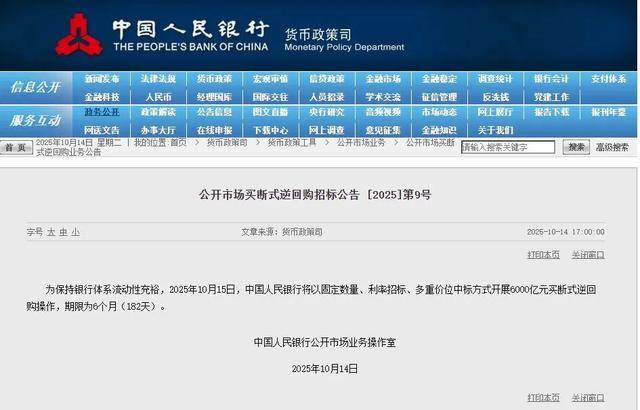
为保持银行体系流动性充裕,2025年10月15日,中国人民银行将以固定数量、利率招标、多重价位中标 方式开展6000亿元买断式逆回购操作,期限为6个月(182天)。 | | | 中国人民视行 THE PEOPLE'S BANK OF CHINA | | 货币政策司 Monetary Policy Department | | | | | | | --- | --- | --- | --- | --- | --- | --- | --- | --- | --- | | 信息公开 | 新闻发布 | 不排不断 炭而改变 | | 宏观审位 信频改策 | 金融市场 | 全融动态 | 加查按计 | 银行会计 | 支付休系 | | 金融科技 | | 人民币 | 经理国际 | 围辉交住 人员招录 | 学术交流 | 征值管理 | 反洗钱 | 党建工作 | | | 服务互动 | 最普公开 阿瑟文告 | 政策解读 办事大厅 | 公告信息 在线申报 | 脚文 ( 央行研究 下载中心 阿上调查 | 置换限频 重期管理 | 市场动态 全融知识 | SHERT 关于我们 | 据备下载 | 报时年级 | | 2025年10月14日 星期二 ...
月内第二次买断式逆回购将落地 合计加量续作4000亿
Sou Hu Cai Jing· 2025-10-14 18:00
10月9日,央行已开展1.1万亿元3个月(91天)期买断式逆回购,相较当月到期量实现3000亿元加量续 作;此次6000亿元6个月期操作则进一步加量1000亿元。至此,10月两个期限品种合计加量续作规模达 4000亿元,较9月增加1000亿元。 对此,东方金诚首席宏观分析师王青表示,6000亿元6个月期买断式逆回购投放能有效熨平资金波动, 维持市场流动性稳定充裕。 [ 央行通过买断式逆回购注入中期流动性,既能助力政府债券顺利发行、引导金融机构加大信贷投放, 也释放出数量型政策工具持续加力的信号,彰显货币政策的支持性立场。 ] 10月15日,中国人民银行开展6000亿元6个月期(182天)买断式逆回购操作,操作方式为固定数量、利 率招标、多重价位中标。此举为10月第二次买断式逆回购操作,旨在保持银行体系流动性充裕,应对潜 在资金面收紧压力。 公开数据显示,10月共有1.3万亿元买断式逆回购到期,其中3个月期8000亿元、6个月期5000亿元。 招联首席研究员董希淼则认为,3个月期与6个月期买断式逆回购的组合,不仅能呵护节后资金面平稳, 更可保障明年元旦前后市场流动性充裕,为跨年金融市场平稳运行奠定基础。同时,由 ...