西部证券

Search documents
非银金融行业周报:稳定币监管加速落地,保险预定利率再迎调降-20250727
East Money Securities· 2025-07-27 08:20
Investment Rating - The report maintains an "Outperform" rating for the non-bank financial sector, indicating a positive outlook for investment opportunities in this industry [2]. Core Insights - The report highlights the acceleration of stablecoin regulation and a reduction in insurance product interest rates as significant developments impacting the non-bank financial sector [1]. - The capital market is experiencing structural changes driven by policy support and internal demand, with expectations for continued improvement in brokerage valuations and performance due to mid-year earnings catalysts and long-term capital inflows [4][11]. - The upcoming implementation of the stablecoin licensing regime in Hong Kong is expected to create new growth opportunities for brokerages, particularly in the virtual asset ecosystem [13]. Summary by Sections Securities Business Overview and Weekly Review - The China Securities Regulatory Commission (CSRC) is focused on stabilizing the market and enhancing regulatory effectiveness, with key tasks including risk prevention and promoting market vitality [11]. - The merger of Guotai Junan Asset Management and Haitong Asset Management is expected to enhance operational efficiency and profitability, with projected net profits for the first half of 2025 expected to increase by 205%-218% year-on-year [12]. - The securities sector indices outperformed major indices, with the non-bank financial index up by 3.37% and the securities index up by 5.35% [16]. Insurance Business Overview and Weekly Review - The maximum preset interest rates for various insurance products have been reduced, with ordinary life insurance rates dropping from 2.5% to 2.0%, reflecting regulatory adjustments to align with market conditions [31]. - The Ministry of Human Resources and Social Security is promoting the expansion of entrusted basic pension fund investments, which is expected to inject significant long-term capital into the market [32]. - The report notes a surge in insurance capital's equity market participation, with 21 instances of capital increases recorded this year, indicating a strong interest in equity investments by insurance institutions [33]. Market Liquidity Tracking - The central bank's net injection of liquidity amounted to 55.487 billion yuan during the week, with significant reverse repo operations contributing to market liquidity [43]. - The average daily trading volume in A-shares increased by 14.20% compared to the previous week, indicating heightened market activity [21].



科创50指数涨超2% AI应用端普遍走强
Shang Hai Zheng Quan Bao· 2025-07-25 18:26
Market Overview - On July 25, A-shares experienced adjustments, with the Sci-Tech 50 Index rising over 2% against the trend. The Shanghai Composite Index closed at 3593.66 points, down 0.33%, while the Shenzhen Component Index and the ChiNext Index fell by 0.22% and 0.23%, respectively. The total trading volume in the Shanghai and Shenzhen markets was 1.7873 trillion yuan, a decrease of 57.4 billion yuan from the previous trading day, marking the seventh consecutive day of exceeding 1.5 trillion yuan. Notable stocks included Northern Rare Earth, China Power Construction, and Dongfang Wealth, each with trading volumes exceeding 10 billion yuan [1]. Technology Sector - The technology sector saw a significant inflow of funds, particularly in AI applications. Companies such as Insai Group and CloudWalk Technology experienced gains of 20% and over 10%, respectively. The World Artificial Intelligence Conference (WAIC) is set to take place from July 26 to 29, featuring over 60 leading domestic and foreign enterprises, showcasing more than 3000 cutting-edge exhibits, the largest scale in history. Analysts believe that the trend in the AI industry will continue to drive capital expenditure from major tech companies and boost the performance of companies in the computing power supply chain [2]. Healthcare Sector - The healthcare sector was notably active, with medical device, CRO, and AI medical stocks performing well. Kangtai Medical surged by 20%, while other companies like Nanwei Medical and Yiming Pharmaceutical also saw significant gains. Recent announcements from the National Medical Insurance Administration regarding the optimization of centralized procurement rules and the introduction of new drug directories for commercial health insurance are expected to positively impact the sector. Analysts suggest that the healthcare industry may see a recovery in valuations and performance due to these changes [3][4]. Investment Strategies - Investment strategies are focusing on two main directions: first, on generic drugs and medical devices that continue to win bids in centralized procurement, which are expected to gain market share; second, on innovative pharmaceutical companies with rich R&D pipelines that have core products entering medical insurance or are likely to be included in new drug directories [4]. - Analysts from Dongfang Securities and Zhongyuan Securities suggest that the current macroeconomic expectations are stable, with a generally ample capital environment. They recommend focusing on sectors with high growth in performance and technology, as well as high-dividend banks and public utilities [5][6]. Fund Allocation Trends - Recent fund allocation trends indicate a clear shift towards industry leaders in sectors such as communication, non-bank finance, media, agriculture, and beauty care, while significant reductions were seen in steel, coal, real estate, and food and beverage sectors. Analysts recommend focusing on four main lines: AI-driven communication and hardware, non-bank finance, new consumption trends in Hong Kong stocks, and safety-related investments [6].
多家券商因股权变更、并购重组更名
Zheng Quan Ri Bao· 2025-07-25 15:52
Group 1 - Several brokerage firms have undergone name changes this year, including Credit Suisse Securities to Beijing Securities, Hongxin Securities to Tianfu Securities, Guotai Junan to Guotai Haitong, and Guolian Securities to Guolian Minsheng, primarily due to significant changes in shareholding structures and mergers and acquisitions [1] - Credit Suisse Securities officially changed its name to Beijing Securities on July 23 after a shareholding change that made it a state-owned brokerage, reflecting a distinct regional characteristic [1] - Hongxin Securities changed its name to Tianfu Securities on May 29, with its largest shareholder being Sichuan Trust, which holds 60.38% of the shares after a bankruptcy restructuring [1] Group 2 - The involvement of state-owned shareholders can enhance brokerage firms in governance, capital strength, and business expansion, providing strong financial support to navigate complex market conditions [2] - Mergers and acquisitions are a significant reason for the name changes among brokerages, with Guotai Junan and Haitong Securities' merger being a notable example, completing its registration changes on April 3 [2] - Guolian Minsheng also completed its name change on February 7 after a merger, reflecting its strategic development needs [3] Group 3 - Ongoing mergers and acquisitions in the securities industry include partnerships like Guoxin Securities with Wanhua Securities and Zheshang Securities with Guodu Securities, indicating a trend towards consolidation [3] - The industry is expected to see increased mergers and acquisitions driven by policy guidance and internal motivations, with resource integration becoming a key method for brokerages to enhance scale and comprehensive strength [3] - Large brokerages may use mergers to address weaknesses and consolidate advantages, while smaller brokerages could achieve scale effects and business complementarity through acquisitions [3]

南网能源:7月25日接受机构调研,西部证券参与
Zheng Quan Zhi Xing· 2025-07-25 11:36
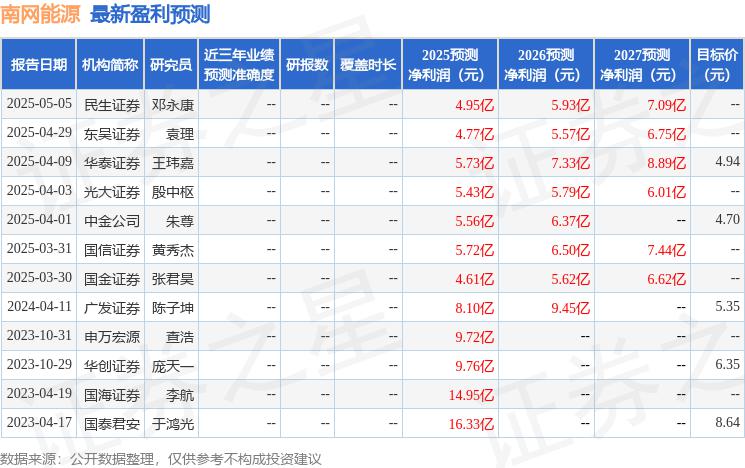
Core Viewpoint - Company is undergoing a strategic transformation from a focus on "investment holding" to a dual emphasis on "investment holding + high-end services" and expanding its business scope to include "comprehensive energy + energy conservation and carbon reduction" [2] Business Transformation - The company has launched a strategic plan for 2025, focusing on optimizing its business structure and expanding into high-end services, including consulting, design, construction, operation, and energy trading services [2] - Initiatives such as the "Energy Conservation Business Doubling Plan" and "Service Doubling Plan" are being implemented to strengthen the energy conservation and carbon reduction business [2] - A digital services company has been established to support the transition towards a dual focus on investment and high-end services [2] Biomass Power Plant Operations - The company has applied for bankruptcy for two biomass project companies, with the court accepting the applications, while other projects like the Fengtian and Chishui projects are operating normally and have achieved profitability [3] Distributed Photovoltaic Projects - The company's distributed photovoltaic projects are primarily located in five provinces of the southern power grid, with approximately 70% of installed capacity targeting industrial and commercial users [4] Building Energy Efficiency Projects - The company provides comprehensive energy-saving services for existing buildings and efficient energy supply systems for new constructions, with revenue derived from energy management, profit-sharing based on energy savings, and service fees [5] - The decline in gross margin for building energy efficiency projects in 2024 is attributed to reduced electricity savings and increased project costs, with future strategies focusing on energy-saving renovations in public institutions and key industries [5] Financial Performance - For Q1 2025, the company reported a main revenue of 693 million yuan, a year-on-year increase of 20.35%, and a net profit of approximately 91.34 million yuan, up 1.65% year-on-year [8] - The company has a debt ratio of 64.6% and an investment income of approximately 11.7 million yuan, with a gross margin of 34.67% [8] Market Outlook - The company anticipates a positive outlook for 2025, driven by stable growth in core industrial and building energy efficiency sectors, and a reduced impact from biomass operations [7] - The company is actively monitoring renewable energy subsidy policies and is prepared for potential adjustments in subsidy payments [7]


B轮融资不及预期?质子汽车欲IPO,陕汽集团上市路径或已改变
Mei Ri Jing Ji Xin Wen· 2025-07-25 11:22
Group 1 - Proton Auto has completed a B-round financing of several hundred million yuan, with plans for an IPO aiming to raise approximately 200 million USD [1][2] - The company is backed by Shaanxi Automobile Group, which has faced challenges in its own capital market ambitions, leading to a strategy of listing subsidiaries like Proton Auto [1][6] - Proton Auto's B-round financing amount is reportedly lower than expected, with estimates around 400 million yuan, compared to the previously announced 550 million yuan [2][3] Group 2 - Proton Auto is positioned as a leader in the hydrogen fuel heavy truck market, with plans to be the first IPO in this sector, despite facing significant industry challenges [4][5] - The hydrogen fuel cell vehicle market remains small, with only 1,915 units sold in the first half of the year, indicating limited support for multiple IPOs in this space [5] - Shaanxi Automobile Group has shifted its listing strategy from a whole-group approach to individual subsidiaries, with Proton Auto being a key focus for future capital market entry [6][7]
数据复盘丨电子、计算机等行业走强 56股获主力资金净流入超1亿元
Zheng Quan Shi Bao Wang· 2025-07-25 10:16
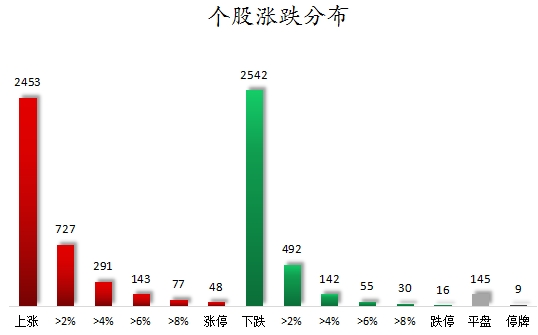
Market Overview - The Shanghai Composite Index closed at 3593.66 points, down 0.33%, with a trading volume of 821.61 billion yuan [1] - The Shenzhen Component Index closed at 11168.14 points, down 0.22%, with a trading volume of 965.73 billion yuan [1] - The ChiNext Index closed at 2340.06 points, down 0.23%, with a trading volume of 435.87 billion yuan [1] - The STAR 50 Index closed at 1054.20 points, up 2.07%, with a trading volume of 41.94 billion yuan [1] - Total trading volume for both markets was 1787.34 billion yuan, a decrease of 57.37 billion yuan from the previous trading day [1] Sector Performance - Strong sectors included electronics, computers, real estate, education, light manufacturing, and media [3] - Active concepts included multi-modal AI, glyphosate, AI corpus, AI glasses, remote office, and composite flow batteries [3] - Weak sectors included construction decoration, building materials, food and beverage, coal, steel, home appliances, electric equipment, and public utilities [3] Stock Performance - A total of 2453 stocks rose, while 2542 stocks fell, with 145 stocks remaining flat and 9 stocks suspended [3] - 48 stocks hit the daily limit up, while 16 stocks hit the daily limit down [3] Fund Flow - The net outflow of main funds from the Shanghai and Shenzhen markets was 30.98 billion yuan [5] - The net outflow from the ChiNext was 11.57 billion yuan, from the CSI 300 was 7.30 billion yuan, and from the STAR Market was 1.61 billion yuan [6] - Six sectors saw net inflows, with the computer sector leading at 1.79 billion yuan [6] Individual Stock Highlights - 2065 stocks experienced net inflows, with 56 stocks receiving over 100 million yuan in net inflows [11] - The stock with the highest net inflow was Yanshan Technology, with 515 million yuan [11] - 3075 stocks faced net outflows, with 119 stocks seeing over 100 million yuan in net outflows [15] - BYD had the highest net outflow at 1.144 billion yuan [15] Institutional Activity - Institutions had a net sell of approximately 933 million yuan, with seven stocks seeing net purchases [19] - The stock with the highest net purchase by institutions was Weiman Sealing, with approximately 28.48 million yuan [19]
【盘中播报】6只A股跌停 建筑材料行业跌幅最大
Zheng Quan Shi Bao Wang· 2025-07-25 07:14
Market Overview - The Shanghai Composite Index decreased by 0.29% as of 13:58, with a trading volume of 1,129.57 million shares and a turnover of 1,398.80 billion yuan, representing a decrease of 6.36% compared to the previous trading day [1]. Industry Performance - The top-performing sectors included: - Computer: Increased by 0.83% with a turnover of 132.30 billion yuan, led by Tianrun Technology, which rose by 26.67% [1]. - Real Estate: Increased by 0.60% with a turnover of 18.73 billion yuan, led by Zhangjiang Hi-Tech, which rose by 7.45% [1]. - Textile and Apparel: Increased by 0.55% with a turnover of 10.91 billion yuan, led by Red Dragonfly, which rose by 9.95% [1]. - The sectors with the largest declines included: - Building Materials: Decreased by 1.91% with a turnover of 26.66 billion yuan, led by Huaxin Cement, which fell by 9.57% [2]. - Building Decoration: Decreased by 1.81% with a turnover of 46.99 billion yuan, led by Zhubo Design, which fell by 14.71% [2]. - Comprehensive: Decreased by 1.39% with a turnover of 2.83 billion yuan, led by Nanjing Xinbai, which fell by 7.58% [2]. Summary of Key Stocks - Leading stocks in the computer sector included Tianrun Technology with a significant increase of 26.67% [1]. - In the real estate sector, Zhangjiang Hi-Tech showed a notable rise of 7.45% [1]. - Red Dragonfly in the textile and apparel sector also performed well, increasing by 9.95% [1].
信安世纪实控人之一拟减持 2021上市募6亿1年1期亏损
Zhong Guo Jing Ji Wang· 2025-07-25 06:49
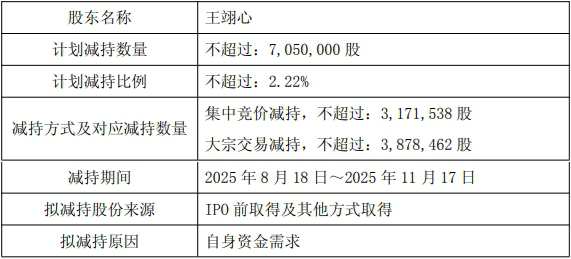
Core Points - The company, Xin'an Century, announced a share reduction plan by its major shareholder and key personnel due to personal funding needs [1][2] - The total number of shares to be reduced is up to 7,050,000, representing a maximum of 2.22% of the company's total share capital [1][2] - The reduction will occur over a three-month period starting 15 trading days after the announcement [2] Share Reduction Details - The planned reduction includes up to 3,171,538 shares through centralized bidding, accounting for up to 1% of the total share capital [1][2] - An additional reduction of up to 3,878,462 shares will occur through block trading, representing up to 1.22% of the total share capital [1][2] - The total number of shares reduced in any consecutive 90-day period will not exceed 1% for centralized bidding and 2% for block trading [1][2] Financial Performance - In 2024, the company reported a revenue of 501 million, a year-on-year decrease of 8.86%, and a net profit attributable to shareholders of -47.82 million, a decrease of 526.08% [5] - For Q1 2025, the company achieved a revenue of 75.16 million, a year-on-year increase of 6.44%, but still reported a net loss of -10.38 million [6] - The net cash flow from operating activities for Q1 2025 was -48.28 million, compared to -39.75 million in the same period last year [6][7]

主力资金监控:张江高科净买入超5亿
news flash· 2025-07-25 06:22
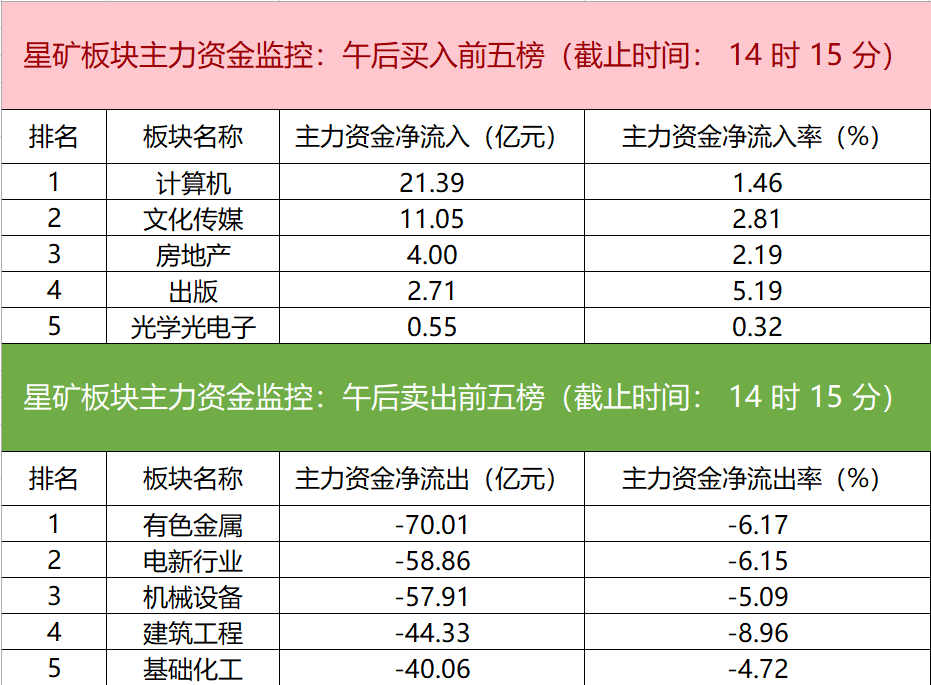
Group 1: Market Overview - Main capital inflow was observed in the computer, cultural media, and real estate sectors, while significant outflows occurred in the non-ferrous metals, electric new energy, and machinery equipment sectors [1] - The non-ferrous metals sector experienced a net outflow exceeding 7 billion [1] Group 2: Capital Inflow by Sector - The computer sector led with a net inflow of 21.39 billion, representing a 1.46% inflow rate [2] - Cultural media followed with a net inflow of 11.05 billion, with an inflow rate of 2.81% [2] - Real estate sector recorded a net inflow of 4 billion, with a 2.19% inflow rate [2] Group 3: Capital Outflow by Sector - The non-ferrous metals sector had the highest net outflow of 70.01 billion, with a -6.17% outflow rate [3] - The electric new energy sector saw a net outflow of 58.86 billion, with a -6.15% outflow rate [3] - Machinery equipment sector experienced a net outflow of 57.91 billion, with a -5.09% outflow rate [3] Group 4: Top Stocks by Capital Inflow - Zhangjiang Hi-Tech topped the list with a net inflow of 5.73 billion, reflecting a 15.70% inflow rate [4] - Cambricon Technologies-U followed closely with a net inflow of 5.37 billion, at an 11.94% inflow rate [4] - Western Securities recorded a net inflow of 5.08 billion, with a 15.14% inflow rate [4] Group 5: Top Stocks by Capital Outflow - China Power Construction faced the largest net outflow of 22.34 billion, with a -16.55% outflow rate [5] - Tibet Tianlu had a net outflow of 19.07 billion, reflecting a -22.08% outflow rate [5] - Northern Rare Earth experienced a net outflow of 17.50 billion, with a -13.21% outflow rate [5]





这一市场,大爆发
Zheng Quan Shi Bao· 2025-07-25 04:24
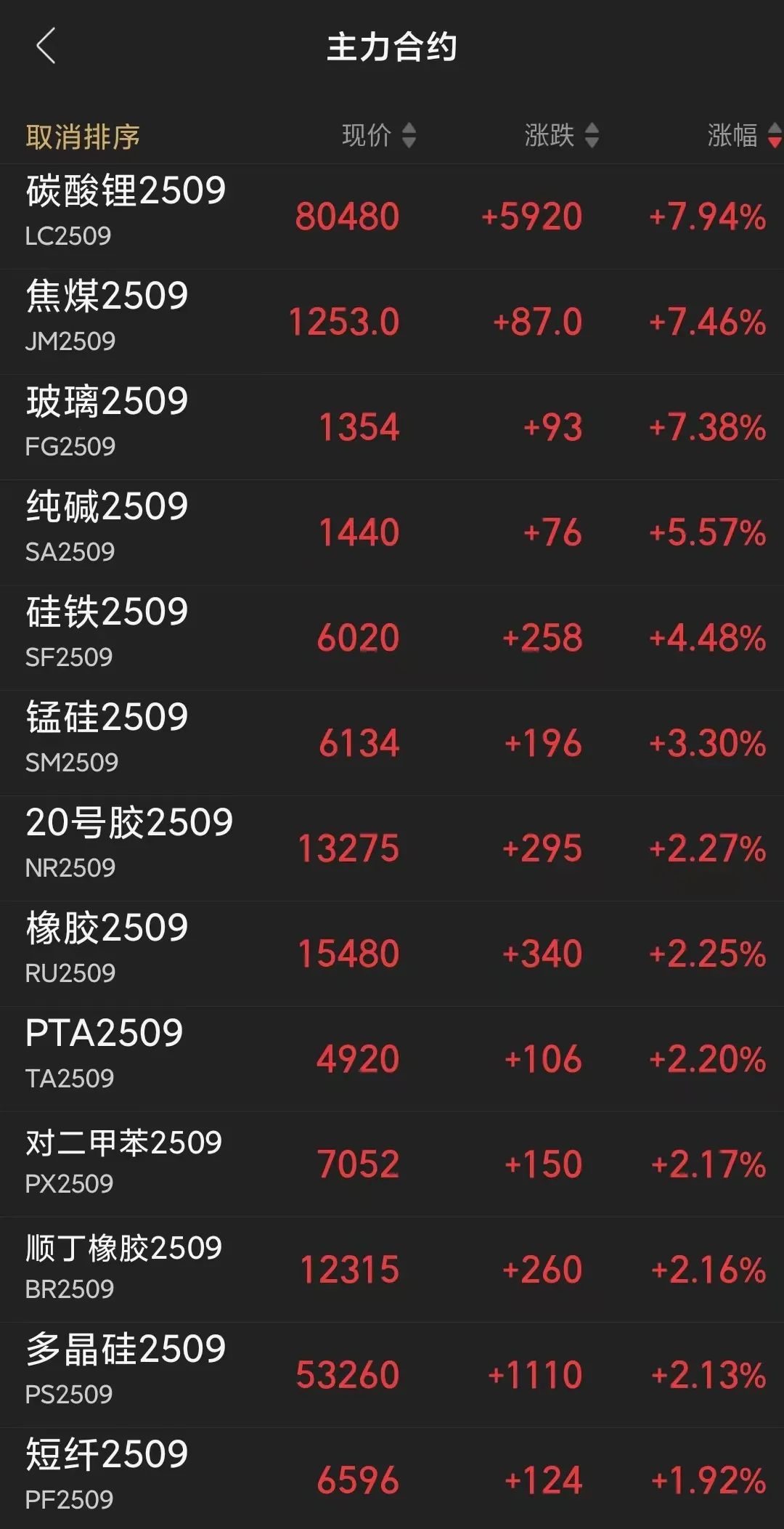
Group 1: A-Share Market Performance - The A-share market experienced slight adjustments, with the Shanghai Composite Index falling below the 3600-point mark, closing down 0.34% [2] - The brokerage sector, often seen as a market leader, initially surged but later reversed gains, with stocks like Western Securities hitting the daily limit [2] - Individual stocks remained active, with Xining Special Steel achieving a consecutive five-day limit up, reporting a cumulative increase of 46.81% over four trading days [2][3] Group 2: Company Announcements - Xining Special Steel's latest rolling P/B ratio is 2.31, significantly higher than the industry average of 1.01 [3] - Tibet Tourism also reported a static P/E ratio of 238.16 and a P/B ratio of 3.85, with a trading turnover rate of 5.87% [4] - Both companies highlighted the potential for irrational market behavior and rapid price increases, urging investors to exercise caution [4] Group 3: Hong Kong Market Overview - The Hong Kong stock market showed a generally weak performance, with the Hang Seng Index down over 1% [5] - Among the constituents, companies like WuXi Biologics and Nongfu Spring saw gains, while stocks like Kuaishou and New Oriental faced declines [6] Group 4: Futures Market Trends - The domestic futures market saw significant increases across various commodities, including lithium carbonate and glass, with lithium futures rising by 7.94% to 80,480 yuan/ton [9][11] - Glass futures also surged, with prices exceeding 1,300 yuan/ton, marking an increase of over 30% compared to a month ago [10][12] - Other commodities like coking coal and soda ash also experienced substantial price hikes [13]